Showing posts with label Vintage Mystery Challenge. Show all posts

Monday, June 8, 2026

The Man Who Didn't Fly


 The Man Who Didn't Fly
(1955) by Margot Bennett

Four men--Joseph Ferguson, Maurice Reid, Harry Walters, and Morgan Price--decide to book a private plane for Dublin. They all claim to have business in Ireland and plan to come back to their family and friends at home. But those who saw the plane start its westward journey across England tell of a fireball that plunged into the Irish Sea. But when an investigation is mounted, the police find that only three of the men joined the pilot in that disastrous journey. The difficulty is finding out which man didn't fly. No one who saw the men--from the bus driver who took passengers to the airport to the barman at the small airport to the men who helped get the plane ready can swear to which men were actually there. There were too many other people milling about and there was no reason to take special notice of any of them. The only things the detectives assigned to the case have to go on is a half-heard conversation that mentions Australia...or maybe South Africa and the fact that at least one of the men might have smoked and might have had a silver cigarette case.

It is odd that the man who didn't fly doesn't come forward. Did he somehow arrange for the plane to go down? If so, how? And why? The investigation comes to center on the family left behind--listening to their version of what happened in the days leading up to the plane's take-off. Other clues crop up in the conversations and eventually the police are able to fit all the pieces of the jigsaw together.

I have to say that I'm not finding the revival of Margot Bennett stories to be very satisfying. I wasn't nearly as impressed with her The Widow of Bath as some of my Golden Age Mystery friends (see linked review) and The Man Who Didn't Fly was just as disappointing. This time around the characters are not nearly as well-drawn (though they are just as un-engaging). I had a hard time keeping all the men straight (Was "Uncle Joe" the one who might have been in the plane or was it Hester's father?). And, speaking of Hester--she may not be "bitter, dreary, and cruel" as I have described the heroine of Bath, but she's definitely not one of the shining lights of GAD leading ladies. Her relationship, such as it is, with Harry is not at all believable. Why on earth both she and her step-mother (?--I'm not really sure about the relationships of all the women in the case either) are both attracted to him is a mystery to me. And the rest of the women are just as unimpressive. Added to the lack of interesting characters is a lack of interesting detection. We've taken what could have been a very engaging mystery (the premise really hooked me when I purchased this copy) and dragged it out through an endless parade of "here's what happened--in excrutiating detail--on the Monday before they all left" and "here's what happened on Tuesday"...rinse and repeat for each day leading up to the plane crash. Even breaking up the recollections with other bits of investigation didn't help me. By time things picked up and we were finally getting some action and interesting discoveries I was too numb to even care. ★★

But--my friend Kate over at Cross Examining Crime gave this a glowing review--so your mileage may vary.

First line: At eleven in the morning the aeroplane began its westward flight across England; shining like snow under is blue sky; losing its glitter in the thick white clouds; passing, heard but unseen, over the Welsh hills.

"Would you be willing to say that one of them wore a hat?"
"No. and I'll tell you why. Because I didn't see. and, if I did see, I didn't remember. And if I didn't remember, it was because I was thinking of something else. And, if I was thinking of something else, it was the three thirty at Lingfield. And if I was thinking of the three thirty at Lingfield, there's no law against it." (Police detective, Mr. Crewe; p.4)

He is a poet in words. That is now of no importance. I am a poet of money. Words! We have too many words. Word poets talk all the time of love and death. People fall in love and they die and no amount of poetic advice has ever helped them to do either of those things more successfully." (Joe Ferguson; p. 55)

"Let me try curling my lip. Do you suppose when people curl their lips it's convex or concave?" She went to the glass over the mantlepiece. "It looks queer both ways. If I curl it up towards my nose it is worse, don't you think? People in those books must look odd most of the time." (Prudence Wade; p. 116)

Last line: She kissed him and there was nothing left of Harry, except a small handful of poems for the anthologies.
*****************

Deaths = 5 (four airplane crash; one shot)

Thursday, March 7, 2024

Ellery Queen's Mystery Magazine Sept 1965


 Ellery Queen's Mystery Magazine Sept 1965 by Ellery Queen, ed. 

I have to say that I thought this collection one of the weakest of the EQMM's I've read so far. The best of the bunch are the Christie and the Queen...and I've read both of them before. "A Fine Winter Thirst" is good and pulls at the heart strings a bit with that ending. "The Mystery of the Fulton Documents" is a much better Dupin pastiche than the Goulart story's parody of hardboiled pulp (quite frankly it made no sense to me and I didn't find it funny at all). The Chandler story is a much rougher version of his novel The Big Sleep (which I read last year and enjoyed very much). I didn't get much out of "to Reach the Sea" or "Who Walks Behind" and the rest of the stories are okay. ★★ and 1/2

"Blood Brothers" by Christianna Brand: The Birdswell identical twins are said to be devoted to each other. And so they are...until they both get involved with the same woman. Then murder and competing alibis put them in Inspector Cockrill's sights and it's every man for himself. [2 hit by car]

"Unc Probes Pickle Plot" by John Jakes: A story chock full of slang that makes it a bit of a trudge to read through. And the big mystery--who switched a jar of about-to-be prize-winning pickles for a jar of beets at a town fair--is pretty ho-hum.

"The Mystery of the Fulton Documents" by Michael Harrison: An Auguste Dupin pastiche in which Dupin discovers how the top-secret weapon plans were smuggled out of a French official's safe.

"Bloehm's Wall" by George Emmett: Bloehm is slowly dying from a cancer eating away at him. He's always know that Emil will show up one day to settle old scores. But when Emil does things don't quite go as he anticipated. (one neck broken)

"A Fine Winter Thirst" by George Emmett: A mute itinerant worker finally finds love--only to have it snatched away from him by a cruel barkeeper. (one poisoned; one stabbed)

"All the Way Home" by Jaime Sandaval: Tommy has to listens to rumors about his dad and Miss Abby Hunter, the young teacher who taught school about a mile from their home. Tommy's dad had installed Miss Abby in the lighthouse near their property and Tommy's mom was none too pleased. Things come to a head one windy night when the lighthouse burns down and Tommy's Dad's boat is found adrift. (2 burned to death; one natural)

"The 'Supernatural' Murder" by Agatha Christie: Dr. Pender takes center stage next with a tale of a seemingly impossible murder cloaked with a bit of mysticism. The murder was committed on the night of a costume party near the grove of Astarte. The grove was on the estate of Sir Richard Haydon, a man who was rival of his cousin Eliot for the love of the beautiful Dianna Ashley. The grove contained a mysterious summer house which was rumored to have been a place where secret rites were held long ago. Diana decided to dress the part of Astarte--appearing in a mysterious glow in the summer house. The vision startled Sir Richard and he then stumbled to the ground. when the others reached him, he was dead from a knife wound...but there was no knife to be found. Miss Marple spots the answer. [one stabbed]

"The Needle's Eye" by Ellery Queen: A man suspects his new son-in-law and his father of having evil designs of one sort or another on either himself or his daughter (or both). He asks Ellery to investigate--and in the process Ellery solves a murder and the mystery of a pirate's hidden treasure. (one natural; one shot)

"To Reach the Sea" by Monica Dickens: An odd little story about a woman having an affair and a wig with hair that grows--oh, and one drowning. In a river. Nowhere near the sea...as far as I can tell. [one drowned]

"The Curtain" by Raymond Chandler: A rehearsal story for Chandler's The Big Sleep--all the bones are there--from the old General who wants to know what happened to his son-in-law to red herrings before Carmody (Marlowe's predecessor) figures out what really happened. The killer has changed--but not the motivating factor. [four shot]

"The Peppermint Striped Goodbye" by Ron Goulart: Seems to be a mash-up parody of Chandler's "The Curtain" and a Ross MacDonald Lew Archer story. Rumor has it this is funny. Don't attribute that rumor to me...[two fell from height]

"The Restorer of Balance" by Avram Davidson: In the matter of feeding tigers--who is the hunter and who the hunted? [one fed to tigers]

"Who Walks Behind?" by Holly Roth: George feels compelled to help a man who claims to be a refugee...but he's not sure if it's safe. If perhaps there's someone following after...

First line (1st story): "And devoted I hear?...David and Jonathan?" he said.

Last line (Last story): George was not wrong to be suspicious, and she must learn to live with the understanding that he might some day be right in his ceaseless doubts.

Wednesday, July 5, 2023

The Frightened Pigeon


 The Frightened Pigeon (1942) by Richard Burke

Diary, diary...who's got the diary? Vichy, France during World War II. General von Stamm, a German who is Army but not Party has been keeping a very indiscreet diary in which he has criticized many of the orders he has nonetheless carried out "faithfully." The diary has disappeared and he commissions his son (a true Nazi) to find it before the Gestapo do. Although Colonel Kurt von Stamm is contemptuous of a father who could A. not be a devotee of the Fuhrer and B. keep such a diary, he agrees to find it when he realizes that the sins of the father could tarnish the son. Corporal Otto Fleber, a man with his eye to the main chance and an ear for eavesdropping, overhears this conversation and is quite pleased when the general assigns him to assist the colonel. Fleber has an entirely different plan for the fate of the diary.

Meanwhile, Charles John Dillon (known by the nickname "Ching" because of a period during the Spanish revolution when he shaved his head and his slightly upturned eyebrows made him look as if he were trying to appear Chinese), a war correspondant, has managed to get his hands on the diary and plans to smuggle it out of France and back to America where it can be published. He passes the diary off to his girlfriend Valerie Bright. Val is a dancer and he has decided that they can use her profession as a cover--a fake telegram will offer her a dancing gig in a town near the Spanish border. He'll make his unobtrusive way there and they'll slip into Spain where friends he made during the revolution will help them get away to America. 

Except...rival reporters Lotus Nedry and Jurg Sampson also know about the diary have plans of their own. For a good portion of the book, the diary switches hands faster than a game of hot potato. Now Val has it. No--Lotus and Jurg do. No, wait--the colonel and the corporal got it. Or maybe it was the Gestapo. All this makes for an interesting, action-packed adventure ending in a crypt on the Spanish border and a face-off between the good guys and the bad guys. There are double- and triple-crosses and what is meant to be a surprising reveal at the end. I'm afraid I wasn't surprised--I had my suspicions from the beginning...

And all Val wants is to go home with the man she loves. For a good chunk of the story, Val is an immoral wench--sure the Nazis are doing bad things, but they aren't doing them to her and as long as they leave her alone why should she do anything to put herself in danger? It was fairly unexpected, in a wartime thriller of this nature, to find the character growth that takes place in Val. She changes pretty significantly as she becomes entangled in the operation (at first pretty much against her will) and then more and more committed to the objectives. 

This is an engaging and satisfying war-time thriller. ★★ and 1/2

First line: Corporal Otto Fleber, attached to the Kommandant's headquarters staff in Paris, tilted his swivel chair back against the thin wall which separated his cubicle-like space from General von Stamm's office.

Hitler didn't excite her at all. He bore to her a marked resemblance to a Mr. Glank who'd attended the plumbing deficiencies of her home in Terre Haute from time to time. (p. 9)

Last line: The Spanish boy looked at him vaguely. "Good. Shall we be going?"

****************

Deaths = 5 (one shot; three; stabbed; one strangled)

Saturday, November 5, 2022

The 10:30 from Marseille (slightly spoilerish)


 The 10:30 from Marseille (aka Compartiment Tuers AND The Sleeping Car Murders; 1962) by Sébastien Japrisot

When the Marseille express arrived in Paris, all of the passengers got off but one. The pretty young divorcee Georgette Thomas remained behind, sprawled across her sleeping berth. There were marks of strangulation on her neck and a broken faux pearl necklace at her feet. Her killer had struck swiftly and efficiently, committing the murder while the railroad clean-up man had a quick cup of coffee before checking the compartments once the passengers disembarked. The police are called in and the task of tracking down compartment killer is given to Pierre Emile Grazziano, "Grazzi." It seems that robbery was not the motive because all of her money was still in her purse.

In order to find out more about Georgette Thomas, Grazzi and his men begin looking for her relatives and friends, as well as the other five passengers who occupied the other berths in the sleeping car. The police hope that the others in the compartment may have seen or heard something that will help point to a motive, if not to the killer him/herself. Apparently the killer is worried the other passengers have something to tell the police because as fast (or faster) as Grazzi's team locates them, they begin dying as well--all shot with the same gun. Will Grazzi find his way to the solution before all of his potential witnesses are murdered?

This was a very mixed bag. The opening was good. I liked the way Japrisot framed the investigation--following each passenger from the train to the end of their participation in the plot (either from the killer's bullet or otherwise...). I appreciated the reworking of a Christie plot. Japrisot's version had a lot of potential. Grazzi is an interesting and sympathetic lead investigator--one really sympathizes with the exasperation he feels at his superior's behavior. But--and this is a very large but--the ending leaves a lot to be desired. It feels very rushed for one thing. And implausible. And very much like we pulled a motive out of the air--even though I did have some suspicions about one of those involved. Not to mention I just don't believe in the connections made between several of the characters. I don't know if something was lost in translation, but I was very lost in the wrap-up. And don't get me started on the teenager playing amateur detective and somehow being ahead of the police. 

I'm going to give this ★★, but almost entirely for the first half or so of the book. A terrific set-up and initial investigation that just doesn't live up to its promise.

First line: The train was coming in from Marseille.

Last line: He was saying, Bambi, my little Bambi, and without a word, just by the movement of her head, with her blond hair shining in the light from the lamp, she was saying, yes, yes, yes.

***************

Deaths = 7 (one strangled; six shot)


Friday, October 28, 2022

The Worm of Death

So, for one of the prompts in my Vintage Scattergories Reading Challenge, I'm tasked with randomly selecting four books, reading the first line of each and then choosing one of the four to read--based on that first line. I've already done this for the Golden Age category. Here are the selections from the Silver Age:

Toby Glendower was in a state of complete happiness akin to ecstasy; he snuggled down in the dry, withered grass and looked lovingly at the huge granite boulders above and on three sides of him. (Death on the Dragon's Tongue by Margot Arnold)

Nigel Strangeways and Clare were strolling down the hill past the Park. (The Worm of Death by Nicholas Blake)

"Look," said the man who preferred to call himself Roger Farrar, "let's call the whole thing off." (The Dog It Was That Died by H. R. F. Keating)

"...These were not, members of the jury, crimes of passion, committed while the blood was hot." (The Sleeping Tiger by D. M. Devine)

***************************

I wrote the above portion before making my selection and starting my chosen book. I don't know which one grabs your attention--there are reasons why each of them could spark interest. Are the huge boulders above Toby Glendower the Dragon's Tongue, the apparent scene of murder? Is the entire Blake book going to be a huge contrast to that very placid opening? What is the "thing" that Roger Farrar wants to call off (and what's his real name)? What cold-blooded crime is the prosecutor talking to the jury about in the last selection? As this review's title indicates, I decided to find out what dastardly deeds would follow Nicholas Blake's very sedate first line.


 Nigel Strangeways and Clare Massinger are invited to the home Dr. Piers Loudron on a foggy February night. They are fairly new to the Greenwich area and the dinner invitation is a chance for them to get to know some of their neighbors. It is a pretty uncomfortable meal with Loudron's children behaving as though they're still in the nursery rather than grown men and women and the doctor being sarcastic about the lot. They squabble amongst themselves and take verbal potshots at one another. His son James is also a doctor, but he lacks the confidence and presence of his well-respected father. Rebecca, the daughter of the house, is in love with Walter Barn, an artist and a man her father heartily disapproves. Howard is fairly unsuccessful business man with a costly wife who has an eye for anything in trousers. And then there's Graham, an adopted son,  who apparently can do no wrong in the good doctor's eyes. Nigel and Clare aren't quite sure why they've been invited--unless there was hope that their presence would put a damper on the family tensions. But it doesn't help matters that Loudron announces to all that Nigel is something of an amateur sleuth.

"Do you have noble ideas about justice and retribution and all that? Do you see yourself as a hound of heaven tracking down the wrongdoer?"

Later that night, long after the dinner party, Loudron disappears from his home. The next morning Rebecca and Walter come to Nigel to ask for his advice. But other than a search of the house and grounds (already done) and contacting the police (also done), Nigel has nothing to suggest. A little over a week later Loudron's body is found in the Thames. But he wasn't drowned...his wrists were slit. Was it suicide? If so, why was he in the river? If not, who killed him? And did the same person dump his body?

It's been a while since a read a Nigel Strangeways mystery. And it's been an even longer while since I read this one. I remembered exactly nothing about it. Not that it would have mattered if I did, because there's very little mystery about who did it. Despite Inspector Wright's point of view:

"We're getting nowhere. Nowhere at all. A lovely set of motives. Lots of lovely opportunity. Some cockeyed alibis. But hardly one solid fact to build on. Even their lies--and they've told enough, between them--seem to cancel one another out."

Wright's a trifle pessimistic. If, as Strangeways does, you pay any attention at all to psychology then you have to know who did it. Sure, all of the suspects have psychological hangups. That's an effort to muddy the waters and make the reader think there's some sort of choice about who did it. But, supposing the number of motives and personalities does distract you--there's really only one logical reason for the second murder. Especially after the reader recognizes the important psychological motive. And, knowing how Strangeways operates, the reader should be thinking about the psychology.

And--speaking of personalities. We've really got a prize set here. Not a likeable character amongst the suspects. I kindof wanted to root for one of the Loudron children, but they made it pretty darn hard to do so. And Strangeways isn't even all that attractive here--what with eyeballing old prostitutes and flirting along with the unashamed vamp. The best character is Clare, but we don't see nearly enough of her. I love how she saves the day for Nigel at the end. But overall, the book just didn't do it for me. The mystery is rather squalid and culprit is pretty cold-blooded. You can tell that we're not in the Golden Age anymore, Toto. ★★ and 3/4.

First line: Above

Last line: But you are dead, and myself I cannot forgive...

***********************

Deaths = 4 (two natural; one stabbed; one strangled)


Sunday, April 10, 2022

Always Lock Your Bedroom Door


 Always Lock Your Bedroom Door (1976) by Roy Winsor

Addie Hill, an elderly neighbor of professor-detective Ira Cobb, calls on the erudite sleuth and his guest Steve Barnes (also a professor) to witness her new will. It seems that a house guest of her husband's, a certain Robey Pearson, has been blackmailing Ellis Hill and when he wouldn't pay up began to demand money from Addie. She also refused to pay blackmail money and Pearson turned around and threatened her life--knowing full well that Ellis would inherit the bulk of her rather hefty estate. Addie has already had difficulties with other greedy relatives and has decided that making a new will that cuts out both her husband and the rest of the money-grubbing clan will protect her from any unfortunate accidents.

She would be wrong. The will gets signed, Cobb and Barnes head back to Cobb's place--taking the will with them for safety. The plan is to mail it to Addie's lawyer. Cobb hands an envelope addressed to the lawyer to Barnes, who promptly sets out to mail it. He's later found knocked out cold and the envelope missing. Cobb is certain that Addie's life is in danger and they rush back to her house to check on her. They're too late. Someone has already hit her over the head as well...doing a more thorough job and killing her. Pearson is also lying dead in her room, but evidence shows that he didn't kill her.  It only makes sense that whoever hit Barnes over the head and stole the envelope also killed Addie to prevent her from replacing the will. But everyone with a motive also has an alibi for at least one (if not both) of the attacks. It's up to Cobb to figure out who really had time to do the deeds...and also why Pearson was killed as well.

This turned out better than I thought it would. I picked this up at one of our Red Cross Book Fairs back in 2014. Never heard of Roy Winsor before, but, by golly, he had a professor acting as sleuth and you know how those academically-inclined mysteries grab me. And then--I kept picking it up and thinking I might read it, but the opening paragraphs just never did much. And then--this year I fixed myself up with a Reading Randomizer reading challenge that was meant to get books off the ol' TBR pile whether you wanted to or not. And the randomize prompt brought this one up for April. So now, if I wanted to complete the challenge, I HAD to read the Winsor book

I'm glad I did. Once I got past those first few pages (that still didn't excite my reading heart), it got interesting. I really like Addie and was sad to see her killed. But I knew it was coming as soon as I heard about those greedy relatives and she decided to cut them out of her will. I also enjoyed the two professors working together and the fact that Cobb likes to drop quotations here and there. Though I must point out--he doesn't do it quite so effortlessly and adroitly as Lord Peter Wimsey. The ending is a little clumsy (which is why I didn't give a full four-star rating) and anti-climatic. Even though I didn't get why Cobb immediately knew who hit Steve Barnes over the head as soon as they found the weapon, the complete solution was telegraphed a little too plainly two-three chapters from the end. So when the "big reveal" came in a gather all the suspects moment in the final chapter...well, it really wasn't all that big. 

But overall I enjoyed my introduction to Ira Cobb and I'm looking forward to reading the other title I picked up at that same book fair. ★★ and 1/2.

First line: Below the high bluff at Siasconset on the northeastern coast of Nantucket and as far out as I could see, the ocean lay motionless, iron-gray under the dark overcast of the mid-August evening.

Last line: And that's just what we did do, closing both the house and our minds to the aftermath, the sweeping up of ashes of the two murders on that Thursday night and of those who had committed the crimes.

********************

Deaths = 3 (one hit on head; two poisoned)

Tuesday, March 15, 2022

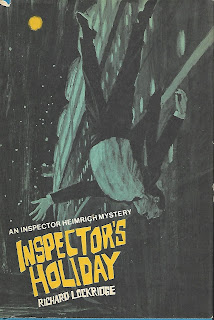
Inspector's Holiday


 Inspector's Holiday (1971) by Richard Lockridge

Inspector M. L. Heimrich and his wife Susan are booked for a leisurely Mediterranean cruise from late March to early May. It's just what the doctor ordered for Susan's recovery from flu compounded by pneumonia. A convalescence in warm climates will do her a world of good. And the good Inspector, who rarely takes a leave from his position with the New York State Police, could stand a vacation as well.

It starts out as a lovely cruise. The accommodations are spacious and luxurious. The food and drink is appetizing and abundant and over-indulgence seems to be the order of the day. They find themselves meeting many interesting people--including Sir Ronald Grimes, recently retired British embassy attache, and his lovely young wife; Major Ian Whitney, another British subject; Inspector Albert Hunt, introduced as Heimrich's British counterpart, but apparently more of a hush-hush secret service type; Miss Emily Farrell, a famous cookbook author; and Mrs. Raymond Powers, widow of an apparently famous businessman (though the Heimriches haven't heard of him).

When Sir Ronald disappears from the ship and Inspector Hunt is found strangled in his cabin--all in the same night, the ship's captain calls upon Inspector Heimrich for help. Heimrich tries to beg off, but the captain almost begs for assistance (no one else on board has any experience with violent death) and Heimrich soons admits that he can't not investigate when a fellow "cop" has been murdered. It isn't long before he also realizes what a difficult job he has ahead. Alone in his investigation, without being able to put the usual machinery in motion (fingerprints, crime scene detectives, easy access to any files/information on suspects, etc), and especially without his right-hand man Charles Forniss, he has to use all his wits and pull whatever strings he can from afar to find his man/woman before the ship docks at Malaga (where he and Susan disembark for a week in Spain). It helps that Forniss (when called via ship-to-shore) "just happens" to know a man at the British Embassy in D. C. (I never cease to be amazed how many people former Marine Forniss "just happens" to know....but I suppose you meet a lot of people while in the service during wartime.)

A fun entry in the Heimrich series. I don't always enjoy mysteries that see the detective out of their usual element, but I think Lockridge did a good job with this one. The set-up for why Heimrich needs to get involved is well-done and it was interesting to watch him work without the usual official support system in place. We could have used a few more viable suspects. Lockridge (through Heimrich's processes) tries to spread suspicion around a bit, but it doesn't really work well. But overall it's a solid entry in the series and it was nice to see more of Heimrich and Susan together. ★★ and 1/2.

First lines: It was not snowing on the morning of that thirtieth of March. Heimrich had gloomily supposed it would be; had envisioned a blizzard.

Last lines: "Yes, Susan. No matter what. You bring it with us."

*****************

Deaths = 3 (one heart attack; one drowned; one strangled)

Thursday, March 3, 2022

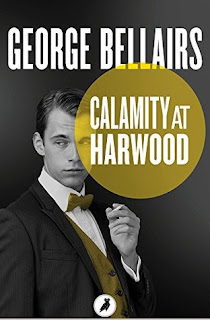
Calamity at Harwood


 Calamity at Harwood (1945) by George Bellairs (Harold Blundell)

The bulk of the story is set in 1939 and the war is just heating up for Britain. The blackout is prevalent and women and children have been sent out of London. Before we get to the main thread, we're given a prequel. We see Mr. Solomon Burt ( Bernstein), a real estate developer, get stranded near the Harwood manor house. While his chauffeur fiddles with the car engine, he decides to take a stroll and explore the area Though the grounds are not all they should be and the house is in disrepair, Burt immediately sees possibilities. And though the owner says he'll never sell, the canny businessman soon has possession. 

He has envisioned a renovated manor house with luxury flats, immaculate grounds, a swimming pool, tennis courts, and all the comforts that the well-to-do would like in a little country get-away. Work begins, but all is not smooth sailing. Wiring is pulled out, water pipes burst, and an ornamental ceiling caves in. The locals talk of ghosts and poltergeists, but Burt doesn't believe in such nonsense (and can't afford to--he must get the flats done and get some wealthy residents). Finally, the outbursts cease, the renovations are complete, and all eight flats are leased--with Burt taking one for himself.

All but one resident (who is abroad and will move in later) get settled in and it looks like everything is turning out just as Burt planned. But then...the ghosts and poltergeists start in with a renewed vengeance. Appliances are turned upside down and placed in the sink in one apartment. Another resident's pantry is demolished and all the china broken. One couple hears the sound of dice-playing all night (apparently there was a Regency-era gaming hell in the house at one time). And another resident experiences blasts of hot and cold air. Barring Miss Elaine Freyle, a West-end actress, all of the residents insist they'll not let ghosts and ghoulies run them out of their cushy new digs. Miss Freyle breaks her lease and leaves.

Mr. and Mrs. Carberry-Peacocke are amateur psychic researchers, so they are pleased as punch. They hold seances and even get their neighbors, Mr. and Mrs. Hartwright interested. Professor Braun, an Austrian refugee and anthropologist, is too grumpy to allow mere ghosts interfere with his work--besides, he says he hasn't heard any of the disturbances. Mr. Williatt is a writer and sees the whole thing as an experience made for putting into fiction. And the Misses Pott are stubborn spinsters who refuse to be scared off. Besides ghosts can't really hurt anyone...can they?

Apparently they can. Because one night a couple of Regency-era spooks show up in Mr. Burt's bedroom. They hustle him outside, force him to disrobe, and plunge into the icy pool. While he's getting himself back on dry land, the ghosts disappear--along with his clothes. He finds a couple of burlap sacks left behind by the workmen and manages to make himself fairly decent. But after he manages to get himself back into the house and upstairs, the lights go out, there's a loud crash, and the next thing the residents know is that Burt has fallen from the upper story and broken his neck.

Enter Inspector Thomas Littlejohn of Scotland Yard. As soon as the doctor examines Burt, we know that murder has been done. The developer was socked over the head before being dropped off the second story landing. Littlejohn is certain that there is more to the ghostly visitations than meet the eye and he wonders if Burt stumbled onto something worth killing for. The locals make his investigations difficult at first, remaining loyal to the Harwood family (even if they are no longer in residence), but once he can get them to talk he's able to clear away much of the extraneous matter--leaving him with indications that the luxurious manor house may be sheltering a cell of Nazi sympathizers. When he finds the murderer, he just may find an espionage ringleader as well.

This was great fun and a different sort of Littlejohn story from those I've previously reviewed. The mystery of the poltergeists/ghosts was easily handled, but it was cleared up in order to make way for the more intricate espionage/thriller plot. I thoroughly enjoyed Littlejohn's investigation into Nazi fifth-columnists and the story was worth it just for the scene where the country policeman takes out one of the spies with a nicely bowled stone (using his excellent cricket skills). I also enjoyed the information gained about Britain during the early days of the war--adding to what I already knew from other period mysteries. All-in-all one of my favorite Bellairs books to date. ★★

First line: One afternoon in the late autumn of 1938, the large, flashy car of Mr. Solomon Burt ( Bernstein) came to a halt on the London-Brighton road.

Last lines: "It's been a rest and a change," said Littlejohn as they stepped into the blackout again. "What are you laughing at?"

****************

Deaths = 9 (one fell from height; two car accident; two shot; three hanged; one hit by a bell)


Sunday, January 2, 2022

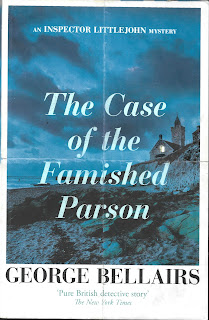
The Case of the Famished Parson


The Case of the Famished Parson (1949) by George Bellairs

The Bishop of Greyle, James Macintosh, is bashed over the head and his body dumped over a cliff edge into Bolter's Hole, a convenient little place along the coast at Cape Mervin. But, unfortunately for the murderer, the body isn't washed out to sea. The bishop gets lodged between some rocks and is found relatively quickly by Harry Keast when he goes out early in the morning looking for golf balls hit just a little too hard off the green near the cliffs. Allain, the proprietor of the Cape Mervin Hotel, calls upon his illustrious guest from Scotland Yard, Inspector Thomas Littlejohn, to make a busman's holiday and lend a hand with the investigation. He hopes that the matter will be cleared up with little fuss and less publicity.

But odd things begin to complicate the case and it doesn't look like a solution will come quickly. There's the matter of emaciated state of Macintosh's body. And the millionaire's shoes that went for a walk that night--without the millionaire. There's the mysterious phone call that lured the bishop from the hotel after 11 pm. And the bishop's loony family. And the fact that somebody takes a potshot at Littlejohn when he visits said loony family, hitting him in the thigh and laying him up for several days. There's also the curious lights in the harbor and the fact that nobody seems to have seen anything that night--not even the night watchman in the little shed near the hotel. But when a second murder follows closely on the first it becomes clear that at least one person knew something...unfortunately, he's now dead as well. Littlejohn, his right-hand man Sergeant Cromwell, and the local inspector have their hands full sifting alibis and deciding whether the motive for murder lies with the bishop's family or in something he discovered while on holiday in Cape Mervin. But what could an inoffensive bishop with a interest in psychology and Eastern religions have found out in the short time he was at the hotel?

This was a much more satisfying read than my previous book. And I have to say that I positively adore Harry Keast who makes up long words because he doesn't know enough real ones (example in quote below). He's a quite lovable, quirky character that we see too little of. I also really enjoy Bellairs's writing--it's clear and concise and move things along nicely without missing out on any of the fun of language. I could tell he was having a good time with vocabulary in this one (both Harry's made-up vocabulary and honest-to-goodness words). 

After the shooting incident, Littlejohn spends several days conducting the investigation from bed, reminding me of The Daughter of Time and The Wench Is Dead--though investigating a current crime instead of a historical mystery. I enjoyed watching his impatience at not being able to get out and investigate...but he was able to pick up some nifty clues while watching out his window. 

Slight spoiler ahead....


The one thing that keeps this from being a five-star book, was the plot. It becomes obvious pretty quickly what's going on and I was a little let down by the motive for the murder. The only real question is who ultimately did the killing--there are several for whom the motive could be valid (I can't say more without giving things away). And perhaps that is the point of a murder mystery, finding out "whodunit," but it would have been more satisfying with a different motive. Still...this is an excellent read from Bellairs and I quite enjoyed myself this evening. 

First lines: Wednesday, September 4th. The Cape Mervin Hotel was quiet as the grave.

Harry...had little to no formal education, but experience and shrewdness made up for a lot. He was fond of long words, but knew hardly any. So he made them up as he went along for the sheer pleasure of mouthing them. "Brognostication is the thief of time," he said to himself by way of excusing his early appearance on the links. (pp. 8-9)

Mr. Rufus Flank's voice was worn out, like his clothes. He began fortissimo and gradually diminuendoed until at the end of each sentence you couldn't hear a word he said...."MISSUS MACINTOSH TOO DISTressed...speak on behalf...regret unable...light....Hrumph, chmha...THERFORE BEG the court...indulgence...Hrumph, chmha...." (p. 46)

"You're on fire!" The vicar had put his lighted pipe in his pocket as he entered the hospital and had set fire to his handkerchief. (p. 85)

In all matters except paying and receiving cash in the ordinary course of business, Mr. Topham had to consult. He consulted the authorities in Greyle on banking, his domineering mother on affairs of the heart, three stockbrokers about his surplus income, and, in secret, Old Moore's Almanac about the future. (p. 100)

[about thrillers/mysteries] Thing that strikes me is that there's more money in imagining crimes than in actually solving them on the spot. And what makes me laugh is the number of detectives there are. All big shots at Scotland Yard. Hundreds of them. (Sergeant Cromwell, pp. 103-4)

Mulroy looked surprised a bit annoyed. It is exasperating to spend years studying a subject and mastering its terms and then find the apparently ignorant layman intuitively knows as much as you do. (p. 109)

Last lines: He passed a lot of time seated on the grass in the sun and air, reading detective stories, which are one of his favorite diversions. They appeal to his irrepressible sense of humour.

**************

Deaths = 4 (one hit on head; one shot; two hanged)


Friday, August 27, 2021

Add a Pinch of Cyanide


 Add a Pinch of Cyanide (1973) by Emma Page (Honoria O'Mahony Tirbutt)

Godfrey and Pauline Barratt have turned the family home into a guest house--a summer retreat for vacationers with a beach nearby and a quiet place in the country to relax on holiday. And odd assortment of people--including Pauline's sister and brother-in-law come to stay and by the end of the week Stephen Lockwood will dead--from a cyanide-laced sandwich. Was the deadly lunch intended for Lockwood--or did the killer miss his mark? It seems that that sandwich may have been meant for his wife. Who could have had it in for either of the Lockwoods? As it happens, a fair amount of people. It's actually kind of odd how many of the guests have ties to Lockwood in one way or another.

~what a dreary lot of characters and isn't it grand that we get to see the thoughts and motivations of each one and how much they misunderstand one another? It's like a murder mystery soap opera. Pauline Barratt doesn't realize how attractive she is. Her husband Godfrey doesn't seem to care--but he's really distracted by the impending bankruptcy of his business. Her brother-in-law Stephen Lockwood is fooling around with his secretary after having wooed her sister Marion away from Godfrey. Marion was the beauty of the family--but her looks have gone to seed a bit. Henry Whitall, the lawyer who looks after Aunt Elinor (who has money to will away to deserving nieces and/or companions), grew up with them all and secretly loved Marion. Whittall has an inferiority complex and resents that Barratt and company look down on him (or so he thinks). And so on.

Vastly different character study from my previous read by Page (Every Second Thursday) and not nearly as interesting. Things do pick up once the murder happens and Inspector Kenwood comes on the scene. The investigation is pretty good. What ultimately saves this book is the final twist in the plot--the wrap-up is everything. ★★ and 1/2

First line: A sunny July morning with a salty stir of breeze among the tall green spears of montbretia in the narrow border under the kitchen window.

Last line: His last emotion on earth must have been that massive appalled surprise.

**************

Deaths = 2 (one poisoned; one fell from ladder)

Tuesday, July 20, 2021

The Kennel Murder Case


 The Kennel Murder Case (1933) by S. S. Van Dine (Willard Huntington Wright)

There are a number of odd things going on in this sixth entry in the Philo Vance mystery series. There is Arthur Coe, found dead behind a bolted door in a room with locked windows and no other entry. He has a peaceful, restful look on his face and a bullet wound in his temple. There's a revolver held tightly in his hand (rigor mortis is well established), but the position of his arm relative to the chair in which he is seated and the table under his arm is rather odd. And, yes, the man has been shot--but he didn't die from the bullet wound. He was hit on the head before he was shot--but that didn't kill him either. He was stabbed with a rare Chinese dagger! Not only that, but the man was stabbed through clothes that he had since removed (or had removed for him) and was clothed in his dressing but still had his street shoes on.

Of course, the big question is: If this isn't suicide (and how could it be with three different types of wound?), then how did the murderer get in and out of the locked room? Then there are other trifling things, like the show-quality Scottie dog found wounded behind a curtain. The dog doesn't belong to the household and, in fact, no one in the house likes dogs. And there's the missing priceless Chinese vase which has been replaced by a much inferior piece and is later found broken with bloodstains. Oh, and don't forget the victim's brother, Brisbane, who has also been stabbed and bundled into the coat closet. 

For suspects, we have the victim's niece, Hilda Lake, who disagreed most emphatically with her uncle's views on her money and who she should marry. Raymond Wrede is her chosen intended and he had an argument with Arthur shortly before the murder. Gamble, the butler, seems to be on the spot every time something happens--even though others were closer and should have heard various noises first. Liang Tsung Wei, the Chinese cook, who appears to be less of a cook and more an agent investigating his employer's plundering of rare Chinese artifacts. And Signor Eduardo Grassi from the Milan Museum of Oriental Antiquities who had an interest in both the deceased's collection and his niece. Grassi also had an argument with Coe over a deal on some of the collection--Coe had changed his mind and Grassi was not pleased at all.

Van Dine is not shy about his clues in this installment. He strews them about liberally--in fact, at one point Markham, the District Attorney, complains that there are too many clues. Van Dine frequently points out something in his narrative (such as the chair the victim was seated in and those heavy street shoes he wore with his dressing gown) and adds that this item "constituted one of the vital links in the evidential chain of this strange and perplexing case" or that "the answer to this question was also was to prove a vital point in the solution of the tragedy." The reader certainly can't complain that the clues are too obscure or too well-hidden. We can, however, complain that the kennel of the title isn't nearly as central to the murder as it should be. The kennel helps trace the Scottie dog to her owner and that does help Vance solve the case, but if we're going to hang the story title on that bit of the plot, then The Scottie Murder Case makes more sense.

This is an interesting mystery with several side-stories to make things just a bit complicated. We have the dog angle and the Chinese artifacts angle (both of which give Vance ample opportunity to educate Markham and company, as well as the reader). I found the plot to be enjoyable and the characters to be well-drawn. If I hadn't spotted the murderer and had a good idea of how it all worked out (not down to the last detail--but close), then I'd definitely rate this as a four-star effort or higher. Perhaps Van Dine should have shined the light a little less brightly on some of those clues... ★★ and 1/2.

First line: It was only three months after the startling termination of the Scarab murder case that Philo Vance was drawn into the subtlest and most perplexing of all the criminal problems that came his way during the four years of John F. X. Markham's incumbency as District Attorney of New York County.

On the surface it smacked of strange and terrifying magic, of witch-doctors and miracle-workers; and every line of investigation ran into a blank wall. (p..15)

Have you ever stopped to think how much of all the world's disturbance is caused by butlers being able to see through keyholes? (Philo Vance; p. 21)

...a collector who has just acquired a pair of peach-bloom vases of that size doesn't commit suicide the next day. (Vance; p. 22)

I'm a doctor not a detective. (Dr. Doremus, p. 52) [I love a good echo of Star Trek's Dr. McCoy...]

[after examining the body] "Mr. Markham," he said with precise solemnity, "that baby had been dead for hours when that bullet entered his head." (Dr. Doremus; p. 54)

Interestin' situation--eh, what? Really, Markham, a man doesn't ordinarily shoot himself after death....I fear you simply must eliminate the suicide theory. (Vance, p. 55)

I merely made the suggestion by way of indicating that, at this stage of the game, we should not jump at conclusions. And the more obvious the conclusion, the more cautious we should be. This is not, my dear Markham, an obvious case. (Vance (p. 64)

Oh, well, I'm no moralist. I'm a doctor. (Dr. Doremus, p. 126)

Last line: Sometimes I think that Vance would rather part with one of his treasured Cézannes than with little Miss MacTavish.

****************

Deaths = 4 (two stabbed; one attacked by dog; one shot [dog named Ruprecht--important to plot])

Sunday, April 18, 2021

An Ad for Murder (slightly spoilerish)


 An Ad for Murder (original title: Notice of Death; 1982) by John Penn (Palma Harcourt & Jack H. Trotman)

Major Tom Cheryl, DSO, is a World War II veteran. In the normal way of things he doesn't scare easily. But when a series of newspaper ads in the literary section confidently assert: "Coming Soon: The Death of Major Cheryl," he is a bit unnerved. He tells himself that it's just a coincidence--that some author has just happened to pick his name for the title of his new book. But people in the village begin to talk and look at him expectantly...as if he might fall over dead at any moment. And then the accidents start happening. The brakes malfunction on his car. There's a swift push that nearly lands him under a bus. And then a motorcycle rider nearly runs him down and does kill his faithful boxer, Sal.

The death of his dog finally spurs Cheryl to contact Scotland Yard. Chief Inspector David Taylor is assigned to look into matters, but beyond discovering that some (unknown) unauthorized person has used a London publishing house's letterhead to make the request for the insertion of the ads he is able to get no further. Cheryl and his family can think of no one who would wish him dead and his service career wasn't such to have gained him enemies of that sort. Matters become far more serious when a hand-delivered package explodes as Major Cheryl's wife opens it and she is killed instantly. Did the killer miss his target? Rumors in the village now suggest that the major has been behind this all along and the real target was Aileen Cheryl from the beginning. The ads were just a red herring. Is the rumor mill full of truth this time? With a murder to investigate, Taylor finds evidence of a trail that leads to a diabolically cold-blooded killer and an unexpected ending.

SPOILER AHEAD (I must spoil the plot just a bit to explain my slight dissatisfaction. I do not reveal the culprit.)

I first read An Ad for Murder back in the 1990s. I enjoyed the mystery so much that I immediately put John Penn down on my list of authors to look for--and had little success in the used bookshops and sales until the Hoosier Hills Bookfair in the 2010s. Someone must have unloaded their small collection of titles and I scooped them up. Reading this a second time, I still find the plot enjoyable and the characters are well-drawn and interesting. I do cry foul at the lack of real clues available to give readers any inkling of the motive prior to the final few chapters. As far as it goes, I suppose you could say it was fair--after all Inspector Taylor finds out late in the game as well. But we still couldn't have figured it out based on the previous seventeen chapters.

Overall, I did find this to be an enjoyable read. The husband and wife team writing as John Penn do have a real flair for character and narrative. The book moves quickly and holds the reader's interest. If it weren't for my slight dissatisfaction over the way the culprit and motive are revealed, it would be a four-star book. As it is:  and 1/2.

First line: For a moment he was shocked--stupidly shocked, perhaps--but shocked nevertheless.

Last line: "No, No," said Taylor. "I didn't...I couldn't...I'm sorry Miss Lee."

***************

Deaths = 3 (one explosion; one poisoned; one fell from height)

Sunday, March 7, 2021

Dead, Man, Dead


 Romano surveyed the scene and shook his head despairingly. "Why don't they give me nice, easy murders, like when some guy cuts another guy's throat in front of a couple of dozen witnesses?"  he asked. "In this case you can't tell the dead bodies from the dummies."
Dead, Man, Dead (1959) by David Alexander

Bart Hardin is a hardworking newspaperman who never takes a vacation. Not because he's a hard-working newspaperman....but because he also tends to gamble and his money goes out about as fast as it comes in. But his girl Carole Ann Lee takes a week's cruise to the Bahamas with her uncle and he decides that maybe a vacation will be good for both of them. While on the ship, they meet some interesting characters--including King Pegleg, a Calypso musician; Anton Maschek, a performer with two very bizarre wooden dolls; and Mrs. Rutherford Barnes, a British subject from Nassau who has never been to England but who tries to out-British the Queen. Bart and Carole Ann little realize how intertwined their lives will be with these people once they return to New York.

At dinner on the evening before they return to dock at New York, there is an incident with one of Maschek's wooden dolls and early the next morning Carole Ann sees the man throw the thing overboard. Given how protective he had been of the dolls previously, she thought it very odd and it almost seemed to her like he was drowning the dummy. When Maschek realizes he's been observed he flashes a malevolent look at her before rushing below to his cabin. Later at the dock, she and Bart see him talking with a dock worker in a bright red sweater. They also see Mrs. Barnes in conversation with a well-known gangster 

And now things really start happening. Red sweater manages to follow Carole Ann and is ready to kill her when a delivery man interrupts him. Red sweater then disappears for much of the book. King Pegleg begins speaking in Calypso rhyme about murders that will happen...or that have already happened but not yet discovered. Several deaths do happen and it looks like Pegleg might be a killer...at least that's what Bart's friend Lieutenant Romano thinks. Bart is convinced Pegleg is innocent even though he may know more than he's telling. But is red sweater the real killer or is someone else behind it all? And will Bart and Romano find out in time to prevent a second attempt on Carole Ann from being successful? 

This was my first read by David Alexander. Bart Hardin is definitely a character to like and now that I've read what looks like the last of the eight books which feature him I need to find the earlier books and read those too. A book of the 50s, it's not focused a great deal on puzzle plot--it's immediately obvious what's going on with Maschek and his dolls, for instance. But there are some good detective moments amidst the more action-centered adventure and there is a wrap-up scene between Bart and Romano which is very reminiscent of Golden Age summations. Overall, a fun afternoon's read with a nice Calypso beat. 

First line: The night shadows crawling over New York's waterfront were dark-furred animals on the prowl for prey.

Last line: "You're a livin' doll," he said.

***********

Deaths = 3 shot

Tuesday, January 12, 2021

Reading Challenge Prize Winners!

Well...last week ended in quite an uproar in the way of news events and I lost track of the fact that I had challenge prizes to hand out. So I'm going to condense my announcements into one.

First up for the Vintage Mystery Extravaganza...this was pretty easy for the Random Number Generator. Christina from You Book Me All Night Long wrote up a very nice wrap-up post and was the my only responder. Thanks for checking in Christina! I've sent you an email.


Next up, is the Mount TBR and Calendar of Crime Challenges . In 2020, I had the largest climbing crew ever--193 of us out there scaling the TBR mountain scape. Ten climbers checked in for the final wrap-up and I've fed the info into the Generator and our winner is commenter #5 Susan at Avid Series Reader. Congratulations, Susan! Susan is also our Calendar of Crime Queen as the only responder to that wrap-up and winner of the "My Calendar's Book" prize as social butterfly--for reporting the most books read on the criminal calendar! An email is coming your way too.


And finally--The Virtual Mount TBR Challenge. In 2020, there were 34 of us trekking up the holodeck mountainsides. Three of those climbers checked in on the wrap-up post. The Generator has thought carefully and decided to choose commenter #1 Jean at Howling Frog Books. Congratulations, Jean! Keep your eyes peeled for your email.

Thanks so much to everyone who joined me for challenges this year. I hope you all had fun and that the world's events didn't intrude too much on your reading time. 


Tuesday, December 29, 2020

Vintage Mystery Extravaganza Wrap-up


It's time to wrap up our 2020 challenges and look ahead to a brand new set of reading adventures in the new year. As noted in the original sign-up post, all challengers who have fulfilled at least five of the basic categories are eligible for the prize-drawing. If you have also completed bonus levels of the challenge, please include the number of levels completed in your wrap-up in the comments below. Each bonus level will add an extra entry for the drawing--increasing your chances of a prize!

Entries will be accepted until 11:59 pm on Saturday, January 9. On Sunday, I will crank up the Custom Random Number Generator and pick the winner. I will base the number for the prize drawing in your position in the comments.

Friday, December 4, 2020

Thursday, October 22, 2020

Vintage Scattergories 2021: My Sign-Up

 2021 marks the ten-year anniversary of the Vintage Mystery Reading Challenge and I decided to go back to the early days and revive the Vintage Scattergories edition. I am, of course, signing up for my own mystery challenge and, being a glutton for mysteries, I'm going to try for all the categories in the Golden Age and as many as I can in the Silver. For full details and to join me for some mystery madness, click on the link .

Categories:
1. Colorful Crime: A book with a color or reference to color in the title
Gold: Behind the Green Door by Mildred A. Wirt [1940] (2/26/21)
Silver: Blue Octavo by John Blackburn [1963] (3/12/21)
2. Murder by the Numbers: 
Gold: Death of a Millionaire by G.D.H. & Margaret Cole [1925] (1/4/21)
Silver: With One Stone by Frances & Richard Lockridge [1961] (5/7/21)
3. Amateur Night: A book with a detective who is not a P.I.; Police Officer; or other official investigator (Nurse Keate, Father Brown, Miss Marple, etc.)
Gold: The Boomerang Clue by Agatha Christie [1934] (2/21/21)
Silver: Resurrection Row by Anne Perry (Charlotte & Aunt Vespasia serve as amateur detectives to help Inspector Pitt) [1981] (8/4/21)
4. Leave It to the Professionals: A book featuring cops, private eyes, secret service, professional spies, etc.
Gold: Gently in the Sun by Alan Hunter [1959] (4/5/21)
Silver: The Coconut Killings by Patricia Moyes [1977] (3/22/21)
5. Jolly Old England: A mystery set in the United Kingdom
Silver: Crimson Snow by Martin Edwards (ed) [2016, but all stories pre-1990] (1/13/21)
6. Yankee Doodle Dandy: A mystery set in the United States
Gold: Dead, Man, Dead by David Alexander [1959] (3/7/21)
Silver: The Cannibal Who Overate by Hugh Pentecost [1962] (2/14/21)
7. World Traveler: A mystery set in any country except the U.S. or U.K.
Gold: Murder in the Calais Coach (aka Murder on the Orient Express) by Agatha Christie (1934) [events take place from Syria to Yugoslavia (present-day Croatia)] (1/30/21)
Silver: The Private Face of Murder by John & Emer Bonett (1966) [Spain] (8/29/21)
8. Dangerous Beasts: A book with an animal in the title
Gold: Hunt the Tortoise by E. X. Ferrars [1950] (6/6/21)
Silver: The Sound of Insects by Mildred Davis [1966] (8/5/21)
9. A Calendar of Crime: A mystery with a date/holiday/year/month/etc. in the title
Gold: Drink to Yesterday by Manning Coles [1940] (7/30/21)
Silver: Trolley to Yesterday by John Bellairs [1989] (5/13/21)
10. Wicked Women: A book with a woman in the title--either by name or by reference
Gold: Rebecca by Daphne du Maurier [1938] (2/24/21)
Silver: The Body of a Girl by Michael Gilbert [1972] (8/25/21)
11. Malicious Men: A book with a man in the title--either by name or by reference
Gold: The Listerdale Mystery by Agatha Christie (1934) [Lord Listerdale] (2/7/21)
Silver: Death & the Dutch Uncle by Patricia Moyes [1968] (1/18/21)
12. Murderous Methods: A book with a means of death in the title (The Noose5 BulletsDeadly Nightshade, etc.)
Gold: Murdock's Acid Test by George Harmon Coxe [1936] (4/19/21)
Silver: Add a Pinch of Cyanide by Emma Page [1973]
13. Staging the Crime: A mystery set in the entertainment world (theatre, musical event, pageant, Hollywood, etc)
Gold: Think of Death by Frances & Richard Lockridge [1947] (5/23/21)
Silver: Sleight of Crime by Cedric E. Clute & Nicholas Lewin [eds] (magicians) [1977] (8/4/21)
14. Scene of the Crime: A book with the location of the crime in the title (The Body in the LibraryMurder at the Vicarage, etc)
Gold: The Sands of Windee by Arthur W. Upfield [1931] (5/3/21)
Silver: Callander Square by Anne Perry [1980] (7/25/21)
15. Cops & Robbers: A book that features a theft rather than murder
Gold: Raffles (The Amateur Cracksman) by E. W. Hornung [1899] (1/28/21) 
Silver: Lord Mullion's Secret by Michael Innes [1981] (7/30/21)
16. Locked Rooms: A locked-room mystery
Gold: The Clue of the New Pin by Edgar Wallace [1923] (5/15/21)
Silver: The Locked Room by Maj Sjöwall and Per Wahlöö [1972] (9/23/21)
17. Impossible Crimes: Any other impossible crime (locks not necessary)
Gold: Dragon's Cave by Clyde B. Clason [1940] (6/21/21)
Silver: The Witch of the Low Tide by John Dickson Carr [1961] (9/18/21)
18. Country House Criminals: A standard (or not-so-standard) Golden Age-style country house murder
Gold: Mr. Smith's Hat by Helen Reilly [1936] (4/7/21)
Silver: The House of Care by W. J. Burley [1981] (9/6/21)
19. Murder on the High Seas: A mystery involving water 
Gold: The Floating Admiral by The Detection Club [1931] (1/17/21)
Silver: The Lake Frome Monster by Arthur W. Upfield [1966] (9/11/21)
20. Planes, Trains, & Automobiles: A book with a mode of transportation in the title
//Gold: Murder Underground* by Mavis Doriel Hay [1934] (7/5/21) *British subway
Silver: The Graveyard Rolls by Maurice Procter [1963] (7/31/21) *Rolls Royce
21. Murder is Academic: A mystery involving a scholar, teacher, librarian, etc. OR set at a school, university, library, etc.
Gold: Murder Goes to College by Kurt Steel [1936] (4/8/21)
Silver: Hallowed Murder by Ellen Hart [1989] (1/26/21)
22. Things That Go Bump in the Night: A book with something spooky, creepy, gothic in the title (The Skeleton in the ClockHaunted LadyThe Bat; etc)
Gold: The Haunted Attic by Margaret Sutton [1932] (5/10/21)
Silver: The Secret of Skeleton Island by Robert Arthur [1966] (8/3/21)
23. Repeat Offenders: A mystery featuring your favorite series detective or by your favorite author or reread an old favorite
Gold: Death in the Clouds by Agatha Christie [1935] (3/31/21)
Silver: Paragon Walk by Anne Perry (1981) [reread] (8/1/21)
24. The Butler Did It...Or Not: A mystery where the butler is the victim, the sleuth...(gasp) the criminal...or is just downright memorable for whatever reason.
Gold: Murder in 3 Acts by Agatha Christie [1934] (3/25/21)
Silver: Appleby's Other Story by Michael Innes [1974] (8/31/21) 
25. A Mystery by Any Other Name: Any book that has been published under more than one title 
Gold: Mr. Parker Pyne, Detective (aka Parker Pyne Investigates) [1934] (3/8/21)
Silver: Many Deadly Returns (aka Who Saw Her Die?) [1970] (9/25/21)
26. Dynamic Duos: A mystery featuring a detective team (Holmes & Watson; Pam & Jerry North; Nero Wolfe & Archie Goodwin, or a little-known team that you introduce to us)
Gold: Accent on Murder by Frances & Richard Lockridge (Captain Heirmich & Sergeant Forniss [1958] (5/6/21)
Silver: Murder by the Book by Frances & Richard Lockridge (Pam & Jerry North) [1963] (5/5/21)
27. Size Matters: A book with a size or measurement in the title (Death Has a Small VoiceThe Big FourThe Weight of the Evidence; etc.)
Gold: The Perfect Crime (aka The Big Bow Mystery) by Israel Zangwill [1892] (7/21/21)
Silver: Hang the Little Man by John Creasey [1963] (8/22/21)
28. Psychic Phenomena: A mystery featuring a seance, medium, hypnotism, or other psychic or "supernatural" characters/events
Gold: The Ultraviolet Widow by Frances Crane (1956) [ghost appears] (5/31/21)
Silver: Dolls Are Deadly by Brett Halliday (1960) [voodoo; seances] (9/16/21)
29. Book to Movie: A book that has appeared on screen (feature film or TV)
Gold: The Kennel Murder Case by S. S. Van Dine [1933] (7/20/21)
Silver: Tinker, Tailor, Soldier, Spy by John Le Carré [1974] (2/20/21)
30. The Old Bailey: A courtroom drama mystery OR a mystery featuring a judge, lawyer, barrister, district attorney
Gold: The Bride of Newgate by John Dickson Carr [1950] {Mr. Mulberry--the lawyer who figures out the mystery plot} (7/3/21)
Silver: Smooth Justice by Michael Underwood [1979] (4/25/21)
31. Serial Killers: Books that were originally published in serial format (from the pulp era) OR a book that includes three or more deaths--all committed by the same person.
Gold: Uncle Silas by Joseph Sheridan Le Fanu [serialized in Dublin University Magazine, 1864] (2/22/21)
Silver: The Cater Street Hangman by Anne Perry [1979; five murders all by same person] (7/23/21)
32. Killed in Translation: A work that originally appeared in another language and has been made available in English--original publication date determines Gold or Silver Age--OR if your native language is not English, then a work that originally appeared in English which you read in your native language.
Gold: Great French Detective Stories by T. J. Hale (ed) [all stories pre-1960] (7/25/21)
Silver: DeKok & Variations on Murder by A. C. Baantjer [1984] (9/21/21)
33. Blondes in Danger: A variation on "Colorful Crime." A book that features a blonde in the title (The Blonde Died FirstThe Case of the Black-Eyed Blonde) or another shade of hair color (The Case of the Substitute Brunette)
Gold: Stone Cold Blonde by Adam Knight [1951] (7/17/21)
Silver: The Venetian Blonde by A. S. Fleischman (5/3/21)
34. International Detectives: A variation on "World Traveler"--but instead of the crime being set in another country, the detective is not from the U.S. or U.K.
Gold: The African Poison Murders by Elspeth Huxley (Canadian detective, now in East Africa) [1939] (4/21/21)
Silver: The Bitter Path of Death by Pierre Audemars (French detective) [1982] (6/18/21)
35. Somebody Else's Crime: Read a book that someone else has already read for the challenge.
Gold: The Basle Express by Manning Coles (1956) [read by Rick Mills] (7/28/21)
Silver: Henrietta Who? by Catherine Aird (1968) [read by Aidan] (8/2/21)
36. Genuine Fakes: Read a book by an author who wrote under a pseudonym (Josephine Tey [Elizabeth Mackintosh]; Nicholas Blake [Cecil Day Lewis]; etc.)
Gold: Death of a Busybody by George Bellairs (Harold Blundell) [1942] (4/10/21)
Silver: An Ad for Murder by John Penn (Palma Harcourt & Jack H.Trotman) [1982] (4/18/21)
37. Hobbies Can Be Murder: A mystery that involves a hobby in some way: stamp, coin, book collecting, etc; knitting; birdwatching; hunting; etc.
Gold: Murder in the Bookshop by Carolyn Wells (rare book collecting) [1936] (4/17/21)
Silver: The Judge Is Reversed by Frances & Richard Lockridge (tennis & bridge) [1960] (6/10/20)
38. Snatch & Grab: Read the first book you pick up off your shelf or TBR stack/s
Gold: Look Behind You, Lady by A.S. Fleischman [1952] (5/1/21)
Silver: Preach No More by Richard Lockridge [1970] )5/9/21)
39. I've Got You Covered: Pick a book to read based on the cover:
Gold: The Portcullis Room by Valentine Williams (1934) [chosen because I needed a book with a plaid cover for another challenge] (7/27/21)
Silver: The River & the Rose by Sandra Abbott (1967) [nice gothic cover] (9/4/21)
40. Get Out of Jail Free: One per customer. You tell me what special category the book fits and it counts
Gold: The Adventure of the Peerless Peer by Philip Jose Farmer (1974) [really bad Sherlock Holmes pastiches] (2/28/21)
Silver: Mr. President, Private Eye by Martin H. Greenberg & Francis M. Nevins, Jr. [eds] (1988) [features real historical figures] (1/22/21)