
Showing posts with label 1001 Books Before You Die. Show all posts

Saturday, September 9, 2023

The Big Sleep


 The Big Sleep (1939) by Raymond Chandler

Introducing...Philip Marlowe. Chandler's first detective novel gives us the educated, streetwise private eye. A man who can handle himself, a gun, and all the dames and tough customers that life throws at him. In his debut on the investigation stage, Marlowe is hired to make the drop on a blackmail payoff for elderly General Guy Sternwood. But the detective is blunt and honest and he can't stand to see the old guy get bitten. 

As honest as you can expect a man to be in a world where it's going out of style.

So Marlowe takes on more than he's paid for and finds himself in the middle of murder spree that seems to have connections to the disappearance of Sternwood's ex-bootlegger son-in-law, Rusty Regan. He also tangles with the daughters--both of whom alternately seem to hate him and want him in their beds...but for all the wrong reasons.

I don't mind your showing me your legs. They're very swell legs and it's a pleasure to make their acquaintance. I don't mind if you don't like my manners. They're pretty bac. I grieve over them during the long winter nights.

Marlowe doesn't seem to fall into the mold of the hardboiled detective who jumps into bed with every dame that gives him the glad eye (even if he suspects she might be out for his blood). He keeps his head and his eye on the investigation. He's determined to find out what's really behind the blackmail...and, just maybe, find out what happened to Rusty Regan along the way.

"Hard-boiled, mean streets" detective novels aren't normally my thing. But I picked up this edition of the novel because it was a digest-size paperback and I love those. And Chandler is kind of a big deal in American detective fiction. I read it now because I needed a book that "everyone has read" and I chose to interpret that as the most people from my Facebook friends group. I presented them with a listchallenge with all the mysteries on my TBR pile (there are A LOT) and asked them to mark all the ones they had read--whichever book was marked the most would be the one. So here we are with The Big Sleep.

Marlowe is my kind of private eye--honest, courageous, and ready to help out an old man who wants to believe his daughters aren't as naughty as they really are. I enjoyed meeting Philip Marlowe and following him as he tried to get to the bottom of the blackmailing game. The mystery was well done and Chandler certainly knew how to handle language. I was right there on the mean streets with Marlowe and I believed every moment of it. A very good American private eye story. ★★

First line: It was about eleven o'clock in the morning, mid October, with the sun not shining and a look of hard wet rain in the clearness of the foothills.

Last line: All they did was make me think of Silver-Wig, and I never saw her again.

**********************

Deaths = 5 (three shot; one drowned; one poisoned)


Monday, February 22, 2021

Uncle Silas


 Uncle Silas (1864) by Joseph Sheridan Le Fanu

When Maud Ruthyn's loving but remote father dies, she is placed in the "care" of her Uncle Silas. True to form, she has inherited quite a bit of property and money and if she dies before reaching her majority guess who gets to scoop the pot? Good ol' Uncle Silas. She's been put under the thumb of an intimidating and kindof nutty French governess and we learn that Silas has been involved in a previous mysterious death. He is a small menacing presence rather than a large, overbearing villain. The whole household under Silas, including his ghastly son, are on the weird and threatening side and Maud feels danger from nearly every direction. Fortunately, she makes a few steadfast friends among her father's household servants and a cousin Lady Knollys (Monica) who see her through the worst of her trials. She undergoes frights and threats and there is a final midnight attempt on her life which lends itself to explaining the earlier death. 

Of course, Maud Ruthyn tells her story of Gothic horror from a place of safety, years later after she is married to the charming Lord Ilbury. Having her tell the story in the first person takes quite a bit of the suspense away. I mean, if Maud can tell us this story we know she survives her ordeal, right? I'm afraid that the suspense just didn't hold me as well as it might have done if this had been told from a different perspective and there had been any possibility of doubt about the outcome. Le Fanu did his best to give the reader proper Gothic shivers and (when one could forget who was telling the story) was fairly successful. An interesting Victorian thriller with an air of mystery and suspense, though for preference, I would take his shorter ghost stories over this longer novel.  

First Line: It was winter--that is, about the second week in November--and great gusts were rattling at the windows, wailing and thundering among our tall trees and ivied chimneys--a very dark night, and a very cheerful fire blazing, a pleasant mixture of good round coal and spluttering dry wood, in a genuine old fireplace, in a sombre old room.

Last Lines: This world is a parable--the habitation of symbols--the phantoms of spiritual things immortal shown in material shape. May the blessed second-sight be mine--to recognize under these beautiful forms of earth the ANGELS who wear them; for I am sure we may walk with them if we will, and hear them speak!


****************

Deaths = 4 (one natural; one stabbed/throat cut; one hit with hammer; one poisoned/overdose)


Saturday, August 22, 2020

Neuromancer

 Neuromancer (1984) by William Gibson

[Synopsis from Britannica] Neuromancer follows its protagonist Case, an unemployed computer hacker who is hired by a mysterious new employer called Armitage. He's teamed with Molly, a cyborg, and Peter Riviera, a thief and illusionist, to carry out a series of crimes that set the stage for the group's ultimate purpose, which is played out on the orbiting space station called Freeside, home of the wealthy Tessier-Ashpool family. The family has created two artificial intelligences (AIs), Wintermute and Neuromancer, that are so powerful that they can only be connected at a single point. Case and his cohorts learn that they have been hired by Wintermute to break the separation between the AIs.

Reading this, I have discovered that cyberpunk is definitely not my thing. I found the book equal parts confusing, annoying, and offensive (mostly in language). The scenes jumped around and the characters spoke in jargon that we were expected to just soak up like a sponge, I guess. But none of it stuck with me. It's possible this sort of science fiction might have gone down better with me when I was younger, but it's not the kind of science fiction that appeals to me at this point of my life. I can see that the story has ground-breaking concepts and I understand why it won the awards that it did--it just didn't do anything for me.★★

First Line: The sky above the port was the color of television, tuned to a dead channel.

Last Line: He never saw Molly again.

Sunday, March 15, 2020

Ragtime: Review

Ragtime (1975) by E. L. Doctorow is set in early 20th-Century America (about 1902-1914). Its fictional heart is with an unnamed family in upper New York. None of the family has names beyond Mother, Father, Grandfather, Mother's Younger Brother, and the son of the house. Their lives are entwined with various famous real-life personages such as Harry Houdini, Emma Goldman, and Evelyn Nesbit. And these famous people interact with the likes of Henry Ford, J. P. Morgan, Sigmund Freud, and Emiliano Zapata. On the periphery is another fictional family--known only as Tateh and his daughter--who will become important to Mother and her family at the end of the story. 

So...I just finished this book last night and it has pretty much fallen completely out of my head (I had to go back and look at details to give the synopsis above). I guess I should have taken notes while reading it so I would have something more to say about the thing. But--actually, the fact that I don't have much to give you in the way of impressions speaks volumes in and of itself. Honestly, I can't see why this was (according to the blurb on the front) an "astonishing bestseller." Unless the fact that it was a bestseller is what is so astonishing--then, yes, I'm in total agreement with that. This seems to me to be a rambling book that reminds me a lot of stream of consciousness novels but, on the surface, making more sense. I mean, there are story lines to be had, but the way they jump around and in & out of each other is very disconcerting. 

We witness Houdini's desperation to conquer more and more complicated and dangerous feats. We get a look at a bizarre conversation between Ford and Morgan. Ford develops his assembly-line car manufacturing process. Freud visits Clark University. Factory workers strike and a black man seeks justice that isn't there for people of color. But it's all smooshed together in such a mish-mash that it's hard to get much out of it. Definitely not my cup of tea.  ★★ and 1/2.

Tuesday, October 8, 2019

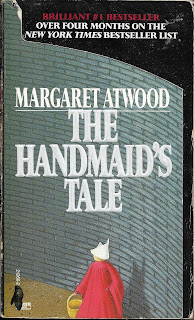
The Handmaid's Tale

In 1985 Margaret Atwood published The Handmaid's Tale, a dystopian novel depicting a future United States (and most particularly, the New England area) where the government has been overthrown and replaced by a theonomy called the Republic of Gilead. It is implied that this has taken place in part as a response to the growing numbers of infertile people and those who have deliberately chosen not to have children. The new regime affects women to the greatest extent. It is now illegal for women to hold property, work at paid jobs, read and write, or have any autonomy at all really. They are divided into various classes--women of the ruling class who may or may not be capable of bearing children; Handmaids who essentially serve as broodmares for those in the ruling class who are infertile; Marthas who do all the household chores for the ruling class; Econowives, legitimate wives of the lower classes; Aunts who train and discipline the Handmaids in preparation for their lives as broodmares; and the illegitimate women (Unwomen and Jezebels), those who fall outside the boundaries of these highly regulated categories.

The story follows Offred, a woman in her thirties who remembers what it was like before the militaristic theonomy took over. She had a husband, who was not allowed to keep her because he had been divorced, and a daughter, who was taken from her parents and given to one of the new regime's Commanders. She had work and money of her own. A great deal of Offred's thoughts makes it appear that she is trying to accept the new order and just fit in and yet she also speaks of wanting shears or scissors (anything with a sharp blade). We're sometimes not sure if she wants them to do away with herself or if she wants to use them on the Commander or his wife though she often makes a point of how anything that might be useful to a suicide has been kept out of her reach.

I thought this was a shatteringly good novel when I first read it for a college English class in 1988. At that time it was an interesting look at a dystopian society that could happen, but to a child of the 70s and early 80s it seemed unlikely. Though positive change was slow, it was happening and seemed to be trending to keep happening. So, I read it as more of a cautionary tale. Reading it now with the background of the United States from 2016 on, it is even more shattering. It doesn't seem so far-fetched that so much could change so quickly--that a free woman could find herself stripped of her autonomy and enslaved in the ways that Offred and her fellow Handmaids are. Because so much has changed so quickly in the last three years. It is so easy to take a way of life for granted--but this book (and current events) show us has dangerous it is to take anything for granted...even the basic rights promised to us in the Constitution. Even battles already fought in the courts can be reversed and taken from the victors.

It also teaches us how easily humans adapt--how quickly we conform. How much the average person doesn't want to upset the apple cart...even when the cart becomes filled with rotten apples.  There will always be those who will take advantage of opportunities to wield power over others (the Aunts and those who inform on anyone who steps out of line). There will always be those who assume it isn't really as bad as it seems and will buy the party line that things are "better now." But as the Commander says, "Better never means better for everyone....It always means worse, for some."

This is an incredible story made even more incredible by how very relevant it is thirty-some years later. ★★★★

Monday, July 29, 2019

A Passage to India

A Passage to India (1924) by E. M. Forster is very much rooted in its time and place. Set in colonial India, the reader is exposed to the viewpoints of both the British who rule in India and the Indians who must live their lives as subjects to a foreign government. Forster comes through as solidly anti-imperialist and his characters appear most passionate when they speak of the situation of those who must endure the imposition of British power or those who are part of the system but feel it unjust. 

Forster also highlights how the British believe that their way and their people are always right. Ronny Heaslop, the young British city magistrate of Chandrapore and intended of Adela Quested, exemplifies this point of view. His treatment of Indians is deplorable and his condescending treatment of Adela's interest in understanding the people she might come to live among (should she decide to marry Ronny) underlines his belief that Indians don't matter enough to try and understand. This attitude is underlined again when the accusation of sexual assault is made against Dr. Aziz and Ronny's rapid move to break his engagement when Adela realizes she has been mistaken. Rather than seeing the wrong that has been done to the doctor, Ronny believes that Adela has betrayed her countrymen. She has "let the side down."

Of course the Indian point of view is also well-represented. In the first half of the book Dr. Aziz has made some headway in friendship with Cyril Fielding, a headmaster at a local school, as well as intellectually profitable interactions with Adela as she tries to understand the Indian way of life. But all that falls apart with her accusation--even though he is ultimately exonerated. Aziz loses his faith in any good will from the British contingent and tells Fielding at the end of the book that they can never really be friends until India is free from British rule. This is very true--no matter the good intentions; no matter how equal any British subject may try to treat the Indians, there is still that difference. There is still the position of the ruling class and the ruled. ★★and 1/2.

Finished 7/21/19

Quotes
...Life never gives us what we want at the moment we that we consider appropriate. Adventures do occur, but not punctually.  (p. 23)

...Ronny was dignified. 
Mrs. Moore was surprised to learn this, dignity not being a quality with which any mother credits her son. Miss Quested learnt it with anxiety, for she had not decided whether she liked dignified men. (p. 24)

MC: I really do know the truth about Indians. A most unsuitable position for any Englishwoman--I was a nurse in a Native State. One's only hope was to hold sternly aloof.
AQ: Even from one's patients.
MC: Why, the kindest thing one can do to a native is let him die. 
(Mrs. Callendar; Adela Quested, p. 25)

But Ronny was ruffled. From his mother's description he had thought the doctor might be young Muggins from over the Ganges, and had brought out all the comradely emotions. What a mix-up! Why hadn't she indicated by her tone of voice that she was talking about an Indian? (p. 30)

AQ: Now look here, wouldn't you expect a Mohammedan to answer you if you asked him to take of his hat in church?
RH: It's different, it's different; you don't understand.
AQ: I know I don't, and I want to. What is the difference, please? 
(Adela Quested; Ronny Heaslop, p. 30)

I'm just a servant of the Government; it's the profession you wanted me to choose myself, and that's that. We're not pleasant in India, and we don't intend to be pleasant. We've something more important to do. (Ronny Heaslop; p.52)

How he did rub it in that he was not in India to behave pleasantly, and derived positive satisfaction therefrom!...His words without his voice might have  impressed her, but when she heard the self-satisfied lilt of them, when she saw the mouth moving so complacently and competently beneath the little red nose, she felt, quite illogically, that this was not the last word on India. One touch of regret--not the canny substitute but the true regret from the heart--would have made him a different man, and the British Empire a different institution. (pp. 52-3)

The feeling grew that Mr. Fielding was a disruptive force, and rightly, for ideas are fatal to caste, and he used ideas by that most potent method--interchange. Neither missionary nor a student, he was happiest in the give-and-take of a private conversation. The world, he believed, is a globe of men who are trying to reach one another and can best do so by the help of good will plust culture and intelligence-- (pp. 64-5)

AQ: I do so hate mysteries.
MM: We english do.
AQ: I dislike them not because I'm English, but from my own personal point of view.
MM:I like mysteries, but I rather dislike a muddle.
CF: A mystery is a muddle.
MM: Oh, do you think so, Mr. Fielding?
CF: A myster is only a high-sounding term for a muddle. No advantage in stirring it up, in either case. Aziz and I know well that India's a muddle.
(Adela Quested, Mrs. Moore, Cyril Fielding; p. 73)

Mr. Fielding, no one  can ever realize how much kindness we Indians need, we do not even realize it ourselves. But we know when it has been given. We do not forget, though we may seem to. Kindness, more kindness, and even after that more kindness. I assure you it is the only hope. (Dr. Aziz, p. 126)

Saturday, December 22, 2018

Thank You, Jeeves: Review

Bertie Wooster is (big surprise) cheerfully causing trouble. This time he disrupts his home life with a banjo. He's recently discovered this delightful instrument and is determined to master it. His dedicated but untuneful playing cause his neighbors to complain to the building manager and he's given an ultimatum--either he ditches the banjo or he and the banjo must go. He opts to go. When Jeeves finds that Bertie plans to move the household to a cottage in the country so he can practice in peace, he regretfully submits his resignation. Next thing we know, Bertie is staying at one of his friend Chuffy's cottage (Chuffy being a Baron with a huge estate and loads of land, random cottages, and no money) and Jeeves is up at the manor house as Chuffy's valet.

Further shenanigans ensue when Bertie's ex-fiancee, Pauline Stoker, shows up with her rich papa who is interested in taking the estate off Chuffy's hands and filling them (Chuffy's hands) with money in exchange. Chuffy promptly falls in love with Pauline and she with him, but of course the path of true love is strewn with problems. Will Bertie be willing to sacrifice another bit of his reputation to see his friend happily married with a land deal in the bargain? And more importantly, will he ever give up the banjo and get Jeeves back into his service where he belongs?

So...a few years ago (when this blog was young), I started on a little P. G. Wodehouse reading jag. I read several of his Blandings Castle books and one non-series book and, for the most part, I thought they were hilarious. I've watched several of the Jeeves & Wooster episodes with Stephen Fry and Hugh Laurie...and, for the most part, I thought those were hilarious too. While I was on my reading jag, I (as I'm wont to do) also went on a buying binge and scooped up Wodehouse books whenever they came my way. 

Well...apparently my funny bone isn't tickled in the same way as it was about seven years ago. Or I'm just not in the right frame of mind for Bertie Wooster's silliness. I mean to say, it all started out okay. I was smiling over Bertie's efforts to play the banjolele (as he calls it) and how he annoyed the neighbors and even drove Jeeves to leave his employment because of his enthusiastic practicing. But then the humorous bottom just fell out. I wasn't appreciating the bucolic country setting. I didn't think much of Bertie's plan to help his friend Chuffy get the girl--by kissing her himself. And most of the supporting characters weren't as fun (or funny) as I remembered Wodehouse characters being from my previous experiences. Jeeves, of course, is marvelous (and saved the book for me) with his wide knowledge of literature (a quotation for every occasion) and his fantastic way of smoothing all that is ruffled, pouring just the right amount of oil on troubled waters, and unobtrusively orchestrating everything towards a happy ending. ★★

I've got other Jeeves books on the TBR pile...I think I'll put them off for a bit. Maybe my Wodehouse funny bone will come back.


Monday, November 19, 2018

Red Harvest: Review


"Plans are all right sometimes," I said. "And sometimes just stirring things up is all right--if you're tough enough to survive, and keep your eyes open so you'll see what you want when it comes to the top." ~The Continental Op in
Red Harvest (1929) by Dashiell Hammett

Newspaper publisher, Donald Willsson calls on the Continental Detective Agency to send an operative to his town of Personville (known colloquially as "Poisonville"). Our unnamed narrator, known forevermore as The Continental Op, arrives in town without any briefing on what Willsson wants. He's told that he'll find out once he meets Willsson at his home. But Willsson isn't at the house and his wife doesn't know where he is. She gets a phone call, runs off without a word, comes back some time later with what looks like bloodstains on her shoes, and announces that Donald won't be coming home that night. The Op isn't too shocked to find out that Willsson is dead.

Willsson's father Elihu has, until recently, owned the town. But when a strike threatened his businesses, Elihu brought in professional strong men to break the strike and those men decided they like the looks of Personville and hung around. Elihu is still the nominal big man, but he has to kowtow to the gangs when they say so. Donald was trying to stir up support to clean up the town through his paper and when The Op visits the elder Willsson a deal is struck (with a signed contract and all) that the Continental Detective Agency will clean up the town.

After a lot of people (and I do mean a LOT) are killed (and Elihu tries to cancel the deal), the town is cleaned up and Elihu is back in control. But Elihu Willsson may not like the state of his town once The Op is finished with it.

So....this is SO not my thing. Hard-boiled, noir is in general not my thing. But I loved The Maltese Falcon. And I enjoy small doses of Brett Halliday's Michael Shayne. But Red Harvest is really not my thing--this is noir at its blackest and grittiest. This is hard-boiled so hard it's turned to stone. There are bodies everywhere. There are double- and triple- and quadruple-crosses. There are huge shoot-outs between the gangs and the police (who have gang ties of their own). 

The saving grace? Hammett knows how to write. Even though I'm not happy with what I'm reading, he makes it go down nice (though I'm not sure "nice" is exactly the right word here...). The Op may take extreme measures to get the job done. He may not operate within a particularly palatable set of rules--but reading about his exploits and his interactions with various characters is entertaining. The plot line is a bit convoluted (what with all the double- and triple- and so-on-crossing and all)--otherwise I would have have rated this classic in the hard-boiled realm higher. ★★ If you like noir and hard-boiled detectives, then this is definitely your thing.

[Finished 11/12/18]

Saturday, September 29, 2018

Pride & Prejudice: Review

Pride & Prejudice (1813) by Jane Austen is probably Austen's most well-known book. People who don't read (or read much) are familiar with it through the various films and television versions. I'm not going to give an in depth run-down of the plot. In a nutshell, Mr. & Mrs. Bennett have five marriageable daughters that they hope to see well-situated as soon as possible. Miss Elizabeth Bennett meets the eligible, but seemingly haughty Mr. Darcy and things get off to a rocky start. After various misunderstandings and various opportunities for Miss Bennett to learn Darcy's true nature, love (as it tends to) finds a way.

P & P is not my all-time favorite Austen book (that honor belongs to Persuasion) but it is in my top three. I thoroughly enjoy a good British comedy of manners and Austen is the master of the genre--weaving romance and witty conversation into delightful plots of misunderstanding. I really do feel like giving Lizzie Bennett a good shake, though, when she decides to listen whole-heartedly to Wickham's wicked assertions--just because he is so charming and easy to be in company with. 

But after all, that is one of Austen's themes in this story. Miss Bennett learns that first impressions aren't always best and sometimes appearances can be deceiving. It would serve a lady well to look beyond the superficial and dig deeper to find the true worth of her companions. But she isn't the only one to learn a few essential truths--both she and Mr. Darcy also learn to recognize their own faults and work to correct them. Of course, all of this is working itself out through a good old-fashioned love story where Miss Bennett and Mr. Darcy must overcome obstacles (mostly of their own making) to reach their happily-ever-after ending. 

I read this quite some time ago when a friend was astonished that I had not yet done so (Persuasion--read in college--was my only foray into Austen's work at the time). I was delighted with Austen's light touch and witty Regency dialogue then and enjoyed it just as much this time around. ★★★★


[Finished 9/18/18]

Monday, July 30, 2018

Melmoth the Wanderer: Review

This is going to be awfully short--especially in comparison to the book I read. You would think that I would have more to say about about a book that is 659 pages long. But really, I don't have the words. Charles Robert Maturin used them all up in the early 19th Century. Good old Charles has a lot in common with Tristram Shandy--he loves to tell stories within stories with stories. Besides that, he's long-winded and repetitive. He really wanted his readers to know how corrupt and down-right bad the so-called "holy men" of the Catholic Church were and he was willing to tell them so in story after story and hit them over the head with the idea until they cried for mercy.

With so much anti-Catholic propaganda coming at me as well all the stories within stories, I had a really difficult time concentrating on what's supposed to be the main plot--that John Melmoth's ancestor made a pact with the devil and takes a couple of hundred years to try and snare some innocent soul to take his place. SPOILER--he fails. Just think if Maturin had put it that directly, I wouldn't have wasted all that time wading through a bunch of stories about life in a monastery, which quite frankly was repetitive and boring and didn't really add much to the basic plot line. I mean, seriously, I think I snoozed through the part where it's explained what the conniving of the Abbott to put the Spanish dude into a monastery against his will had to do with Melmoth's ancestor....All I got out of it was that apparently none of the "religious" fellows who took up the monastic life really believed anything and were miserable and only wanted to recruit new monks so someone else could be miserable too. Wheee!

So....this deadly dull classic story made it onto the 1001 Books to Read Before You Die list somehow. I get to check that one off the list. And it counts for the Back to the Classics Challenge. And it counts for the Dread & Read Challenge. AND I've read it and don't ever need to read it again. Not a very coherent or comprehensive review....but then I didn't think Maturin was all that coherent himself. So, it's fitting really.  , I guess.

[Finished 7/22/18]

Friday, July 27, 2018

She: Review

She (1886) by H. Rider Haggard concerns the journey undertaken by Horace Holly, a Cambridge University professor, and his young ward Leo to find the mysterious woman who killed one of Leo's ancestors. When Holly agrees to take on the guardianship of Leo Vincey, Holly's friend gives the professor a locked iron box and instructions that the box may not be opened until Leo turns 25. In the meantime Leo is to be trained in various ancient languages and generally prepared for what awaits him when the box is opened.

As soon as Leo comes of age, he is presented with the box and he finds within materials that tell and support a story about his ancestors in a time long before Christ. It tells how two lovers, a man and his wife, were relentlessly pursued and the man killed rather than become the husband of a mysterious woman. The wife escaped and had a child. The wife left materials and her testimony as proof of the horrible treatment and tasked her descendants with returning to Africa and exacting revenge for her husband's death. Also included is the notes from a more recent ancestor who said he tried to follow the instructions, found the right place and people, but failed to carry out the directive for revenge.

Holly says the materials either reflect a myth or the deranged imaginings of the recent ancestor, but Leo insists that he is going to follow the instructions whether Holly goes with him or not. The professor agrees to join him and they--along with their servant Job--travel to east Africa by boat. Their boat is wrecked and the only other survivor is their Arab captain. They are soon captured by a violent race of people who are ruled by a powerful white queen who has demanded that these strangers be brought to her. This queen, referred to as Hiya or She-who-must-be obeyed (shortened to just "She" throughout the book), is rumored to be thousands of years old.


photo source
The men suffer through many deadly adventures on their way to She's home and it is only her protection that saves them from Amahagger people (who are revealed as cannibals). But living under her protection may not be as safe as it appears and Holly soon suspects that She will not let them go easily--especially Leo, who she believes to be the reincarnation of her great love. They must overcome one last trial if they are ever to see England again and there is reason to suspect that they might fail.

Haggard wrote his novels during the height of the British Empire. Victorian and Empirical viewpoints are heavily represented from the depiction of the native folk of Africa to representation of a powerful woman. Although, She (or Ayesha--her real name) appears to be quite intelligent and crafty, her primary power over the men is in the wiles of her sex. She uses her great beauty to ensnare both Holly and Leo--making it near impossible for them to resist her. It is interesting, however, that Holly retains his reasoning powers even though quite enthralled by She's beauty and, in fact, holds quite detailed debates with her on many subjects. She even concedes that She might need to think over many of his views--though She absolutely will not give up the idea that Leo must belong to her. 

An interesting Victorian adventure novel that runs just a tad long on the front end. While it was necessary to give the background for the adventure to come, Haggard had a tendency to over-explain and we definitely didn't need long passages in Latin (or Arabic or whichever version happened to be under examination amongst the materials in the box). A synopsis of the ancestor's story would have sufficed. ★★

[Finished 7/17/18. I started this before my long vacation and then didn't read one word while traveling to and from Montana. Too many adventures of my own, I guess!]

*The cover shown above is not my edition. My edition is a boring, gray hardcover with nothing on the front.


Saturday, April 14, 2018

Go Down, Moses: Mini-Review

Go Down, Moses (1942) is a book of seven interconnected short stories by William Faulkner. The stories' most prominent character and the character's voice which becomes most familiar is Isaac McCaslin, also known as Uncle Ike. Isaac lives to be a quite old man who is "uncle to half a county and father to no one." Faulkner uses the McCaslin family to highlight the very complex and changing relationship between whites and blacks. The McCaslin family itself has two branches--a white branch which descends from Carothers McCaslin and his wife and a black branch which descends from McCaslin's sexual relationship with a slave named Tomey. Tracing the history of the families, Faulkner presents events to the reader that take on significance only in later stories. He also uses the stories to underline the painful racial divisions that permeate the South and wants the reader to know that without an understanding of that basic fact of Southern life, there can be no understanding of the South as a whole.

I've mentioned before my difficulty with stream of consciousness writing, particularly in relation to Faulkner's work. I struggled with Intruder in the Dust seven years ago, but I found the struggle to be rewarding and didn't mind the slog through the stream. Unfortunately, that was not the case here. One would expect that the shorter format would limit the exhaustion of the stream of consciousness format--it didn't. The shorter format only seemed to make the long, convoluted sentences more obvious and more work for less reward. 

Intruder, in my opinion, is even more crucial to understanding the division in the South than these stories...or Harper Lee's To Kill a Mockingbird. "The Fire and the Hearth" (included here) is tagged in the fly-leaf notes as a kind of prelude to Intruder in the Dust, but I can't say that I really see the connections (of course, that may be because that happens to be one of the stories in this collection that I understand least). And it certainly doesn't have the power of the longer work. I do appreciate Faulkner's technique in weaving the stories together and I found his stories about Uncle Ike's younger years to be most interesting. ★★ and a half.

[Finished on 3/30/18]

Tuesday, August 22, 2017

The Black Dahlia: Review

The Black Dahlia (1987) is James Ellroy's fictional re-telling of the true murder case from Hollywood of the 1940s. On January 15, 1947, Hollywood was shocked when the brutally murdered body of Elizabeth Short was discovered in a vacant lot on South Norton. Ellroy uses the facts of the horrendous crime--a crime in which Short's nude body, mutilated and cut in half, was dumped like so much trash--and creates Bucky Bleichert and Lee Blanchard, two LA cops obsessed with the Black Dahlia and finding the right culprit even if it means going against the city establishment.

Bucky and Lee--known as Fire and Ice--are former boxing rivals who, after an interdepartmental boxing match, brings kudos and financial support to the department, are assigned as partners as warrant officers. One of their investigations takes them to the South Norton area on the morning that Short's body is found and Lee wangles their way into the murder investigation. Lee's obsession with the crime stems from the death of his younger sister years earlier and Bucky is concerned for his partner and obsessed with finding redemption through his work on the force and through his relationship with Lee and Lee's beautiful lover. 

Lee squirrels away files on the investigation and stretches himself to the limit (not sleeping or eating as he should) hunting down leads. When Lee disappears, Bucky continues the investigation and discovers secrets that help him find what he believes to be the solution.  But it's a solution he won't be able to produce officially and his investigation may cost him dearly professionally.

This is an intense, noir retelling of a very nasty crime. Ellroy invests a great deal of insight and intensity in his story--which is even more evident when you read the afterword to this edition and realize that Ellroy's mother was also the victim of a rather horrific crime. While noir is not my usual fare and I don't do a great deal of true crime (or even fictional true crime), Ellroy does write a compelling novel. His build-up of a case and possible solution to a crime that remains unsolved even now is convincing and well-constructed. It's easy to see why this has made one of the "1001 Books to Read Before you Die" lists even if I may not appreciate it as fully as those with a taste for noir and true crime. ★★


[Finished on 8/8/17--I'm still struggling to catch up on my reviews and I'm afraid that until I do, the reviews are going to be a little sparser than usual....]

Wednesday, May 10, 2017

Blind Man with a Pistol: Review

Blind Man with a Pistol (1969) is the first Grave Digger Jones and Coffin Ed Johnson novel I've read and the last in the series published before Chester Himes's death in 1984. It tells the story of one night and a day in Harlem. A period in which Detectives Jones and Johnson are tasked with finding the person responsible for a spate of organized race riots while weaving their way through murders, Black Muslims, Black Power movements, organized crime, and terrible violence everywhere. 

They get sidetracked from their primary assignment (the race riots) when a pantsless white man with his throat cut falls dead at their feet.  A trail of blood leads back to a cramped apartment building where apartments full of people neither saw nor heard anything. Another murder (of a key witness) follows and the police seem powerless to stop the murderer or the riots. The story ends with a regular shoot-em-up featuring the titular Blind Man and his pistol. 

I have to admit that I really didn't follow what was going on throughout most of this. Plot does not seem to be a major point of interest for Himes. I think I know who was behind the riots, but I wouldn't bet anything too valuable on that and I haven't the faintest idea about who killed the pantsless man and the witness. Jones and Johnson (and the white policemen on the force) haven't solved that crime by the end of the book and I doubt that they were going to. There is a lot of gratuitous violence and if you have any qualms about language (both racial and vulgar), then I'd suggest you steer clear. Definitely not a mystery story in the traditional sense.

I recognize that Himes was using the crime novel as a vehicle to make statements about violence and conditions in Harlem as well as to highlight the racial tensions of the time period. This is valuable for those interested in the late 60s/early 70s in New York. And, perhaps, the chaotic nature of the book--which jumped around from scene to scene and from viewpoint to viewpoint--was meant to reflect the chaotic atmosphere of the time and place--but it makes things difficult on the reader. Interesting as a snapshot of the time period, but not a typical mystery novel and it was difficult for me to enjoy it from that standpoint. The ending is well-done. Himes does seem to have a gift for describing the crowd mentality and giving the full flavor of the people's reactions without over-doing it. ★★

**********
This fulfills the "Revolver" category on the Silver Vintage Scavenger Hunt card.

Wednesday, August 24, 2016

The Spy Who Came in from the Cold: Review

One of the game changing novels of the spy and thriller genre, John le Carré's The Spy Who Came in from the Cold (1963) portrays the espionage methods of both the East and the West as equally amoral--willing to sacrifice anyone in the name of national security and willing to use their own people as pawns on the chess board of spy and counterspy. His murky world with the worn-out and jaded Alec Leamas contrasts with the glossy, shaken martini world of James Bond.

The story begins in East Germany where the final link in Leamas's chain of informants is gunned down as he tries to escape to the West. Leamas is waiting for him on the other side and watches as his last man is taken. The intelligence agent is tired and ready to "come in from the cold"--give up the intelligence game altogether when he is made an offer that he can't refuse. To play the game one more time and take out a senior East German operative named Mundt. Leamas can't resist the chance to eliminate the man most likely responsible for the loss of his agents. In order to get Leamas where he can do the most damage, the Circus (British Intelligence Service) begin laying the groundwork for him to become a defector. Leamas is booted out, given a pension that is substantially less than a intelligence man of his experience might expect, and reduced to drifting from one odd job to another. He drinks heavily and grumbles often of his treatment by his former employers.


It isn't long before he's approached by the other side and after playing a bit hard to get, he gives in and goes East. But the game is more difficult than he expected and he didn't plan on falling for a girl along the way. He also finds that someone has rigged the dice...but is it the opposition or his own side? It's hard to tell when everyone seems to be playing two hands instead of one.

I'm known for saying that the spy/thriller book just isn't for me. But when someone like le CarrĂ© writes it, it winds up that it is for me. This is an absolute first-rate spy novel that keeps the reader on the edge of her seat waiting to see if Leamas is going to pull it off--and if what he pulls off is really what he thinks he's set out to do. This has everything--love and loyalty, betrayal, secrets, and a "trial" scene that reveals the chilling fiendishness of the plot within the plot within the plot. The finale is a wrenching and horrifying surprise. Well done. ★★★★

********
This fulfills the "One Person" category on the Silver Vintage Scavenger Hunt card.

Tuesday, October 20, 2015

Challenge Committment Complete: 1001 Books Before You Die


Rachel at Resistance is Futile thought it would be fun to gather a few people who are interested in reading through the list of 1001 Books You Must Read Before You Die.  She has put together a perpetual--lifelong!--challenge and has posted a compilation of all editions of the list for us to follow.  OR you're welcome to work from the compilation or from one specific edition - your choice! For full details and to sign up, jump on the link above.
 
When I signed up I was quite sure I wouldn't read (nor want to read) all 1001+ books on the list. So I've made my goal to read at least five books from the list every year, Just finished my fifth book for 157 total so far.

Challenge Goal 2015: Five books (review links may be found at my original post)
1. The Day of the Triffids by John Wyndham 
2. Brighton Rock by Graham Greene
3. The Crying of Lot 49 by Thomas Pynchon
4. Alias Grace by Margaret Atwood
5. The Hitchhiker's Guide to the Galaxy by Douglas Adams
 

The Hitchhiker's Guide to the Galaxy: Review

I just took myself on a little journey back to the 80s. The 1980s. That's when I discovered that marvelously funny science fiction and cult classic The Hitchhiker's Guide to the Galaxy written by Douglas Adams in 1979 at the age of 27. Since I needed a SF book written in 1979 for the Genre Decades Challenge and written by someone younger than 30 for the Pop Sugar Challenge, I decided to revisit an old friend and see how it holds up over 30 years later.

Quite nicely, in fact.

The book is one delicious romp--starting with Arthur Dent, a rather boring Englishman who wants one thing out of life...to save his fairly unattractive house from being demolished to make way for a new freeway. To this end, he is lying in the mud in front of a bulldozer when his friend Ford Prefect plucks him from the mud, convinces him to down several pints of beer, and helps him snag a ride onboard a Vogon ship which has just come along to demolish the Earth to make way for galactic freeway. Ford, ostensibly an out-of-work actor, is in reality an alien from Betelgeuse who has been doing research for a revised version of the Guide and has been waiting fifteen years for someone to come along and rescue him from this backwater little planet. He didn't really want it to be Vogon ship...after all Vogons hate hitchhikers and are likely to drop you out of an airlock if they find you. And if you're really unlucky they'll read their poetry to you first.

This is the story of Arthur and Prefect's adventures after they survive the horrors of Vogon poetry (oh and the demolition of a planet and being tossed out an airlock). Adventures that hook them up with Zaphod Beeblebrox, the two-headed, three-armed President of the Galaxy who's out for a good time and in search of something that his future self wants him to find but won't tell him about; Trillian a brilliant and beautiful woman whom Arthur tried once to pick up at a party and who knows how to fly a ship with Improbability Drive; Marvin, the paranoid android, who is so depressing he causes a space ship to commit suicide; Slartibartfast, award-winning designer of fjords; two white mice in search of a question; and, briefly, a large sperm whale and a surprised bowl of petunias. 

What will our brave heroes learn on there journey? Why, nothing much--just the answer to Life, the Universe, and Everything. Oh wait. That's an entirely different book in the series. ;-) 

I absolutely loved this book when I discovered it back in high school. I thoroughly enjoyed all the witty dialogue and the outrageous adventures of our heroes. I didn't mind that there really (if you think about it much harder than you should) isn't much of a plot. When you're having so much fun imagining the events that Adams puts in front of you, you don't really notice that the story line doesn't have much of an arc. And, you know what? Over thirty years later...I still didn't notice. This is an excellent, crazy, off-the-wall science fiction adventure. I enjoyed every minute. ★★★★

Sunday, August 16, 2015

Alias Grace: Review

Alias Grace is Margaret Atwood's fictional retelling of the true story of Grace Marks. Grace was a Canadian maid who was convicted in 1843 for her involvement in the murder of Thomas Kinnear, her employer, and she was also suspected of the murder of Kinnear's housekeeper and mistress, Nancy Montgomery. James McDermott, the outside man who tended the animals and did the rough work around the house, was also charged. He was found guilty and hanged. But the decision on Grace was not so clear-cut. There was disagreement about whether she was a full participant in the murders or if she was an unwilling or unwitting accessory. Her sentence was commuted to life imprisonment. Because of her pretty face many thought her a wayward siren with designs on her employer and believed that jealousy of Nancy's relationship with Kinnear was the driving force behind the murders. There were a few people who believed in Grace's innocence and petitioned regularly on her behalf for a pardon. After being imprisoned for nearly thirty years, Grace finally received her pardon and left Canada for northern New York where she faded into the surroundings of her new land. 

This book follows the efforts of her supporters in one of their many attempts for a pardon--revolving primarily around the fictional psychiatrist Dr. Simon Jordan and his sessions with Grace Marks. Her supporters have asked Dr. Jordan to help them find evidence that will support Grace's innocence. His methods are simple--win the patient's trust, bring objects for her to identify and make associations with, and coax her into to telling her story. Grace has long claimed that she cannot remember what happened that fateful day at the Kinnear house--that any statements or confessions she made were prompted by her lawyer in an effort to get a lighter sentence. Jordan's goal is to find the key to unlock those hidden memories. Dr. Du Pont, another doctor who favors hypnotism as a treatment,  is also interested in Grace. And it is through a hypnotic session that the most startling memories are revealed. But will the efforts of the doctors really be useful in procuring Grace's pardon--or will they do more harm than good? 

Atwood, it seems to me, has two purposes in Alias Grace. The first, and of course most obvious, to tell us Grace's story in an entertaining manner and to fill in with speculation where the bald facts of history are lacking. She tells us in the afterword that there were many portions of the story where the facts were simply not known. She weaves a very convincing tale from the threads she has. Or, to use a theme from the book, she patches together a very pretty quilt-story indeed. Secondly, Atwood examines the nature of memory and truth. Truth as it is connected with memory and truth as it is connected with intention. 

As Jordan works on unlocking Grace's memory, he often wonders how truthful she is with the story she's telling. And our omniscient look into Grace's thoughts tells us she's holding back and sometimes deliberately telling Jordan what she thinks he wants to hear. So at the conclusion, we're left wondering if the answer Atwood has given us is any nearer the truth than the incomplete story which history has left behind.

We also have to wonder at the truth of Jordan's intentions as well as those who are seeking Grace's pardon. Do they really care about Grace or merely seeing their own work recognized? Jordan wants to set up his own clinic someday and needs some new and astonishing results to get the funding he'll need. The minister who is leading the committee working on Grace's behalf may only want earthly recognition for his good works. 

This is a well-told tale of true crime, giving a voice to the perceived culprit and leaving the reader to determine just how culpable (if at all) Grace was. The research and historical detail are impeccable. A very absorbing piece of fictional history. ★★★★ 
 

Wednesday, July 8, 2015

The Crying of Lot 49: Thoughts

This really isn't a review. I don't see any way that I can reasonably review Thomas Pynchon's The Crying of Lot 49, so I have pretty much by-passed that on Goodreads. But, here on the Block, I'm going to just record my random thoughts on the work for my own future reference. Possible spoilers ahead.

Basic plot (sortof): Oedipa Maas is made the co-executor of her ex-boyfriend's estate. The whole story is supposed to be about how she handles those duties. But not really--because she gets all distracted by everything and most prominently by this secret mailing system thing.

I've noted before that stream of consciousness writing doesn't do a whole heck of a lot for me. Yes, I do realize that our brains do work that way to an extent. I may be typing up these notes on the book and suddenly I realize I'm hungry and, hey, I wonder if I really do want the lunch that I brought with me or maybe I'll see if anybody else wants to order sandwiches delivered. I don't want to go out for lunch because, well, it's raining. [we decided to order, by the way] And...did I really see on the weather that it's going to rain for the rest of the week? Maybe I should look that up. Oh, look, somebody commented on a picture I posted on Facebook. Wait. Wasn't I doing something? Oh, yeah. Notes on The Crying of Lot 49. Hi. I'm back now.

I mean really. Can you imagine if I tried to hold a conversation with my coworkers that went like that All. Day. Long? Yeah, they'd get pretty darn tired of me bouncing all over the place. That's what I think about stream of consciousness writing and this postmodernist stuff. You got a story to tell? Then, how about you just tell it? Stick to the point and don't drag in random things and expect everybody to know how they're connected to the story when you just pop them in front of us and pop them out again. And I don't know if I'm supposed to believe half of what I'm told about people. For instance, Dr. Hilarius (don't even get me started on that bit of punnery), Oedipa's psychiatrist, admits at one point that he's a former Nazi. The whole scene has such a weird, dream-like quality (the man takes LSD, so no surprise there) that I have no idea if this is true. The police take him away--but I can't really say whether it's because he's a former Nazi that they've been looking for or if it's because he's been holed up with a gun and semi-threatening Oedipa.

According to what I read in the comments from other readers on Goodreads, there really is a point to the story. You could have fooled me. The back of the book tells me that Oedipa Maas makes all kinds of discoveries about herself. Again, you could have fooled me. I'm not convinced and the ending of the book seems very flat. Maybe that's on purpose.

No rating. Just glad to have it off the TBR pile and to be able to count this for various challenges.