Showing posts with label Alphabet Crime. Show all posts

Friday, April 30, 2021

The Egyptian Cross Mystery...or Planes, Trains, & Automobiles


 The Egyptian Cross Mystery (1932) by Ellery Queen (Frederic Dannay & Manfred Lee)

The beginning of one of Ellery Queen's weirdest and most brutal cases takes place on Christmas Eve in the small town of Arroyo, West Virginia. an eccentric schoolmaster by the name of Andrew Van is found crucified on a T-shaped sign post at the crossroads near his house. His head has been cut off--turning the body into a T and a T has been marked in blood on the door of his small house. Ellery is fascinated by the details of the case and initially thinks there is an esoteric connection to the tau or Egyptian cross (as he believes it to be). But when a second murder takes place, this time of a wealthy man near New York, and the body is found crucified on an American Indian totem post, it looks like the T imagery must stand for something else. Ellery's former professor (who lives near the home of the second murder victim, invites him to come and stay and show him how this detective business works. But after examining the available evidence everyone, including Ellery, is completely baffled. 

After the second murder, it becomes apparent that the recent murders have roots in a Central European past. The men in the case--both victims and a third missing man--all have ties to Central Europe. But what do they all have in common. When a third man is targeted, the case is just as baffling as before and it isn't until a fourth murder occurs that Ellery finds the clues that will allow him to discover the true identity of the killer. But he, Professor Yardley, and the police will have to track the villain half-way across the country by means of planes, trains, and automobiles before they can bring him to justice.

It's kind of mind-boggling to watch Professor Yardley (in the lead), followed by Ellery, followed by the New York DA & Inspector Vaughn of the police be able to hop on trains and chartered planes one right after the other in their mad-dash across country in pursuit of the villain. It's difficult to imagine just one of them doing it, let alone three separate groups. Imagine trying that trick today...Of course, in today's world, there's also the advantage of technology to get messages where they need to go and for travel tracking purposes. So, perhaps it all evens out.

This is a pretty gory book considering that it was written in the 1930s. Four headless bodies, crucified. Blood dripping all over the place--especially in the last two murders. Not exactly what one expects from the Golden Age of Crime. And the esoteric bits--with Egyptian sun gods and nudist colony of sun worshippers of a different sort--serve a real purpose in addition to providing a distraction from other important bits. It's weird--but Queen had a method behind the madness.

I'll just fess up right now and tell you that when Queen gave his Challenge to the Reader--you have all the clues now. Do you know who did it?--I did not. The solution didn't occur to me at all. I had a sortof close idea--but with the wrong person in mind. An enjoyable read even though the murders were a bit more brutal than one might like in a classic crime novel. ★★★★

First line: It began in West Virginia at the junction of two roads half a mile out of the little village of Arroyo.

Last line: "I'll write a book about it, call it as a memento of my sometimes impulsive erudition The Egyptian Cross Mystery, and let the public pay for it!"

*************

Deaths = four (all bashed on head and then beheaded)

Thursday, August 9, 2018

I Capture the Castle: Review

I Capture the Castle (1948) by Dodie Smith is really the diary of Cassandra Mortmain, a 17-year old girl in 1930s England. She fills three notebooks over the course of six months and tells us about her eccentric family life. The Mortmains live in a dilapidated English castle (with moat and everything!), barely any money, and barely enough food to continue living. They have come down in life quite a bit since Cassandra's father James Mortmain was the darling of the United States with his first novel Jacob Wrestling. James retreated with his family to the castle when writer's block plagues him. He hoped the atmospheric setting would inspire him. There's been no inspiration for years and Cassandra's sister Rose is desperate to escape their genteel poverty--but how's a girl trapped in a broken-down castle in the back of beyond supposed to meet eligible (rich) young men? No worries...enter the handsome,wealthy, and single young Americans Simon and Neil Cotton who have just inherited nearby Scoatney Hall.

Cassandra hones her writing skills as she describes life in the castle before and after the Cottons arrive. And she pours out her feelings as Rose determines to marry Simon (the elder--so therefore richer of the brothers), Simon falls hard for Rose, and Cassandra realizes that she loves Simon. There is a triangle or two in the romantic entanglements. We mustn't forget Stephen, the Mortmain's handyman-come only source of income, who loves Cassandra OR Neil who loves....well, that would be telling. Needless to say, most of these issues sort themselves out by the end of the novel--even James Mortmain's writer's block seems to be broken. The only real question at the end is whether Cassandra will wind up with the man she should. But that's left as a cliff-hanger....

This is a charming story about a quirky girl and her even more quirky family. It is good reading for those who enjoy Jane Austen and/or a clean and pleasant romance. A lovely portrait of England in the 1930s with a dose of humor mixed in. A definite time-travel to a simpler time that deals nicely with the issues facing the girls who are trying to sort out romance and more difficult life problems. ★★★★

[Finished 8/5/18]

Tuesday, September 1, 2015

Jewelled Eye: Review

Jewelled Eye is the 22nd entry in Douglas Clark's series starring (now) Detective Chief Superintendent George Masters and his team of crack investigative officers. This time Masters has been given a highly sensitive, top-secret mission--to track down a biochemist who has disappeared with the knowledge of a scientific breakthrough that can mean so much to humanity and big bucks to anyone who can bring that knowledge to fruition. Masters has been given even more extensive powers to call upon anyone and everyone who might help bring this mission to a successful end. Joining Masters and his usual crew--Detective Chief Inspector Green and Sergeants Reed and Berger--are another Detective Chief Superintendent, a forensic medical specialist, and an ex-con army major. Masters will rely on everyone's special skills to help him discover where the missing scientist is, whether he's still alive, and how best to rescue him from an international ring of industrial spies.

One of Douglas Clark's strengths is his characters. The team that Masters gathers work well together and have quite distinct personalities that contribute to the efforts. I always enjoy watching them in action. He is also rather good at describing the setting and the situations that Masters and company find themselves in. The major drawback to this outing is the amount of time spent talking. There have always been moments in each entry to the series where the team gathers and discusses--whether they need to hash out information that is new to them or just to have a brainstorming session when they don't seem to be making much progress. But this time--fully three-quarters of the book is spent in talking with Masters filling in each and every team member on each and every detail. Then we bring in an expert to talk about the chemical side of the industrial espionage business and he goes into detail. And then, after a bit of running around looking for clues, we all sit down and go over every single detail all over again. It really was a bit much and the lack of action keeps this from being Clark's best.

This is a departure from the usual Masters and Green fare. There are no real clues to follow up and there isn't much of a chance for the reader to reach the solution before the grand finale. It is interesting to see the relationship develop between Masters and Gudgeon (the ex-con who Masters indirectly sent to prison) and Clark's way with characters and the final scenes keeps this from being a very dull book.  Just barely ★★

This will fulfill the "Crime Other Than Murder" square on the Silver Vintage Bingo card. I had not yet used this square for a bingo, so I will be transferring The Cavalier in White to the "Color in Title" square--and claiming a Bingo!

Thursday, May 9, 2013

Alphabet Crime: Letters D & E

Here we are kicking off another year of the Alphabet in Crime Fiction hosted by Kerrie at Mysteries in Paradise.  Each week she expects participants to produce a post featuring a mystery/crime novel, mystery novelist, or crime fiction topic related to that week's letter.  In the past I have pretty much stuck to titles or authors, but this year I'm going to try and produce posts on various crime and mystery topics.
I somehow got off track last week and missed posting.  So, here are both letters D & E. 


D is for Detectives. What good would a mystery novel be without a detective? Whether it be an official representative of the law such as Lt. Bill Weigand or Inspector Heimrich in the novels of Frances and Richard Lockridge, a private, "consulting" detective like Sherlock Holmes, or your out-and-out amateur like Agatha Christie's Miss Jane Marple, you've got to have a detective to help the reader sort out the clues and get to the bottom of the mystery. Personally, I always enjoy trying to figure it all out before the detective. And I'm pretty broad-minded. I like most any kind of detective--even the hard-boiled type in small doses.

Within each category of detective there is even more variety....There are the quiet, unassuming elderly ladies like Jane Marple and Patricia Wentworth's Miss Silver whom everybody seems to underestimate. Those fluffy old ladies drink in the gossip and have their eye on everything that goes on in their small towns. There's Nero Wolfe sitting in his brownstone home--drinking beer, raising orchids and unraveling all the mysteries that come his way. There's the very logical and scientific "Thinking Machine" (Dr. S. F. X. Van Dusen). And, of course, there's Hercule Poirot who depends on his "little grey cells." Representing the law, you have Inspector McKee, one of New York's finest and starring in some of the first examples of the police procedural. More recently, and on the other side of the pond, there is London's Inspector Lynley. A very good detective--but a very human one. Elizabeth George's stories have a lot of human interest mixed in with her mysteries.

Hmmm. Maybe I should put The Age of Innocence by Edith Wharton on hold and grab me a detective novel.....


E is for Evildoers.  And, of course, without the evildoer/s...the culprit, villain, murderer or thief...there would be no mystery.  Crime fiction features evildoers in all shapes and sizes from the "Napoleon of Crime," Professor James Moriarty who is Sherlock Holmes's nemesis, to Flambeau, the jewel-thief and master criminal in Chesterton's Father Brown stories who eventually turns detective.  There are burglars and serial killers, bank robbers and poisoners.  There are the famous master criminals (as mentioned) and the regular Joes who suddenly burst out in murderous rage.  There are the fictional accounts of Jack the Ripper--with everyone from P. D. James to John Gardner and Robert Bloch (Pyscho) to
Paula Marantz Cohen (What Alice Knew) giving us their solution to Jack's identity.  There are blackmailers and poison pens, art thieves and frauds.  There is a little larceny and a lot of blood-letting and it all serves to allow the crime fiction reader the pleasure of hunting down the culprit from the comfort of their own home, watching as justice prevails, and knowing that, for the most part, good will conquer evil in the fictional world of crime.

Sunday, April 21, 2013

Alphabet Crime: Letter C

Here we are kicking off another year of the Alphabet in Crime Fiction hosted by Kerrie at Mysteries in Paradise.  Each week she expects participants to produce a post featuring a mystery/crime novel, mystery novelist, or crime fiction topic related to that week's letter.  In the past I have pretty much stuck to titles or authors, but this year I'm going to try and produce posts on various crime and mystery topics.
Zipping right along on our mysterious journey, we're already at the letter C.  And C is for Criminal Covers.  I've been admiring the pulp covers on my little square pocket-sized crime fiction collection. I do love those little pocket-sized book put out by Dell (Map Backs!) and Pocket Books (especially the World War II era books that were printed small in an effort to save paper for the war effort) and Permabooks and Bantam and Popular Library.  I'm mighty pleased whenever I come across one or two...or a stash...of those books in my used bookstore hunts.  I've been fortunate in my travels and have managed to collect a fair number.  And I just can't resist sharing some of these little gems with you.  My most recent read is the The Devil's Stronghold by Leslie Ford joined by others that are sitting companionably up on the shelves....


Sunday, April 14, 2013

Alphabet Crime: Letter B

Here we are kicking off another year of the Alphabet in Crime Fiction hosted by Kerrie at Mysteries in Paradise.  Each week she expects participants to produce a post featuring a mystery/crime novel, mystery novelist, or crime fiction topic related to that week's letter.  In the past I have pretty much stuck to titles or authors, but this year I'm going to try and produce posts on various crime and mystery topics.  
After this weekend's experience, I've decided to do B...as in Bookstore.  More specifically, used Bookstores.  And even more specifically, used Bookstores that carry vintage mysteries.  There aren't as many of those around as there used to be.  So many of the ones I've found over the years have sold up, closed out, and disappeared.  I've mentioned Mason's Rare & Used Books here on the blog before.  Mason's is where I fed my Nancy Drew habit and found all the other mysteries that Nancy led me to.  Mr. Mason started in my hometown of Wabash and I haunted his shop from the time I was about seven until I graduated from high school.  At about that time, Mr. Mason sold his shop to some of his employees and headed east....in search of rare books that never made it to the Midwest.  He stayed away for nearly ten years and then moved back to Indiana and opened up another incarnation of Mason's near Indianapolis.  And for a few more years I had the pleasure of handing over my extra money to Mr. Mason for those delightful things...used books.  Until he retired and closed up shop for good.  

And, over the years, there have been far too many used bookshops that have closed.  There was that nice little shop in Brownsburg (called most originally, "The Used Bookshop") that I only got to visit once before it disappeared.  And the tiny little shop (that I can't remember the name of) on the way to Vincennes where I found my first 1st edition Dorothy L. Sayers twenty years ago.  And Partners & Crime in New York City that closed the year after I visited.  And the

And now....well, Bloomington used to have four used bookshops (non-academic).  Being a college town, there always seemed to be plenty of support to keep the stores going.  Each of them had their own personality and I visited them all fairly regularly.  After April 30, we'll be down to one.  This weekend I discovered that The Book Rack was going out of business.  All books are 50% off. Which is nice--but I'd rather keep the store.  Here's hoping that the Caveat Emptor stays open for a good long time.

Now, I realize that there's this invention called the internet and it's so very easy to go online and search for that long-sought-after, hard-to-find classic mystery.  But that takes away from the thrill of the hunt for me.  Clicking a few buttons on the computer just can't compare to browsing the shelves in a brick and mortar store; meandering one's way along the aisle and then....can it be? A Dell Map Back edition? A find like that makes me pounce (quite literally) and grab the book from the shelf before someone lurking in the shadows can snatch it from under my nose.  You just can't pounce at a book on a computer screen.  I had that kind of an experience Saturday--for probably the last time in The Book Rack.  There sitting innocently on the shelf was Murders in Volume 2 by Elizabeth Daly.  Not a first edition, unfortunately--not even close--but one of the few Daly titles that I've never read and have never been able to find while on my bookstore hunts.  I pounced....and brought it home.  

My husband and I found a used bookshop that nearly matches my memories of the first Mason's when we were on our Route 66 trip last year.  As anyone who read my write-up of the trip knows, there was lots of pouncing and I came home with a treasure trove of Map Back editions and pocket size editions.  We're planning another trip in June--let's hope that Books on the Square is still loaded with stacks of vintage mysteries just waiting for the hunter.

Monday, April 8, 2013

Alphabet Crime: Letter A

Here we are kicking off another year of the The Alphabet in Crime Fiction hosted by Kerrie at Mysteries in Paradise.  Each week she expects participants to produce a post featuring a mystery/crime novel, mystery novelist, or crime fiction topic related to that week's letter.  In the past I have pretty much stuck to titles or authors, but this year I'm going to try and produce posts on various crime and mystery topics. 

There are various sub-genres of this field that we all love--everything from Vintage/Golden Age mysteries to recently written stories with historical settings; suspense thrillers to serial killers; police procedurals to comfortable cozies. One of my more recent favorites is the Academic Mystery. Now, my definition may not precisely coincide with a more accepted or expected definition. For my purposes an academic mystery must have one or more of the following: a professor or teacher acting as the primary (amateur) detective; a professor or teacher as the victim, culprit or essential main character; and/or a school or university setting. My love for this sort of mystery has loaded my shelves with all sorts of unlikely looking specimens. Sometimes I wind up with a real gem and sometimes I shake my head over what I have bought just because the back cover mentions Professor So-and-So or Whatsit Univeristy.

And within the sub-genre of academic mystery there is everything from the series with a university setting to stand-alone novels that have professors sprinkled in the mix. Some of my favorite academic series are Amanda Cross' series starring Kate Fansler, M. D. Lake's campus cop Peggy O'Neill, Edmund Crispin's eccentric Oxford don Gervase Fen, and Charlotte MacLeod's very funny Peter Shandy series. Kate Fansler is a witty, smart, feminist professor who finds herself mixed up in mysteries that often give her creator Amanda Cross (Carolyn Heilbrun, a professor herself) a chance to air her own views on women in the academy. Never preachy, the stories bring to life what it was like for women in the 1960s (and beyond) to make their way in a male-dominated world. This series also highlights Kate's relationship with her husband, Reed. It is one of those true partnerships that one would hope all couples aspire to. Campus cop Peggy O'Neill is more of a blue collar, hardworking policewoman trying to make her way through the mysteries of the ivory tower. She also finds herself in the middle between the academics and the city police. The tension of Peggy's position makes for an interesting story line. Gervase Fen is an eccentric and sometimes absent-minded Oxford don whose adventures are complex and fantastic with sometimes unbelievable solutions, but always fun and funny. I read the Crispin novels for pure enjoyment. The same is true of the Peter Shandy series. These mysteries are not for the who-dunnit fans who must have every I dotted and every T crossed; they are for students of life who want to see their professors as the human and sometimes humorous people they are.


My all-time favorite stand-alone novel is Dorothy L Sayers' Gaudy Night. Focused on a poison pen loose in a women's college, there is no murder in this one, but it is a story of human emotion and what crimes can be done to love and in the name of love. I would probably credit my interest in academic crime to this story of Lord Peter Wimsey and his lady-love, Harriet Vane. That and the fact that I work for a university. It is very interesting to me to read mysteries with an academic setting and see how many types I recognize. There are often characters that read exactly like professors in my own English Department. Other very good stand-alone academic mysteries include Seven Suspects (aka Death at the President's Lodge) and The Open House--both by Michael Innes and Corpses at Indian Stones by Philip Wylie.


Although the two Innes books share the same detective, Inspector, later Sir, John Appleby, there is no other connection between the two. In Seven Suspects, Inspector Appleby is on the grounds of St. Anthony's College and he must confront academic intrigues, scholarly scandals and one clever killer. And it is not a nice quite, intellectual murder. It is a vulgar and ungentlemanly crime with bones scattered about the room, a grotesque drawing of grinning death's-heads scrawled on the wall, and President Umpleby's head wrapped up in an academic robe. Then in The Open House Sir John's car breaks down on a deserted road. He wanders up a drive in search of assistance. What he finds at the end of the drive is a large house with all the lights blazing merrily away. Candles are lit, champagne is on ice, and dinner is waiting in the dining room. But there is no one to be found to answer his calls for help. In this adventure he faces an absent-minded professor, a mysterious lady in white, South American conspirators, several murders and their victims.


Philip Wylie's book, Corpses at Indian Stones, is a more recent read.  A gift from my good friend John over at Pretty Sinister Books, I just finished this one in February.  This delightful novel starring Agamemnon ("Aggie") Telemachus Plum--professor of anthropology, archaeologist, and hobbyist in vertebrate paleontology....and crack amateur detective. Aggie takes on the mystery of who killed Jim Calder--a man with plenty of enemies--up at Indian Stones, a summer resort that his aunt visits annually.  There's a lot to like in this one, including a rather nifty locked room mystery.
On the docket for this year's reading, are two more academic mysteries:
 Murder at Cambridge by Q. Patrick and Darkness at Pemberley by T. H. White. Both of these are vintage mysteries written in the 1930s and I look forward to seeing how Patrick and White incorporate the academic life into their novels.

Tuesday, March 12, 2013

Crime Fiction Alphabet 2013


The Alphabet in Crime Fiction is a meme/challenge hosted by Kerrie at Mysteries in Paradise. It was first run in 2009 and then again in 2011 and 2012.  I had so much fun the last years, that I'm set to go again.

Here are the rules
Each week, you have to write a blog post about crime fiction related to the letter of the week. Your post MUST be related to either the first letter of a book's title, the first letter of an author's first name, or the first letter of the author's surname, or a crime fiction topic. The key is that it must be crime fiction.  You have a lot of choices and you have choices for your post. You could write a review, or a bio of an author, so long as it fits the rules somehow.

Please check the site
each Monday for the letter of the week (a letter image will be supplied that you can use in your post as well as the meme icon if you wish), and then link your post back to the page. Also go back and put the link to your blog post in Mr. Linky on the Mysteries in Paradise site. Then check to see who else has posted and visit their blog. You will have until the end of the week to complete your mission. The mission begins on April 8--so lots of time to contemplate your first post.
I'm getting set to post Letter A in about a month, how about you? 

Sunday, November 11, 2012

Crime Fiction Alphabet: Letter Z

 
This week we come to the end of a second year of The Alphabet in Crime Fiction, a community meme which has been sponsored by Mysteries in Paradise.  Thank you, Kerrie, for hosting us again! It's been fun as always! Each week she expected participants to produce a post featuring a mystery/crime novel or novelist related to that week's letter.  And we've finally come to the last letter of the alphabet--the Letter Z.  

Earlier this year I took a little ride in a time machine and read M. J. Zellnik's Murder at the Portland Variety.  That's right, Z is for Zellnik.  From the author's websiteM. J. Zellnik is the joint pen name of sister-brother writing team Miriam and Joe Zellnik. Miriam, based in Portland, OR, is an accomplished freelance writer who's been published in Marie Claire, Bust, and other local and national publications, as well as authoring numerous novelty titles for Running Press Publishing, Quirk Books, and others. Joe lives in New York City where he is a theatrical composer and graphic designer. His musicals have been performed at New York's Ensemble Studio Theater, Dodger Stages, Playwright's Horizons, and London's Bridewell Theater, among others, as well as touring the country. This series marks their first collaborative effort (well, since early childhood!)  I have read the first book in the Libby Seale series (review below) and looked forward to more.  Unfortunately, when I ventured to the website to get background info, I discovered that the publisher has opted to pass on publication for the third in the series.  I still plan to pick up the second at some point.
Zellnick took me back to the 1890s in Portland, Oregon. The Portland Variety is a theater house where vaudeville acts made up of beautiful dancing girls, magicians, and recycled opera singers entertain Portland audiences.  Libby Seale is a seamstress who works backstage to keep the vaudeville players properly dressed.  Libby has come to Portland from New York City--escaping a past that she wants to forget and that she hopes to keep secret.  She hasn't been at the theater long before the magician's assistant, Vera Carabella, is found murdered in the tunnels that run underneath the city.
Libby is disappointed when the police chalk Vera's death up to the white slave trade and refuse to waste time investigating.  She feels she owes it to her friend to try an find out what really happened.  Libby makes another friend of Peter Eberle, a young reporter with the local newspaper.  Between the two of them, the investigation will reach from the brothels and dockside bars to the house of Portland's mayoral candidate. The clues they find will lead them to one of the key players in the white slave industry, a chase through the underground tunnels, and a surprise confession at a society wedding.
This is a very promising beginning to a new historical mystery series.  The characters are solid and have plenty of depth.  The period detail is just enough to support the story without overwhelming the reader with minutia.  The mystery is fairly well-clued and is generally well-plotted, although it is not an extraordinary page-turner.  I enjoyed the development of the partnerships and relationship between Libby and Peter and look forward to seeing how things progress in future books.  Libby is very clever and a bit forward-thinking for the time period--hopefully Peter will continue to put up with her unorthodox (for the time period) ways.  Three stars for a good, solid mystery.
Quotes:
With Libby, he never had to search for words, and she seemed to understand what he was going to say before he said it. (p. 70)
She was a good friend of mine...perhaps not a close friend, but a good one....I hadn't known her long, but sometimes acquaintance of short-standing can be more intense for its brevity, rather than less. [Libby Seale] (p. 151)
One can't right all the wrongs of the world, child. There will always be crime, and there will always be innocent victims. [Hatty Matthews] (p. 185)

Sunday, November 4, 2012

Crime Fiction Alphabet: Letter Y


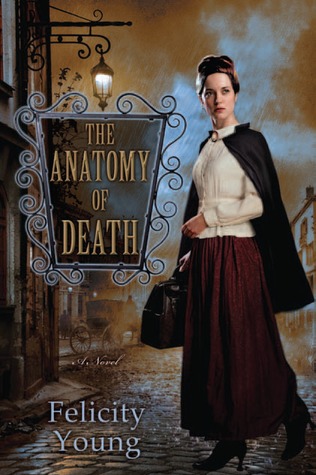
I have signed up for a second year of The Alphabet in Crime Fiction, a community meme sponsored by Mysteries in Paradise. Each week she'll be expecting participants to produce a post featuring a mystery/crime novel or novelist related to that week's letter.  The end is in sight--only two more letters to go!  This week we're on the Letter Y.  And Y is for Felicity Young, an Australian author who was born in Germany and educated in Britain.  She and her family settled in Australia in 1976. She started in the mystery writing business with contemporary and this year began a new historical series.


The Anatomy of Death (aka A Dissection of Murder) is the first in this Victorian-era series which features Dorothy (Dody) McCleland, a young woman who has gone into the medical field at the turn of the twentieth century.  Denied the chance to become a surgeon for the living (because of her sex), she trains as an autopsy surgeon and becomes England's first female doctor of this type.  She has just returned to London from her studies in Scotland--all set to take up her post as an assistant to Bernard Spilsbury--Scotland Yard's autopsy surgeon--and is greeted at the train station with a note calling her to her very first case.  The Superintendent of Police is none too pleased to find that his new "man" is a female surgeon, but Spilsbury is out of town and unavailable, so he lays the facts before her.
What started as a peaceful protest in support of voting rights for women turned very ugly indeed when roughs and toughs from the dock area were incited to assault the marchers.  Three women are struck down in the violent attack--including one of the prominent suffragettes.  Dody must excuse herself from the autopsy because the woman, Lady Catherine Cartwright, was a friend of her sister.  However, when it is rumored that the death was actually from police brutality and it seems that the incident is going to be swept under the carpet, Dody begins working on her own to determine whether the rumors are true.  She earns the trust of Chief Inspector Pike--who has his own reasons for looking into the events of that day--and the two of them gather clues to determine whether a police officer let his emotions get the better of him or if the killer is closer to home.
This is an interesting start to a very promising historical series.  The time period is an intriguing one--right at the turn of the century and watching the fight for women's rights.  There are so many things that women today take for granted now that were just being thought of and fought for.  Dody is a pretty strong character--although it is evident that there is much room for growth.  I thoroughly enjoyed getting to know her and look forward to future installments.  I found her and the other central characters believable and interesting.  The mystery itself had a nice twist and it was pretty fairly clued.  A solid opening and worth three stars.
 

Sunday, October 28, 2012

Crime Fiction Alphabet: Letter X


I have signed up for a second year of The Alphabet in Crime Fiction, a community meme sponsored by Mysteries in Paradise. Each week she'll be expecting participants to produce a post featuring a mystery/crime novel or novelist related to that week's letter.  The end is in sight--we're up to that diabolical Letter X.  And X is for E. X. Ferrars.  

E. X. Ferrars is the American-generated pen name for a British mystery writer born Morna Doris McTaggart in Rangoon, Burma.  She is also known under her British pen name Elizabeth Ferrars. Ferrars wrote stories that best fit in the cozy genre--puzzle mysteries, solved by fairly average folks, and with story lines that don't challenge the "status quo."  Most of her novels are stand-alone stories, but she did give us three series featuring recurring characters.  Her first five novels feature freelance journalist Toby Dyke and his companion George.  She also wrote about Virginia and Felix Freer, an estranged couple who still manage to get together often to solve crimes, and Andrew Basnett, a retired botany professor.

While I have read and enjoyed several of Ferrars's stand-alone novels and a couple of the Freer series, my favorites come form her Basnett series.  Basnett is an academic (one of my mystery weaknesses).  He has retired and is supposedly working on a book ('cause he has all this time do so now you know), but is continually getting side-tracked by various episodes of deviltry going on around him.  Here's just one example, Something Wicked:

"When Andrew Basnett, a retired professor of botany, took his nephew's cottage in a quiet Oxfordshire village for the winter, he didn't expect to find himself living opposite a woman locally reputed to have killed her husband, even though an unbreakable alibi meant she had never been brought to trial. Nor did he expect to find himself cut off from all mains services as the result of a blizzard. And he certainly did not expect to discover in his cold, dark living-room the body of the village's second murder victim." (from Goodreads)