
Showing posts with label PopSugar. Show all posts

Sunday, August 22, 2021

Cards on the Table


 Cards on the Table
(1936) by Agatha Christie

The flamboyant Mr. Shaitana is well-known for his parties, his rather sly sense of humor, and his collections. When he meets Hercule Poirot at an art exhibition, he reveals that in addition to collecting objets d'art he also collects types of people. He is particularly interested in what he considers to be the art of murder and tells Poirot that he knows of several perfect murderers--those who have killed and gotten away with it. He is delighted when the idea for a new party occurs to him. He will invite four of his collection of murderers as well as four experts in crime for dinner and a bridge party. What fun!

In addition to Poirot, Shaitana invites Superintendent Battle of Scotland Yard, Colonel Race (presumably of the Secret Service, though one mustn't say so), and Ariadne Oliver, the famous author of detective novels. The supposed murderers are Dr. Roberts, Mrs. Lorrimer, Major Despard, and Anne Meredith. Shaitana lets certain suggestive statements slip during the dinner and Poirot watches for sudden intakes of breath or widening of the eyes. Then, they all sit down to bridge with the suspected murderers at a table in one room and the sleuths at a table in another. Mr. Shaitana doesn't play bridge and sits down quietly by the fire. When the evening draws to a close and the guests approach their host to say goodbye, they find him dead--stabbed with a stiletto from his collection. One of the suspected murderers has definitely murdered Shaitana. The four detectives take up the case in their own way. Battle follows the dogged order of police procedure; Colonel Race uses his connections to dig up information on Major Despard; Mrs. Oliver uses her author's knack of picturing every possible scenario and her friendly personality to interview Miss Meredith; and Poirot uses psychology, particularly the psychology of the game of bridge, to find the killer.

This particular Christie never comes to my mind when I'm thinking of my favorites--and, honestly, I haven't read it as often as those I do list as favorites. I don't think I've read it since I first read it back in the early '80s. But it really is quite good. Dame Agatha piles on twist after twist. Just when you think we've finally gotten down to who really did it, she shakes the kaleidoscope and we get another view of what happened. Knowing there were still quite a few pages to go didn't prevent me from being surprised (repeatedly).

I really enjoyed the premise of this one--pitting the four detectives against the four possible suspects--suspects whom, if we believe Shaitana, have already gotten away with murder at least once. It was also fun to follow the various detectives and watch them investigate in their own way. It's a shame we didn't get to see more of Colonel Race. He pretty much hands over his report on Major Despard and goes away. But we did get to see quite a bit of Battle and Oliver in addition to, of course, Poirot. A most unusually entertaining mystery. ★★★★

First line: "My dear M. Poirot!" It was a soft purring voice--a voice used deliberately as an instrument--nothing impulsive or unpremeditated about it.

Oh, my dear friend, it is impossible not to give oneself away--unless one never opens one's mouth! Speech is the deadliest of revealers. (Poirot; p. 82)

Mon cher Battle! Does anybody know the truth about anything? (Poirot; p. 82)

Last line: "Let's stab him, Rhoda, and see if his ghost can come back and find out who did it."

***************

Deaths = 7 (one stabbed; four poisoned; one shot; one drowned)

Sunday, August 15, 2021

Funerals Are Fatal (After the Funeral)


 Funerals Are Fatal (After the Funeral) [1953] by Agatha Christie

Cora Lansquenet has always had a way of blurting out whatever came to mind--inconvenient truths, as Mr. Entwhistle, the family lawyer tends to think of them. One never knew for sure if  Cora was as innocent as she seemed or if she dropped these little verbal bombs to see what effect might be produced. So it isn't odd that she does a bit of blurting when the Abernathie relations return to the family home after the funeral of the Richard Abernathie--Cora's brother and family patriarch, so to speak. But "he was murdered, wasn't he?" seems a bit extreme even for Cora. No one appears to take her seriously and they all try to pretend it was never said. But a few of them, including Mr. Entwhistle, have to wonder whether Cora knows something.

Then, when Cora is subsequently murdered by someone wielding an axe (and who tried, very inefficiently, to make it look like a random robbery gone bad), Mr. Entwhistle begins to think there was something in that statement after all. He calls upon his old friend, Hercule Poirot, and asks him to investigate. Not long after, Cora's companion, Miss Gilchrist, is nearly done in by a piece of poisoned wedding cake. Poirot's investigation reveals that all of Richard Abernathie's relatives had a motive--primarily monetary and they all benefit under Richard's will. From his brother Timothy and wife whose home is badly need of funds for upkeep to his nephew George who has been speculating with other people's money (and losing) to his niece Susan who wants to the money to start a new business to his niece Rosamund and husband who want the the money to put on a play (with hubby in the starring role). 

Richard, if truly murdered, must have been poisoned and the poison could have been planted at any time. But who had an opportunity to kill Cora? As it happens...just about any of them. No one has a really good alibi. It isn't until Poirot understands what is behind the running theme of nuns and paint--and Helen Abernathie (wife of Richard's deceased brother, Leo) remembers what bothered her on the occasion of Cora's exclamation after the funeral that our detective is able to find the villain of the piece.

I thought I knew who did it. Then I got distracted by a few red herrings and changed my mind. I should have stuck with my first thought...Dame Agatha managed to throw the dust in my eyes once again for another enjoyable Poirot mystery. In this one, he collects few clues and discerns all through interactions with people--just letting them talk and unknowingly reveal their true natures to him--and, of course, employing his little grey cells. ★★

First line: Old Lanscombe moved totteringly from room to room, pulling up the blinds.

Funerals are absolutely fatal for a man of your age. (Mr. Entwhistle's sister; p. 21)

The very simple-minded have often the genius to commit an uncomplicated crime and then leave it alone. (Hercule Poirot; p. 117)

If the murderer is wise he will let well alone, but murderers, Inspector, are seldom wise. (Poirot; p.124)

You don't want to fluster your bird too soon. But when you do fluster it, you want to fluster it well. (Inspector Morton; pp. 125-6)

Things aren't over when you've done them. It's really a sort of beginning and then one's got to arrange what to do next and what's important and what's not. (Rosamund Shane; p, 154)

Everyone had accepted U.N.A.R.C.O. as a matter of course--had even pretended to know all about it! How adverse human beings were ever to admit ignorance! (p. 165)

It is a profound belief of mine that if you can induce a person to talk to you for long enough, on any subject whatever, sooner or later they will give themselves away.... (Poirot; p. 221)

Last line: They were silent--and Poirot thought of murderers he had known...

**********************

Deaths = 3 (two natural; one cut with axe)


Friday, August 6, 2021

Bluegate Fields


 Bluegate Fields (1984) by Anne Perry

The body of a sixteen-year-old boy is found drowned and naked in sewers near the out-take to the Thames. But he wasn't drowned in sewer or river water and his body shows him to be from the upper-classes. Since the lungs are full of bath water, it becomes apparent that this is a case of murder. Inspector Pitt traces the body to the Georgian home of Sir Antsey and Lady Wraybourne. It is that of their eldest son, Arthur. They are, of course, shocked that their son has been murdered. But there is worse to come--his body shows signs of sexual abuse and the beginnings of syphilis.

The family want nothing more than for the investigation to be over quickly and they want the guilty party to be some degenerate ruffian from the streets. Find someone to blame, get the trial over with a little fuss as possible, and make the man pay for his crime. But evidence shows that it must be someone closer to home. Pitt has been given a new sergeant who has a way of ingratiating himself with his betters and he soon digs up evidence that the guilty man is the boy's tutor, Mr. Jerome. Pitt doesn't like Jerome much, but he isn't wholly convinced of his guilt. He has no alternate suspect to suggest, however, so his superior officer orders him to arrest Jerome and stop investigating (and, of course, stop bothering the gentry). The tutor is found guilty and due to be hanged in three weeks' time...Pitt continues to investigate in his off-hours and, of course, Charlotte and her sister Emily and Aunt Vespasia get involved. They begin to see a pattern of behavior...but will it be in time to save an innocent man from the gallows?

This entry in the series is a mixed bag. I wasn't nearly as enthusiastic about the mystery overall (I don't like children in danger) and the background wasn't quite as well-sketched as in previous books. But--it was very nice to see Pitt hard at work investigating (not just endlessly questioning people or disappearing for great portions of the book) and Charlotte's role in finding out the key pieces towards the end worked well without putting her--yet again--into a dangerous situation. ★★ and 1/2.

First line: Inspector Pitt shivered a little and stared unhappily while Sergeant Froggatt lifted the manhole cover and exposed the opening beneath.

Last lines: And Pitt would go home to Charlotte and the warm, safe kitchen. He would tell her--and see her smile, hold her tight and hard.

***************

Deaths = 3 (one drowned; one strangled; one shot)


Thursday, August 5, 2021

PopSugar 2021 Reading Challenge

 
The folks at PopSugar are back with their boundaries-pushing reading challenge for 2021. they encourage us to expand our reading horizons with reading prompts that may push us out of our comfort zones. They give us 40 standard prompts along with 10 more for those who are very committed. We don't have to do all of them--the goal is to read more and to read more of the things we might not normally choose. I wasn't sure I could do enough of the prompts this year, but looking over my reading I've done pretty well. So, I'm putting up a post. As in the past, I have set a personal goal of 20 prompts--from either list--in order to claim the challenge complete. I may do more.
 
Here are the prompts that have most appealed to me--for the full list, please click the link above.

1. Published in 2021: What the Devil Knows by C. S. Harris (7/22/21)
3. With a heart, diamond, club, or spade on cover: Cards on the Table by Agatha Christie (8/22/21)
4. By an author who shares your zodiac sign: The Mystery of a Hansom Cab by Fergus Hume (7/29/21)
5. With a gem, mineral, or rock in title: The Hardway Diamonds Mystery by Miles Burton
6. Main character works at your current/dream job: Final Notice by Jo Dereske [librarian] (4/27/21)
9. Book with a family tree: After the Funeral/Funerals Are Fatal by Agatha Christie (8/14/21)
13. Locked-room mystery: The Clue of the New Pin by Edgar Wallace (5/15/21)
15. Set mostly or entirely outdoors: A Silver Spade by Louisa Revell (6/9/21)
20. Book about do-overs or fresh starts: The Mystery of Mrs. Christie by Marie Benedict (8/18/21) [Agatha Christie has a fresh start at the end of the book)
23. Set somewhere I'd like to visit in 2021 (or any time, really): Death Under the Sun by Agatha Christie [the Devon coast in England] (8/10/21)
25. Title starts with "Q," "X," or "Z": Quaker Witness by Irene Allen (7/19/21)
27. About a social justice issue: Bluegate Fields by Anne Perry [Charlotte, her sister, and Aunt Vespasia are organizing other society women to influence their husbands over child poverty and working conditions in Victorian London] (8/6/21)
29. Black & White Cover: Why Kill the Innocent by C. S. Harris (6/23/21)
31. Same title as a song: A Night to Remember by Walter Lord (7/14/27)
35. Different format than you normally read: Murder at Bray Manor by Lee Strauss [audio] (2/21/21)
36. Has fewer than 1,000 reviews on Amazon or Goodreads: The Sound of Insects by Mildred Davis [4 reviews on Goodreads] (8/5/21)
38. About art or an artist: Lord Mullion's Secret by Michael Innes [lead character is an artist] (7/31/21)
39. Everyone seems to have read but you: The Magpie Murders by Anthony Horowitz (2/4/21)

Advanced/Bonus
41. Longest book (page count) on TBR: Vintage Mystery & Detective Stories by David Stuart Davies [ed]
42. Shortest book (page count) on TBR: Buzzy Beaver by Alice Sankey
44. Ugliest cover: Theoretically Dead by Tinker Marks (5/19/21)
45: On TBR the longest: Rutland Place by Anney Perry [on TBR since 7/1/91] (8/5/21)
46. TBR book meant to read last year, but didn't: The Montmartre Investigation by Claude Izner (5/17/21)
47. TBR book associated with a favorite person, place, or thing: The 13th Warrior (aka Eaters of the Dead) by Michael Crichton [give from Paula--BFF] (5/22/21)
48. Chosen from TBR list at random: Princess Elizabeth's Spy by Susan Elia MacNeal (1/2/21)
50. Free book from TBR list (gift/borrowed/library): Crimson Snow by Martin Edwards (ed) [library] (1/13/21)


Friday, August 28, 2020

R.F.K.: A Photographer's Journal


 R.F.K.: A Photographer's Journal (2008) by Harry Benson

Published 40 years after the assassination of Robert F. Kennedy, Benson captures in pictures and journal entries the days of Kennedy's run for the presidential nomination--from the day he announced his candidacy to that fateful day in June of 1968 when a man with a gun in the kitchen of the Ambassador Hotel cut that run short. The photography is excellent--beautiful, touching, and haunting--capturing RFK in private moments with his family and public moments when he made connections with those of all races and all backgrounds. Benson also captures the horror and tragedy of Kennedy's final moments and the outpouring of grief in the faces of those who lined the railroad tracks as his body made its way to Arlington. Robert Kennedy is one of those "what ifs" of history--what if he hadn't been taken through the kitchen that night? What if he had lived and become president? What kind of president would he have made and how might we as a nation be different?  ★★★★

Friday, August 21, 2020

A Night in the Lonesome October


A Night in the Lonesome October (1993) by Roger Zelazny

It's October and your favorite classic monsters and things that go bump in the night are coming out to play...a brand new (to us) Game. A paranormal game that will either usher in a whole new reality (if the openers have their way) or maintain the status quo, if the closers get the upper hand. We've got our friend the Count and the good Doctor and his huge, hulking Experimental Man. And then there's Larry Talbot who sometimes appears as "Lucky" the werewol--er dog. Yeah...dog, that's it. We've also got Jack, a fellow who's pretty handy with knife, and a few other players who maybe aren't quite so familiar. 

Speaking of familiars...each of of the players have a helper in the form of an animal. Jack's sidekick, and our narrator, is Snuff, the dog (who really is a dog). Snuff is a watcher and a calculator, whose job is to keep an eye on the various Things trapped in mirrors, wardrobes, and trunks around the house as well as to calculate the location for this year's paranormal battle. He has to manipulate a map in his head based on where each of the other players have their home base. His computations are made more difficult by the fact that the Count keeps changing the location of his coffin and Snuff isn't sure if Larry Talbot is a player or not. And should he take any note of the Great Detective and his friend with the military doctor air about him?

This is a rollicking good tale from a master of SF and Fantasy--made even better by the illustrations from the pen of the illustrating legend, Gahan Wilson. We follow Snuff as he loyally helps his master Jack collect the oddest of odds and ends necessary to play the Game properly. Snuff also makes friends with the other familiars--from Graymalk the cat and Needle the bat to Nightwind the owl and Quicklime the snake. Until the "death of the moon" they are allowed to trade gossip and attempt to discover how many players are in the Game as well as what their "persuasion" is (opener vs. closer). When some of the players wind up dead, the animals band together to figure out who is taking out the humans.

I haven't enjoyed anything so much for a long time. Excellent storytelling and having it all told from the viewpoint of Snuff, the watchdog was amazing. I love Zelazny every time I read him. And every time I read him, I wonder why I haven't read more sooner. ★★★★


********

PopSugar: Bird on cover

Wednesday, July 22, 2020

In Memory Yet Green

In Memory Yet Green: The Autobiography, 1920-1954 (1979) by Isaac Asimov

Asimov's autobiography gives us the early years of his life--from his birth in Russia and his family's immigration to the United States to the point where his writing career had really taken off. By the time the book ends, he has written his most famous novelette, "Nightfall," and has seen his Foundation series (originally published as separate short stories) released in book form. He provides an intimate view of history--from post-WWI Russia to the United States during WWII and the Korean conflict and includes snippets of other events along the way. The book also features the struggles faced by a young immigrant family in early 20th Century America. Most relevant for those who, like me, have enjoyed his science fiction are the insights into how he got into the writing business and what the early years of science fiction and publishing were like. 

*****

Finally finished this one--it seems like I've been working on it forever. At over 700 pages, Asimov was one wordy dude and only covered 34 years of his life. I love his fiction, having cut my SF eye teeth on his books and short stories. But I must say: the man had a (shall we call it) healthy ego. Once he knew a thing, he was quite prepared to point out how well he knew a thing. Repeatedly, in case you missed it. To give him his due, he also presents the reader with his shortcomings and mistakes in life and is perfectly willing to own up when he was at fault. He also seems to have been a remarkedly loyal friend and family member--helping out in situations that may have turned out disastrously simply because he, as he called it, was following the code of the Woosters: Never let a pal down. He also stuck with his first book publisher, Walter "Brad" Bradbury at Doubleday even when Fredrick Pohl tried to tempt him with bigger profits at Ballantine books.

It would be great to make a lot of money with my writing, and I would feel silly if all the other writers went on to make a lot of money and left me behind

But then I thought of Brad taking my first book, and going over the galleys with me, and working with me to cure me of overwriting, and being kind and helpful, and I had to picture myself saying, "Sorry, Brad, you've been outbid."

So I finally said, "I can't do it, Fred. I'm sorry."

Asimov, as is true of all of us, was a complex individual. Intelligent, creative, competitive (he always wanted to be first or youngest to do something), loyal, sometimes easily angered over trivialities, in equal parts self-deprecating and somewhat egotistical, and, well....a bit of a lech--he never met a pretty girl he didn't want to hug. With his spare, direct style (you wouldn't think it since he took over 700 pages to to tell us about less than half of his life), he comes through as trying to be honest about his life. He is on display, warts and all, and some of it is a little difficult to take--especially in these days. One has to wonder if all the women he thought were so indulgent with his eyebrow-wagging and suggestive comments really were (I sincerely doubt it). And whether they really did think he was just harmless. It's obvious that he thought they thought so (or had chosen to believe it). He also seemed to be disproportionately concerned with everyone's looks--men and women--especially in first encounters. Everyone is initially described in terms of how attractive they are. He soon moves on to other matters and has great respect and interest in others' intelligence, but it's a bit jarring to see that everyone is measured on the Asimov attractiveness scale.

But--putting that to the side--this is a very good autobiography. It is entertaining and informative and even though it's quite long it was never tedious. Asimov is a storyteller above all and he makes the story of his life worth telling. ★★★★


Monday, July 20, 2020

Between the Thames & the Tiber: The Further Adventures of Sherlock Holmes

So...after a much longer hiatus from reviewing than planned, I'm back with a short review of Between the Thames & the Tiber (2011) by Ted Riccardi. Short--because I listened to the audio novel version as I traveled to and from my parents' house last week to provide support while my dad underwent surgery (thus explaining a week of the radio silence) and I have difficulty doing in-depth reviews of books I listen to rather than read (especially if it's the first time "reading" them).

The audio novel version made pleasant listening through most of the stories. Simon Prebble does an excellent job representing Holmes and the good Doctor as well as providing distinctive intonations for the various characters they meet in their adventures. I found most of the stories to be just intricate enough to keep my interest while driving, but not complex enough to frustrate me if I happened to miss anything while concentrating more intently on traffic situations when necessary. I do have the distinct impression (supported by various reviewers on Goodreads) that the plots might not hold up to the greater scrutiny I could give them if I read the hard copy book. 

And there were definitely a few frustrating details that I noticed even though I was listening and not reading. The adventures are not given in chronological order; they jump back and forth in time with one story taking place before Moriarty died and yet it isn't given a flashback feel. It is produced as if it just naturally comes next after a story that takes place in the early 1900s.  Several of the adventures--particularly in the latter half of the audio novel--quite simply do not have a resolution. The culprits are not caught and in two of the stories you don't even know for sure who culprit was. The story just ends as if Holmes had given up which is not at all what one expects of the world's greatest detective. In addition, Riccardi introduces a lady-interest (not enough happens that we could call it a love-interest) for Holmes in one of the first stories and then she just disappears. Watson makes remarks in his introduction to the stories about how influential this relationship was on Holmes and yet we are given no evidence of any such thing. 

What I enjoyed most about the collection was the relationship between Holmes and Watson. Riccardi gets that right (for the most part). The friendship between the two is quite evident and portrayed well. Prebble's reading helps to emphasize this. Also, Watson is, as he should be, not as observant and intelligent as Holmes, but he is not the bumbler or fool that is sometimes his lot in pastiche (or in the Rathbone/Bruce films). ★★ for a pleasant audio novel experience.

*****************
Deaths = 7 (one poisoned; one hit on head; three shot; one electrocuted; one natural causes) [There were actually more--but since I listened to this and didn't read it, I don't have a good record and can't name any of the others as a certainty]

Sunday, April 19, 2020

The Chinese Nightmare

Chinese Nightmare (1947) by Hugh Pentecost

Johnny Curtain, a former POW in WWII and a pretty darn good piano player, wakes up, disoriented in a hospital in Chunking. He starts putting together his memory--traveling by plane and ferry towards a gig playing music for GIs stationed in China, noticing a man in disguise that joins him on each stage of his journey, realizing with a jolt who that man in disguise is, trying to convince Major Hardwick of the American forces just whom it was he saw, and then a drink in a bar that made him feel awful woozy...

Then, after he's gotten himself sorted, he starts listening to the ramblings of the man in the bed next to him. He seems to have lost someone named Lydia. When this man finally comes fully awake, he tells his story--he met this perfectly lovely girl on the plane and he made a date to have dinner with her after the conference he'd come for. But when he went to pick her up at the hotel address she'd given him--they claimed no such person had registered with them. The airline claimed that no such person had flown with them. Lydia has vanished into a puff of smoke. And now he'd had this infernal accident and couldn't follow up on the mystery any more. Would Johnny be willing to check the story just once more for him--to either prove that Lydia really had existed or to convince him that he'd somehow managed to dream her up?

Johnny's game and sets off to look for Lydia. And finds himself even further embedded in the mystery that started with the man in disguise.

Pentecost packs quite a lot into this tiny digest-size story. Mystery, murder, action, Nazis, spies and counter-spies, treachery and double-crosses...and even romance. He manages to set it in China without turning it into a latter-day Yellow Peril story and gives the whole thing a slam-bang (literally) finish. Very enjoyable, fast-paced little novelette. ★★★★

*************
Deaths=  5 (one poisoned; four shot--and a whole slew more who are nameless and therefore can't count who are blown up)
Vintage Extravaganza Gold: Rule #5 (Chinaman)

First Line: It was like coming back from death.
Last Lines: I hope you weren't kidding when you said you like the piano. You're going to hear an awful lot of it the rest of your life.

Sunday, March 29, 2020

Good Luck to the Corpse

Good Luck to the Corpse (1951) was written by Max Murray. Murray was a journalist from Australia who started out working on a paper in Sydney. He then opted to leave Australia and work his way around the world--holding jobs in lumber camps, freight yards, and on a tugboat on the Mississippi. He later worked as a foreign correspondent and wrote and edited a newsreel for the BBC during WWII. His mobile lifestyle informs his books--with many of his mysteries set in foreign climes. This particular novel takes place in Nice among the society set who frequent the hotels and casinos as well as the local residents who call Nice home.

Among the locals is Penelope Whitecliffe who has inherited her father's language school and is trying to make a go of it. Helping her is her uncle Ainslie Whitecliffe--an older gentleman who has never outgrown the boys own adventure novels of his youth and imagines himself in a hero's role. He's come to help his niece save the school and when he discovers that Raoul de Wolfe and his beautiful wife are determined to take the school away from Penelope he decides to do a little spy-work to discourage them. But Ainslie isn't cut out for high adventure and his spying leads him into even more dangerous waters than a simple school takeover. 

Meanwhile, Julian Ashford and his son Tyler have arrived in Nice after years of living in far more dangerous locales. Julian is hoping to settle his son somewhere quiet while he (Julian) does one more job for his company. He enrolls Tyler in the Whitecliffe school and hires Ainslie as a private tutor and companion for his son while he's away. Then he packs his bags and prepares to set off on his journey later in that day.

The next thing we know Ainslie is in the casino gambling with wads of money like his life depends on it. But if that's the case, even though he's winning...he loses. Because as his winnings hit the eighty thousand franc mark and he prepares to scoop up his winnings, he falls over dead. Since Julian was one of the last people to see Ainslee before his gambling streak, he's prevented from leaving the country and the police begin sifting through Whitecliffe's life to discover who could have wanted the little man dead. Before they're through, they'll dig up surprises at the school, the past will come back to haunt Julian, the de Wolfes will come under the microscope, a refugee language student will wind up dead as well, and a lady's jewels will go missing. 

After working on this book for eleven days, I finally finished it! The whole social-distancing, working-from-home, seeing-my-husband-24/7, what-day-is-it-anyway? thing really threw my reading mojo for a loop and I was beginning to think I would never get back to reading even though I have scads of time now. And it wasn't like this was a big book (only 190 pages) or a bad book (it was quite enjoyable, really). I just had trouble settling down with it.

It certainly isn't a complicated book. There's a fairly straight-forward plot device driving the murders and the investigation was interesting. Not quite fair--because there's an element to the motive that isn't revealed until the wrap-up (and there's no way for the reader to know what it is). Still a tidy little mystery with angles that keep things moving. But the best part is the characters--particularly Julian and his son and a friend from their travels, John Keeble. And then when Mrs. Tilford decides to take on Julian and Tyler and enters their household, well, she's simply delightful. ★★ and 1/2.

**************
Vintage Mystery Scattergories Gold #21 Things That Go Bump In the Night--"Corpse" in the title
Pick Your Poison: Careers (written by a former/current journalist)
Mystery Reporter: How = poison
Deaths = one poisoned; two stabbed, one drowned

First Line: He had always known he would meet Risa again.

Why on earth? Don't ask me to fathom a woman's mind; sorry for you perhaps, with an instinctive feeling that you had become embroiled in something that was none of your business....Perhaps that was it. Risa, I am happy to say, is unpredictable. At the risk of sounding suburban, that's why I love her. (Raoul de Wolfe; p. 72)

Yes, Julian realized that it would be his prestige that would count. The social standing of Raoul de Wolfe would have to be maintained at all costs. He was like an actor with his public. Here now, sitting in the sun, looking with amused tolerance on the passing scene, he was playing a part and quite obviously enjoying the part of Raoul de Wolfe. (p. 73)

...when you set out to carry a baby through a jungle infested with Japanese, you don't carry a bundle of documents. You carry quinine and a rifle and some basic food, not the birth certificate and marriage lines. (Julian Ashford; p. 82)

RdW: All your life you've been able to behave naturally, haven't you?
JA: I suppose I have, but why not?
(Risa de Wolfe, Julian Ashford; p. 83)

I find that trying to protect somebody is in nine cases out of ten a complete waste of time yet the idea is dinned int people's heads from the time they are born. (Mrs. Tilford; pp. 100-101)

Her head was close to his shoulder. He touched her hair with his lips, and she raised a hand and let it lie in surrender on his shoulder. Childlike and at rest. To love, he thought, you don't have to make love, you keep it like this and like this till it is no longer bearable; wait without movement till it is no longer tolerable. Wait because never again will it have this enchantment. (p. 145)

Last Lines: He grinned and made a little wave of dismissal. And then he walked away.


Thursday, February 27, 2020

The Big Four

The Big Four (1927) by Agatha Christie, read by Hugh Fraser

I reread my own paper copy of this novel about two years ago (review at title link). At that time I also viewed the David Suchet version of the story. I won't rehash the plot here or reference my previous review--other than to say: Of these three recent experiences of Christie's excursion into the evil masterminds/thriller genre, I much prefer this audio version with Hugh Fraser narrating. Fraser does a terrific job managing all the different voices and accents--from Poirot's French to Russian and Chinese tones. The one misstep comes when Poirot meets with the Home Secretary and the Prime Minister of France, Monsieur Desjardeux. Desjardeux is outraged when Poirot names the French member of the Big Four and Fraser's efforts to differentiate Desjardeux's voice from Poirot's results in the Prime Minister's tones venturing towards those of his Chinese characters. But that is only momentary and the performance overall is outstanding. And somehow the idea of a nefarious gang of super-criminals doesn't seem quite so fantastic when Captain Hastings himself is telling the tale. So--for the audio version, I'm bumping the rating back to the ★★ and 1/2 that I gave the story when my much younger self first read it (long, long before blogging).

First Lines: I have met people who enjoy a channel crossing; men who can sit calmly in their deck chairs and, on arrival, wait until the boat is moored, then gather their belongings together without fuss and disembark. Personally, I can never manage this. 

Last Line: “Marry and arrange myself,” he said again. “Who knows?”

***************
Deaths = 11 (two poisoned; two stabbed; one electrocuted; one run over by car; one drowned; three blown up; one other [suicide])
Calendar of Crime: January (Original Pub Month)
PopSugar: Set in the 1920s
Pick Your Poison: Reading Cliches (By an author "everyone has read"--well, "everyone" in Golden Age mystery circles, anyway.)

Monday, February 24, 2020

Deep Waters: Murder on the Waves

Deep Waters: Murder on the Waves (2019) edited by Martin Edwards contains a lovely set of water-related mysteries for the reader with a fondness for crime. Stories ranging from those from the pen of well-known authors such as Sir Arthur Conan Doyle and Edmund Crispin to the more obscure offerings of Gwyn Evans and Kem Bennett. Overall, a very strong showing with a wide range of liquid murderous methods. My favorites are "The Pool of Secrets," "Four Friends and Death," "The Turn of the Tide," and "The Queer Fish."  ★★

"The Adventure of the Gloria Scott" by Sir Arthur Conan Doyle: Sherlock Holmes tells Dr. Watson about his first case. A nice literary tidbit, but it serves more to give background on Holmes and show the earliest use of his powers of observation than to serve up an actual mystery for Holmes to solve. There are few deductions on display--the answer to the puzzle is served up in a document from the father of Holmes's friend.

"The Eight-Mile Lock" by L. T. Meade & Robert Eustace: John Bell, who specializes in debunking the supposed supernatural, is taking a short holiday with his friends Lord and Lady Ridsdale aboard their house-boat on the Thames. While there, Lady Ridsdale's beautiful diamond bracelet disappears. But it isn't until Bell helps the local lock-keeper to get to the bottom of the ghostly cries for the locks to be open that the thief and the whereabouts of the bracelet are revealed.

"The Gift of the Emperor" by E. W. Hornung: The last of the Raffles stories. Our gentleman burglar decides to steal a pearl of great price and boards a German ship to do so. Will he succeed? Will he escape justice? And what of poor Bunny?

"Bullion!" by William Hope Hodgson: Strange deaths by "just sickening and going off" and mysterious late-night whisperings haunt a ship hauling cases of gold bullion. The second mate realizes just in time what it all means.

"The Echo of a Mutiny" by R. Austin Freeman: Two men who had previously been involved in a mutiny meet up for duty in a lighthouse. One of the men is killed and the other tries to cover his tracks--but when Dr. Thorndyke enters the case, his hopes for escape rapidly dwindle.

"The Pool of Secrets" by Gwyn Evans: features a murder that is supposed to be the work of the Silver Bride, the ghost of a woman who drowned herself in her wedding gown. Quentin Drex uses some unorthodox methods to get to the bottom of the mystery.

"Four Friends & Death" by Christopher St. John Sprigg: a short vignette about whether friendship can last when one of the four friends (alone together on a boat) falls down dead--from poison!

"The Turn of the Tide" by C. S. Forester: A murderous lawyer finds the answer to the problem of what to do with the corpse....with unexpected results!

"The Swimming Pool" by H. C. Bailey: Dr. Reggie Fortune is called in when an anonymous note says that Old Mr. Colburn's death wasn't as natural as it seemed. Fortune is disturbed by the disused swimming pool on the estate and soon has a headless corpse and a missing nurse on his hands.

"A Question of Timing" by Phyllis Bentley: Bentley begins her story with an interesting hook: "A month or so ago, one Thursday afternoon, I stopped a murder." And this short little story goes on to tell how Robert Beringer, a writer, did just that while out on a walk along the Thames. He saved a life and got the girl...all in an afternoon's walk.

"The Thimble River Mystery" by Josephine Bell: Bell's story could also have been titled "A Question of Timing"--because timing becomes very crucial to the solution of the murder. There is a limited window of time when the killer could have reached the boat to do the deed.

"Man Overboard" by Edmund Crispin: A blackmailer's stash helps Inspector Humbleby catch a killer--an American whose brother supposedly "accidentally" drowned.

"The Queer Fish" by Kem Bennett: Albert Pascoe, salmon poacher, is forced at gunpoint to give transport to two strangers who want to make landfall in France. He takes them for a ride all right...and gets a bit of a surprise for his trouble.

"The Man Who Was Drowned" by James Pattinson: A woman claims to have seen a man go overboard, but Barton Rice, friend of the ship's captain and something to do with Scotland Yard, immediately spots a few inconsistencies in her story. He decides to do a little investigating on his own.

"Seasprite" by Andrew Garve: A smuggler gets more than he bargained for when he takes on a new partner.

"Death by Water" by Michael Innes: Did Sir John Appleby's vague philosopher friend commit suicide or did someone help him to his death by water? A very fishy state of affairs with a very fishy little clue.


***********
Deaths: 16 (one other/natural; six drowned; two other [attacked by piranhas]; three poisoned; two strangled; one hit on head; one fell from height)
PopSugar: Anthology
Pick Your Poison: Shorts (book of short stories)

Sunday, February 23, 2020

The Crying Sisters

The Crying Sisters (1939) by Mabel Seeley

Janet Ruell is a small town librarian who is taking her first vacation without her mother. She's escaping her humdrum, rural life where the most "exciting" thing to happen to her is a proposal from the dull, older banker (the only eligible bachelor in town). She's determined to accept the attentions of the first man she meets and to take on any adventures that come her way during her month's stay in northern Minnesota. She gets her chance at both when she makes an unexpected stop at a small tourist camp along the way.

There she meets Steve Corbett and his young son "Cottie." She is immediately charmed by the little boy--though not quite so much by his father. Steve is a man of little words, short-spoken, and often mysterious. But he offers her an adventure of sorts--come with him to Crying Sisters lodge and look after his son. When she agrees (unaccountably after the rudest offer ever made), she finds herself stepping into a life of deception--pretending to be Steve's wife and the mother of Cottie. As soon as they are installed in their cabin, Steve hands her a gun--to protect herself and the boy--and starts making late-night excursions around the camp. He won't explain anything and tells her to just keep her mind on the boy and her nose out of his business. Before her adventure is over, she hears screams in the night, stumbles over a dead man who disappears and then reappears in the most unlikely places, is locked up with Steve as possible murderers, becomes briefly associated with gangsters, witnesses an explosion at the gambling den across the lake, and shoots a crazed killer. She certainly gets her wish for excitement in spades....

I seem to be in the minority on Goodreads (not rating this a three or higher)...but I honestly could not get over the opening and the heroine's whole reason for getting mixed up in this murder mystery. Here we have a supposedly level-headed librarian who just ups and goes off with a surly man she just met and winds up pretending to be his wife and mother to his small son. She's sure he's up to something, but she is so starved for adventure in her life that she's going along with it. Really?! And then, of course, once the nasty things start happening, she's gotten so attached to Cottie that she can't possibly leave. Again, really?!

The mystery plot itself is fairly solid. I did think throwing in the obvious red-herring gangsters was a bit much, but other than that, it was a nice, tidy mystery with a decent amount of clues sprinkled around. The reader might not figure out the whole story, but there is enough to point in the right direction if you know what you're looking at. I enjoyed that part of the book the most and have given all the star-rating based on plot alone. If our protagonists had been more engaging and the behavior of Janet had been more believable, then the rating would be higher. I will say that I do admire her strength at the end--managing to foil the murderer's plan to leave her to die and shooting the villain in turn. But, not enough to change the rating. As it is...★★

~~Spoilers ahead! Continue at your own risk.~~

I also find the sudden romantic ending to be totally unbelievable. Here's a man who has gone to all this trouble to search for his wife and has constantly been more than rude to the woman currently caring for his son and out of the blue he just proposes to her? Sure--maybe he's trying to keep his distance from her to keep her and Cottie safe. But there is absolutely no undercurrent of feelings between these two people. If you want a romantic ending, then please lay a little groundwork for it. Even if it's just a few hints of romantic tension here and there. But don't just give us nothing...

*********
Calendar of Crime: August (Primary Action)
Pick Your Poison: Recovery (missing person)
PopSugar: has a map
Deaths = 6 (two poisoned; one hit on head; one stabbed; two shot)

Quotes
First Line: I still pinch myself and say it isn't true.

Small towns never forget, not when they can take malicious triumph in remembering. (p. 8)

Last Line: As well as I could I curved my bandaged hands upward around his face.

Tuesday, February 18, 2020

The Man Who Loved Books Too Much

If I had to reduce him to a sentence, I'd say that Gilkey is a man who believes that the ownership of a vast rare book collection would be the ultimate expression of his identity, that any means of getting it would be fair and right, and that once people could see his collection, they would appreciate the man who had built it. (p. 251)

The Man Who Loved Books Too Much (2009) by Allison Hoover Bartlett purports to be the story of John Gilkey, rare book thief, and the man who helped catch him, Ken Sanders (book detective or "bibliodick" as he is dubbed). It is also Bartlett's tour of the world of rare books--the dealers and collectors and supposedly is a peek at what makes them tick. The cover announces that it is "Compelling with elegant suspense." Uh, no. Not compelling. Not the least bit suspenseful. And quite frankly, as a journalist, Bartlett leaves a lot to be desired. She inserts herself into the narrative--accompanying Gilkey on little jaunts to book dealers he has conned, to pay phones he has used in his scams, and generally behaving like a book thief's groupie. One wonders if his book-thieving ways has rubbed off on her--she opens the book by telling us that a rare edition of a 1630s German herbal medicine book has made its way to her desk. She makes an effort to track down the library that it belongs to--but by the time the book ends we don't know what she did with the thing. Last we know it's still on her desk and she's musing "...did not returning it make me a thief? Or was I a thief only as long as I kept it?"


Overall: This book is like a song with a single verse and chorus--played on repeat all day long every day that you read it. Bartlett is looking for what makes a person jump from law-abiding book collector to book thief and repeats this observation on Gilkey's book-lifting habit ad naseum throughout the book:

While many collectors build images of themselves through their collections, most of them do not cross the line between coveting and stealing. It was not just a collection Gilkey was building but an image of himself for the world....The leap between collector and thief is a huge moral and ethical one. {you don't say...}

She appears to think that the reader will see these comments as some sort of stupendous revelation--every. single. time. she makes them. [Most readers should be astute enough to get it the first time. And probably already knew it.] She jumps back and forth between saying that Gilkey is just like other collectors (the more books they get, the more they want) and not--because of that whole "thieving is bad" thing and he's a thief.

I also have a small issue with the title. Gilkey did not really love books. He loved having books that he thought others valued and in some twisted way he thought "owning" them would give him prestige. He felt like he had a right to them and if others had valuable books, then he ought to have valuable books too. He reminds me of the rich man who has a trophy wife. He doesn't actually love her--he loves having a beautiful woman on his arm and considers it to reflect on him--his good taste, his position, he ability as a man. It's all about him--not her. And with Gilkey--it's all about him, not the books. He also seemed to get a bigger thrill out of stealing the books than actually having them.

The best thing about the book is the peek at the world of rare books. More of that would have gone a long way. And I think I would have been much more interested in a book that focused on Ken Sanders and others who hunted down book thieves. ★★ and a half--leaning more towards two than three. 

Quotes
First Line: At one end of my desk sits a nearly four-hundred-year-old book cloaked in a tan brown sack and a good deal of mystery.

After all, much of the fondness avid readers, and certainly collectors, have for their books is related to the books' physical bodies. As much as they are vessels for stories (and poetry, reference information, etc.), books are historical artifacts and repositories for memories--we like to recall who gave books to us, where we were when we read them, how old we were, and so on. (p. 20)

A book is much more than a delivery vehicle for its contents, and from my perspective, this fair was a concentrated celebration of this fact. (p. 21)

Gilkey has a strong sense of decorum, which comes through on the phone, and a complete lack of guilt about ripping people off, which does not. (p. 106)

Last lines: Not long before this book went to press, Sanders, nominally retired "bibliodick," had nevertheless alerted colleagues of Gilkey's most recent theft: stealing a book from a Canadian dealer. Gilkey was not arrested. The story never ends.

Saturday, February 15, 2020

Silver Wings for Vicki


People have to dream, darling--dream, and make their dreams come true. Why, that's how the world goes on. (p. 6)

Silver Wings for Vicki (1947) by Helen Wells is the first book in the Vicki Barr Flight Stewardess series and there is a lot going on. It begins with Vicki having just finished two years of college and not being terribly excited at the prospects of going back. She knows her father, Professor Barr, would prefer that she finish her education--but she sees an ad in the newspaper with the headline

To Girls Who Would Like to Travel
To Meet People -- To Adventure

and she just knows that she's one of those girls. What she wouldn't give to go flying around the world in one of those big silver birds.

So, even though she knows she's a little young and doesn't have quite all the experience asked for, she decides to go to the interviews and give it a try anyway. Her father, knowing how much it means to her, is willing to let her go for her dreams.

To her amazement (but not to the reader's--because after all we've been told that this is the "Flight Stewardess" series), she convinces Miss Ruth Benson, the interviewer, to give her a chance. Before she and her family know it, she's on her way to New York City for an intense training session where only girls who score 95-97% (there are no perfect scores) make the grade and earn their silver wings. Vicki is a personable young woman and quickly makes friends. Of course, she and her five closest friends pass the class. They set up house in a shared apartment with a housekeeper-cum-house mother who makes sure they get fed properly, get plenty of sleep, and she sends any male callers home at a reasonable hour. The girls settle down into their flight routines, getting used to managing flights on their own and then Vicki falls headlong into a mystery involving suspicious travelers and ostrich-leather bags. She helps the authorities capture the bad guys and winds up a heroine on the front page of all the papers.

Vicki is another strong, independent character that I would have loved had I discovered her when I was reading Nancy Drew. She is a career woman who wants to be a flight stewardess--not because it's glamorous, but because she loves the idea of flying and helping the people who travel. She is intelligent and notices when passengers are behaving oddly and this leads to many of her adventures. The mysteries aren't terribly intricate, but they are good fun, especially for young readers. Silver Wings was an excellent beginning for the series. ★★★★


***************
Calendar of Crime: Author DOB
Vintage Mystery: Rule #13 (No Corpse)

First Line: There it was, as big as life, in the Fairview Sunday paper.
Last Line: Give my love to Dean and the girls and tell them I'll be back--soon!

Friday, February 14, 2020

Red Threads

Red Threads (1937) by Rex Stout

Millionaire Val Carew is found bludgeoned to death in his wife's tomb. It's a high-profile case that the powers-that-be would like to see wrapped up quickly and neatly. But all the clues that the police find seem to lead nowhere, so the NYPD recall one of their finest, Inspector Cramer, from a well-deserved vacation to take over the case. He manages to uncover a few new clues--including a discarded peach pit, an ancient red thread, and a whippoorwill's call--but with every witness telling lies, it's going to be difficult to pin the murder on any of them.

I'll just tell you upfront: this is not one of Stout's all-time best novels. I think he hit his mark with the combination of Nero Wolfe and Archie Goodwin working in what often seems to be opposition to the official police represented by Inspector Cramer. Red Threads is billed as "an Inspector Cramer mystery"--which I guess it is if only because Nero Wolfe is not here (must be too busy with his orchids). Cramer is an honest, hard-working cop and he does his bulldog best to track down the killer when his superiors drag him back from his first real vacation in years. But it takes clues supplied by fashion designer Jean Farris to get him on the right track.

The biggest failing in this one (in my opinion) is the lack of interesting characters. Even in his worst Wolfe novels, the characters have a bit of interest and force to them. Jean's character starts out nicely but rapidly loses steam about midway--even her fight to find answers that will prove that Guy Carew (the love of her life) didn't kill his father didn't particularly interest me. I would say to skip this one unless you're a Stout completist. ★★


**************
Deaths = One (hit on head)
Calendar of Crime: October (Author DOB)
Vintage Mystery (2011): 1st book towards Murderous Mood level

First Line: Eileen Delaney heard the door of the noisy old elevator close behind her, and the diminuendo of its bang and rattle as its ascent progressed up the shaft.

Last Line: He sang the boastful Cherokee song a little later.


Friday, February 7, 2020

Flame in the Mist

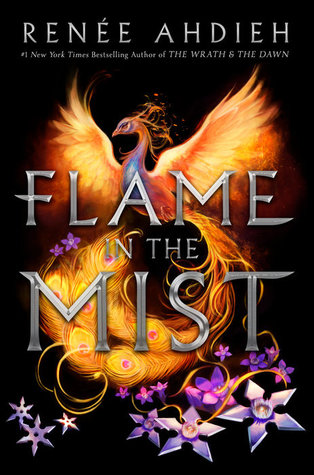
Flame in the Mist by Renee Ahdieh is a young adult historical fantasy set in feudal Japan when samurais protected the royal class and young girls were raised for one purpose--to make good marriages that would bring honor to their families. Mariko is the daughter of a samurai and she never seemed comfortable preparing for her role--she asked too many questions, her mind was always busy, and she was a gifted alchemist. But when the time comes and one of the Emperor's sons offers for her hand, she gives in to destiny. But fate has a way of twisting things up...

On the way to her bridegroom's palace, her convoy is attacked by what seems to be a horde of bandits who go by the name the Black Clan and who have been hired to kill Mariko. Miraculously, she survives and vows to find out who is beyond the plot to kill her and dishonor her family. She cuts her hair and disguises herself as a young peasant boy. Soon, she finds herself in the position to infiltrate the Black Clan and discover their secrets.

Meanwhile, her twin brother Kenshin is hunting for her. Despite the wreckage and burned bodies left behind by the attackers, Kenshin is sure his sister survived and he's determined to find her. He's not alone, Raiden--her intended--is also looking. But is his concern for her safety or do other motives drive him?

When I was looking for an award-winning book to read for this month's entry in the Monthly Book Award Challenge [2018 Southern Book Prize--Children's/Juvenile category], this sounded like a really interesting option. Young samurai daughter setting out on a quest to avenge herself on the bad guys who attacked her caravan and tried to kill her. You bet. Strong female character. Lead me to her. But honestly--she spends a great deal of time talking to herself (inside her head) like she's trying to convince herself that she's as tough as the book blurbs said she was. Not a whole lot happens for about two-thirds of the book. And the bulk of the action happens in the last 30 pages--all crammed together.

The writing is okay, although a great deal of the time I felt like the prose was trying too hard--too hard to be lyrical and descriptive, too hard to be all fantasy-like in a historical Asian setting. Some of it may have been an effort to duplicate the feel of translated Japanese works. I've read several books translated from the Japanese and it has an entirely different pace. But it never came off. Overall--a decent story, but I didn't quite feel that it was good enough for prizes. ★★

*************************
Pick Your Poison: Birds of a Feather (wings or feather on cover)