Showing posts with label Monthly Book Award. Show all posts

Monday, March 1, 2021

February Pick of the Month


When I decided to renew my Pick of the Month Awards, I was amazed to find that it had been three years since I put together a monthly list of books read, stats, ratings, and overall My Reader's Block P.O.M. Award winner. So far (two whole months!), I'm sticking to the plan. In the past, I had participated in Kerrie's Pick of the Month meme which focused on mysteries, but it doesn't look like she's got that up and running. My plan is to focus on mysteries (since that's the bulk of what I read), but if there are non-mysteries worthy of a P.O.M. award then I will hand two awards. So...let's see what I've been up to in February.


Total Books Read: 16
Total Pages: 4,882

Average Rating: 3.41 stars  
Top Rating: 5 stars 
Percentage by Female Authors: 56%
Percentage by Male Authors: 44%
Percentage by both Female & Male Authors: 0%
Percentage by US Authors: 31%

Percentage by non-US/non-British Authors:  6%
Percentage Mystery: 75
Percentage Fiction: 94%
Percentage written 2000+: 31%
Percentage of Rereads: 19%
Percentage Read for Challenges: 100% {It's eas
y to have every book count for a challenge when you sign up for as many as I do.}    
Number of Challenges fulfilled so far: 5 (20%)

Mysteries Read:
1. The Boomerang Clue  [aka Why Didn't They Ask Evans?] by Agatha Christie (4 stars)
2. The Listerdale Mystery by Agatha Christie (3 stars)
3. Rebecca by Daphne du Maurier (4 stars)
4. The Adventure of the Peerless Peer by Philip Jose Farmer (1 star)
5. The Talisman Ring by Georgette Heyer (3.5 stars) [romance/mystery]
6. Magpie Murders by Anthony Horowitz (5 stars)
7. The Bookwanderers by Anna James (5 stars)
8. Tinker, Tailor, Soldier, Spy by John Le Carre (3 stars)
9. Uncle Silas by Joseph Sheridan Le Fanu (3 stars)
10. The Cannibal Who Overate by Hugh Pentecost (3 stars)
11. Murder at Bray Manor by Lee Strauss (3 stars)
12. Behind the Green Door by Mildred A. Wirt (3 stars)

As in January, of the books read this month I handed out two five-star ratings. But February's stars both have mystery elements. The first one to scoop up five stars was a young adult story with equal parts mystery and adventure which I read for one of the challenges I do that pushes me out of my comfort zone of vintage mysteries and mysteries in the vintage tradition. The Bookwanderers by Anna James features Tilly Pages who has lived under a cloud of mystery ever since her mother disappeared when she was a baby. The story reveals that she comes from a family of Bookwanderers (those who can actually enter the fictional worlds of books) and in her adventures she manages to unravel the mystery surrounding both her parents. 


The other five-star winner was Anthony Horowitz's Magpie Murders. This was fantastically put together. A great homage to classic detective novels with nods to characters and places particularly in the novels of Agatha Christie. Horowitz does an excellent job of laying out the clues and then distracting you from them in both the inner story written by Conway and the framing story about Conway's death. He actually did a much better job with the inner mystery--I didn't guess the culprit there, though I clearly recognized the clues once I finished. I did figure out the plot surrounding Conway's death, but the fact that it was more obvious to me didn't detract from my enjoyment. A truly fun, twisty read.


Last month I handed out two P.O.M Awards. However, since both of the February five-star winners have mystery elements I'm going to have to make a decision.....and that means our February P.O.M. Award Winner is.....Anthony Horowitz and The Magpie Murders.


Sunday, January 31, 2021

January Pick of the Month


It's been quite a while (three years? surely not) since I put together my Pick of the Month list of books read, stats, ratings, and overall My Reader's Block P.O.M. Award winner. I'm going to try and get back into the swing of things. In the past, I had participated in Kerrie's Pick of the Month meme which focused on mysteries, but it doesn't look like she's got that up and running. My plan is to focus on mysteries (since that's the bulk of what I read), but if there are non-mysteries worthy of a P.O.M. award then I will hand two awards. So...let's see what I've been up to in January.

Total Books Read: 15
Total Pages: 4,131

Average Rating: 3.44 stars  
Top Rating: 5 stars 
Percentage by Female Authors: 40%
Percentage by Male Authors: 27%
Percentage by both Female & Male Authors: 33%
Percentage by US Authors: 40%

Percentage by non-US/non-British Authors:  6%
Percentage Mystery:  80% 

Percentage Fiction: 93%
Percentage written 2000+: 33%
Percentage of Rereads: 13%
Percentage Read for Challenges: 100% {It's eas
y to have every book count for a challenge when you sign up for as many as I do.}    
Number of Challenges fulfilled so far: 1 (4%)

Of the books read, I handed out two five-star ratings. One to a reread of Agatha Christie's brilliant murder on a train, Murder in the Calais Coach (aka Murder on the Orient Express), and the other to a Young Adult Fantasy by Garth Nix. As a rule, I don't read a lot of Young Adult books, but the synopsis for The Left-Handed Booksellers of London sounded so good that I couldn't resist. I'm glad I didn't. Booksellers is a lovely mash-up of action/adventure, fantasy, historical fiction, and a little bit of mystery (not enough to count as mystery, though). I read it straight through in one day and enjoyed it more than I've enjoyed anything in a long time. I loved all the literary references that came up (what else would you expect from a book about booksellers?) and I was very pleased to see a Lord Peter Wimsey reference. Great fun and it earns a non-mystery P.O.M. award.


Mysteries read:
1. Princess Elizabeth's Spy by Susan Elia MacNeal (3 stars)
2. Death of a Millionaire by G.D.H. & Margaret Cole (3 stars)
3. Crimson Snow by Martin Edwards [ed] (4 stars)
4. Sidney Chambers & the Shadow of Death by James Runcie (3 stars)
5. The Floating Admiral by The Detection Club (4 stars)
6. Death & the Dutch Uncle by Patricia Moyes (3 stars)
7. When Maidens Mourn by C.S. Harris (4 stars)
8. Mr. President, Private Eye by Martin H. Greenberg & Francis M. Nevins [eds] (3 stars)
9. Dead as a Dodo by Jane Langton (2 stars)
10. Hallowed Murder by Ellen Hart (3 stars)
11. Raffles (The Amateur Cracksman) by E. W. Hornung (3 stars)
12. Murder in the Calais Coach (aka Murder on the Orient Express) by Agatha Christie (5 stars)

January was certainly a solid mystery-reading month. I managed to read twelve mysteries among the fifteen book total and most of them were decent, middle of the road reads. As you can see, three books followed close on Dame Agatha's heels with four star ratings: The Floating Admiral, a collaborative effort from The Detection Club which was just as enjoyable this time around as when I read it in the 80s; When Maidens Mourn, one of C. S. Harris's excellent regency-era historical mysteries; and Crimson Snow, a collection of Golden Age short stories primarily set around the Christmas holiday and edited by Martin Edwards. I've handed Ms. Christie a P.O.M. award for Orient Express in the past, so we'll be looking to the four-star winners for our January pick. All of these books have their charms and the Admiral's may have something to do with nostalgia for my early days of mystery reading. So, I think we'll keep searching for our P.O.M. winner. I've been thoroughly enjoying my visits to regency England and Harris's characters and plots keep me reading through the series. But..I also feel like she has a five-star book in her and I'm going to hold off on handing her a P.O.M. till I see if I'm right. Which means that our first Pick of the Month for 2021 is.....


Once again Martin Edwards has gathered together a delicious selection of holiday treats for the Golden Age mystery lover. We have Christmas ghosts, spurious Santas, mysterious strangers who leave no tracks in the snow-covered country-side, and criminous carolers...among other mysterious fare. Well-known authors such as Margery Allingham, Michael Gilbert, Julian Symons, Edgar Wallace, and Josephine Bell appear with those who may not be as familiar to mystery fans. All but two are seriously good mysteries and Josephine Bell closes the book out with a very dark and sad tale that brings home the plight of those who left alone on Christmas. There's even one story that offers a final challenge to the reader--with the answer at the end of the book. Can you figure out Cork's secret? Overall, an excellent collection for Christmas--or any time you're in the mood for a holiday mystery or twelve.


Saturday, December 12, 2020

The Sirens Sang of Murder


 The Sirens Sang of Murder (1989) ~Sarah Caudwell (Sarah Cockburn)

I say, Larwood, is this tax-planning business really as exciting as these Daffodil characters seem to think or do they just make believe it is to make life more interesting? I mean, if I'd known it was all about does and secret documents and biffing chaps in false beards, I wouldn't have minded going in for it myself.... (Michael Cantrip--by telex, p. 47)

This is the third in a quartet of fun, witty, twisty mysteries that Caudwell wrote about Hilary Tamar, law scholar and sometime amateur sleuth, and a group of junior barristers who have an uncanny knack for landing themselves in the middle of murder and mayhem. Our most recent adventure opens with Michael Cantrip and Larwood knee-deep in concocting a novel loosely-based (ahem) on themselves and the doings in their law office. Cantrip is immediately taken off to the Channel Islands ostensibly to advise on a tax case [though, if the Daffodil Settlement folk wanted really good tax advice, why didn't they ask Larwood, a more notable authority on the subject?]. 

The Channel Islands served (maybe still serve?) as tax havens for folks such as those who set up the Daffodil Settlement. A settlement (or other such conveyances) properly set up could protect people living in heavily taxed countries from being bothered by such pesky details like income tax or death duties or such. Part of the idea was to hide the identities of the real owners and beneficiaries so the Inland Revenue spies...er officials couldn't figure them out. But, generally speaking, the administrators of such things were supposed to know. Key word supposed

Apparently, now that the chief administrator of the Daffodil Settlement has died in a swimming accident, nobody knows identity of any of the important players. And a situation has arisen that makes it imperative to know--otherwise about 9 million pounds is going to be paid out to the named beneficiary (which was supposed be just pretend). Cantrip has been brought in to advise the remaining administrators on "what the heck do we do now?" But then another member of the little group falls off a cliff...and it begins to look like somebody is trying to make sure the trust is paid out in a certain way.

Cantrip gets a bit worried about the whole situation and begins sending telex messages to his colleagues back in London keeping them abreast of the situation. Things get very tense and Professor Tamar goes buzzing off to the island of Sark to prevent Cantrip from being the next contestant in the death stakes. Will our intrepid amateur detective be in time? Does Tamar know who is behind it all and why? 

****Possible spoiler ahead. Read at your own risk***

I absolutely love Cantrip this time around (and am ready to forgive him for having a name that makes me want to call him Catnip). The telex updates that he sends to his fellow lawyers are hilarious and following his adventures as he tries to foil whatever nefarious plans "old Wellieboots" has up his sleeve is worth the price of admission. I am tempted to give this a full five stars based on that alone--but I have to deduct a star for the solution. I mean, yes, there's all that tax and settlement and who's the real beneficiary business floating around to create a nice bit of suspicion all round. But, honestly, when the real villain of the piece crawls out of the woodwork, it feels a bit cliche. I have to agree with Larwood that the old-fashioned motive rearing its head amongst the overall flow of the plot seemed just a bit out of place. I can't really cry foul though--Caudwell does strew the clues about and it should have been possible for me to identify the culprit. But I definitely wasn't thinking about that motive, so the clues didn't point where they should have. ★★★★

First line (prologue): There will be much disappointment, I fear, among my fellow scholars.

First line (first chapter): "No, no, let me go or I'll scream," cried the lovely Eliane, her beautiful eyes filling with tears and her bosom heaving under the delicate silk of her blouse as she struggled to free herself from the vile embrace of the brutal Barrister's Clerk.

Trouble, so far as Julia had been able to discover, was what Colonel Cantrip had spent a lifetime of more than seventy years getting into. (p. 33)

So, the impasse--which I take to be the correct expression for a situation in which no one makes a pass at anyone--continued throughout my stay and  until after dinner on my last evening. (Julia Larwood; p.68)

The thing that gets me, looking back on last night, is that there was actually a stage when I was quite looking forward to getting a solid eight hours of health-giving zizz. Which just goes to show how right all those chaps are who say what a waste of time it is expecting things to turn out the way you expect them to, because they never do. [Michael Cantrip--by telex; pp.83-4)

I do not doubt that in a crime novel having any pretention to modernity, the pen would be quite inadmissible. As a mere historian, however, there is nothing I can do about it. Nature, as we know, does imitate Art, but I fear that she all too often falls short of the highest standards. Were you to turn your attention from fictional crime to those reported in the newspapers, you would find that people are still leaving fingerprints and murdering spouses for all the world as if they were living in the 1920s. (Hilary Tamar; p. 151)

Yoo-hoo there, Larwood, it's me here--ace investigator Catseyes Cantrip reporting back to base. Bet you'll never guess what I'm doing in Monte Carlo. Well you won't, not in a million years, so I'll tell you. (Cantrip--by telex; p. 154)

I was on my own in the office at the back of the Alexandra and I suddenly saw this awful face at the window--sort of inhuman-looking, with glaring eyes and lots of teeth. First thing I thought was that it was a werewolf or something from outer space. Second thing I thought was that it looked just like old Wellieboots [Judge Welladay] when someone tries to cite the Duke of Westminster's case. Third thing I thought was that it actually was old Wellieboots, and I was right....Well, you don't find High Court judges prowling round Sark glaring through office windows just for the fun of the thing, do you? (Cantrip--by telex; pp. 154-5)

The trouble with real life is that you don't know whether you're the hero or just some nice chap who gets bumped off in chapter five to show what a rotter the villain is without anyone minding too much. (Cantrip; p. 173)

Nutty as a fruitcake. And the problem about people going nutty is that it's jolly difficult to tell whether they're harmlessly nutty or dangerously nutty. (Cantrip; p. 203).

Last line: No doubt she was right; but we had been dealing, as I pointed out, with a deplorably old-fashioned murder.

***********

Deaths = 2 (one drowned; one fell from height)

Wednesday, November 18, 2020

Replay


 Replay (1987) by Ken Grimwood

As the cover indicates, Grimwood's novel poses the question: What would you do if you could do it all over again? Or even just part of it? Jeff Winston, a 43-year-old radio journalist gets the chance to find out. In 1988, he dies from a heart attack while on the phone with his wife. But he immediately becomes conscious again and finds himself back at college in 1963. He's naturally disoriented at first, but quickly realizes that all his memories of the next 25 years are intact and begins to figure out how he can use that to his advantage. A few strategically placed bets and soon he...and his partner Frank are set for life. (Since Jeff was underage, he needed Frank to place the bets.) The two set up a company and begin making investments based on Jeff's "sense" of the market. Along the way, Jeff makes an effort to change history for the better--attempting to prevent the assassination of JFK by tipping the FBI off about Oswald. But it's all for naught...someone else does the job and history unfolds as if nothing had happened. 

He even tries to avoid his own death in 1988 by living a far more healthy lifestyle. But when 1988 rolls around, he's hit with that same slam in the chest and finds himself back in 1963--just a few hours later than the last time. He goes through several rounds--trying various life-styles and producing small, but insignificant (in the grand scheme of things) changes. And then he meets a woman (Pamela) who is experiencing the same thing. They fall in love and then they try to find a way to have a happy ending. But the resets keep getting shorter and they don't know what will happen when there's no more time left to reset. Will there be a happily-ever-after after all?

I read this back in the late 80s, shortly after it first came out and absolutely loved it. I was deep in my science fiction mode at the time and I really enjoyed the theme of reliving your life and trying to get things right...or better. I absolutely would have agreed then that this was an award-winning book (as it was--World Fantasy Award 1988). This time--it just didn't hook me in the same way. I still can see that it was an influential book. You can see its stamp on Groundhog Day, for instance, and other stories where traveling into your own past is involved. At times, the writing is really, really good. But I did get  bogged down a bit in the various resets. They just didn't interest me as much on a second reading 30-some years later. 

One thing that I did think about this time: Why was this happening? Was the point to make Jeff and Pamela realize how their choices affect their lives? And how exactly did it happen? There's no real attempt at explanation. It just happens. Because. I gave the book four stars when I first read it. ★★ now.


First line: Jeff Winston was on the phone with his wife when he died.

Tuesday, October 13, 2020

Talking About Detective Fiction


 Talking About Detective Fiction (2009) by P. D. James

A somewhat disappointing overview of primarily British detective fiction from a highly respected recent author in the genre. Disappointing in several ways. First, don't read this if you haven't read all of Agatha Christie and all of Josephine Tey and a smattering of others. James, who ought to know better, spoils several plots in her meandering walk through the Golden Age of murder mysteries. Some of her spoilers are mere references, but she comes right out and tells you whodunnit in Christie and the main plot point in Tey. Second, although she claims to have enjoyed these Golden Age authors, she comes across as slightly condescending towards them--all those delicate sensibilities of the Golden Age who had their murders decently off-stage and dealt in very little blood and violence; little depth to the characters (meaning that we didn't get to see all the motivations which drove the evil-doer to do the wicked deed). But then she turns round and decries the current trend towards angsty detectives with all sorts of emotional baggage and background, saying how it would be refreshing to have a nice, dull, happily-married detective instead. [I thought she was plumping for interesting characters? I guess she means suspects and not detectives.] Third, unless you're brand-new to the detective genre, she doesn't really have much new too say. Which may seem contradictory to my statement that you shouldn't read this unless you have read a fair amount in the field. That's part of the problem--a book of this sort should bring new insights into the genre, especially having been written by an author, without spilling the beans on her colleague's work. I mean--if you haven't already read The Murder of Roger Ackroyd, why would you bother to do so after James told you straight up who did it? There are many other books that have come before [and since] that have provided fresh insights and interesting information on mysteries while avoiding spoilers--or, at the very least, when spoilers seem necessary, giving fair warning to the reader. I'm really a bit baffled why this book won both a Macavity and an Anthony Award for Best Mystery Nonfiction and Best Critical Non-Fiction when it contributed so little in fresh material--unless it was simply the name of the author.  ★★

Thursday, September 3, 2020

Fahrenheit 451


 Fahrenheit 451 (1953) by Ray Bradbury is story of a dystopian future that is every book lover's nightmare. Guy Montag is a fireman--but not the kind children we have all known have always dreamed about being when they grow up. Firemen in Montag's world don't put out fires--they start them and they mostly start them wherever there are books, because in this world books have been outlawed and any that are found are burned.

Up till now, Montag has been pretty happy as a fireman--but encounters with Clarisse, his seventeen year-old neighbor, and their discussions about simple pleasures, his wife's suicide attempt, and a book-burning that results in the self-immolation of an elderly book hoarder all contribute to a growing set of doubts about his chosen profession. It isn't long before he's hoarding books and finds himself on the wrong end of a Mechanical Hound (a robot used to track bookish lawbreakers) hunt.

It's been a long time since I read this the first time--back when I was haunting Mason's Rare & Used Book Store in my hometown and spending all my hard-earned lawn-mowing money on classic science fiction...Bradbury, Asimov, Ellison, Silverberg, Tiptree and the like. I read Fahrenheit then because I wanted to read all of Bradbury that I could get my hands on after my first sip of his Dandelion Wine collection. And was absolutely amazed by it. I was surprised that it never got assigned in school (neither high school nor college).

This reading seems very timely in an age when social media takes up so much of our time, when there are literally thousands of television programs available at any one time, and when I regularly see articles stating the percentage of people who say they haven't even read one book in the last year. Books are such an important part of my life and have been since I learned to read. I can't even imagine what it would be like to live in a world where owning books...any books, not just certain banned books...was illegal. An incredible (if bleak) vision of the future by a SF master. ★★★★

Quotes:

First Line: It was a pleasure to burn.

M: Why is it I feel I've known you so many years?                                                C: Because I like you, and I don't want anything from you. And because we know each other. [Montag, Clarisse; p. 26)

Always before it had been like snuffing a candle. The police went first and adhesive-taped the victim's mouth and bandaged him off into their glittering beetle cars, so when you arrived you found an empty house. You weren't hurting anyone, you were hurting only things! And since things couldn't really be hurt, since things felt nothing, and things don't scream or whimper, as this woman might begin to scream and cry out, there was nothing to tease your conscience later. (p. 33)

There must be something in books, things we can't imagine, to make a woman stay in a burning house; there must be something there. You don't stay for nothing. (p. 47)

She didn't want to know how a thing was done, but why. That can be embarrassing. You ask Why to a lot of things and you wind up very unhappy indeed, if you keep at it. (p. 55)

We have everything we need to be happy, but we aren't happy. Something's missing. I looked around. The only thing I positively knew was gone was the books I'd burned in ten or twelve years. So I thought books might help. (p. 73)

That's the good part of dying; when you've nothing to lose, you run any risk you want. (p. 76)

Last Lines: Yes, thought Montag, that's the one I'll save for noon. For noon....When we reach the city.


Saturday, August 22, 2020

Neuromancer

 Neuromancer (1984) by William Gibson

[Synopsis from Britannica] Neuromancer follows its protagonist Case, an unemployed computer hacker who is hired by a mysterious new employer called Armitage. He's teamed with Molly, a cyborg, and Peter Riviera, a thief and illusionist, to carry out a series of crimes that set the stage for the group's ultimate purpose, which is played out on the orbiting space station called Freeside, home of the wealthy Tessier-Ashpool family. The family has created two artificial intelligences (AIs), Wintermute and Neuromancer, that are so powerful that they can only be connected at a single point. Case and his cohorts learn that they have been hired by Wintermute to break the separation between the AIs.

Reading this, I have discovered that cyberpunk is definitely not my thing. I found the book equal parts confusing, annoying, and offensive (mostly in language). The scenes jumped around and the characters spoke in jargon that we were expected to just soak up like a sponge, I guess. But none of it stuck with me. It's possible this sort of science fiction might have gone down better with me when I was younger, but it's not the kind of science fiction that appeals to me at this point of my life. I can see that the story has ground-breaking concepts and I understand why it won the awards that it did--it just didn't do anything for me.★★

First Line: The sky above the port was the color of television, tuned to a dead channel.

Last Line: He never saw Molly again.

Friday, July 24, 2020

Between the Devil & the Duke

Between the Devil & the Duke (2017) by Kelly Bowen is a regency romance novel with heavy doses of mystery, intrigue, and murder. It features Lady Angelique Archer who bears the weight of her family's troubles on her shoulders. Her mother died five years ago from a mysterious illness. Then her father, the Marquess of Hutton, died during a hold-up by a highwayman, leaving his family with far less money than anticipated. The family solicitors hem and haw about the difficulties, but it boils down to the fact that the Marquess sold off all of his property save the family home in London and the proceeds from those sales have disappeared into the ether. No one knows why he was selling or where the money went. 

Lady Angelique's brother (now the Marquess) is a wastrel--frittering away what little money was left on wine, women, and song--and she is at her wit's end as to how she can keep things together. She has sold everything in the house that could be converted into cash and still isn't going to be able to meet the bills--including the school fees for her twin younger brothers. But the lady has a skill that she can put to use. She has extraordinary mathematical abilities and decides to use those abilities to allow her to count cards at society's gambling dens. She's turning a fair profit and managing (she thinks) to draw little attention to herself in the process....

But Alexander Lavoie, owner of the club she's been frequenting, has noticed her. He noticed her the moment she walked in and has watched the masked woman work the cards like no one he's ever seen before. He doesn't mind because she's been playing vignt-et-un and relieving some rather despicable members of the ton of their money. More than that, he doesn't mind because she fascinates him and he wants to find a way to discover who the lovely lady behind the mask is. Opportunity falls into his lap one night when one of his customers becomes more than unusually upset at having lost and accosts her. Even though it's clear that the woman can handle herself, Lavoie takes advantage of the situation and steps in as owner. He uses the situation to find out more about her and offers her a job dealing the cards for a vingt-et-un table--where she'll be able to make money for the house (and considerably more for herself with percentage he guarantees).

One thing leads to another and, of course since this is a romance novel, sexual tension starts running all over the place. Alex keeps telling himself that he must keep business and pleasure separate, but we all know that's not going to last long. Angelique is too alluring, too clever, and too able to make him a good partner in all ways. On her side, she keeps telling herself that she had a lucky escape from an really bad engagement and that she doesn't need a man to interfere in her affairs, but that's not going to last long either. Alex is too handsome, too easy to talk to, and too concerned about her for her to walk away from. And she does wind up needing his help...

Her wastrel brother gets framed for a murder he swears he didn't commit and Alex has connections that can help get to the bottom of the plot. And plot it is--someone has hated the Archer family for at least five years and is willing to kill repeatedly to get the revenge they feel due. The budding romance has to go on hold while Angelique and Alex follow the twisting trail to a surprising culprit.

I don't read a lot of romance novels anymore...but this fit right into a challenge category that I was having difficulty with, so I snatched it up from the library. It was a pleasant surprise to find a murder mystery plot receiving equal time with the romance--and to find it to be an interesting mystery plot. I thoroughly enjoyed the relationship between our two protagonists and I have to say that my favorite scene occurred after they had sneaked into the Tower to visit her imprisoned brother. They are making their way out when they hear guards coming. Alex (who is dressed in his old military uniform) tells her to hide while he tries to talk his way out of it and he spins a story about his general sending him to look up records (they're caught in some sort of records stash area in the Tower). The guards aren't buying it and Angelique, who is dressed in male clothing with hair stuffed under a hat, bustles out and plays the pompous secretary to the general to perfection. It's a delightful scene.

Overall, an enjoyable read, though I do prefer older regency romances (such as those by Georgette Heyer) with less emphasis on the sex. This one mitigates the sexy bits by offering up a nice, juicy mystery. ★★ and 3/4


**********
Deaths = 5 (one poisoned; one stabbed [throat slit]; three shot) 


Saturday, June 20, 2020

Dreamsnake

Snake went back to bed, musing about Center, which gave chains to slavers but refused to talk to healers. (p. 127)
Dreamsnake (1978) by Vonda N. McIntyre

In a post-apocalyptic world, healers have evolved techniques using a combination of nature and the little bit of off-world technology to treat and cure the people left outside the sealed City. Snake is a young healer who has been honored with a special name--her family believes she will make a strong healer and the name Snake has only been given three times before. She has begun her probationary year as a fully equipped healer and makes a trip into the desert with her three medicinal snakes. Two offer ways through their medically changed venom to treat cancers and other diseases. The third, a dreamsnake named Grass, has the ability to give soothing dreams and ease a dying patient's last moments. 

A misunderstanding among the desert people results in the death of Grass and leaves Snake crippled in her abilities to fully function as a healer. She dreads returning to the Center and telling her people that she has allowed one of the precious dreamsnakes to be killed. For dreamsnakes are rare and it is difficult to get them to reproduce. She doesn't fear punishment, but she knows that there won't be a replacement for Grass and that she may have to give up her profession. And that would be punishment enough.

But then a chance comes to travel to the City where she might find a replacement. The journey will be hard and there are dangers she can't imagine--from the crazies (half-mad from the effects of radiation) to thieves and the storm season is coming bring dangers of its own. Its a risky quest, but one that Snake knows she must take up. She makes friends along the way--helping a mayor's son named Gabriel to start his own journey to find his own path and rescuing a young girl named Melissa from an abusive guardian. If she's successful, she will have proved herself worth of her name. 

Dreamsnake was one of the first science fiction novels I read that was written by a woman and which had a strong female protagonist. Snake is a strong, well-rounded character. She is grounded morally and is at her best when relating to others--whether during healing sessions or through other means. Her care and concern for the others she encounters from Arevin and the desert people to Gabriel and Melissa are her strongest characteristics. She is a healer--not just by profession, but in her very nature. And seeing a woman on a quest was a great thing as well. So many quest stories are about men and boys. It was empowering for this preteen to read such a story about such a forceful personality.

I knew this book had made a strong impression on me when I first read it over 30 years ago. When I sat down read it again, it was like I had never left it. I knew what was going to happen next because it came back so clearly. But that didn't spoil this reading at all. It was more like it amplified it. It will sound very mystical (kind of like the "magic" medicinal changing of venom to cures), but it seemed as though I was both reading it as I had before as well as reading it now. I remembered the excitement of discovering a strong female character--strong and yet with flaws; strong enough to learn from her mistakes; strong enough to take responsibility for those mistakes and find a way to make things right. But I also read it with a sense of nostalgia, knowing that I had already read it and felt that way. It was an extraordinary reading experience. ★★★★★


Monday, May 25, 2020

Agatha Christie's Secret Notebooks

I'm going to need to reread this one at some point...I really wasn't in the proper frame of mind to go through the details of how her notes differed (or didn't) from the final versions of the novels and short stories. I powered my way through simply because I had it down for several challenges but I can't say that I've taken in much of the information or that what I have taken in has interested me much.

The most interesting portion for me in this initial reading was the inclusion of the two unpublished stories: "The Capture of Cerberus" and "The Incident of the Dog's Ball." Each of these were later reworked--the first as a short story and the second transformed into the novel Dumb Witness.

Since I feel like my timing is off on reading this and I plan to reread at another time, I'm not going to assign a rating. It wouldn't be fair.

Wednesday, April 8, 2020

The Grey Flannel Shroud

The Grey Flannel Shroud (1959) by Henry Slesar was awarded the Edgar for Best First Novel in 1960. Slesar used his backgrond in advertising to set up a murder mystery set in the advertising world. This gives the agency a very real atmosphere and is one of the highlights of the book. It features Dave Robbins, a young ad man, who finds himself in charge of one of the Hagerty Taits Associates biggest campaigns. When the Burke Baby Food's account manager is sidelined due to a heart attack, Dave gets his big chance. But will the new position be the death of him?

He soon soon discovers a few mysteries surrounding the newest Burke Baby campaign--from the mysterious firing of the photographer assigned to the account to a large, unexplained payment to "A. G." Those connected to the account begin dying and he feels like a target himself after a near fatal subway incident even before he took the account and poison in his nerve medication after the assignment. The clues continue to pile up and they all seem to point towards his boss, Homer Hagerty. His girlfriend, Janey--who is the boss's niece and a darn good ad illustrator--insists it can't be Uncle Homer (insists quite loudly and angrily and often), but if it's not good ol' Uncle Homer, who is it? And why did they have it in for David before he was even assigned to the account?


As far as the whole Edgar award thing goes--I'm just going to tell you up front that I'm not entirely convinced...But then I just stepped aside for a moment to check on the other nominee that year (A Dream of Falling by Mary O. Rank) and I guess of the two, yeah, give it to Slesar. [But seriously were there no other contenders out there in 1959?]

It's not that Shroud is a bad book. It's not. It's got a perfectly decent plot line as far as it goes. The initial set-up around the Burke Baby (for which I read the Gerber Baby) is actually pretty good. But the reveal on the motive isn't. The entire last chapter is a bit of an anti-climax to be quite honest. And the relationship between Dave Robbins and Janey Hagerty doesn't do a whole heck of a lot for me. The blurbs make it seem like she's integral to Robbins figuring out what's going on at the ad agency. but all she seems to be there for (in terms of the mystery) is to argue with Dave every time a bit of evidence comes up that makes her uncle look guilty. ★★ and 3/4--just not quite a three-star effort by my reckoning.


***************
Deaths = 4 (one fire; one heart attack; two shot)
Vintage Scattergories 2013 Gold #1 Colorful Crime

First line: It was his first morning on the Sword's Point railway platform, and Dave Robbins looked about him with interest.
Last line: "Virus," Louise said. "Isn't it terrible how it gets around?" [Much too apt for the times we live in.]

Sunday, March 15, 2020

Ragtime: Review

Ragtime (1975) by E. L. Doctorow is set in early 20th-Century America (about 1902-1914). Its fictional heart is with an unnamed family in upper New York. None of the family has names beyond Mother, Father, Grandfather, Mother's Younger Brother, and the son of the house. Their lives are entwined with various famous real-life personages such as Harry Houdini, Emma Goldman, and Evelyn Nesbit. And these famous people interact with the likes of Henry Ford, J. P. Morgan, Sigmund Freud, and Emiliano Zapata. On the periphery is another fictional family--known only as Tateh and his daughter--who will become important to Mother and her family at the end of the story. 

So...I just finished this book last night and it has pretty much fallen completely out of my head (I had to go back and look at details to give the synopsis above). I guess I should have taken notes while reading it so I would have something more to say about the thing. But--actually, the fact that I don't have much to give you in the way of impressions speaks volumes in and of itself. Honestly, I can't see why this was (according to the blurb on the front) an "astonishing bestseller." Unless the fact that it was a bestseller is what is so astonishing--then, yes, I'm in total agreement with that. This seems to me to be a rambling book that reminds me a lot of stream of consciousness novels but, on the surface, making more sense. I mean, there are story lines to be had, but the way they jump around and in & out of each other is very disconcerting. 

We witness Houdini's desperation to conquer more and more complicated and dangerous feats. We get a look at a bizarre conversation between Ford and Morgan. Ford develops his assembly-line car manufacturing process. Freud visits Clark University. Factory workers strike and a black man seeks justice that isn't there for people of color. But it's all smooshed together in such a mish-mash that it's hard to get much out of it. Definitely not my cup of tea.  ★★ and 1/2.

Friday, February 7, 2020

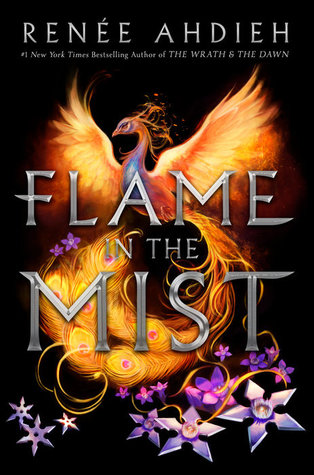
Flame in the Mist

Flame in the Mist by Renee Ahdieh is a young adult historical fantasy set in feudal Japan when samurais protected the royal class and young girls were raised for one purpose--to make good marriages that would bring honor to their families. Mariko is the daughter of a samurai and she never seemed comfortable preparing for her role--she asked too many questions, her mind was always busy, and she was a gifted alchemist. But when the time comes and one of the Emperor's sons offers for her hand, she gives in to destiny. But fate has a way of twisting things up...

On the way to her bridegroom's palace, her convoy is attacked by what seems to be a horde of bandits who go by the name the Black Clan and who have been hired to kill Mariko. Miraculously, she survives and vows to find out who is beyond the plot to kill her and dishonor her family. She cuts her hair and disguises herself as a young peasant boy. Soon, she finds herself in the position to infiltrate the Black Clan and discover their secrets.

Meanwhile, her twin brother Kenshin is hunting for her. Despite the wreckage and burned bodies left behind by the attackers, Kenshin is sure his sister survived and he's determined to find her. He's not alone, Raiden--her intended--is also looking. But is his concern for her safety or do other motives drive him?

When I was looking for an award-winning book to read for this month's entry in the Monthly Book Award Challenge [2018 Southern Book Prize--Children's/Juvenile category], this sounded like a really interesting option. Young samurai daughter setting out on a quest to avenge herself on the bad guys who attacked her caravan and tried to kill her. You bet. Strong female character. Lead me to her. But honestly--she spends a great deal of time talking to herself (inside her head) like she's trying to convince herself that she's as tough as the book blurbs said she was. Not a whole lot happens for about two-thirds of the book. And the bulk of the action happens in the last 30 pages--all crammed together.

The writing is okay, although a great deal of the time I felt like the prose was trying too hard--too hard to be lyrical and descriptive, too hard to be all fantasy-like in a historical Asian setting. Some of it may have been an effort to duplicate the feel of translated Japanese works. I've read several books translated from the Japanese and it has an entirely different pace. But it never came off. Overall--a decent story, but I didn't quite feel that it was good enough for prizes. ★★

*************************
Pick Your Poison: Birds of a Feather (wings or feather on cover)


Wednesday, January 15, 2020

The Seven Deaths of Evelyn Hardcastle

Somebody's going to be murdered at the ball tonight. It won't appear to be a murder so the murderer won't be caught. Rectify that injustice and I'll show you the way out.
~The Seven Deaths of Evelyn Hardcastle (2018) by Stuart Turton

That quote essentially sums up the plot of The Seven Deaths of Evelyn Hardcastle. Evelyn Hardcastle has come home to Blackheath after being sent to Paris for schooling. Nineteen years ago her younger brother Thomas was murdered. The family abandoned their home, leaving the memories behind, until Lady Helen Hardcastle decides to throw a party in Evelyn's honor on the anniversary of Thomas's death. She invites all the same guests who were at the house nineteen years ago. And plans to announce her daughter's engagement to Lord Cecil Ravencourt at a gala ball. But all her plans are ruined when Evelyn dies of an apparently self-inflicted gunshot wound in full view of the guests.

That's the overall set-up. But then there's another thread to the story. Among the guests are some interlopers--our narrator, Aiden Bishop finds himself inhabiting the body of various members of the guest list. Eight guests in all--and he hops from body to body (through what mysterious means, we're never told) and back again over a period of eight "days." He slowly learns that he has been tasked with the unraveling of the murder of Evelyn Hardcastle--no matter how much it looks like suicide. A mysterious figure, named the Plague Doctor for the mask he wears, instructs him that if he solves the murder by 11 pm of the night of Evelyn's death, then he will be free to leave. Otherwise, once the eight days (actually the same day, spent repeatedly as different guests) are over, his memory will be wiped and he'll have to start again.

Oh...and there's another complication. He has two rivals who are also trying to solve the murder and earn their escape. He has the advantage over them--he has eight "hosts" to help him and can carry memories from each host's day with him. The rivals live the day as themselves and if the story gets reset, they lose what they've learned. Aiden is allowed to see the events from several different viewpoints to gather clues from all directions. He finds himself drawn to Anna, one of his rivals, and vows to save both her and himself even though the Plague Doctor tells him that only one of the three can escape. He will have to fight his way through lies and betrayals if he's going to make good his promise to Anna. He will also have to avoid being killed (in all his different bodies) by another mysterious figure known as the Footman.

This is an intricate book--not only intricately plotted at its most basic level, the storyline (which it has to be in order to follow so many viewpoints that switch not just once per host but multiple times) but there are also many layers to that plot. We have the basic murder mystery to solve. We have the backstory for the three rivals and trying to figure out who the Plague Doctor and the Footman are. There are intricate themes being played out--themes of revenge and redemption and loyalty and betrayal. There is an examination of just how possible is it for the most reprehensible people to really change

Do you know how you can tell if a monster's fit to walk the world again, Mr. Bishop? If they're truly redeemed and not just telling you what you want to hear?

Aiden Bishop learns. And while he inhabits the various bodies--belonging to people who are, for the most part, vile in various ways--he is able to influence them and help them be, if only temporarily, better people than they were. And each of these hosts also manage to leave their mark on him--assisting him in his efforts to find the truth and find a way out for both Anna and himself.

This was an exhilarating roller coaster ride through the fun house with a side trip through the house of horrors--complete with mazes and mirrors and scary things jumping out at you in the dark. I thoroughly enjoyed trying to piece together the murder mystery plot while puzzling over why the three were being held there. It was difficult to capture all the pieces as they flew by, but I caught enough to have a good time trying. One small thing that I would like to know is how the trick of making Aiden pop into the various bodies was done--was it some kind of Star Trek holodeck-type program? ★★ and 1/2.

**********
Calendar of Crime: February (Pub date)
Mystery Bingo: Card #2-Clues & Cliches: Muddy/wet clothing; Red Herrings: maid/butler/chauffeur
Deaths = 11 (five stabbed; three shot; two poisoned; one drowned)

Quotes
[First Line] I forget everything between footsteps.

We are never more ourselves than we think people aren't watching, don't you realise that? It doesn't matter if Stanwin's alive tomorrow, you murdered him today. You murdered a man in cold blood, and that will blot your soul for the rest of your life. I don't know why we're here, Daniel, or why this is happening to us, but we should be proving that it's and injustice, not making ourselves worthy of it. (Aiden Bishop; p. 323)

I've always known more than them. I knew more than you. Knowledge was never my problem. Ignorance is the condition I struggle with. (The Plague Doctor; p. 452)

We've both hurt each other, Anna, and we've both paid for it. I'm never going to betray you again, I promise. You can trust me. You already have trusted me, you just can't remember it. (Aiden Bishop; p. 464)

The Plague Doctor claimed Blackheath was meant to rehabilitate us, but bars can't build better men and misery can only break what goodness remains. This place pinches out the hope in people, and without that hope, what use is love or compassion or kindness? (p. 480)

...today feels like a good day, and Blackheath hasn't seen one of those for a very long time. I think I'll enjoy it for a while and worry about the cost tomorrow. It will come soon enough, it always does. (The Plague Doctor; p. 503)

[Last Line] I just have to keep walking until I get there.


Thursday, November 14, 2019

Monthly Book Award Challenge


The ladies over at Girlxoxo have given us another reading challenge: the Monthly Book Award Reading Challenge. The goal? To read one book per month--and the book read must have earned a book award that was given out that month. For full details click on the link.

Here is my tentative list:

January: The Seven Deaths of Evelyn Hardcastle (aka The 7 1/2 Deaths of Evelyn Hardcastle) by Stuart Turton (Costa Book Awards 2018) [1/15/20]
February: Flame in the Mist by Renée Ahdieh (Southern Book Prize 2018) [2/6/20]
March: Ragtime by E. L. Doctorow (National Book Critics Circle Award 1975) [3/25/20]
April: The Grey Flannel Shroud by Henry Slesar (Edgar Award 1960) [4/6/20]
May: Agatha Christie's Secret Notebooks by John Curran (Agatha Award 2010) [5/25/20]
June: Dreamsnake by Vonda N. McIntyre (Locus Award 1979) [6/20/20]
July: Between the Devil & the Duke by Kelly Bowen (RITA Award 2018) [7/24/20]
August: Neuromancer by William Gibson (Hugo--awarded August 1985) [8/22/20]
September: Fahrenheit 451 by Ray Bradbury (1954 Retro Hugo--awarded September 2004) [9/3/20]
October: Talking About Detective Fiction by P. D. James (Anthony Award 2010 [NF/Critical]) [10/9/20]
November: Replay by Ken Grimwood (World Fantasy Award 1988) [11/17/20]
December: The Sirens Sang of Murder by Sarah Caudwell (Anthony Award 1990) [12/10/20]

Complete!