
Friday, February 4, 2022

Leonard: My Fifty-Year Friendship with a Remarkable Man


 Leonard: My Fifty-Year Friendship with a Remarkable Man
(2016) by William Shatner with David Fisher

From the book flap: Leonard Nimoy and William Shatner first crossed paths as actors on the set of The Man from U.N.C.L.E. Little did they know that their next roles in a new science fiction television series, would shape their lives in ways no one could have anticipated. In seventy-nine television episodes and six feature films, they grew to know each other more than most friends could ever imagine. Over the course of half a century, Shatner and Nimoy saw each other through personal and professional highs and lows. In this powerfully emotional book, Shatner tells the story of a man who was his friend for five decades, recounting anecdotes and untold stories from their lives on and off the set, as well as gathering stories from others who knew Nimoy well, to present a full picture of a rich life. As much a biography of Nimoy as a story of their friendship, this is a uniquely heartfelt book written by one legendary actor in celebration of another.

This book was a must-read for this long-time classic Trek fan. Though I am an avowed McCoy girl, I have always enjoyed the on-screen relationship between Kirk and Spock. Having grown up with Trek and heard all the stories about supposed the behind-the-scenes feuds as well as the stories of Shatner and Nimoy's estrangement at the end of Nimoy's life, I was interested to read Shatner's side of things--but I also know to take it all with a grain of salt. After all, Nimoy is no longer here to tell his side...if he were willing to do so, and Bill Shatner is...well, Bill Shatner. Key words in his vocabulary are "I" and "me" and they appear a fair amount, even in this tribute to his friend.

But--he does come across as genuine. He readily admits his failings--that his own ego often got in the way and that, as the only boy in the family, he got a great deal of attention which contributed to his self-estimation. He also relates his great difficulty in making friends. As a boy from an Orthodox Jewish family, he walked alone to school and felt an outsider among his non-Jewish neighbors. He didn't have any close friends growing up and he found it difficult to make friends when he got older. It took a long time for him to become close to Leonard Nimoy and it really wasn't until they began appearing at Trek Conventions that they became close.

I do feel, from the stories related, that Shatner felt a lot closer to Nimoy than perhaps Nimoy did to him. It seemed that he got a lot more out of the relationship than he gave. And, again, that may stem from his admitted character flaws--he just didn't know how to give that kind of support. I don't know if it is his ego or his lack of real experience at friendship that causes him to say that he has no idea why Nimoy cut off the relationship in those final years. But his bafflement and hurt is genuine, I truly believe that he doesn't know or perhaps hasn't been able to recognize what went wrong. I really feel for the man who can't understand how he lost something important to him. I do hope that, as he has chosen to believe, that Nimoy really did see the final letter that Bill Shatner wrote to him--telling him of his great respect and love for his friend of fifty years.

The stories he tells of their work together and stories about Leonard's life--from early days in Boston to his young acting career through the glory days of Star Trek to finding new passion in photography in his later years were, to quote Mr. Spock, fascinating. Some of the stories had made the rounds of Trek lore previously, but there were enough new anecdotes to keep the memoir interesting and informative. A thoroughly enjoyable memoir. ★★

First line: At the conclusion of the second Star Trek movie, The Wrath of Khan, the Enterprise is facing destruction.

Last line: LLAP, my friend, my dear, dear friend.


Tuesday, February 1, 2022

January Pick of the Month


image by George Henley

Well, January has started the reading year off with a roar--even if January has been less like Narnia under the White Witch's spell and fairly warm. I racked up 23 books this month and 19 of those were mysteries (or at least rumored to be...I don't quite buy Fadeaway Girl by Grimes as a true mystery...). If I can keep that pace up, I should get to plant a flag on top of Mount Olympus on Mars again for my Mount TBR Challenge. Fingers crossed. So much for quantity. How about quality? The books were a mixed bag...several one-star showings and all of the five-star winners were rereads. Hope February brings in some books that will warm my reader's heart. Here are the stats:

Total Books Read: 23
Total Pages: 5,856

Average Rating: 3.46 stars  
Top Rating: 5 stars 
Percentage by Female Authors: 61%
Percentage by Male Authors: 30%
Percentage by both Female & Male Authors: 9%
Percentage by US Authors: 52%

Percentage by non-US/non-British Authors:  8%
Percentage Mystery: 83%
Percentage Fiction: 97%
Percentage written 2000+: 26%
Percentage of Rereads: 35%
Percentage Read for Challenges: 100% {It's eas
y to have every book count for a challenge when you sign up for as many as I do.}    
Number of Challenges fulfilled so far: 2 (6%)

Mysteries Read
The Green Island Mystery by Betsy Allen (3.75 stars)
The Case of the Famished Parson by George Bellairs (4 stars)
And Then There Were None by Agatha Christie (5 stars)
Easy to Kill by Agatha Christie (4 stars)
Hercule Poirot's Christmas by Agatha Christie (4 stars)
Witness for the Prosecution by Agatha Christie (4 stars)
The Ruby Raven by Michael Dahl (3.5 stars)
An Old Betrayal by Charles Finch (3 stars)
Best "Thinking Machine" Detective Stories by Jacques Futrelle (3 stars)
What, Me, Mr. Mosley? by John Greenwood (1 star)
Fadeaway Girl by Martha Grimes (1 star)
Death Comes to Pemberley by P. D. James (1 star)
And Soon I'll Come to Kill You by Susan Kelly (2 stars)
Overture to Death by Ngaio Marsh (4 stars)
Bodies from the Library by Tony Medawar [ed] (3.75 stars)
Cut to the Quick by Kate Ross (4 stars)
Whose Body? by Dorothy L. Sayers (5 stars)
Eight Perfect Murders by Peter Swanson (3.5 stars)
Deathblow Hill by Phoebe Atwood Taylor (3.5 stars)


Now it's time to get down to cases. All of the Christie, Marsh, and Sayers rereads are out. I have read them very recently (and reviewed most of them on the blog twice) and I believe some of them have won before, anyway. That cuts out all of the five-star winners and over half of the books that grabbed up four stars, leaving us with two four-star contenders: The Case of the Famish Parson by George Bellairs and Cut to the Quick by Kate Ross. There was much to love about the Bellairs book--from the rural coastal setting to the vintage mystery plotting to my favorite supporting character, Harry Keast. Keast makes up long words because he doesn't know enough real ones and his speech is delightful. The Ross book is the first in a series of four Regency-era historical mysteries starring Julian Kestrel--dandy and man about town. I read her books back in the mists of time, before blogging and before I really kept good notes. All I have is star ratings that tell me I really enjoyed them, so I thought it time to revisit the stories and see if they held up. Well...Kestrel's debut does. Ross gives us a very humane detective hidden beneath the dandy's finery. He is sharp and intelligent...and just human enough to make realistic mistakes on his way to the solution. A fine historical mystery and...therefore...the winner of the first P.O.M. Award of 2022


February Reading by the Numbers Reviews


You are invited to the Inlinkz link party!

Click here to enter

February Virtual Mount TBR Reviews


You are invited to the Inlinkz link party!

Click here to enter

February Mount TBR Reviews


You are invited to the Inlinkz link party!

Click here to enter

February Vintage Scattergories Reviews


You are invited to the Inlinkz link party!

Click here to enter

Monday, January 31, 2022

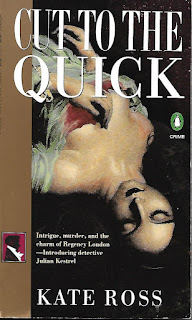
Cut to the Quick


 Cut to the Quick (1993) by Kate Ross

Julian Kestrel--dandy, man about town. Devoted to the gaming tables and the latest Regency-era fashion. Underneath his dandified pose, he's also a man of honor with more concern for others than he cares to let on.  And now--he's about to turn amateur detective. When Kestrel rescues young, inexperienced Hugh Fontclair from entangling himself too deeply at the gaming tables, he never dreamed he'd wind up invited to the man's wedding...and not as a guest, but as best man! Since he doesn't really know Fontclair from Adam, Kestrel is tempted to say no, but his curiosity gets the better of him. If he doesn't go to the Fontclair's country estate he'll never know why he's been asked.

From the moment he arrives it becomes obvious that there is more to this wedding than meets the eye. Mark Craddock, the bride's father, has some sort of secret hold over the Fontclairs and he's using it to force a marriage between his daughter and Hugh. The secret is so terrible that Hugh is willing to sacrifice his happiness to save the family honor. But--whatever that secret is, could it possibly be worse than murder? For on the evening of the second day, Kestrel returns from an afternoon of exploring the grounds (with Hugh) to find a dead girl tucked up in his bed. 

Initially, his manservant is arrested. Dipper, a former pickpocket with an instinct for lying under pressure, is caught out in a few mild untruths and suspected of lying about something much worse. Even Kestrel, as an outsider, is preferable as a suspect. With his own honor at stake and his servant already arrested, Julian dives into the investigation. He soon discovers the dreadful secret behind the arranged marriage--but that isn't the only secret being kept hidden in the confines of the Fontclair estate. In order to save Dipper from the hangman, Kestrel will have to decide which secret was worth killing for.

Kestrel makes for a very clever and humane investigator. While he has no qualms about questioning his host's family in the effort to exonerate his innocent servant, he regrets the pain he has to cause others in the search for the truth. It was also interesting to watch him go through several rounds of thinking he had finally gotten to the bottom of who-dunnit only to discover that the secret the current suspect was hiding wasn't the ultimate secret of murder. I thoroughly enjoyed his interactions with the doctor and the way he won over the crusty, country medico. It would be nice if Dr. MacGregor would become his Watson, but I don't believe that's in the cards.  

A highly entertaining historical mystery. ★★

First line: Mark Craddock paced slowly, deliberately, back and forth behind the desk in his study.

This waiting is worse than anything. It's like one of those nightmares where you know something terrible is going to happen and you don't know what it is, but you there's nothing you can do to stop it. (Hugh Fontclair; p. 55)

Last line: "I promise," he said.

***************

Deaths =  4 (two stabbed; two natural)

Saturday, January 29, 2022

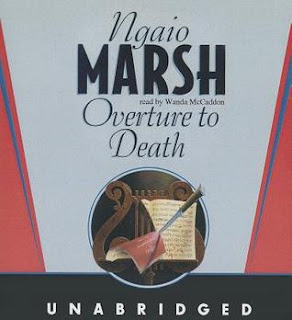
Overture to Death


 Overture to Death (1939) by Ngaio Marsh

When reading the synopsis for Overture to Death (1939) by Ngaio Marsh, one can be excused for thinking that this will be another of her theatrical mysteries. After all, it tells us that a group of seven amateur actors are preparing to put on the play Shop Windows when Rachmaninoff's "Prelude in C Sharp Minor" is set for the overture. Then on opening night the pianist barely gets started--playing three chords and then stepping on soft pedal--before a loud bang is heard and Miss Idris Campanula falls dead against the sheet music. There's no performance and the play setting itself features very little in the plot other than to provide a way for Marsh to insert a rather ingenious method of murder. I'm quite sure I'd never come across a deadly piano before I read this one the first time (long ago and far way from my hometown Carnegie Library).

The stars of Marsh's show are Miss Campanula and her bosom friend Miss Eleanor Prentice, two embittered old maids who like nothing more than to spread dreadful rumors about their neighbors and then confess their sins to the handsome rector. Of course, the dear friends are also rivals for the rector's regard--each woman imagining herself to be the front-runner in the "rector's wife" stakes.  When Inspector Roderick Alleyn arrives on the scene to decide who gave Miss Campanula such a dramatic death scene, he finds that he must first discover if the murderer has cast the right woman as victim. For until about twenty minutes or so before curtain time, everyone assumed that Miss Prentice would be playing her standard piece as the opening. She is prevented from doing so by an infected finger and only agrees to give up her martyr's determination to play no matter how much it hurt after the rector convinces her. There seems to have been no time for the gun to have been rigged up in the piano after the change in pianists took place--so was Miss Prentice the intended victim? And what was the motive? Do people really kill just because someone is a meddling, gossipy busybody?

This was an enjoyable entry in the Alleyn case files. A cast of interesting characters from repressed village spinsters and the handsome cleric to the county squire and the young lovers (whose parents are forbidding the match) to the doctor and his adulterous love interest, the attractive widow; a clever murder method; a heaping helping of red herrings (some provided courtesy of the young scamp George Biggins; and plenty of humor and excellent dialogue. 

Great fun even though I remembered who the culprit is--of course I did read this about four years ago. This time I listened to an audio version read by Wanda McCaddon. She does a very nice job giving voice and unique personality to each of the characters  and increased the rating for this reading from 3.5 stars (previous) to a full ★★.

First line: Jocelyn Jerningham was a good name.

Last line: "Not I," said Alleyn.

******************

Deaths = one shot

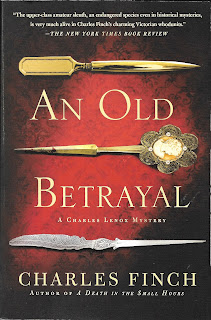
An Old Betrayal


 An Old Betrayal
(2013)

Charles Lenox's detective protégé, Lord John Dallington, is very sick and asks Lenox to meet a client at Charing Cross. The meeting goes wrong, but Lenox is so intrigued by the circumstances that he takes time from his busy schedule as a Member of Parliament to keep his hand in the case. Someone is impersonating a reclusive country squire and harassing a social secretary at Buckingham Palace. When the country squire is found murdered, Lenox and Dallington realize that something much deeper than harassment and fraud is going on. something that may threaten the Queen herself. 

I enjoy Finch's Victorian-era mysteries. He has the details of the period and the inner workings of the Parliament down cold. And it is always fun to visit with all our old friends--Lenox, his wife Lady Jane, his secretary Graham, and his friend Dr. Thomas McConnell--as well as Lord John Dallington. In general, the mystery plot was a good one with an interesting motive behind the killings and attempted killings. My only quibble is with the anti-climatic ending. We catch the culprit/s about ten chapters from the end, the prisoner/s won't say a word about anything, and Dallington has to go rooting about in the countryside to find the motive. And even then he doesn't find the whole story. It just felt a bit flat after the huge action scene when Lenox, Dallington, and Inspector Jenkins catch the criminal/s in the act. A solid mystery and I was pleased to see the turning that Lenox's career is taking at the end of the book. ★★

First line: The long green benches of the House of Commons were half-deserted as the evening session began, scattered with perhaps a few dozen men.

Last line: And what happiness to share it with someone.


*************

Deaths = 5 (one natural; two shot; one fell from height; one hanged)

Thursday, January 27, 2022

The Pocket Book of Popular Verse


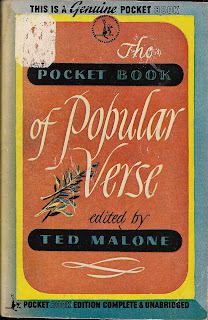
  The Pocket Book of Popular Verse (1945) by Ted Malone (ed)

It was interesting to look back at the poems which Malone chose as the favorites of the common person of the 1940s. Quite a lot of these are long forgotten--poems that really aren't memorable or, truthfully, very good. I give you "Door Mat" by Mary Carolyn Davies as an example:

Women are door-mats and have been--/The years those mats applaud--/They keep their men from going in/With muddy feet to God. [Say what?!] 

But sprinkled among them are verses and lines that were still being repeated--though sometimes by people who didn't really know where they came from--when I was growing up. I recognize lines such as these about Boston "Where the Lowells talk only to Cabots, And the Cabots talk only to God" by John C. Bossidy and "A garden is a lovesome thing, God wot!" by Thomas Edward Brown, though I would have been hard pressed to give you the authors names. There are poems that appeared often in the classroom and those that have collected many times in other anthologies. And then, of course, there are more famous and much better known (especially to English majors) poets and poems from William Blake to Elizabeth Barret Browning's Sonnets from the Portuguese from Lewis Carroll and "Jabberwocky" to William Wordsworth's "She Was a Phantom of Delight."

An entertaining selection overall. ★★

First line: My mind lets go a thousand things (from "Memory" by Thomas Bailey Aldrich

Last line: Why can't we all be like that bird? (from "A Wise Old Owl" by unknown)


Monday, January 24, 2022

The Green Island Mystery


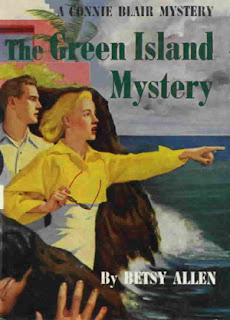
 The Green Island Mystery (1949) by Betsy Allen (Betty Cavanna)

The fifth installment in the Connie Blair series finds Connie and Georgia Cameron on a business trip to Bermuda. They work for the Reid & Renshaw Advertising Agency and are on a mission to help the Tremont Shop, a long-established British firm, improve their image and their sales. Their trip takes them by ocean liner to the beautiful green island and aboard ship Connie, who attract mysteries like bees to honey, makes the acquaintance of David Scott. 

David is on his way to Bermuda to settle his aunt's estate. His aunt was Penelope Sebastian, a well-known mystery author, and there is a bit of a mystery attached to her death. Aunt Penelope was just finishing her memoirs (spilling secrets left, right, and center). One half had already been sent to the publishers, but the second half has disappeared from her estate. David hopes to find the rest of the manuscript so he can honor his aunt's wish that the royalties from the memoirs' sales should go to an orphanage. 

Connie is immediately intrigued and spends all her free time--after sketching scenes for Tremont ads--hunting clues with David in Horizons, the house he inherited from his aunt. Someone has broken into the house once while David was on his way from the States and then Connie is attacked and bundled into an old clothes press when she's alone and sorting through papers. Did the assailant find what they were looking for? There are clues in a bundle of check stubs as well as in a guest book listing all of Aunt Penelope's visitors over the years. A missing thermos, a scrap of an old photo, a broken record, and a partially typed page in Penelope's old typewriter provide just the evidence Connie needs to discover the location of the missing manuscript as well as the identity of her attacker.

This is a fun career girl mystery in the same vein as the Beverly Gray and Vicki Barr series. Connie is an assured young woman who can't help getting involved in mysteries wherever she goes and has a knack for getting to the bottom of them. It is good to the young men appreciating her skills and letting her take the lead in investigating. She's a hardworking artist and sleuth--but she also gets to have fun and enjoy David company as well. There's an air of gentle romance between them, but it's her no-nonsense senior partner, Georgia, who finds love with the junior Tremont. Connie will be heading back to the States and more work and adventures with the advertising agency. 

As with most of these 1940s "girl detective" mysteries, the plot is not terribly intricate and there are few real suspects to be had. I spotted the villain as soon as they made their first appearance, though I didn't quite see the twist in who they really were. An enjoyable light mystery. ★★★ and 3/4

First line: Connie Blair stood at the rail of the great ocean liner and watched her mother, her dad, and her twin sister walk down the gangplank to the dock.

Last line: And from three thousand feet the entire island was green--as green as an emerald set in the sapphire sea.

****************

Deaths = one heart attack

Sunday, January 23, 2022

And Soon I'll Come to Kill You--Spoilerific Review


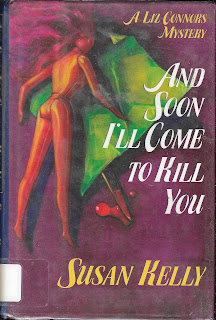
 And Soon I'll Come to Kill You (1991) by Susan Kelly

Liz Connors writes articles about true crime and short fiction pieces as a free lance. Over the years, her work has annoyed a number of people and she's regularly gotten anonymous mail from those who have a bone to pick with her--for one reason or another. But she's never been seriously alarmed. Until now. Previous letters were one-offs--someone getting their grievances off their chest and moving on with their life. This time the letters keep coming and the tone becomes more menacing with the latest one ending: And soon I'll come to kill you.

Liz's boyfriend, Lieutenant Jack Lingemann of the Cambridge Police Department, insists that she take it seriously and that she move in with him while they try to figure out who might be sending these letters. They come up with a short list of people who might be vindictive and disturbed enough to take revenge--from the leader of a vicious street gang to a repressed computer geek who was arrested for computer fraud to an ex-boyfriend with ego issues to an eye doctor who molested elderly patients to the leader of a cult-like religious sect. When others connected to one of the suspects begin receiving threatening notes and then some of them are found dead, Jack becomes convinced that he's Liz's tormentor as well. But is that the case? And, if so, will the police nab him in time?

Spoilers Ahead! Read at your own risk.

I found this entry in the Liz Connors series (#5, in fact) to be much weaker than the debut novel, The Gemini Man. When I read that one several years ago I felt there was a weakness in plotting--the red herrings and false clues weren't strong enough to mislead readers, but I did like the characters and thought there was great promise in the writing. I still like Liz and Jack. They are a great couple and work together well. The writing from Liz's point of view is excellent. I just didn't care for the plot of this one at all and I especially didn't appreciate the fact that we wound up with not one, but two separate whackos threatening Liz. Seriously? This made the plot messy.

And...I honest-to-goodness could not believe that Jack would be so insistent that Liz not be left alone even after he thinks it's over and then, by golly, if he doesn't take her back to his place and leave her there all by herself, saying that Gloria (another cop) "should be here in fifteen minutes." So, of course, the real stalker is right there on the spot and kidnaps her. It would have worked much better if Jack had just assumed that everything was over and dropped her off thinking it was all okay. That would make sense and we'd still get the final twist ending where it really wasn't all over. But the man was still checking all the rooms, still walking around the premises, still thought somebody should be with her--so why didn't he wait the fifteen measly little minutes until backup showed up? If he (obviously) still thought something could happen, why did he think those fifteen minutes were magical and nothing would happen then? Sorry for my little rant--but it bugs me. The other thing that bugs me is the real ending. After it's all over and the nutcase who's been stalking Liz has finally been caught, the book ends with a bit of a cliffhanger. Liz goes back to her apartment and sorts through her mail and finds yet another anonymous note calling her names. Like it's all going to start over again.... I like my mysteries to have a definite finale. The bad guy gets caught (or killed or whatever) and that's the end of the story. Don't leave things open-ended. ★★

First lines: The first letter arrived on October sixteenth. I read it and dismissed it.

Last line: It began, "You bitch..."

*************

Deaths = 5 (two shot; one car accident; two stabbed)


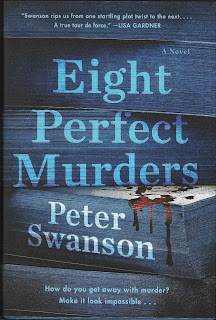
Eight Perfect Murders


 Eight Perfect Murders (2020) by Peter Swanson

From the very first line Malcolm Kershaw, used bookstore owner and former crime fiction reader, is plunged into a murderous mystery. When he first began working at Old Devils Bookshop, the owner asked him to start a blog for the store. His first blog post was called "Eight Perfect Murders" and he listed eight crime novels that fit his definition of perfect murders. 

Now--five years later, deaths begin happening and Special Agent Gwen Mulvey of the FBI has come calling. She sees some similarities between the deaths and the books on Kershaw's list and she's asking him for any help he can give. It soon becomes apparent that the killer is someone who knows Kershaw and that Kershaw's past is intricately linked to the present crimes. He becomes intent on preventing further deaths without letting too many of his own skeletons out of the closet. But is that really going to be possible? 

First--a warning. If you haven't read the books on Malcolm Kershaw's list (see bottom of this post), might possibly want to in the future, and don't want the plots spoiled, then you should read the books before picking up Eight Perfect Murders. I have read all of the books which might interest me, so I didn't mind having the others spoiled. But if I hadn't read the Christies, in particular, I would have been very upset with the huge spoilers Swanson drops.

Second--this is a thriller. If classic mystery fans are looking for a story in the classic detective tradition, they'll be disappointed.

That said, this was a fairly enjoyable thriller in the modern unreliable narrator (or is he?) style--at least for me. Swanson packs in the twists and turns and gave me a very nice afternoon's entertainment. I picked up on the one clue from classic crime that was most casually introduced, but I didn't take it as far as I needed to. I expected part of the ending, but not quite all and it was nice to have a bit of surprise left. I know that others (see John's non-review over at Pretty Sinister Books, for instance) didn't enjoy it as much, but I suspect I didn't find it as annoying and obvious for the simple reason that I read so few modern mysteries and haven't really indulged in many of the recent unreliable narrator novels. 

I will say that it would have been a far superior book if Swanson had done a true homage to classic "perfect" crimes rather than recycling their plots (and spoiling them in the process). But it did make a change of pace from my usual fare. ★★ and 1/2

Also reviewed by the Puzzle Doctor at In Search of the Classic Mystery Novel

First line: The front door opened, and I heard the stamp of the FBI agent's feet on the doormat.

I ran my thumb along the edge of the book, riffling the pages, and that musty, prickly smell of an old paperback reached my nostrils. I've always loved that smell, even though the book collector side of me knew that it was a sign of a book that had been improperly maintained over the years.... (p. 35)

Books are time travel. True readers all know this. But books don't just take you back to the time in which they were written; they can take you back to a different version of yourself. .(pp. 37-38)

Last line: It's nice to think I'll leave a mystery in my wake.

*****************

Deaths = 16 (five shot; one beaten to death; one hit on head; one cancer; one heart attack; one fell from height; one car accident; one house fire; one strangled; two poisoned; one hit & run) [This includes deaths from the books mentioned within the story where victim and method are named.]

Books Mentioned in Kershaw's List:

The A.B.C. Murders by Agatha Christie; The Red House Mystery by A. A. Milne; Malice Aforethought by Francis Iles (Anthony Berkeley Cox); Double Indemnity by James M. Cain; Strangers on a Train by Patricia Highsmith; The Drowner by John D. MacDonald; Deathtrap by Ira Levine; and The Secret History by Donna Tartt. Also spoiled in a big way: The Murder of Roger Ackroyd by Christie

Saturday, January 22, 2022

Mystery Reporter's Challenge 2022


 Mystery Reporter's Challenge 2022

Sponsored by Ellie in The Challenge Factory on Goodreads
My posts on Goodreads
The challenge runs from January 1, 2022 to December 31, 2022.


Who? What? Where? When? How?
Why? – because it’s fun to read!

I'll be going for News Anchor (3 from each category). Commitment complete 2/24/22!

Cub reporter: 5 books (1 from each category) [1/19/22]
Columnist: 10 books (2 from each category) [1/24/22]
News Anchor: 15 books (3 from each category) [2/24/22]
Editor: 20 books (4 from each category) [3/22/22]
Newspaper Mogul: 25 books (5 from each category) [3/28/22]

BONUS CATEGORY:
Pulitzer Prize Winner (Newspaper Mogul plus Bonus Category) = 30 books

EXTRA BONUS CATEGORY:
Nobel Prize for Literature (Newspaper Mogul plus Pulitzer Prize + Extra Bonus) = 31 books

WHO
Protagonist is in the book business (bookshop owner, librarian, writer, etc): Eight Perfect Murders by Peter Swanson (1/23/22)
Protagonist works with an animal (K9 cop, Vet, etc.): The Murderer Who Wanted More by Baynard Kendrick [actually, two animals] (2/11/22)
Protagonist OR a Main Character is paranormal (witch, vampire, ghost, etc): The Ghost Finders by Adam McOmber (3/2/22)
Protagonist is starting a new business or job: Murder Roundabout by Richard Lockridge [new real estate agent] (3/12/22)
Protagonist is a senior citizen or a juvenile (under 18): Hercule Poirot's Christmas by Agatha Christie (1/1/22)

WHAT
A color in the title: A Plate of Red Herrings by Richard Lockridge (3/28/22)
A number in the title: The Five Red Herrings by Dorothy L. Sayers (2/24/22)
Title is at least six words: The Case of the Famished Parson by George Bellairs (1/2/22)
Title is exactly two words: Fadeaway Girl by Martha Grimes (1/2/22)
Title is a pun (ex: Hooked on Ewe): With Option to Die by Richard Lockridge ["option to buy"] (3/22/22)

WHERE
Set in Europe (NOT England): The Devil in Music by Kate Ross [Italy] (3/13/22)
Set in a country village or small town: Easy to Kill by Agatha Christie (1/7/22)
Set in a state starting with a vowel: The Golden Box by Frances Crane [set in Illinois] (2/14/22)
Set in a state or country you have lived in: Midsummer Nightmare by Christopher Hale [set in USA--only country I've lived in] (2/21/22)
Set on foreign soil (NOT America or England): The Green Island Mystery by Betsy Allen [Bermuda] (1/24/22)

WHEN
Set in the 1800s or earlier: Death Comes to Pemberley by P. D. James (1/15/22)
Set in the 1900s: Whose Body? by Dorothy L. Sayers (1/20/22)
Set during a celebration: Death Stops the Frolic by George Bellairs (2/18/22) [set at the church's 25th anniversary tea]
Set during summer: Deathblow Hill by Phoebe Atwood Taylor (1/21/22)
Set during a storm: And Then There Were None by Agatha Christie (1/9/22)

WHY (Motives)
Money/Greed: Witness for the Prosecution by Agatha Christie (1/21/22)
Jealousy: Overture to Death by Ngaio Marsh (1/29/22)
Revenge: The Ruby Raven by Michael Dahl (1/19/22)
“Love”: Clouds of Witness by Dorothy L. Sayers (2/19/22)
To keep a secret/cover up: A Broken Vessel by Kate Ross (2/27/22)

BONUS CATEGORY – PULITZER PRIZE
WHO – The protagonist is a widow/widower: Murder at the Spring Ball by Benedict Brown (2/5/22)
WHAT – The title starts with your first or last name’s first initial: Bodies from the Library by Tony Medawar [ed] (1/13/22)
WHERE – Set in a place (city, village, state, country, etc) starting with your first or last initial: The Corpse with the Grimy Glove by R. A. J. Walling [set in Bosenna, England] (3/5/22)
WHEN – Set in the decade you (or a close family member) was born: The Egyptologist by Arthur Phillips [both of my grandmas were born in the 1920s] (2/6/22)
WHY – Accidental death (as well as others): An Old Betrayal by Charles Finch (1/29/22)

EXTRA BONUS CATEGORY – NOBEL PRIZE FOR LITERATURE
Horoscope (from on-line or a newspaper or wherever)
Pick a date that has special meaning for you (your birthday, anniversary, birthday of a child, parent or pet, etc.)
Read your 2022 horoscope for that date.
Then read a book that relates to that horoscope.

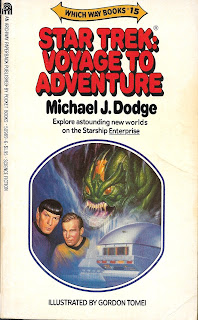
Star Trek: Voyage to Adventure


 Star Trek: Voyage to Adventure
 (1984) by Michael J. Dodge

Mystery...Adventure...Time Travel...all this and more await the reader of this Which Way Book (a choose-your-own-adventure-type) who finds herself assigned as an Ensign aboard the legendary U.S.S. Enterprise with Captain Kirk, Mr. Spock and the rest of the crew. Solve the mystery of the Klingon spy. Travel through time with Mr. Spock. Investigate the mysterious messages from an alien race. And try to avoid slip-ups that will result in your own destruction.

I loved the Choose Your Own Adventure Books from the time I ordered my first one (The Mystery of Chimney Rock) through the Scholastic Book Club order form in elementary school. Being a Trek fan, I immediately scooped this one up when it came out in 1984. And enjoyed it immensely. It was just as much fun revisiting this story now. I love the way Dodge has packed this small book with so many coherent adventures. Short and to the point, but full of mystery adventure to make reading fun for kids--and adults. ★★★★

First lines: You are an Ensign in Starfleet, just graduated from the Starfleet Academy. Because of your high scores as a cadet, you have been assigned to the starship Enterprise, commanded by Captain James T. Kirk.

Last line (of my favorite ending): Ask them if we can give them a ride home...without the dilithium crystals, of course.

************

Deaths (usually your own) = 11 (one accident; four shooting; three electric shock; one attacked by alien; one asphyxiated; one smashed by falling rock)