
SCAM artist alert

Apparently there is someone calling himself "Luigi Calloway" out there who is claiming to be associated with the Mount TBR Reading Challenge. He is contacting authors and telling them if they pay him, then their books will be used for the challenge. It's possible he's also telling people they must pay to participate in any way. Please know that there is absolutely no charge associated in any way with this reading challenge and that this person does NOT represent me or anything associated with my blog. I DO NOT endorse anything that he claims.There will NEVER be a reason for anyone to have to pay for participation in any way for any of my challenges. If only people who exert this much time and effort on scamming people would put it into something worthwhile....like reading their own books! A message to Luigi: Please cease and desist contacting authors (or anyone) in my name or claiming to represent this reading challenge. You absolutely DO NOT.

Tuesday, March 22, 2022

With Option to Die


 With Option to Die (1967) by Richard Lockridge

When Ann and Eric Martin rent a country house in North Wellwood, New York, they find themselves in the middle of a divided community. The current uproar is over the request for a building permit for a new, integrated country club. Thomas Peters, a well-known African American lawyer, had moved into the area with this grand plan to make a club where everyone (or at least everyone who could pay the membership fees) could gather--no restrictions. But North Wellwood is a conservative, Republican town and there are many folks who don't care for the idea at all--not that they have anything against people of color, you understand...but the location isn't right OR it's a fine experiment but can't we experiment somewhere else first? Of course, there are those who are downright hostile and those folks get even more stirred up when outside influences under the name "Patriots United" hook up with members of the North Wellwood Preservation Association. A high-profile instigator in Patriots United is spotted in the town. There's general name-calling (using "liberal" as a derogatory term isn't anything new it seems) and complaints that those who want to change things are communists or socialists...or worse. 

And then there's murder. Mrs. Faith Powers, who has been vocal in her support of the club, is shot as she's out driving in her little Mercedes. Lieutenant Forniss takes the lead in the investigation with the recently-promoted Inspector Heimrich leaving his desk often to "delegate" on the spot as it were. (It takes time to get used to a new position with less field work...) Then the newspaper office (where an editorial in support of the club had been printed) is attacked with a dynamite booby-trap attached to one of its presses. And the Martins suffer a round of attacks, culminating in a couple of hand grenades tossed in the windows. Ann works as an investigative reporter and had recently been credited on a television program about racial conditions in the south. So, even though the Martins are new to town, it's obvious where their loyalties lie...Forniss and Heimrich will have to decide if these incidents are all of a piece or if there are other motives hidden in the racial unrest.

The more things change...the more they stay the same. Racial unrest. "True Patriots" vs. Liberals. What a familiar ring this Lockridge book has. It is an excellent view of how propaganda and a hate compaign can take over the most calm and quiet communities. How evil--whether in the name of racial hatred or using that hatred as a cover for other crimes--can flourish with just a little wind to fan the flames. 

It is also a nicely plotted mystery and it is fun to watch Heimrich try and get comfortable in his new role. The old war horse has a difficult time staying out of the thick of the battle, but Forniss makes a good detective in his own right and gathers plenty of evidence on his own. Another good read in the Heimrich series. ★★★★

First line: The blacktop drifted up a gentle slope, and old maples with spring's young leaves arched over it.

Last line: Colonel licked him to make sure. Mite was tolerant. [Colonel = Great Dane; Mite = kitten]

***************

Deaths = 2 (one shot; one beaten to death)

Sunday, March 20, 2022

The Castle Island Case


 The Castle Island Case (1937) by F. Van Wyck Mason [pictures by Henry Clay Gipson]

Major Roger Allenby, ex-Army Intelligence and current crack investigator for the Inter-Ocean Life Assurance Company, is headed to Plunder Island (a fictional appendage of Bermuda) to investigate the suicide of one Judy Fortier, secretary to the well-known financier Barney Grafton. The company is not satisfied, but doesn't want to stir up trouble with Grafton, so Allenby's cover is that he is a banker who is considering an option in Grafton's latest financial coup--a mining concern in South America. There will be a fairly large house party--including fellow prospective investors Terry James, Stanley Gibbons, and Sir George Pakenham as well as Grafton's daughter Gail, Patricia Fortier (who has come to pack up her sister's belongings), Stanly Gibbons (who may or may not be interested in Gail, Kathleen Manship (who may or may not be interested in Stanley),  and Cora Sue Pendleton (Southern belle and friend of Gail's who is interested in anything in trousers).

It was thought at one time that Grafton would marry his secretary, but he wound up marrying wealthy Boston socialite Barbara Wilson instead. It's possible that Judy never got over the love affair gone bad and took her own life, but as Allenby meets the Grafton entourage, he senses tensions and undercurrents that may speak to other motives. When other deaths follow the apparent suicide, it becomes clear that things are much more complicated than the police first thought. There are romantic motives as well as financial ones...not to mention a suggestion of voodoo. Allenby and Inspector Boyd will clear everything up...using photographic trickery as well as evidence.

This is an interesting and unique addition to the crime fiction of the 1930s. Mason's detective story is told through both his text and the pictures provided by Gipson. It gives the novel the feel of a documented true-crime piece rather than a fictional tale of murder and mayhem. The photos throughout the story make the reader feel as though she were part of the house party. We see pictures of what Grafton's Bermuda mansion looks like, the beach and cliffs surrounding the house, and the members of the house party. We get both posed and candid shots. Among what seems to be normal vacation pictures that anyone visiting the island may have taken are hidden clues that will allow the observant reader to solve the mystery. Was I observant enough? Well, no. I did pick up some of the clues in the pictures (and text), but not as many as I should have and I didn't quite get the solution right. But I did enjoy myself and this unusual mystery.   ★★ and 1/2

First line: At three thousand feet the Bermuda Clipper's Chief Pilot had leveled off, leaving behind the angry welter of thunder heads which, by two hours, had delayed departure from Port Washington Airbase.

Last line: There was a silence as, very tenderly, young Tvoobaf led Gail away from ure sngure'f obql. [Bolded text is encrypted because spoilers--to decode, copy bolded portion and use this site: ROT13.]

***************

Deaths = 3 (one stabbed; one strangled; one shot)

Saturday, March 19, 2022

The Man in the Moonlight


 The Man in the Moonlight (1940) by Helen McCloy

The Man in the Moonlight is one of my favorite subgenres in mysteries--the academic mystery. It is set during World War II and features the campus of Yorkville University. Assistant Chief Inspector Patrick Foyle has been visiting the campus in anticipation of the possibility of sending his son there for college. As he's preparing to leave the grounds, he picks up a paper flying in the wind only to read:

I take pleasure in informing you that you have been chosen as murderer for Group No. 1. Please follow these instructions with as great exactness as possible.

The paper goes on to detail a rendezvous at Southerland Hall later that night. Foyle is ready to put it down as an undergraduate rag or some sort of joke. But he is curious and makes his way to the building mentioned. On the way there he hears a pistol shot. Perhaps it's not a gag and someone started proceedings a bit early. But he finds only Professor Raymond Prickett running a psychological experiment on babies' reactions to loud, unexpected noises. [Odd as it may seem, babies cry when exposed to loud, unexpected noises. I could have saved him the trouble of experimentation.] 

There are some hours to go before the rendezvous mentioned in the instructions and Foyle decides to go have dinner and then return to campus and see what exactly is up. During dinner, he overhears another member for the Yorkville faculty, Professor Julian Salt, having an unsatisfactory conversation with his estranged wife. His detective instincts can't help but be interested in the melodrama, but his mind is on Southerland Hall...and more particularly, the laboratory of Dr. Franz Konradi, a biochemist who is a refugee from the Nazi invasions across Europe. Foyle had met Konradi briefly, asked him some questions about the situation and was told that no matter what happened, if Konradi was found killed it would not be suicide...no matter how things looked

He goes back to campus where a young woman tries to dissuade him from going to Southerland Hall. But he's determined and is just in time to watch one of the psychology graduate students (Ian Halsey) perform some very odd actions in a darkened room--lighting a candle, reading from a book, drinking wine, and typing steadily. This goes on for several minutes until a shot rings out. The lights won't come on and the doors and windows are all locked (someone locked the door behind Halsey and Foyle). While they're fumbling in the dark, the murder breaks through a window in the janitor's room (the only breakable window in the place). When they manage to get the lights on, they find Dr. Konradi shot through the roof of the mouth with all the hallmarks of a standard suicide, barring a suicide note. But Foyle remembers what Konradi told him and calls in Dr. Basil Willing, a psychological consultant for the police because as Foyle tells him, it's "right down your alley, doc!" It is indeed, and Dr. Willing will have several very interesting psychological clues to follow up before they'll be able to identify the correct culprit.

First of all, I have to say how very grateful I am to the late Noah Stewart for this lovely Dell mapback copy. He sent it to me as part of one of our Golden Age group Secret Santa gift exchanges. I am only sorry that I did not read it sooner so I could have discussed it with him before he was taken from us much too soon. He knew of my great love for the academic mystery and was thoughtful enough to include this delightful little book in my box of goodies. 

It is, in addition to being a fine mystery, a very good look at the U.S. (and the world) at the time of second world war. We get good descriptions of the situation for refugees, prisoners of war, and the tricky state of trade. We see how precarious fortunes were when they depended on goods needed for the war--especially if any changes in materials might be in the offing. The mystery itself is well-plotted and McCloy pulled the wool over my eyes quite nicely. A very good read.★★★★

First line: the day Dr. Konradi was murdered dawned clear and windy--a fragrant spring day with a cool breeze.

It happened during a psychological experiment--at least that's what they say. Sounds phony to me. That's where you come in. I want you to tell me if it's on the level. There's a guy here named Prickett and he's a three-ring circus all by himself--but wait till you see him. (Inspector Patrick Foyle to Dr. Basil Willing; p. 39)

But do the police realize that this is only a detective story? I'm afraid they'll forget the murderer must
never be a Chinese when they find I have no alibi. (Dr. Feng; p. 96)

Last line: That's not an invitation--it's an order!

************

Deaths = 4 (two shot; one cancer; one drowned)

Tuesday, March 15, 2022

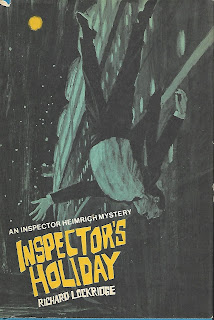
Inspector's Holiday


 Inspector's Holiday (1971) by Richard Lockridge

Inspector M. L. Heimrich and his wife Susan are booked for a leisurely Mediterranean cruise from late March to early May. It's just what the doctor ordered for Susan's recovery from flu compounded by pneumonia. A convalescence in warm climates will do her a world of good. And the good Inspector, who rarely takes a leave from his position with the New York State Police, could stand a vacation as well.

It starts out as a lovely cruise. The accommodations are spacious and luxurious. The food and drink is appetizing and abundant and over-indulgence seems to be the order of the day. They find themselves meeting many interesting people--including Sir Ronald Grimes, recently retired British embassy attache, and his lovely young wife; Major Ian Whitney, another British subject; Inspector Albert Hunt, introduced as Heimrich's British counterpart, but apparently more of a hush-hush secret service type; Miss Emily Farrell, a famous cookbook author; and Mrs. Raymond Powers, widow of an apparently famous businessman (though the Heimriches haven't heard of him).

When Sir Ronald disappears from the ship and Inspector Hunt is found strangled in his cabin--all in the same night, the ship's captain calls upon Inspector Heimrich for help. Heimrich tries to beg off, but the captain almost begs for assistance (no one else on board has any experience with violent death) and Heimrich soons admits that he can't not investigate when a fellow "cop" has been murdered. It isn't long before he also realizes what a difficult job he has ahead. Alone in his investigation, without being able to put the usual machinery in motion (fingerprints, crime scene detectives, easy access to any files/information on suspects, etc), and especially without his right-hand man Charles Forniss, he has to use all his wits and pull whatever strings he can from afar to find his man/woman before the ship docks at Malaga (where he and Susan disembark for a week in Spain). It helps that Forniss (when called via ship-to-shore) "just happens" to know a man at the British Embassy in D. C. (I never cease to be amazed how many people former Marine Forniss "just happens" to know....but I suppose you meet a lot of people while in the service during wartime.)

A fun entry in the Heimrich series. I don't always enjoy mysteries that see the detective out of their usual element, but I think Lockridge did a good job with this one. The set-up for why Heimrich needs to get involved is well-done and it was interesting to watch him work without the usual official support system in place. We could have used a few more viable suspects. Lockridge (through Heimrich's processes) tries to spread suspicion around a bit, but it doesn't really work well. But overall it's a solid entry in the series and it was nice to see more of Heimrich and Susan together. ★★ and 1/2.

First lines: It was not snowing on the morning of that thirtieth of March. Heimrich had gloomily supposed it would be; had envisioned a blizzard.

Last lines: "Yes, Susan. No matter what. You bring it with us."

*****************

Deaths = 3 (one heart attack; one drowned; one strangled)

The Mystery of the Talking Skull


 The Mystery of the Talking Skull (1969) by Robert Arthur

Jupiter Jones, chief investigator of The Three Investigators detective agency, decides that he wants to attend an auction and brings fellow investigators, Pete Crenshaw and Bob Andrews, along. It's all part of the gathering of experiences so they can be well-informed detectives. While at the auction, Jupiter becomes interested in an old trunk that belonged to the Great Gulliver. The Great Gulliver was a mediocre magician who had one great trick--a talking skull who could predict the future. He is the only bidder and becomes the proud owner for only $1. 

He's barely taken possession of the trunk before people start clamoring to buy it from him. There's the elderly lady who reached the auction just moments too late to bid and offers $25 for it, and Maximilian the Magnificent who flaunts $100 and claims to want the trunk of his good friend Gulliver "for old times sake." There's also the mysterious men who keep hanging around The Jones Salvage Yard, owned by Jupiter's aunt & uncle, and who try to steal the trunk. Obviously, the trunk holds a valuable secret--but is it more than just a talking skull magic trick? Once Socrates, the skull, begins talking to him, Jupiter and The Three Investigators just might find out! [synopsis from previous review--full review at link above]

I read this one five years ago in a fit of nostalgia...and because it fit the Birth Year Reading Challenge I was doing at the time (yes, the book is every bit as old as I am...). I read a more recent edition found at our local library and mentioned at the time that I was disappointed that Alfred Hitchcock was no longer the boys' sponsor. Since then I found a 1969 edition and decided to revisit the book (courtesy of another challenge's random selection process). As a collector as well as a reader, it was a very pleasing experience to read this in the original format even though Hitchcock's presence didn't really add much to the proceedings beyond nostalgia. But nostalgia can go a long way sometimes and this made for a nice, cozy morning's read. ★★

First line: It all started because Jupiter Jones read the newspaper.

Last lines: A talking skull! What would they come up with next time!

*****************

Deaths = two natural


Monday, March 14, 2022

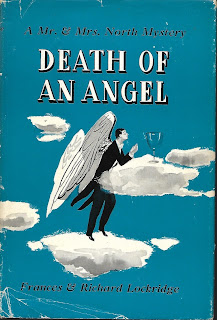
Death of an Angel


 Death of an Angel (1955) by Frances & Richard Lockridge

Pam & Jerry North find themselves plunged into a mystery in the theater world. Sam Wyatt, one of the writers in the North Publishing stable, has written a play called "Around the Corner" that has set Broadway on fire. And the Norths, for the first time ever, have played angel (in a very small way) and invested a small amount in the production. The show's star, Miss Naomi Shaw, shines in the production and it has just hit the 100th show milestone. The "nut" (initial production cost) is about to be paid off and that means that the profits are finally going to start pouring in. If everything goes right, Wyatt will have Hollywood studios fighting for film rights and the producer Wesley Strothers will finally have his big hit after a run of near-misses.

But then Bradley Fitch--wealthy playboy, polo star, and one of the show's biggest angels--throws a wrench into everybody's plans. Having gained access to the actors and, most particularly, the actresses, he's fallen hard for the play's star. He chooses the 100th night celebration party to announce that he and Naomi are going to be married.

"Going to seal your girl, cousins....Put her in my pocket."

And by that he means steal her right off the stage, in mid-run. The show will close and there will be no more standing room only crowds panting to see Broadway's biggest hit. He blithely suggests that they can just get another girl and go on with the show. But everyone knows that there's no way anyone could step into a role that Naomi Shaw had so clearly made her very own.

Naturally, a lot of people are pretty upset when the announcement is made. Sam Wyatt isn't precisely ecstatic to watch Hollywood dreams fade. Wesley Strothers is pretty sore that his big hit (finally!) won't run another night. Jasper Tootle, Naomi's agent, is pretty put out that he won't be getting a percentage on her contracts anymore. The other leads in the play, Phyllis Barnscott and Sidney Castle, aren't exactly thrilled to see the possibility of Broadway stardom going down the drain. But it isn't only professional feathers that get ruffled. Fitch's relatives, Mr. and Mrs. Nelson have counted on the perennial bachelor remaining single. After all, they're his nearest and dearest and most likely to benefit under his will...if he finally ties the knot then their dreams of owning that lovely penthouse apartment will go up in smoke. And...there's Naomi's ex-husband who stalks out of the 100th show celebration turned engagement party like he still has a personal stake in matters.

Well, of course, somebody decides this situation just won't do. So, the morning after Fitch throws a stag party to celebrate his forthcoming nuptials, his housekeeper finds him dead with the remains of a hangover cure beside him. A deadly dose of oxalic acid added to his pick-me-up has ended the threat to Broadway's latest hit. Enter Acting Captain Bill Weigand and Lieutenant Mullins who just happen to be on loan to Homicide East (due to a rash of emergency leaves). Of course, the Norths are in it too--from their connection to the playwright to the fact that one of their monogrammed cocktail napkins is found in Fitch's apartment. Bill naturally keeps them up-to-date on proceedings and Sam Wyatt keeps popping in to have his hand held--he's absolutely certain the cops are going toss him in jail at any moment.

This outing marks one of the few times that Pam is wrong. She normally jumps to the right solution, though following her thought processes is usually a bit tricky. But this time she is very surprised by Bill's selection of culprit. I have to say (even though I have read this before) that I was too. I was absolutely sure I had seen through the red herrings to correct culprit...only to be wrong. In fact, I'm pretty certain I picked the same person that I picked the last time. Again, thinking I'd cleverly avoided the pitfalls of false clues. Another fun outing with the Norths. ★★

First line: Naomi Shaw wore white--a white dinner dress which clung to her.

Last lines: But they must, Pam said, be very careful not to drink too much, even to celebrate. Because hangovers are so dangerous.

*******************

Deaths = 3 (one poisoned; two shot)


Sunday, March 13, 2022

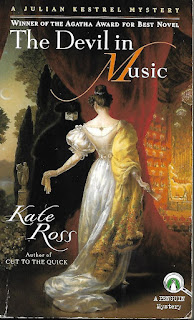
The Devil in Music


 The Devil in Music (1997) by Kate Ross

In a flashback to four years ago, Ross starts the story with Lodovico Malvezzi, an autocratic Italian aristocrat with an inordinate love of music--particularly singing. He delights in discovering little known talent, seeing the young singers trained, and then springing his protégés on the singing world. His most recent discovery is a young man who is referred to as Orfeo and he has never performed in public at all. He will be Malvezzi's most prized singer--an absolute unknown with the voice of an angel. He takes Orfeo and the Maestro Filippo Donati to his secluded castle where no one but trusted servants will see him Even his signing master will not see him because Donati is blind. 

While there, Malvezzi receives a strange package containing a jeweled glove and a somewhat threatening letter. There is also a growing tension between him and Orfeo. And then one night Orfeo disappears and Malvezzi is killed. But because of the growing threat of revolutionary trouble (something Malvezzi's stern rule helped keep at bay), the authorities agree that it would be best to declare the Marquis's death a "heart failure" (rather than a shot through the heart) while quietly hunting the missing singer. Everyone assumes that Orfeo's disagreements with his patron became heated enough that they ended in murder. Why else would he disappear on the very night Malvezzi was killed?

Four years later, Julian Kestrel, his servant Dipper, and his good friend Dr. MacGregor are touring the Continent. Julian intends to continue on to Italy when the doctor decides it's time to go home.When Julian, who has become a dab hand at solving mysteries, hears that the Marquis's death has finally been revealed as a murder and that the family and authorities are reopening the investigation, he offers his services. The family immediately take up his offer of help, but the police commissari Grimani is none to pleased at having a foreign amateur invading his territory. They do manage to work together in a somewhat wary manner. It isn't long before Julian reveals that there are more secrets to uncover than just who killed the Marquis and when a second murder occurs at the same castle, he and Grimani must find the links between the the deaths...before Julian himself becomes a victim.

This is the fourth and, sadly, final book in the Julian Kestrel series. Ross's final book was her best. The writing is sublime and she provides extensive information about Julian's somewhat mysterious past. Just as the singing of Orfeo surpassed that of all the singers Malvezzi had sponsored previously, so too does this novel surpass the other three. It is interesting to see Julian out of his English element and working even harder against the established police. He not only has to seek proofs of his deductions, he must provide proofs that the antagonistic Grimani will be unable to discount. He treads a tightrope and knows one false move could see him in prison for obstructing the police and Italian prisons are not as easy to get out of as English prisons. It isn't until the very end that we realize just how precarious that tightrope was. There are several unexpected and very interesting twists throughout the plot and I have to say that they were all very satisfying. I enjoyed this very much in 1997 when I first read it and I have enjoyed it even more 25 years later--though the enjoyment is bittersweet this time around. In 1997 I didn't know this would be the last mystery with Julian Kestrel. It is very sad that Kate Ross was taken by cancer just as she was hitting her stride in her writing. ★★★★ 

First line: Lodovico Malvezzi signed his name with a flourish and sat back to read what he had written: (full letter follows)

Last line: "All right, my dear fellow. Let's go home."

****************

Deaths = 4 (one shot; one natural; one stabbed; one asphyxiated)

Saturday, March 12, 2022

Murder Roundabout (spoilerish)


 Murder Roundabout (1966) by Richard Lockridge

The lovely Annette Weaver (née LeBaron, film star) had thrown a picnic on the Fourth of July. A lovely picnic...at least up until the point where she decided to tell all the residents of Van Brunt exactly what she thought of them. Over a loudspeaker. And now the lovely Annette was lovely no more. Shot through the neck, she's found dead in her own hallway--first the night before by a new real estate agent named Leslie Brennan, who is supposed to be showing the house to a prospective buyer (who doesn't show) and who doesn't report it, and then the next morning by Mrs. Weaver's cleaning lady, Harriet Larkin, who does.

Leslie receives a phone call from a Mr. J. K. Knight asking to be shown the Weaver house--which is up for sale. She arrives at the house at the designated time, but no one shows up. She decided to go in the house anyway to see if a message was left and is horrified to find Annette Weaver sprawled in a pool of blood. She is just about to call the police when she hears the roar of a familiar engine and rushes out in a panic to try and catch up with the car. She never does call the police and when questioned the next day (as one of several real estate agents who might have been there) doesn't reveal her adventures of the previous night.

Inspector Heimrich and Sergeant Forniss work their way through clues--among them the noisy sports car, the mysterious J. K. Knight who doesn't seem to exist, the many men (not her husband) that Annette had been seen wining and dining with, a missing realtor's house key, and Annette's distinctive voice--to weed out the red herrings. But not before the murderer makes one more, less fatal, attack. 

Spoiliers Ahead--Read at your own risk!

One of the limitations of the Lockridge books is that occasionally there are few suspects to be had. In this particular outing, there should have been plenty of suspects. After all, we went out of our way to set up the possibility with Annette Weaver blasting all her neighbors at that Fourth of July picnic. But it wound up being a pretty feeble attempt at a red herring. When all is said and done, the picnic fiasco has very little to do with Annette's death. We're left with basically two trails of suspicion and when one has read enough Lockridges one knows that one of the trails is a dead-end from the beginning. So--not much mystery about whodunit in this one. The plot could have been much more interesting (and intricate) if Lockridge had made more of the possible motives of the residents who had gotten blasted.

What keeps this one from a much poorer rating (for me) is the characters. Heimrich likes to say that the character fits the crime--making character a vital ingredient in his investigations. And, for me, if the characters are good enough, I can overlook other flaws, especially in a series that I have a great deal of affection for. The Lockridge books are comfort reading for me and I can forgive occasional missteps in their various series. I enjoy Heimrich and Forniss and watching them do their stuff. I like Ray Crowley and wish that we'd had a bit more of him in this one. And it's always a treat to watch Heimrich interact with his wife Susan. We also have nice bit of deduction involving voices and vocal imitations (somewhat reminiscent of the books that involve Professor Brinkley). ★★★ and 1/2.

First line: Leslie Brennan turned her car from the blacktop into the narrow road which served as driveway to the Drakes' big house on the ridge and to the smaller house which was Annette Weaver's.

Murder does not, by intention, make a racket about it. (p. 39)

Last line: "It's time," Susan Heimrich said, "that we have something to eat."

*************

Deaths = 2 (one shot; one natural)

Friday, March 11, 2022

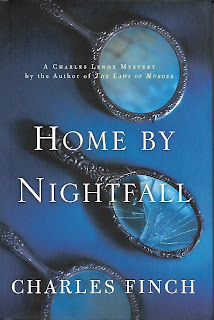
Home by Nightfall


 Home by Nightfall (2015) by Charles Finch

Charles Lenox finds his attention divided in this ninth entry in the series. All of London is agog at the mystery of the missing musician. Muller, the great German pianist, had disappeared from his dressing room during an intermission in his most recent London performance. He went into the dressing room, apparently drank a glass of wine, and vanished into thin air. There was only one way out of the theatre from the dressing room and he would have had to pass dozens of people backstage to leave. No one saw him. Every detective in London is looking for him--hoping to be the first to find the musician and win the favor of Scotland Yard, the public, and the Queen. Lenox and his partners are hoping to scoop their ex-partner and rival, LeMaire--especially since LeMaire has sunk to the all-time low of stealing their clients.

Additionally, Lenox feels like he needs to accompany his brother, Edward, to the family country seat. Edward has recently lost his wife to a sudden fever and is headed to the country to attend to the estate. Lenox is worried about Edward and doesn't want him to go alone. While they are in Markethouse, a spate of petty thefts occur and Lenox enlists his brother as an assistant detective--thinking that the distraction will do him good. Some of the incidents are accompanied by an odd chalk drawing and the circumstances take a vicious turn when the mayor is attacked with a knife and not expected to live. It isn't long before the two cases provide two murders for the detectives to solve.

I still enjoy Finch's writing and I've become very attached to his characters. I do wish that we had seen more of McConnell, Dallinger, and Lady Jane in this one. It seemed to me that Lenox was spread a bit too thin--trying to solve cases in two different locations and two cases that have nothing to do with one another was a bit much. It was difficult for me to keep my mind on the case most immediate in the narrative and I was constantly wondering when we'd get back to the musician. For all Muller's celebrity, he really got short shrift in this story. A pleasant read, but not Finch's finest. ★★

First line: It was a blustery London morning in the autumn of 1879, wind and rain heavy in the trees lining Chancery Land, and here, damn it all. stood before Charles Lenox, something that nobody should have to tolerate before breakfast: a beaming Frenchman.

Last line: It was his son, Teddy, thank God, and that meant that Edmund's family, what family he had left, would all be home for Christmas.

****************

Deaths = 4 (one poisoned; one stabbed; two natural)

Wednesday, March 9, 2022

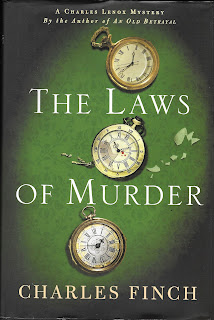
The Laws of Murder


 The Laws of Murder (2014) by Charles Finch

Charles Lenox has left Parliament and thrown his luck in with John Dallington, Polly Buchanan, and LeMaire to open the first cooperative detective agency. Things don't go well from the start. The newspapers seem to have a made a dead set against them and even former friends and colleagues at Scotland Yard are quoted making disparaging remarks about the venture. Lenox, in particular, seems to be a target and as the agency gets underway few cases come his way.

But worries about the agency are put aside when Inspector Jenkins is found murdered and Inspector Nicholson comes to ask Lenox to help investigate. Apparently Jenkins left a message that if anything happened to him, Lenox was to have all his notes and should be allowed to help investigate. Lenox absolutely wants to avenge his friend's death....and, of course, also hopes that a successful investigation will bolster the agency's reputation. It's hard going, though. Jenkins's notes have disappeared and the only thing found on his person is a claim ticket that doesn't seem to belong to any of the usual places for stashing items. 

When Lenox realizes that Jenkins was killed just opposite the house of Lord Wakefield, a man they had been trying for years to find evidence enough to convict of many crimes, he suspects a connection. But then Wakefield is found dead as well and all of his ideas are turned upside down. It will take all of his powers of detection...as well as that of his partners and Inspector Nicholson...to connect all the pieces of the puzzle and identify the culprit behind Jenkins's murder.

Not a fan of letting a primary villain of the piece off easy. When the mystery was wrapped up a couple of chapters before the book ended, I had hopes that more details would come to light and Mr/s. X would get their full desserts. Well...more details did surface, but they didn't do anything to secure Mr/s. X's conviction of the murder. Instead we wind up with someone else who is involved committing suicide by poisoning (while in jail!) and writing a "confession" to take all the blame. So our culprit gets off with a slap on the wrist for lesser charges.

I also didn't much care for the use of Jenkins to make life difficult for the fledgling detective agency by giving them bad press for money. Jenkins seemed to be more honorable than that (in previous books) and also seemed to be far more friendly to Lenox and company. I just don't see him doing it--I don't care what bills were due. And speaking of the fledgling detective agency, Lenox is a bright man. I didn't find it terribly realistic that his skills would have deteriorated that badly while he was in Parliament--especially since he kept his hand in and was involved in several cases while he was serving in the government. Not to mention keeping up with Dallington and discussing his cases. The whole difficulty among the partners in the agency was a bit off-putting. 

[As an aside and as I've mentioned in reviews of previous entries in the series...I wasn't enamored with the story line with Lenox in Parliament over the last few books. He was a good detective. He enjoyed detecting. I wish we could have just let him keep on detecting without sidetracking off into government.]

The mystery itself was solid enough and I appreciated the good detective work that was done (once Lenox stopped bemoaning the fact that his skills just weren't what they used to be and we got away from meetings where it was underlined that he wasn't pulling his weight). There were some nice twists and with a few more bits of good solid evidence, Lenox and Inspector Nicholson could have tied all the criminals up quite nicely. ★★

First line: A late winter's night in London: the city hushed; the last revelers half an hour in their beds; a new snow softening every dull shade of gray and brown into angelic whiteness.

Last line: He closed the door behind him as quietly as he could--his heart filled with happiness.

******************

Deaths =  5 (two shot; one fell from height; two poisoned)

Tuesday, March 8, 2022

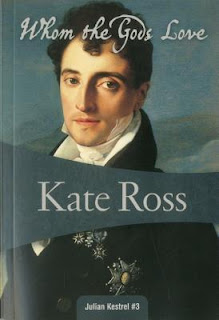
Whom the Gods Love


 Whom the Gods Love (1995) by Kate Ross

When Alexander Falkland is murdered in his own study while a house party was in full swing just a floor above, his father Sir Malcolm Falkland asks Julian Kestrel to assist the Bow Street Runners in bringing his killer to justice. Sir Malcolm adored his son--a man he thought perfect in every way. Perfect in looks, accomplishments, marriage, and in choosing to follow his father into the law as a profession. But obviously someone thought Alexander less than perfect. Someone hated or feared him enough to strike him down with a poker.

Julian accepts the commission, but not before warning Sir Malcolm of the consequences.

You must realize, Sir Malcom, these investigations can turn up painful, even shocking information....I shall ask impertinent questions, respect no one's privacy, treat nothing as sacred, and everyone not absolutely cleared as a suspect. I don't say this to alarm you--merely to make you see that, in embarking on an investigation like this, you must ask yourself, not merely what the truth is, but whether you wish to know it.

The lawyer assures him that he wants nothing but the truth, no matter what it is, where it leads, or to whom the finger of guilt points. That assurance will be tested more than once as the investigation progresses--for it soon becomes clear that Sir Malcolm didn't know his son at all and few people did. 

Alexander was heavily in debt and his new friend David Abrams had bought up all his promissory notes...and then forgave them, apparently without requiring payment. But there is more than one way of paying off a debt. It's also proven that Alexander wasn't nearly the devoted husband that he liked to play in front of the world, and his tastes in extracurricular activities don't bear great scrutiny. And then there is the fact that he wasn't the scholar and devoted law student his father thought him. He had some sort of hold over Quintin Clare (a fellow law-clerk) and Clare is the one who wrote knowledgeable letters to Sir Malcolm and who primed Alexander with topics to discuss in the lawyers' dining hall. It seems that Alexander Falkland was a fraud in nearly every area of his life. But which area was the one that brought about his death? 

When Alexander's widow is thrown from her horse, resulting in the loss of the child she was carrying and it's found that her saddle had been tampered with, it looks as though someone wants to wipe out all trace of Alexander...including his unborn child. Julian fears for Belinda Falkland's safety and redoubles his efforts to find a clear trail to follow among the various byways in Alexander's hidden life. And he wonders again whether Sir Malcolm will want the truth once he finds it.

The Julian Kestrel series just gets stronger with each book. The mystery here is tightly plotted and Ross expertly brought all the threads together to create a solid fabric. Great period details and interesting, well-rounded characters. Alexander is the least vivid--more a caricature of the ultimate bad hat, yet still a good focal point for the plot. Julian's detective work is the most workmanlike of three novels so far--perhaps because he's working closely with Vance, the Bow Street Runner. He sets down a timeline of who was where when and checks witness statements against one another. He spends a greater amount of time interviewing the principle witnesses/suspects and discovers several material clues. A very nicely put together mystery. ★★★★

First line: Go through the holly archway, Sir Malcom's letter had said, then take the long, straight path, past the church.

Last line: And so it happened here.

****************

Deaths = 5 (two hit on head; one throat cut; one accident; one natural)

Clue


 Clue (2018) by Paul Allor

A little further down that internet rabbit hole, I found another graphic novel based on the classic board game and a very meta presentation of the story. This adaptation adds a few characters including our narrator, the butler Upton, as well as one more colorful suspect (Dr. Orchid) and two colorful detectives (Ochre & Amarillo). Upton continually breaks the fourth wall--addressing not only the reader, but also the writer and the editor. In some ways it is an intriguing concept, but his recurring complaints about flashback scenes did get old very quickly.

The story line based on Big Pharma and all its various links to government, military, etc. was interesting and very topical. But it didn't really grip me. And, I'm afraid I'm a bit old-fashioned, but the whole idea of Clue (the game) was that it was based on those nice, tidy little country house mysteries of the 1930s and 1940s. There is just a bit too much gratuitous graphic violence going on here. I understand what the writer was going for in the last few pages...but it doesn't mean I found it satisfying. This, like the previous graphic novel, was a fairly decent read, but not quite what I was hoping for. I would appreciate a really clever twist on the country house mystery in comic form...After reading two graphic novels, I'm still looking. ★★

First line: Ominous. You may think our guests stupid, or even daft, to venture out on a night like this.

Last line: After all...I did say NO witnesses.

***************'

Deaths = 10 (one shot; three hit on head; four stabbed; two fell from height)

Monday, March 7, 2022

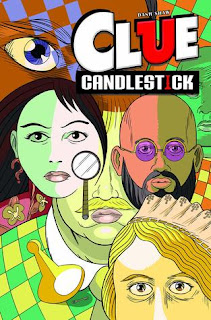
Clue: Candlestick


 Clue: Candlestick (2020) by Dash Shaw

Shaw has taken the classic Clue board game and created a story based on the characters. There are clues dropped throughout and there are puzzles to solve that will help the reader discover the ultimate culprit. But it isn't just a matter of saying "Colonel Mustard in the billiard room with the lead pipe." There are several murders and it isn't necessarily so that they all were committed by the same hand. So watch out for red herrings and false villains.

 So...I went down an online rabbit hole searching for an e-copy of Nancy Drew and came up with this graphic novel based on the mystery board game. The plot is basically okay and the mystery is pretty good for story length. But...I don't really think Shaw has captured the feel of either board game or the 1985 movie. Which may have been the point--but for those of us who grew up on the game and who really enjoyed the movie, it was a bit of a let-down. It seemed a bit odd for Shaw to give us a whole essay at the end where waxes nostalgic about playing the 1972 version of the game (the version I myself played for years) and then to miss the mark in creating a story about it. ★★

First line: Wind blows through the windowsill, creating an eerie whistle.

Last line: What I mean is, to me--you're good.

***********

Deaths = 7 (one shot; three hit on head; one poisoned; one stabbed; one died in fire)

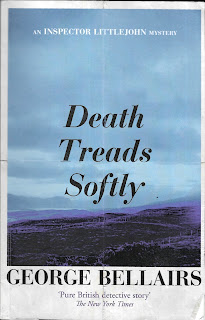
Death Treads Softly


 Death Treads Softly (1956) ~George Bellairs (Harold Blundell)

Chief Inspector Littlejohn escorts Finlo Crennell, the ex-harbormaster of Castletown, back to his home on the Isle of Man. Crennell went missing a week ago while on his nightly constitutional along the harbor. His friends all thought he'd slipped and fallen in--and been dragged out to sea. But he shows up in London with an empty memory and a constant smile on his face. He doesn't speak and shows no real interest in his hometown or anyone who is there to greet him when he arrives--not even his housekeeper (and distant cousin) whom he has known all his life. But he does have some sense of his surroundings--heading straight for where his pipe is kept and sitting in his favorite chair to have a smoke.

The doctor declares him physically sound and makes plans to have him taken to hospital the next day to see what can be done about the memory. Littlejohn, duty dispensed, plans to spend the night with his old friend Reverend Kinrade, the Archdeacon of the Isle of Man, and then return to London in the morning. But neither the doctor nor Littlejohn will see their plans fulfilled. 

Later that evening, Mrs. Cottier (the housekeeper), thinking that Crennell is settled nicely, goes out to get him some beer for his usual last drink of the evening. While she's gone, habit takes over for the ex-harbormaster and he once again sets off for a evening's stroll to his favorite pub (with, I'm sure, the aim of following it with a walk back along the harbor). It's the last stroll he'll ever take. He's found outside the pub--shot in the head. Littlejohn is asked to stay on and help Inspector Knell with the investigation and the two men immediately revise their views of Crennell's earlier "accident." Someone wanted the man out of the way and wasn't taking any chances this second time. Who would want to kill this inoffensive, generous man--everyone they interview speaks well of him. And then Crennell's son-in-law is killed in exactly the same manner, though found in an abandoned farmhouse. What do the ex-harbormaster and a bankrupt farmer have in common that could result in murder?

Each Littlejohn mystery I read seems better than the last. Bellairs is rapidly moving up the list of favorite Golden Age authors. Which is very pleasing because there are so many of the Littlejohn series available through various reprint means. This is apparently Littlejohn's second (maybe third?) visit to the Isle of Man--but it is the first that I've read. Bellairs does an excellent job acquainting us with the locale and the general environs. He also gives us an interesting cast of characters from Littlejohn's friends Knell and Kinrade to the family and friends of Crennell. They are a quirky lot who all seem to keep something back from the police. It is very intriguing to watch Littlejohn get round their reticence and dig deep into the secrets behind the murders. 

This outing was, I think, Bellairs's most fairly clued and neatly plotted that I've yet read. He manages to keep suspicion spread about for quite some time despite a small cast of suspects. I did spot the villain of the piece, but I didn't pick up a couple of clues that would have told me the real motive. A clever classic police procedural. ★★

First line: Saturday November 6th. The King Orry, Liverpool to Douglas, Isle of Man, ploughed her way through seas the colour of lead under heavy skies.

Last line: He closed the vicarage door behind him and followed the parson in.

****************

Deaths = 5 (three shot; one drowned; one natural)

Sunday, March 6, 2022

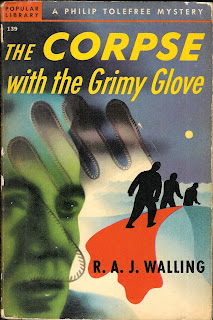
The Corpse with the Grimy Glove


 The Corpse with the Grimy Glove
(aka More Than One Serpent, 1938) by R. A. J. Walling

This is the 15th entry in the Philip Tolefree series, but it's my first introduction to Walling's insurance agent cum private detective. Tolefree is an intelligent, upper-class investigator who knows how to be discreet. His adventures are told by his "Watson" James Farrar. Farrar is the one who gets Tolefree involved in the current mystery. His old acquaintance Arthur Treglohan invites them to Bosenna, a small seaside town, which lives in the shadow of Lanivet Castle and Sir James Lanivet. Treglohan is the parson of Bosenna rectory and is acting at the behest of Lanivet's sister, who fears that her brother is caught up in some murky doings. 

He asks Farrar to bring along his friend "with some skill in puzzling out mysteries" in the hopes that Tolefree will be able to discern what hold an unsavory financier by the name of Tenterton has over Sir James. Miss Lanivet can think of no good reason why her brother would invite such a man to a shooting party with their own friends--especially when it is obvious that everyone in the party has reason to hate Tenterton. She wants Tolefree to protect her brother, but it soon becomes obvious that Tenterton is the one who is afraid. With good reason...

Tragedy strikes during a fireworks display on the Lanivet estate. Tenterton is found bound and gagged, with bruises around his neck, wearing one oil-smeared white glove and a bullet hole in the middle of his forehead. Everyone was milling about the place all evening and no one can say where anyone else was for sure. Tolefree knows that the servants and friends and even the townspeople all have deep loyalty to the Lanivet family and won't say anything that might implicate someone up at the castle. He also knows that there is much to be explained before the truth will be found. Such as...who are the three young men in sailing vessel off the coast and why do they take stealthy skiff voyages up the waterway leading to the castle? Why hasn't Lanivet said anything about the shot that nearly hit him in the woods? Why did it take so long for the footman John to report seeing Tenterton's body on the tennis court? What was the round object that Tolefree found in the dust near where the financier had been shot? And what is the previous case that this one reminds Tolefree of so much?

I do enjoy Walling's style and story-telling. And I really like Tolefree and Farrar and their interactions with each other and the cast of characters. The plot is intricate and interesting, but I don't think Walling plays fair. Tolefree takes a leaf out of Holmes's book--keeping clues to himself. Until he springs his deductions on us, there really isn't any way for the reader to know what the motive is. I identified the culprit...but I couldn't have given you solid reasons why simple because Tolefree is holding many of the reasons/clues so close to his chest. Entertaining. And I am looking forward to the four other Walling titles sitting on Mount TBR. ★★ and 1/2

First line: That a clergyman started Tolefree on the inquiry which led to his unravelling of the tangled horror of Bosenna was not the least unusual feature of the extraordinary affair.

How easy sleuthing would be with an invisible cloak. (Philip Tolefree; pp. 22-3)

Next time I think we'll keep out of range. Detectives are more useful alive than dead. (Tolefree; p. 25)

Last line: We know the most secret man who ever brewed beer, and the smartest young woman who ever lost her memory, and the only parson who ever went to paradise before his time.

**************

Deaths = 5 (two shot; one airplane accident; one hanged; one drowned)