

Thursday, March 3, 2022

Calamity at Harwood


 Calamity at Harwood (1945) by George Bellairs (Harold Blundell)

The bulk of the story is set in 1939 and the war is just heating up for Britain. The blackout is prevalent and women and children have been sent out of London. Before we get to the main thread, we're given a prequel. We see Mr. Solomon Burt (nĂ© Bernstein), a real estate developer, get stranded near the Harwood manor house. While his chauffeur fiddles with the car engine, he decides to take a stroll and explore the area Though the grounds are not all they should be and the house is in disrepair, Burt immediately sees possibilities. And though the owner says he'll never sell, the canny businessman soon has possession. 

He has envisioned a renovated manor house with luxury flats, immaculate grounds, a swimming pool, tennis courts, and all the comforts that the well-to-do would like in a little country get-away. Work begins, but all is not smooth sailing. Wiring is pulled out, water pipes burst, and an ornamental ceiling caves in. The locals talk of ghosts and poltergeists, but Burt doesn't believe in such nonsense (and can't afford to--he must get the flats done and get some wealthy residents). Finally, the outbursts cease, the renovations are complete, and all eight flats are leased--with Burt taking one for himself.

All but one resident (who is abroad and will move in later) get settled in and it looks like everything is turning out just as Burt planned. But then...the ghosts and poltergeists start in with a renewed vengeance. Appliances are turned upside down and placed in the sink in one apartment. Another resident's pantry is demolished and all the china broken. One couple hears the sound of dice-playing all night (apparently there was a Regency-era gaming hell in the house at one time). And another resident experiences blasts of hot and cold air. Barring Miss Elaine Freyle, a West-end actress, all of the residents insist they'll not let ghosts and ghoulies run them out of their cushy new digs. Miss Freyle breaks her lease and leaves.

Mr. and Mrs. Carberry-Peacocke are amateur psychic researchers, so they are pleased as punch. They hold seances and even get their neighbors, Mr. and Mrs. Hartwright interested. Professor Braun, an Austrian refugee and anthropologist, is too grumpy to allow mere ghosts interfere with his work--besides, he says he hasn't heard any of the disturbances. Mr. Williatt is a writer and sees the whole thing as an experience made for putting into fiction. And the Misses Pott are stubborn spinsters who refuse to be scared off. Besides ghosts can't really hurt anyone...can they?

Apparently they can. Because one night a couple of Regency-era spooks show up in Mr. Burt's bedroom. They hustle him outside, force him to disrobe, and plunge into the icy pool. While he's getting himself back on dry land, the ghosts disappear--along with his clothes. He finds a couple of burlap sacks left behind by the workmen and manages to make himself fairly decent. But after he manages to get himself back into the house and upstairs, the lights go out, there's a loud crash, and the next thing the residents know is that Burt has fallen from the upper story and broken his neck.

Enter Inspector Thomas Littlejohn of Scotland Yard. As soon as the doctor examines Burt, we know that murder has been done. The developer was socked over the head before being dropped off the second story landing. Littlejohn is certain that there is more to the ghostly visitations than meet the eye and he wonders if Burt stumbled onto something worth killing for. The locals make his investigations difficult at first, remaining loyal to the Harwood family (even if they are no longer in residence), but once he can get them to talk he's able to clear away much of the extraneous matter--leaving him with indications that the luxurious manor house may be sheltering a cell of Nazi sympathizers. When he finds the murderer, he just may find an espionage ringleader as well.

This was great fun and a different sort of Littlejohn story from those I've previously reviewed. The mystery of the poltergeists/ghosts was easily handled, but it was cleared up in order to make way for the more intricate espionage/thriller plot. I thoroughly enjoyed Littlejohn's investigation into Nazi fifth-columnists and the story was worth it just for the scene where the country policeman takes out one of the spies with a nicely bowled stone (using his excellent cricket skills). I also enjoyed the information gained about Britain during the early days of the war--adding to what I already knew from other period mysteries. All-in-all one of my favorite Bellairs books to date. ★★

First line: One afternoon in the late autumn of 1938, the large, flashy car of Mr. Solomon Burt (nĂ© Bernstein) came to a halt on the London-Brighton road.

Last lines: "It's been a rest and a change," said Littlejohn as they stepped into the blackout again. "What are you laughing at?"

****************

Deaths = 9 (one fell from height; two car accident; two shot; three hanged; one hit by a bell)


Wednesday, March 2, 2022

March Reading by the Numbers Reviews


You are invited to the Inlinkz link party!

Click here to enter

March Mount TBR Reviews


You are invited to the Inlinkz link party!

Click here to enter

March Virtual Mount TBR Reviews


You are invited to the Inlinkz link party!

Click here to enter

March Vintage Scattergories Reviews


You are invited to the Inlinkz link party!

Click here to enter

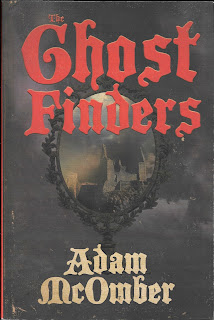
The Ghost Finders


 The Ghost Finders (2021) ~Adam McOmber

The Ghost Finders firm, founded by Phillip Langford, consists of Henry Caxton, Violet Asquith, and Christopher X. Phillip rescues Henry from the gutters of London and sets him up as an occult detective. They add Violet, a telekinetic whose mysterious past will soon catch up with her, and Christopher, a monstrous being with an unknown past and werewolf-like qualities. They take up paranormal (abnatural in the book) investigations--tracking down ghostly figures on horses, the "Up-Train Terror" (which manifested in a dark tunnel) and a tree-climbing pig, among others. 

Things get really interesting and dangerous when the mysterious Sister Rose, a black-bonneted woman, begins dogging Violet tracks and the ghost finders find themselves drawn into a trap that may put a permanent end to their investigations. Each of our characters have a part to play--even the Ghost Finders' housekeeper Mrs. Hastur. How has Violet's training under her father's guidance prepared her for the trial to come? Has Henry received all the preparation he should have? Does it matter that Christopher can't remember anything about who (what) he was before meeting Henry. And what is the job that Mrs. Hastur tells him he must do? What plans do Sister Rose and the "New Lord" have for them? And who is this New Lord that is behind all the mysterious events? What is the dark mirror and can it really be controlled? Or will it destroy everything the Ghost Finders hold most dear?

This is a wonderfully gothic, horrifically fun mysterious adventure. The three main characters are vividly drawn with interesting backstories that are at once disparate, yet also fitting together so perfectly to provide friendship and kinship among these three wildly different individuals. The separate histories weave together to create the fabric necessary for the final scenes. It was interesting to watch these three work their way through various layers of loyalty and betrayal to discover what is necessary to save themselves...and perhaps all reality. 

McOmber is a compelling storyteller. He creates a gaslit world with fully realized characters with complicated stories & complicated relationships and an urgent sense of place. One opens the book and immediately steps into a world of gothic creatures and paranormal manifestations....and it all seems perfectly normal. One shouldn't be surprised by a seven-foot giant with a dog-like head or bones that become animated or men who survive a fatal knife blow. And one isn't because McOmber has created a believable world where anything could happen...and does. ★★ and 1/2.

First line: Storm clouds over the rookeries at Spitalfields.

Last lines: I shook my head. "I think we better get our coats."

****************

Deaths = 10 (one natural; two accident; two shot; one attacked by creature; one drowned; two stabbed; one suffocated)

Tuesday, March 1, 2022

February Pick of the Month


Well, so far I'm holding steady in my reading pace. I came up just shy of January's total with 22 books this month and all but one of those were mysteries. If I can keep that twenty-something pace up, I should get to plant a flag on top of Mount Olympus on Mars again for my Mount TBR Challenge. Fingers crossed. Of course, keeping the quantity high, is quality suffering? It did a bit in January. February saw no DNF or one-star books, so that was an improvement. That said, the books were still a mixed bag...several two-star showings and no five-star winners at all. Still looking for a knock-out read.... Here are the February stats:
 
Total Books Read: 22
Total Pages: 5,217

Average Rating: 3.23 stars  
Top Rating: 4 stars 
Percentage by Female Authors: 36%
Percentage by Male Authors: 59%
Percentage by both Female & Male Authors: 5%
Percentage by US Authors: 59%

Percentage by non-US/non-British Authors:  5%
Percentage Mystery: 95%
Percentage Fiction: 95%
Percentage written 2000+: 14%
Percentage of Rereads: 32%
Percentage Read for Challenges: 100% {It's eas
y to have every book count for a challenge when you sign up for as many as I do.}    
Number of Challenges fulfilled so far: 7 (22%)
 
Mysteries Read
The Murder Game by Steve Allen (3.5 stars)
Murder Begins at Home by Delano Ames (3 stars)
Death Stops the Frolic by George Bellairs (2 stars)
He'd Rather Be Dead by George Bellairs (3 stars) 
Surfeit of Suspects by Georgee Bellairs (3 stars) 
Midnight Sailing by Lawrence G. Blochman (3 stars)
Death Walks in Marble Halls by Lawrence G. Blochman (4 stars)
This Club Frowns on Murder by Albert Borowitz (2 stars)
Murder at the Spring Ball by Benedict Brown (3.5 stars) 
Sad Cypress by Agatha Christie (3.5 stars)
The Golden Box by Frances Crane (3 stars) 
Portrait of a Dead Heiress by Thomas B. Dewey (2 stars)
Midsummer Nightmare by Christopher Hale (4 stars) 
The Murderer Who Wanted More by Baynard Kendrick (3 stars)
The Dishonest Murderer by Frances & Richard Lockridge (3.5 star)
Clutch of Constables by Ngaio Marsh (3 stars)
The Egyptologist by Arthur Phillips (2.5 stars)
A Broken Vessel by Kate Ross (4 stars)
Clouds of Witness by Dorothy L. Sayers (4 stars) 
The Five Red Herrings by Dorothy L. Sayers (3.5 stars) 
Murder Must Advertise by Dorothy L. Sayers (4 stars) 

 
And now for our Pick of the Month Award for mysteries. Sayers, much as I love Lord Peter Wimsey, is out. Those were all rereads--and very recent rereads at that. And Sayers has won in the past. Kate Ross just grabbed the P.O.M. Award in January for her slightly stronger debut book, Cut to the Quick. The two remaining four-star selections are Death Walks in Marble Halls by Lawrence G. Blochman and Midsummer Nightmare by Christopher Hale (Frances M. R. Stevens). This really is a difficult choice because both of these are delightful. 
 
The Blochman is a novella-length story put out in a ten cent bound edition by Dell (of Mapback fame). It has a tight plot with good clueing and interesting peripheral characters packed into 64 pages. And Blochman does a great job of describing the NYC library with enough detail to figure out where who was when. Hale's Nightmare is set in a fictional area just outside of Grand Rapids, Michigan, an area very familiar to me as my maternal grandmother lived in a small town north of there. She gives us interesting characters and manages to introduce a double romance story line that well-done and does not overshadow the mystery. The plotting is so well done that I'm on the hunt for more Lt. French novels. And I think perhaps that is the tipping point...I ended my review by saying that Midsummer Nightmare had added Christopher Hale to the list of authors whose books must be found. So, the winner of the February P.O.M. Award is....


Sunday, February 27, 2022

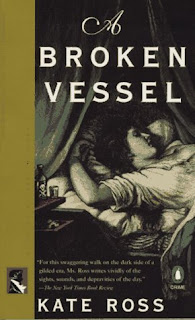
A Broken Vessel


 A Broken Vessel (1994) by Kate Ross

Regency dandy Julian Kestrel is brought into a second mystery--this time by the sister of his valet, Thomas "Dipper" Stokes. Sally Stokes is a girl on the game, has been ever since their parents died and she and Dipper got separated. Dipper (his name from his pickpocketing ways) was rescued from a life of thieving when he lifted Kestrel's "ticker" and rather than prosecute the lad for taking his watch the gentry-cove decided to hire him as a servant. 

When Sally has a busy night with three gents she names "Blinkers," "Bristles," and "Blue Eyes," she does what she always does--lifts a handkerchief as a bit of remembrance (the money the hankies bring in is even better for remembering...). Blinkers turns out to be a bit rough and leaves Sally bruised and battered after their encounter. Fortunately, she runs into her brother when she's back out on the street and he takes her home so he can have a doctor check her over. He doesn't expect his master to be at home, but Julian surprises them both and takes an interest in Sally's welfare. He also returns her property to her...the hankies and the money she had stored in her petticoat pocket had managed to fall out. But when he also hands her a letter found among the handkerchiefs, she claims no knowledge of it. It must have been caught up in the hankie when she lifted it. 

But which one? That becomes an important question because when the letter is read it's obvious that there's an urgent mystery to be solved. The letter is unsigned but clearly the woman who wrote it is in great distress. Sally tells Julian everything she can remember about the three men and he soon identifies one of them. Other clues lead him to the Rev. Gideon Harcourt's Reclamation Society--a "shelter" for fallen women. Sally volunteers to go undercover as a fallen woman looking to be saved, but they are too late. The author of the letter is found dead the very morning Sally presents herself to be reclaimed. What was to be a rescue mission is now a murder inquiry, but there are other mysteries surrounding the three men and the Society and Julian will need to sift the clues carefully to find killer.

I first read the Kate Ross books back in the 90s when they first came out and enjoyed them thoroughly. It has been very nice to revisit these books to see if they still stand up after about thirty years. And they do. The research is impeccable and Ross uses the lingo of the Regency period with ease. She also uses the phrases in such a way that the reader can easily determine what is meant from context and can be very comfortable with the language. 

This outing gave us a fiercely independent young woman in Sally who helps the investigation in very definite ways that neither Julian nor Dipper could accomplish. She makes an excellent addition to the team of detectives and it isn't just Julian and Dipper who are sad to see her go at the end of the story. But she's used to being on her own and doing as she pleases and it's obvious she can't be tied down in one place for long.

The mystery itself is interesting and complex with a couple of side issues to muddy the waters nicely. One has to figure out which of the threads lead to the main issue (the woman who wrote the letter and later died) and which don't. Nicely done. ★★

First line: The man trudged along the pavement with his hands clasped behind him and his eyes on the ground.

There's no second-guessing what's past, or knowing what might have made a difference. It's arrogant, it's a waste of time, and there's an end to it. (Dr. MacGregor; p. 84)

He's doing evil in the cause of good, which is one of life's most exquisite pleasures. One has all the enjoyment of getting up to mischief, and none of the guilt. (Julian Kestrel; p. 196)

Last line: "But now she knows where to find us, she'll be back--Newgate seize me if she won't!"

****************

Deaths = 7 (one poisoned; three natural; two hanged; one fell from height)

Saturday, February 26, 2022

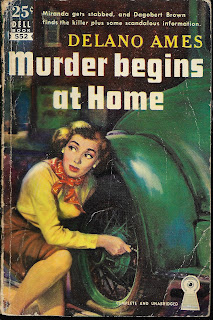
Murder Begins at Home


 Murder Begins at Home (1949) by Delano Ames

Jane and Dagobert Brown arrive in the United States with the aim of visiting his Aunt Clotilda in Detroit. Dagobert seems to think the best way to get there is to buy an old jalopy in New York and head for New Mexico. And, of course, that wouldn't have anything to do with the fact that Miranda Ross, a beautiful WAC Dagobert met in World War II, lives on a ranch in Alamogordo, NM. Certainly not. But the Browns don't exactly get a warm welcome when they first all up Miranda from Pa Fergusson's gas station. Miranda seems vague on her memories of Dagobert and just couldn't possibly put them up...but then, suddenly, she changes her mind and invites them to stay for the weekend. It's only Thursday.

So...they wind up with an assortment of other house guests--from Miranda's younger sister Peggy and her beau, Bill McFarlan to her protégé, the successful Dwight Karnak and his wife Sue. Though Miranda's family and friends and hangers-on all sing her praises, it soon becomes apparent that she's not as well-loved as it seems. And when she's found stabbed to death one morning Dagobert turns detective to help Pa Fergusson (Deputy Sheriff as well as gas station owner) solve the crime.

I really enjoy the relationship between Jane and Dagobert. The witty back and forth and the way that Jane absolutely understands her husband. The character of Pa Fergusson was very well-drawn as well. The rest of the cast--especially the "sainted" Miranda? Not so much. And the plot just didn't seem to pick up as quickly as in the Ames books I've read previously (She Shall Have Murder and For Old Crime's Sake). It seemed to drag a bit in the first third of the book. But it did have a nicely done solution and I enjoyed watching Dagobert work everything out and explain it. ★★★

First lines: Dagobert has an aunt named Clotilda who lives in Detroit, so when we disembarked in New York, we bought a secondhand car and drove to New Mexico. "It's more or less on the way," he explained.

Last line: "Because you're going to learn this is a law-abiding country."

***************

Deaths = 3 (one stabbed; one fell from height; one poisoned)

Friday, February 25, 2022

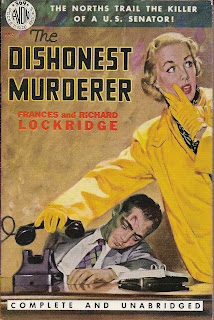
The Dishonest Murderer


 The Dishonest Murderer (1949) by Frances & Richard Lockridge

It's New Year's Eve and Freddie (Winifred) Haven is ready to celebrate...not just a new year, but a new beginning. The party is being held in honor of her engagement to Senator Bruce Kirkhill. But things begin to go wrong before the midnight revelry begins. As they are making final preparations for the party, her father, Admiral Sattrbee, is acting a bit odd, haltingly asking whether she's sure about this engagement, and then she accidentally overhears part of his telephone conversation with an unknown man. A conversation that seems to be about her fiancé. Then Bruce doesn't turn up at "ten-ish" as expected--nor at eleven-ish or midnight. When the party is winding down, a policeman arrives with the news that man, whom they hope very much isn't the senator (but by implication they very much believe is...), has been found dead in very unfortunate circumstances. And could someone come and verify whether the man is Kirkhill or not? It is.

Now, of course, this is a Pam & Jerry North story--so where do they come in? Well, as it happens, Admiral Satterbee is preparing to publish his memoirs and has naturally decided to do so with North Books. Pam & Jerry were invited to the New Year's party and stopped in for a while. Pam's radar went off and she knew that Freddie was worried about something and, being Pam, had been especially nice to the young woman even though she and Jerry had to rush off to another party. Bill Weigand (who seems to catch all the calls for murder in New York City) is on the case. And when a rather disreputable little man shows up at the Satterbee apartment to see her father, Freddie gets even more worried and hares off to the Norths apartment to ask Pam's advice...because somebody had once mentioned to her that "those Norths are amateur detectives...or something."

Senator Kirkhill was found in a seedy section of town, wearing worn and scruffy clothes. He had died from chloral hydrate. One might think that he'd run into trouble of some sort down in the Bowery, but Weigand and company focus on the senator's associates, friends, and family-to-be--because everyone seems to be hiding something and one of them just might be hiding the guilty knowledge of murder. He also happens by the Norths' apartment while Freddie is there and wonders why she's so frightened. Not that she'll admit it him. But Weigand will find out in the end...and he'll get his killer too.

Another light and breezy adventure with the Norths. My memory of this one must be better--or I was just very astute today--because I spotted the culprit right away (as I recall, I spotted them right off the first time I read it, many moons ago). But this didn't prevent me from enjoying myself thoroughly. I love reading the Lockridge books when I need a light, comfortable story. And, I had forgotten the slight twist at the end--where Freddie Haven gives Pamela North a run for her money on figuring out what the culprit is doing while they're doing it. Great fun! 

First line: There is nothing to worry about, Freddie Haven told herself.

Last line: Because usually it isn't, Pam North told herself, rounding off her thought, as she always liked to do.

***************

Deaths = 2 (one poisoned; one shot)

Thursday, February 24, 2022

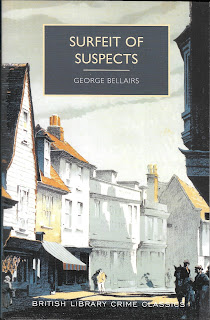
Surfeit of Suspects


 Surfeit of Suspects (1964) by George Bellairs (Harold Blundell)

The growing town of Evingden is rocked by explosion one November evening. It blasts the windows out of shops and houses and completely destroys the offices of the Excelsior Joinery Company, as well as reducing the number of directors from five to two in one fell swoop. When the arson experts get done investigating, it's clear that someone has used dynamite to blow up the building. Did someone have it in for the company--or these particular directors? Or maybe it was more personal and two of the men were caught in a plot aimed at only one of them? Chief Inspector Littlejohn of Scotland Yard is dispatched to get to the bottom of the mystery. He discovers that the company was in deep financial trouble and that the directors had sunk everything they had into trying to save it. He also discovers that a life insurance policy taken out on one of the victims (with their lending bank as beneficiary) will save the company from ruin. Could that be the motive? But as he and Inspector Cromwell keep digging, they unearth more skeletons in the Evingden closets. And one of them was definitely worth killing for.

Surfeit: (noun) an excessive amount of something

I hate to disagree with an author and all, but there really isn't an excessive amount of suspects here (despite the description of the plot above). Honestly, there aren't that many suspects that one can take seriously once we really start examining the supposed motives. That would be one of the major reasons this is a three-star book and not four (or more). While there are plenty of less-than-desirable characters wandering around, it seemed pretty obvious who the main suspect was--though I did find it a bit baffling (for quite some time) how s/he got their hands on the dynamite. But Bellairs explains that nicely. The ending is a bit weak as well, with Littlejohn bluffing his way through a confrontation and the culprit conveniently having a stroke to indicate his/her guilt. 

I still enjoy Littlejohn's character and it was interesting to follow him and Cromwell about in their investigation. And it's well worth the price of admission to watch Littlejohn's exchange with the Fraud Squad personnel. Overall, a solid, though less mystifying entry in the Littlejohn exploits. ★★

First line: At eight o'clock in the evening on the 8th of November, there was a terrific explosion in Green Lane, Evingden.

Last line: He got himself a job somewhere in Australia, for Mr. Fpevobzn [ROT 13] is in gaol for two years and Ohtyre [ROT13] doesn't know what mood he will be in when he gets out.

[If you'd like to decode names (which are slight spoilers), then copy the coded portion, follow the link, and paste the the code into the box for decoding.]

*****************

Deaths: 7 (three hit on head; two heart attack; one drowned; one stroke)

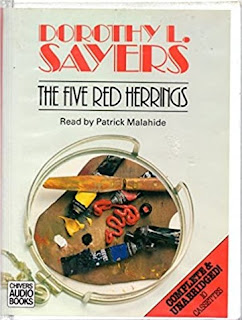
The Five Red Herrings (audio version)


 The Five Red Herrings (1931) by Dorothy L. Sayers [read by Patrick Malahide] 

I'm still treating myself to audio presentations of the Lord Peter Wimsey.  Though I am admittedly partial to Ian Carmichael as Wimsey, I have been venturing out (where possible through the library, Youtube, etc) to sample other interpretations of my favorite amateur sleuth. This particular story features a trip to Scotland with Lord Peter and Bunter for a fishing holiday. Of course, it turns into a busman's holiday when Lord Peter gets involved with a corpse amongst the artist's community that he's landed in. For my full review of the story, please see the link above. This review will focus primarily on Patrick Malahide's reading/performance of the book.

First off, let me say that it was highly enjoyable to hear the actor who portrayed Ngaio Marsh's Inspector Roderick Alleyn give us his version of Sayers' characters. His Wimsey is Alleyn with a much lighter touch and a more obvious sense of humor. The tones are similar; after all, the two gentlemen both come from the gentry class--Wimsey as the younger son in a ducal family and Alleyn as the younger brother of a baronet--and both are Oxford graduates. His Bunter is a bit off--Wimsey and Bunter have served in the first world war together and there is a close relationship underneath the very proper lord and master routine. I think Malahide's portrayal misses that flavor. Of course, I have been spoiled by Glyn Houston's portrayal in the BBC's 1970s series. For the most part, Houston (in my mind) captured the sense of the relationship which I gathered from the novels. But Malahide does a superb job with the Scottish accents--and especially with differentiating the various characters.

As I mention in my linked review to the novel, one of the most tedious bits of this story is the very long and labored rehashing of the clues and motives and each official from the lowest constable to the Chief Constable, Sir Maxwell, backing their favorite suspect (or suspect combo, as the case may be) and explaining how each of the clues work into their version of events. It is really quite tedious and it wasn't any better having it read to me than it was to read it. [This would be the main reason I've shaved a half-star off of previous review ratings. It really got on my nerves this time round.]

In general, this was a highly enjoyable version of a mystery by a well-loved author. I would love to hear Patrick Malahide read other novels and will have to look for more reading performances by this talented actor. ★★ and 1/2.

First line: If one lives in Galloway, one either fishes or paints.

Last line: [Coded ROT13 because spoiler] Gurl oebhtug vg va znafynhtugre, jvgu n fgebat erpbzzraqngvba gb zrepl, ba gur tebhaq gung Pnzcoryy jnf haqbhogrqyl ybbxvat sbe gebhoyr, naq gur orneq bs Fnzfba jnf abg fnpevsvprq nygbtrgure va inva.

[If you'd like to decode the spoiler quote, then copy the coded portion, follow the link, and paste the the code into the box for decoding.]

*************

Deaths = one hit on head


Tuesday, February 22, 2022

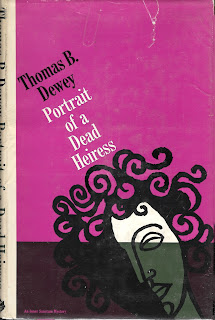
Portrait of a Dead Heiress


 Portrait of a Dead Heiress (1965) by Thomas B. Dewey

Apparently Lorrie King, a beautiful young Chicago heiress, wanted to make her death triple-sure--after taking sleeping pills, she got into a full-to-the-brim bathtub, slit her wrists, and then drowned. But her fiancé, a devoted doctor, doesn't believe it. There was no suicide note and he tells Mac, the private eye he's hired to investigate, that there was no indication that Lorrie had anything to commit suicide over. Dr. Peter Kramm hires Mac to discover the truth and, if it really was suicide, find out who drove her to it.

Mac has barely begun to investigate before it looks like the doctor may be right...because if the police really believed in suicide then why is Detective Saunders still sniffing around and dogging Mac's footsteps? That's not the only odd thing--Mac discovers a cache of paper slips with notations in some sort of personal shorthand. At first, he thinks they're betting slips but can't figure why she'd hide two years' worth. Matching the slips up with huge periodic bank withdrawals, he begins to see a sinister pattern. There's Theresa Russ and her family--who knew Lorrie but are so reluctant to talk about her. Then, of course, there's the question of why Big Danny (a big shot in a little way) has taken such an interest in Mac and his investigation. The private eye also finds evidence of arguments with an artist whose work Lorrie had bought and supported for several years. Plenty of possibilities, but what is the answer? And will the client like it when Mac finds it?

I'm not finding that I have a whole lot to say about this one. I don't much care for the solution and can't quite decide if Dewey has reasons (beyond the page) for why he chose the culprit he did. That's probably saying too much and will be a spoiler if anyone reads my review (such as it is) and heads right off to read the book. I definitely can't say more without thoroughly spoiling the plot. The whole set up just makes me feel rather grubby and like I need a shower. The one saving grace in the whole thing is Mac. His character comes shining through--a good detective and an all-around good Joe. I've a few more books by Dewey on the TBR shelves and I hope that those stories are more in line with quality of the detective. ★★

First lines: When Lorrie King, twenty-six, reached an ending, she filled the bathtub, took a large dose of Seconal, climbed into the tub, and slashed her wrists. Needless to say, she died--of drowning.

Last line: The telephone rang again, once again, and stopped abruptly as the receiver went up at the other end.

****************

Deaths = 2 (one drowned; one stabbed)


Monday, February 21, 2022

Midsummer Nightmare


 Midsummer Nightmare
(1945) by Christopher Hale (Frances Moyer Ross Stevens)

Olivia Warburton is the confidential secretary to Sybrand Jennesma, senior of two brothers who own the Jennesma furniture factory. Sybrand and his brother Gerrit are looking to branch out into the automobile industry. Gerrit, the inventor in the family, is developing a new, smaller engine that will conserve fuel in this war-time era. They have invited the influential Senator North to inspect the work so far in the hopes that he will advise a major investor to take the plunge and finance their endeavors. 

Olivia and her assistant Winifred Leslie are living in a cottage on the Jennesma estate. There's quite a crowd of people (future suspects) milling about the estate. There's Sybrand's wife Myrtilla, the Jennesma's sister Hilda Peradine and husband number four, Eddie, Dirk Adams--manager of the Jennesma factory, Jason Kimball who handles publicity for the Jennesma furniture business, Jerrold Corbin--one of Hilda's ex-husbands who still holds out hope of inheriting something should dear old Hilda pass on, and Tillie, faithful servant to the Jennesmas who can't stand the sight of anyone who isn't family.

All is going smoothly with the Senator's visit until the Jennesma brothers begin receiving threatening notes. The anonymous writer claims that the brothers have stolen the engine idea and demands that they share any wealth...or else. But when they refuse to follow instructions about placing an ad in the paper (to indicate their willingness) they aren't the immediate target. The first victim in this murderous nightmare is their sister Hilda and the circumstantial evidence points to Olivia. Senator North has fallen hard for the young woman and is determined to prove her innocent...and he'll plow through Lieutenant Bill French of the State Police to do so, if necessary. More deaths follow and though the net still tightens round Olivia, there's plenty more suspicion to go around. Winnie (Winifred) is acting strangely, Dirk can't explain certain activities, and Eddie seems to have been up to no-good--burning something in the bathroom (possibly a missing will?). 

This really was an unexpected delight. The book is set in a fictional area just outside of Grand Rapids, Michigan. This is an area I'm fairly well acquainted with as we traveled through that part of the state quite often on visits to my maternal grandmother in White Cloud (north of Grand Rapids). Hale does a good job describing the area and made me feel like I was on familiar ground. She also introduces some very interesting characters--the double romance storyline was well-done, considering that she brought the two couples together fairly quickly. And I was glad to see the relationships sorted out satisfactorily. The plot is a good one--I almost got the right answer, but didn't take my ideas quite far enough. The plotting was so well done that I'm going to be on the hunt for more Lt. French novels. ★★★★

First line: There was the sort of stillness in the air that often comes with a magnificent full moon.

Last line: After all, there would be moments that would require compensations, and it was well this would be one. 

***************

Deaths = 3 (one stabbed; one poisoned; one hit on head)

Sunday, February 20, 2022

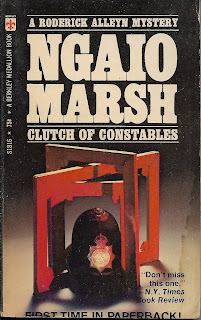
Clutch of Constables


 Clutch of Constables (1968) by Ngaio Marsh

Troy Alleyn, wife of Inspector Roderick Alleyn of Scotland Yard, decides to take a small break after a big art show in London. She sees an advertisement for a last-minute opening on a five-day cruise along an English river aboard the M. V. Zodiac. She hopes to relax and enjoy the slow-paced journey. 

Meanwhile, Alleyn is in the United States on the track of an international criminal who goes by the nickname "Jampot." A criminal with several murders to his credit along with a trade in narcotics and art forgeries. No one knows exactly who he is or what he looks like and he's known to be a meticulous planner and superb mimic with something unusual in his physical appearance. There are hints of Jampot-like activity in the U. S. But when it's discovered that the passenger who "cancelled" his Zodiac reservation at the last minute has been murdered in a way that bears all the hallmarks of Jampot, it looks like Alleyn is searching on the wrong side of the Atlantic.

Could Jampot be one of Troy's fellow passengers? There is a graphics expert with a clubfoot, a most inquisitive cleric with only one eye, a "swivel-eyed*" butterfly enthusiast, and an Ethiopian doctor with an interest in skin dyeing. Of course, the rumors of an unusual physical appearance may have been intentionally circulated to mislead...When a second passenger dies and there is reason to believe she has met her fate at the hands of the international criminal as well, Alleyn becomes concerned about Troy's safety and heads back to England post-haste. He arrives in time to save her, but not soon enough to prevent one final death...

For the most part, this story is told from the point of view of Agatha Troy Alleyn--which makes it an unusual entry in the Marsh mysteries. Framing this main narrative are take-away shots to Alleyn giving a police lecture (about a year later) on Jampot's criminal activities and eventual capture. On the plus side: I enjoyed the difference in telling the story from Troy's point of view. Those sections of the book where we were on the boat and following her adventures were delightful. Marsh does a good job reflecting Troy's "artist's eye" for detail in those portions of the book. What doesn't work so well: the framing of the story with Alleyn's lectures on the investigation. The insertion of these scenes was jarring and took me completely out of the story. It was also evident that Alleyn wanted to kick Carmichael's bottom (the listener in the second row) and I wish he had done and gotten it over with. That running theme was also incredibly distracting and, frankly, unnecessary. 

The plot, once we swallow the incredible coincidence of the wife of the celebrated Inspector Alleyn sharing a river voyage with a criminal mastermind, is interesting enough, though I'm not quite sold on why we had to take a river cruise to try out our art forgery stunts (and there's another lovely coincidence--not only do we have the wife of an inspector aboard--but we have the famous artist Troy along on cruise where art forgery will figure heavily!). Perhaps it's because I've read this before (though it's been about 35 years or so and I really didn't feel like "oh yeah, I remember--that's who did it..."), but I spotted the villain immediately and absolutely knew that his next victim was about to be knocked off. It didn't spoil my enjoyment of the river trip account, so I can put this down as a nice, solid read. ★★

*as far as I can tell, swivel-eyed in this time period meant something like squint-eyed

First line: "There was nothing fancy about the Jampot," Alleyn said.

Last line: A single-berth cabin is available for this day's sailing. Apply within.

***************

Deaths = 3 strangled