SCAM artist alert

If anyone by the name "Luigi Calloway" (or other name) contacts you about the Mount TBR challenge (or any other challenge on this blog) requesting money for participation, then please know that there will NEVER be a reason for anyone to have to pay for participation in any way for any of my challenges. This person does NOT represent me or anything associated with my blog. I DO NOT endorse anything that he claims. A message to Luigi: Please cease and desist contacting authors (or anyone) in my name or claiming to represent my reading challenge/s. You absolutely DO NOT.

Showing posts with label Literary Exploration. Show all posts

Tuesday, November 11, 2014

American Eve: Review

American Eve: Evelyn Nesbit, Stanford White The Birth of the 'It' Girl, and the 'Crime of the Century' by Paula Uruburu (2008) tells the story of [Florence] Evelyn Nesbit who was a beautiful, popluar chorus girl, artist's model, and budding actress at turn of the century (19th to 20th) whose long-term liaison with renowned architect Stanford White led to her identification as "The Girl on the Red Velvet Swing" as well as her involvement in one of the early 20th Century's most notorious murder trials. She rose from humble beginnings in Philadelphia to a model whose face and figure were used in newspaper and magazine advertisements, on postcards and calendars. Her celebrity hit before she was 18 years old. Once she started in the chorus, she found herself the object of many men's fantasies and the recipient of the attentions of "Stage Door Johnnies." Among her admirers were several millionaires, but she ignored them until Stanford White came along. He showered presents on her and her family and introduced her to a side life she only dreamed of. Then he seduced her. But his support--both financially and in the theatre world continued and she kept in touch with him.

When Harry Kendall Thaw, son of the very wealthy Thaw family of Philadelphia family, became interested in Evelyn, she had no idea that he had another agenda in mind other than making her his own through marriage. He had heard of White's association with her and he hated White with a passion. Thaw had no compunction about using the beautiful young woman to wreak havoc on the evil man he believed White to be. He married Evelyn in April of 1905 and just over a year later he took her to the Madison Square Garden rooftop theatre--the playground of her former lover--and shot White to death. White thought he was a hero for revenging his wife's innocence. Given his treatment of her and his behavior leading up to the murder, I'd say he was a bit crazy.

*************
I have to say that I was disappointed in this. When I was looking for a true crime novel to read to fulfill a couple of challenges, the name Stanford White caught my eye. In 2012, I read a book of White's letters to his family and my comment at the end of that review was that "I think I would have been far more intrigued by one of the books which covered this high-profile murder than I was by the collection of letters." And here one of those books is. And I remain fairly un-intrigued. For all the billing on the cover about the "Crime of the Century"--less than one-third of the book is devoted to writing about the crime, trial, and aftermath (very brief info on the aftermath) combined. The rest of the book takes a very long and rambling (particularly for a non-fiction book) trip through Evelyn's early life and journey to become Thaw's wife. Uruburu is repetitive in descriptions and, most noticeably in the first half, given to writing sentences in which it sounds like she's producing the most adjectives with the most of syllables possible. Throwing $10 words around as my relatives used to say. All to no purpose.  

She gives us a fair overview of the time period and attempts to represent Evelyn as a young woman misrepresented by history. But she never made Evelyn a real person to me and she never made me really care about her story. I was horrified by what she went through--but horrified on principal and because the events were, indeed, horrifying. Not because I made any real connection with Evelyn Nesbit as a person. ★★

Wednesday, July 23, 2014

Challenge Complete: Literary Exploration


The 2014 Literary Exploration (through Goodreads) challenges readers to try out new genres; with a 12 book, 24 book and 36 book challenge.They give us a list of genres and anyone participating in the challenge has to complete one book from each genre over the course of the year.  I joined in for the "Easy Challenge" level.  I am quite likely to finish the Hard Challenge level as well, but I have completed my commitment of 12 books for the Easy Challenge.

 
Easy Challenge

Classics My Antonia by Willa Cather (4/20/14)
Fantasy The Hollow Chocolate Bunnies of the Apocalypse by Robert Rankin (5/6/14)
Graphic Novels Harlan Ellison's 7 Against Chaos by Harlan Ellison (3/17/14)
Historical Fiction Dandy Gilver & the Proper Treatment of Bloodstains by Catriona McPherson [set in 1920s] (2/12/14)
Horror Relic by Douglas Preston & Lincoln Child (7/22/14)
Literary Fiction Sinners & the Sea by Rebecca Kanner (5/21/14)
Mystery Faceless Killers by Henning Mankell (1/5/13)
Non Fiction XCIA's Street Art Project by Hank O'Neal (2/20/14)
Romance Faro's Daughter by Georgette Heyer (5/1/14)
Science Fiction Shakespeare's Planet by Clifford D. Simak (1/6/14)
Thriller 12.21 by Dustin Thomason (6/6/14)
Young Adult The 7 Professors of the Far North by John Fardell (6/29/14)

Tuesday, July 22, 2014

Relic: Review

Something nasty is lurking in the basement hallways of the New York Museum of Natural History. A nasty, primeval, ferocious something...that kills swiftly and mercilessly and Special Agent Pendergrast, Lieutenant D'Agosta, museum researchers Margo Green and Dr. Frock need to find out who or what it is before everyone connected with the museum falls victim....

The museum is due for a grand opening of a new, spectacular exhibition by the name of "Superstition." The directors of the museum are determined that nothing will happen to either delay the extravaganza or tarnish the museum's reputation. So, when odd disappearances occur and rumors of a "Museum Beast" start to circulate, Winston Wright and Lavinia Rickman tighten security and clamp down on the rumor-mongers, but refuse to even think about putting off the grand opening. And not even a dead body or three are enough to change their minds.

Pendergrast and the researchers slowly gather evidence that points to a doomed expedition undertaken by associates of the museum several years earlier. Whittlesey, one of the leaders of the expedition, had gone to the Brazilian rainforest in search of the lost Kothoga tribe--a primitive group who worshiped a strange god named Mbwun who was half-man, half-lizard and who was said to be the offspring of a Satan-like demon. A relic which is said to represent Mbwun was found among the crated items sent back by Whittlesey and will be the centerpiece of the new exhibit. With murderer leaving a trail of clues that eerily call to mind descriptions of Mbwun, could the rumors of a "Museum Beast" be more firmly rooted in fact than anyone would like to believe?

This is a hair-raising, edge-of-the-seat thriller.  Weighing in at 468 pages, I managed to finish this book in less than 24 hours--and that's allowing time for sleeping last night and working a full 8 hours today. That's not meant as a brag. I'm simply underlining the fact that, despite thrillers being NOT my thing (and only reading this one because I had to have something in the horror-line for a challenge), I only put the thing down when I absolutely had to. Preston and Child know exactly how to reel you in and keep you reading even when you're being scared out of your wits. Seriously creepy and quite, um, bloody--but not gratuitously so (and I managed to skip the worst descriptions without losing any of the storyline....I'm a weenie when it comes to blood and gore).  I learned with Cabinet of Curiosities that I can take a bit of horror now and then, provided that it's well-written and delivers a good story with interesting characters. Preston and Child come through again with this ★★★★ outing.

Monday, July 7, 2014

Selections from the Essays of Montaigne: Review

I have to say that Monsieur Montaigne doesn't do a whole lot for me.  It may be the translation, but he comes across as rather pompous, full of himself, and long-winded. I think the most irritating thing is that he spends one whole essay ("Of the Education of Children") telling us how tutors/teachers shouldn't just teach children to regurgitate facts or spout the learned words of  the great men who come before them, but should be taught to reason and understand what the great men's words meant and embrace and make the thoughts their own. Then...Montaigne spends the rest of the book (and even this essay) dropping quotations from Homer and Horace and Dante and (you name the great classic thinker) here, there, and yon like a non sequitur looking for a connection. About one out of every five or six he'll incorporate properly into his discussion (properly according to his stated "rules"), not exactly practicing what he preaches. So, apparently, when it comes to quotations it is do as I say and not as I do.

I will admit that his theory on educating children does strike home a bit when you think of America's modern tendency to "teach to the test." As Montaigne says (oooh, I'm throwing in a quote!) "They slap them into our memory with all their feathers on, like oracles in which the letters and syllables are the substance of the matter. To know by heart is not to know; it is to retain what we have given our memory to keep....Sad competence, a purely bookish competence!" But, overall, Montaigne's philosophies as presented were a slog to work my way through and they did not provoke a thoughtful engagement as I expected. 

I will refrain from giving a rating. Given the overall response on Goodreads and the references to Montaigne that I have seen repeatedly in my academic life, I'm sure I'm missing something.

Thursday, July 3, 2014

A Long Fatal Love Chase: Review

The grandmother of stalker stories with roots in obsession. A Long Fatal Love Chase is a story about the dark side of love and a passionate persistence that drives a man to hound the woman he claims to adore to her death. Louisa May Alcott originally wrote the story for magazine serialization under the name of A. M. Barnard and it wasn't published as a complete novel until 1995 because the tale was considered too sensational to be published during Alcott's lifetime.

The impetuous, head-strong young Rosamond Vivian has felt like a captive in her grandfather's house since her parents died. His indifference makes her believe that he does not care for her at all and she longs to escape to a life of freedom and adventure. But she despairs of ever fulfilling her dream. Then, a stranger who resembles Mephistopheles himself comes to her remote island home and she finds herself spellbound and ready to confide in the mysterious Philip Tempest. She tells him that she would "do anything get out of [her] prison." And he takes her at his word. He wins her hand from the grandfather in a game of cards and promises to marry her when he takes her away.

She spends a short glorious time enjoying her new found freedom and learns to love her dark, brooding husband. But all is not as it seems--and soon Tempest destroys her idyllic illusions and she finds that she now lives in the midst of lies, cruelty, and unbearable heartbreak. What she discovers about the man who swears to love her makes her flee from him. She hides under assumed names--in France, Italy, and Germany. She takes refuge in the homes of friends and even in a nunnery, but wherever she goes he pursues her until finally he must follow her to grave if he is to continue his pursuit.

Alcott's story is quite advanced for her time. She writes about an independent and spirited heroine whose story wrestles with such themes as women's right  to be free, strong female friendships, the dynamics of abusive and twisted relationships, divorce, bigamy, murder, and celibacy. While on some levels, Rosamond is the classic Gothic heroine swept away by the handsome, brooding mysterious man, she is no shrinking violet. It isn't unusual for the heroine to discover that the brooding man is really Prince Charming in disguise and everyone lives happily every after. Not so here. Tempest is really quite nasty and he doesn't mind what anguish he causes as long as he can bend his spirited love to his will--the very fire of spirit and independence that first draws him to her is the flame he must quench if he really will possess her again.  It really is amazing that Alcott wrote such a dark tale at a young age--a story so different from the well-known Little Women.

A Long Fatal Love Chase lacks a bit of polish and there are portions that seem somewhat over-the-top with melodrama--perhaps if the story had been published as a novel in Alcott's lifetime it would have been edited. As it stands, the work is a good examination of the obsessive nature and the bargains we all make for our freedom and independence. A good, solid story.  ★★★

Sunday, June 29, 2014

The 7 Professors of the Far North: Review

Eleven-year-old Sam Carnabie is not looking forward to a family trip to visit his Great-Aunt Roberta. Great-Aunt Roberta likes cats and china ornaments; she doesn't much like children. And there isn't even a proper park near her oppressively tidy home in Reading. Why can't the Carnabies be headed out for an adventure somewhere exciting instead. You know what they say: Be careful what you wish for....Because when Professor Ampersand and his adopted children Zara and Ben zoom up on a yellow motorcycle and sidecar to whisk Sam away from the proposed dreadful visit in Reading, the adventure is well on its way. And it will be more adventure than Sam could possibly imagine. 

Sam barely has time for a quick investigation of Professor Ampersand's awesome inventor's digs when one of the professor's colleagues arrives with news that the evil Professor Murdo is out to kill the rest of the original "7 Professors of the Far North"--a group of brilliant scientists who were once going to teach at a university on Nordbergen, an island in the Arctic Circle--as well as making preparations to take over the world. The other professors are called for a meeting at Ampersand's home--but before Professor Gauntraker can fully explain the dangers, Murdo's henchmen arrive and kidnap the professors. Sam, Zara, and Ben manage to hide and Gauntraker leaves a clue behind that will allow the kids to follow to Nordbergen.  But how can three children take on an evil genius and his armed minions? The fate of their friends...and the world...is in their hands.

A wonderful adventure book for the nine and older crowd. The opening immediately grabs the reader and the story provides an exciting ride. This is definitely the type of book that I would have devoured in my younger days and I found it quite enjoyable now. It reminds me of the Choose-Your-Own-Adventure stories--written as a straight narrative. While the idea of three children defeating an evil genius may be a little hard to believe, the story as told sweeps you right along and the kids have enough doubts and get just enough help along the way to make it really easy to suspend your disbelief. Great fun and interesting story. There is also a parallel story about Marcia and her parents that works well as it dovetails with the adventures of Sam, Zara, and Ben--and it serves as a nicely done morality story about being happy with who you are and letting others be exactly who they are as well. Good, solid story-telling. ★★★

Tuesday, June 17, 2014

Undead & Unpopular [...and Unbelievably Bad]

Let's start off with my short, to the point review over at Goodreads: "Rather than post what would probably come across as a rant (and possibly get my review deleted...), let me just say: This book is just incredibly not my thing. If this sort of thing is your thing, then more power to you and you'll probably love it. I just can't."

So...just as a reminder. This little ol' book blog was started as an online book journal for me--a place for me to record my thoughts about books. I'm about to go off full-tilt on this book. If you absolutely adore MaryJanice Davidson and her little band of "Undead and..." characters, then go directly to Goodreads (or some other book/review platform) and look for all the four- and five-star reviews. Do not pass through the review below. Do not pass Go. Do not collect $200. I'm not here to tick anyone off or step on anybody's toes. I deliberately did not post this on Goodreads--so I'm not looking to pick a fight with the author. I just need to get this out of my system....

Okay. I'll admit right here, upfront that paranormal anything isn't my usual reading fare. But after reading Gail Carriger's Soulless (and etc), I'm game to try any that come my way that sound promising and can be used for a challenge or three. Undead & Unpopular was such a one. And, yes, I realize that I entered this party in mid-stream (#5 in the Undead series)...but, honest-to-goodness I can't see that starting at the beginning would have helped. I don't particularly feel like I've missed anything because comments throughout give a fair idea of what has happened in previous books.  

The main problem: I do not care for any of the characters. Not one. They are flat and unsympathetic. And I especially do not care for Betsy Taylor--primary protagonist, Vampire Queen, and needless grump because she doesn't want to drink blood. I can't get up a lot of enthusiasm for a character whose primary response to anything and everything that happens to her is to drop the f-bomb. And repeatedly for emphasis in case you didn't catch when she said it the first time. 

And maybe it's just me, but I don't really see much of a plot here. I mean we spend a lot of time talking about the wedding she's planning with her Vampire King and fiance, Eric Sinclair. We watch her react to the news that her best friend has cancer (and rack up the highest total of f-bombs for a single scene). She has to meet with a delegation of powerful European vampires--one of whom winds up dead (re-dead? not sure how the undead becomes even more dead...but anyway). And there's a zombie. But even with all that going on....nothing really seems to happen. No plot movement. 

This was billed as a fun, delightful little bit of chick lit...witty and funny--a romantic comedy (which I'm totally claiming for a challenge because that's one of the reasons I read it....even if I couldn't find much evidence of wit, fun, or comedy lurking amongst the pages). I'm sorry, but I just didn't care for this at all--I don't know if it was the paranormal or the chick lit  portion that made it the more unpalatable, but either way, a most disappointing read. I gave it one star on Goodreads....but, honestly, I rounded it up.

Friday, June 6, 2014

12.21: Review

For years leading up to December 21, 2012, people were getting their end-of-the-world mojo on. It seemed like everywhere you looked someone was putting out a book taking advantage of the reading public's interest in the supposed doomsday predicted by the ancient Mayan calendar. I read a few myself just to see what was up. I missed 12.21 by Dustin Thomason (Aug. 2012). That's not too shocking given the fact that I'm not, generally speaking, all that into thrillers--particularly medical thrillers. In fact--without scanning through my books read list--I believe the last medical thriller I read was Coma by Robin Cook....in the 80s. But you know how I am with challenges...I can't resist them. So, when Shellyrae at Book'ed Out called for a medical thriller in her Eclectic Reader Challenge and the Goodreads Literary Exploration Challenge also called for a thriller, I couldn't say no.

And the premise for 12.21 grabbed me when I went hunting in the library website for a medical thriller that I thought might do ('cause I just don't have those hanging about the house...). See?:

In Los Angeles, two weeks before the end of the Mayan Long Count clalendar, all is calm. Dr. Gabriel Stanton takes his usual morning bike ride, drops off the dog with his ex-wife, and heads to the lab where he studies incurable prion diseases for the CDC. His first phone call is from a hospital resident who has an urgent case she thinks he needs to see. Meanwhile, Chel Manu, a Guatemalan American researcher at the Getty Museum, is interrupted by a desperate, unwelcome visitor from the black market antiquities trade who thrusts a duffel bag into her hands.

By the end of the day, Stanton, the foremost expert on some of the rarest infections in the world, is grappling with a patient whose every symptom confounds and terrifies him. And Chel, the brightest young star in the field of Maya studies, has possession of an illegal artifact that has miraculously survived the centuries intact: a priceless codex from a lost city of her ancestors. This extraordinary record, written in secret by a royal scribe, seems to hold the answer to her life’s work and to one of history’s great riddles: why the Maya kingdoms vanished overnight. Suddenly it seems that our own civilization might suffer this same fate.
 
With only days remaining until December 21, 2012, Stanton and Chel must join forces before time runs out.
[from the back of the book]


Lots of interesting historical tie-ins which Thomason uses to put a twist on the usual Mayan end-of-the-world thing (shifting of the poles, great earthquakes, and all those other climatic earth-related disasters).  I really enjoyed learning about the Mayans through the ancient codes. The plot line itself is good--believable and a bit scary if prions really could turn that dangerous. It is a fast-moving, quick read that I enjoyed on a a lot of levels. However, like several others on Goodreads, I did find it a bit difficult to connect with the characters. I just never got invested in most of them as people and the one character that I found the most intriguing (and I can't tell you why without a spoiler) winds up dying. Ain't that always the way? Overall--a darn good read for something so far out of my comfort zone. ★★★ and 1/2.

Friday, May 30, 2014

Steampunk Poe: Mini-Review

Steampunk Poe is a sumptuous collection of stories and poems by Edgar Allan Poe effectively illustrated by Zdenko Basic and Manuel Numberac with images influenced by steampunk. This edition showcases a variety of Poe stories--from the well-known "Murders in the Rue Morgue" to the more rarely anthologized "The Spectacles" and "The Balloon Hoax" and ornaments each one with steampunk-inspired artwork featuring elaborate clockwork aviation, cyborg-like evil eyes (a la "The Tell-Tale Heart"), truly phantasmagorical spectres of the Red Death and Roderick Usher's sister, and so much more.

Poe may have written long before steampunk became a major force in fiction, but never has a classic author's work been so perfectly fitted for a steampunk makeover. The illustrations provide a haunting new twist to the grandmaster of mystery and the bizarre. My favorites include the illustrations for "The Masque of the Red Death" and "The Fall of the House of Usher." It was also refreshing to read new-to-me stories: "The Spectacles" and "The Balloon Hoax." My only complaint--and the reason for four stars and not five--is that there are too few illustrations. Having gone to the trouble to provide us with an entirely new slant on Poe's work, I would have hoped for more examples of that view.  ★★★★

Thursday, May 29, 2014

Beyond Uhura: Review

In Beyond Uhura, Nichelle Nichols tells her story from the beginnings growing up in a socially progressive family through her teen years as a young singer/dancer who had already been praised by Josephine Baker and worked with Duke Ellington. She got her first job at the age of fourteen working in a cast at the Sherman House Hotel which portrayed many of the tremendous acts which had been staged at the Sherman House's College Inn supper club in the twenties: Fred and Adele Astaire, Duke Ellington, Al Jolson, Irving Berlin and others. Ms. Nichols helped re-create the appearance of Katherine Dunham and her troupe. From those early years, she went on to travel solo as a singer/dancer and finally worked her way to her first television screen appearance in a new show by a new producer--The Lieutenant by Gene Roddenberry.

Little did she know what working with Roddenberry on that first series would lead to. Nichelle is, as far as I'm concerned, the first lady of Star Trek. (Yes, I know that title is most often given to Majel Barrett as Gene's wife.) She is beautiful, a great actress, and an even better singer. She had a tremendous effect on the entry of women and minorities into the space program. Yes, her autobiography is just a little self-indulgent--but she's earned it. (Show me someone in the entertainment world who isn't. Most are even more so.) And..she manages through each of the negative incidents in her life--from being not only a woman in Hollywood, but a black woman in Hollywood--to remain very positive throughout. 

A fascinating (to quote Mr. Spock) read.  I have always enjoyed her as Uhura. I enjoyed this book and its look at her life before and outside of Star Trek.  ★★★★

Saturday, May 17, 2014

Bed-Knob & Broomstick: Review

My edition of Bed-Knob and Broomstick is the 1957 version which combines both of Mary Norton's works (The Magic Bed-Knob or How to Become a Witch in Ten Easy Lessons AND Broomsticks and Bonfires) in a single volume. The first section of the book (equivalent to The Magic Bed-Knob) reveals how Carey, Charles and  Paul Wilson came to know Miss Eglantine Price and the adventures they had as a result. The children are sent to the country to stay with their Aunt in Bedfordshire.  One morning when they go out early in the morning to hunt mushrooms they find Miss Price in crumpled and torn clothes and with an injured ankle. She is pretty evasive when they try to find out what happened to her, but Paul (the youngest) calmly supposes that she must have fallen from her broomstick.

So, Miss Price confides to the children (I'm guessing she's been longing to share her secret with someone) that she's been studying to be a witch, but she's not so very good at it yet. It takes an enormous amount of concentration and uninterrupted time--especially if one wants to be a proper wicked witch. She no sooner reveals her secret when she immediately regrets her indiscretion and (in good wicked witch form) starts thinking of some way of shutting the children up. Carey suggests an alternative--what if Miss Price gives them something magical and puts a spell on it so if the children reveal her secret then the magic will no longer work?

The bargain is made and Miss Price enchants a bed-knob that Paul has unscrewed from his bed. If he screws it on half-way and makes a wish, the bed will take them anywhere they'd like to go--past or present. The children take it on a test run back to London--because Paul is missing his mother and get into all kinds of trouble with the police in the war-time black-out. They decide that their next adventure may need a little more (magical) insurance and invite Miss Price to join them on a visit to a South Seas Island. Their goal is to investigate the coral, but they wind up back in trouble...this time with cannibals. By the time Miss Price can get them out of harm's way and safely back to Paul's bedroom, they have no time left to clean up the sand and salty water before their aunt discovers the mess.  She naturally doesn't believe their explanation of how it happened and packs them up and ships them back to their mother. End of part one.

The second section (equivalent to Broomsticks and Bonfires) takes place two years later. Carey and Charles have systematically worked to convince Paul (and themselves) that their adventures with Miss Price were just dreams--all in an effort to prevent Paul from blurting out something strange at an inconvenient moment. Just when they've almost done the job, an advertisement from Miss Price appears in the newspaper saying that she would gladly take in children for the summer for a small fee. The children manage to persuade their mother that a summer in the country with their friend Miss Price is just what they need and off they go--ready for more adventures. (They are well-prepared because Paul left his aunt's house with the magic bed-knob in his pocket.) 

But when they arrive at Miss Price's they find that she has given up her studies. No more magic. Ever. She has bought the bed from the children's aunt--but they won't be allowed to travel on it. In fact, she unpacks their things for them and the bed-knob disappears. But then one morning, the bed, Miss Price, and Paul are gone and Carey and Charles are put out that Miss Price and their brother went traveling without them. After they reappear, Carey convinces Miss Price that it isn't fair that she and Charles didn't get one more chance and if Miss Price will let them travel into the past "just once" (because, after all, they didn't get to try that part out yet), then they could all be done with magic forever. So, the children travel back to the 1600s, meet a "real" necromancer, bring him back to the 20th Century, and that's when a new set of problems arise....

Previous to finding this book in a stack of books to be thrown out in the hallway at work (don't even get me started on that particular horrifying moment), my only exposure to the story of Miss Price, the apprentice witch, and the Wilson children (renamed Rawlings by Disney & co.), Carey, Charles, and Paul, was the Disney film starring Angela Lansbury and David Tomlinson. I thoroughly enjoyed Disney's animated/live-action treat but it was very interesting to read the original stories and see how much had been changed--as Disney always did. One thing I do like about the Disney film is that it brings the themes of World War II very much to the center of the story. 

The book(s) by Norton touches upon the war--with references to the black-out and the children wondering if it would be fair to use magic in war-time. What if all the soldiers were turned into white mice? But, unlike the movie, Miss Price is not studying magic to aid the war effort--she simply wants to become a witch. And apparently a wicked one at that--though her actions belie any real wickedness in her nature. I enjoyed this venture into the book behind the Disney film more than Mary Poppins (for my take on that please see my review)--there wasn't quite the difference between the book and the movie in the character of Miss Price as there was with Mary. 

This was a fun read. One that I know I would have enjoyed even more had I read it when I was a child. ★★★★

Challenges Fulfilled: Mount TBR Challenge, Bookish TBR, Monthly Key Word, Century of Books, Outdo Yourself, How Many Books, 100 Plus Challenge, Back to the Classics, Women Challenge, Literary Exploration, A-Z Reading Challenge, Semi-Charmed

Tuesday, May 6, 2014

The Hollow Chocolate Bunnies of the Apocalypse: Review

The Hollow Chocolate Bunnies of the Apocalypse is an epic title. That would be why this book jumped off the shelf at the library, into my hand, and insisted that I needed to take it home with me. Which I did. Sadly, the book did not quite live up to its epic title. The book is good. The book is funny--as I expected it to be. But it's not that good. And it's not that funny. There are places in it where I am sure there are jokes and I'd get that feeling that I was supposed to laugh--like Robert Rankin had paused expectantly waiting for the audience to provide the laugh track. But then I'd be like Sherman in the Mr. Peabody & Sherman movie (which we just saw at the drive-in last Saturday) and I'd look up and think to myself I don't get it.

Rankin has created an interesting premise. A young man named Jack is on his way to the big city to seek his fortune--he's heard stories that that's where all the fortunes to be made are made. But when he gets there, all is not as glamorous as he's been given to believe. First off, the "big city" is really Toy City (aka Toy Town). Everybody is a toy except for the rich and famous nursery rhyme characters like Little Miss Muffet and Little Tommy Tucker and Ole King Cole, etc. And there is a serial killer loose who is knocking off the Mother Goose celebrities one by one in rather gruesome methods based on their rhymes. The Toy City police are stumped and Bill Winkie, a Private Eye who has starred in his own series of crime novels, has mysteriously vanished.

Jack runs into Winkie's sidekick, Eddie Bear, and Eddie convinces him to partner with him to solve the murders and collect a fabulous reward. Because you know, Eddie was the real sawdust--er, brains behind the P.I. business. Eddie leads Jack into underage drinking, high-speed car chases, in and out of jail, and into encounters with mysterious spider women. There will be quite a few more deaths and some high-tension drama before Eddie and Jack can find out who's really behind the nursery rhyme murders.

The book is a fantasy-style riff on the noir genre and private eyes in general. It is very self-aware and that is part of the fun. Jack and Eddie discuss how "if this were one of Bill Winkie's private eye books" then "we'd have met all the important characters by now" or "we'd have gotten hold of the MacGuffin by now." They also talk about whether or not the decisions they make along the way would be what a true detective in a crime novel would do. Lots of in jokes (and, as discussed, plenty that go right over my head) and plays off of the nursery rhymes. Excellent premise that manages to fall just short of being a fantastic story. Good solid entertainment, but not extraordinary. ★★★

Quotes:

It's a wise man who knows where he is. And if he knows where he is, he should stay there, don't you agree? (p. 22)

Things really could be worse. You'll be okay. I can direct you to the hospital if you think you need your head bandaged. Or I'll stagger with you, if you want. Or you can carry me upside down and I'll sing you drunken songs. I know some really rude ones. They're all about pigs and penguins. (~Eddie [Bill Winkie's bear], p. 27

It is a fact well known to those who know it well that we can only know what we personally experience. Above and beyond that, it's all just guesswork and conjecture. (p 72)

Thursday, May 1, 2014

Faro's Daugher: Review

Poor Lady Mablethorpe is having a bout of the vapors. Her innocent, young, soon-to-be wealthy son has announced his intention to marry the beautiful twenty-five-year-old Deborah Grantham. The only difficulty? Miss Grantham is the niece of Lady Bellingham, the owner of a gambling establishment. And, even worse, Miss Grantham actually presides over the gaming tables--flirting with the gentlemen and playing them off one another in the hopes of driving them to leave even more of their wealth behind.

The distraught mama enlists the aid of her nephew, Max Ravenscar, to, at best, persuade young Lord Mablethorpe of his folly and put an end to the love affair or, if necessary (heavens she hopes not as she reaches for her vinaigrette), to buy off the shameless hussy at any cost. Mablethorpe is thoroughly besotted and there is no hope of changing his mind, so Ravenscar meets with Miss Grantham to try and make a deal. But--inexplicably--Deb Grantham refuses the more than handsome offer of 20,000 pounds and is thoroughly insulted by the insinuation that she would take advantage of an innocent. She determines to make Ravenscar pay for his injustices to her....and she and Ravenscar are plunged headlong into a battle of wits and wills to see who will get the better of whom.

Georgette Heyer was the queen of the Regency Romance. She did her research well and the reader is completely immersed in the age from the first sentence to the last. The conversations are pitch perfect and the descriptions of the gaming house, Vauxhall, and the Park (where everyone who's anyone goes to be seen) are delightfully on target. Despite the fact that historical romances tend to run in a somewhat formulaic manner to brooding, pompous, I'm-going-to-be-a bachelor-forever-so-there Heroes and strong-willed, feisty Heroines and even though the two declare throughout the book how much they despise each other, so we all know what will inevitably happen--despite all that, Heyer writes fantastic stories with characters that keep you reading for the fun of it. Her books have it all: witty dialogue, the life and doings of the ton, creditable characters that are some sometimes a bit larger-than-life (but not too, too much larger), a great concern with social standing which always, always puts a twist on the romance in question. She's my go-to author for historical romances and I love reading her books. ★★★★

Wednesday, April 30, 2014

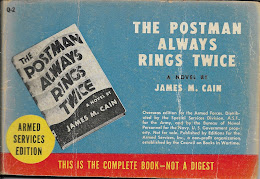
The Postman Always Rings Twice: Review

The Postman Always Rings Twice by James M. Cain could so easily have filled the "Out of Your Comfort Zone" square on the Golden Vintage Bingo card for me." Because a noir fan I'm not. But no worries, I've got a hard-boiled, private eye story waiting on the TBR pile, so I'm slotting this short novel which has been converted to film twice (1946 & 1981) into the "Book to Movie" square instead. 

Postman has nothing to do with the mail service or ringing (or doorbells or whatever). It is narrated by Frank Chambers, a drifter who has been in and out jail and a man who likes a hustle better than a steady-paying job. He stops at a diner in California intending to cadge a meal and move on. The diner's owner Nick Papadakis (also known as "the Greek") thinks the fit young man looks like someone he'd like to have work for him at his gas station, but Frank doesn't want to get tied down.....until Nick's sultry, sexy wife Cora comes into view.

Cora is younger than her husband and bored silly with the restaurant work...not to mention disgusted by her husband's size and the grease that seems to linger round him from the kitchen and the cars. Frank is just the bit of excitement she's been looking for and she tumbles straight into his arms at the earliest opportunity. It isn't long before they're plotting to remove the obstacle to their lus--- er, love. But the results of their plans may not be what they think.


This is, as anyone familiar with crime fiction knows, a classic in the noir genre. Considered one of the more important crime novels of the 20th century, it was very successful and notorious once published--banned in Boston at one time for sexual content and violence. Of course, now it doesn't seem nearly so risqué--but it is still full of sexual tension.  It is a book about obsession and the consequences of lust and greed. I can't say that I like any of the characters--none of them are really likeable, not even earnest, hardworking Nick. But the characters are real and vividly display the flaws and short-comings of human nature.  Not my cup of tea--but a good, solid story that kept my attention to the end nonetheless. Three solid stars. 


Challenges Fulfilled: Vintage Mystery Challenge, Mount TBR Challenge, Bookish TBR, 1001 Books Before You Die, Century of Books, Outdo Yourself, How Many Books, My Kind of Mystery, 100 Plus Challenge, Back to the Classics, Literary Exploration

Sunday, April 20, 2014

My Ántonia: Review

My Ántonia by Willa Cather is the final book of her "pioneer trilogy" of novels...and I must confess that I haven't read the other two. The novel consists, primarily, of Jim Burden's memories of life on the Nebraska prairie and his interactions with Ántonia and her Bohemian family. Jim's parents have died and he travels by train to Nebraska where he will live with his grandparents. On the same train are the Shimerdas--the Bohemian family who have come over from the old country to take possession of land which they have bought sight unseen. Jim and Ántonia form a strong bond somewhere between friendship and siblings and first love--later in the book Jim will admit that he loves Ántonia, but she will not accept his declaration. The novel is divided into five books that roughly follow the stages of Ántonia and Jim's lives and ends with Jim's return to Nebraska to visit Ántonia one more time.

The introductory notes to my edition make a fairly big deal of the possessive "my" in the title. "Is the emphasis in the novel's title on the pronoun or the noun, or, to put it differently, is this Ántonia's story or Jim's?" Quite honestly, I don't think that's the point at all. I would say that the title, as a whole, comes from Ántonia's father's plea to Jim's grandmother: "Te-e-ach, te-e-ach my Ántonia!" Ántonia will become the Bohemian family's ambassador to their English speaking neighbors and the family's interpreter. Without Ántonia, they would have to depend on their rather unreliable (if not down-right dishonest) distant relative--the one who "helped" them pay too much for land and a house. So--maybe in that sense--it is Ántonia's story and not Jim's. And certainly Ántonia never truly belongs to Jim, except perhaps in friendship, so the possessive should not be emphasized by him.

In some ways Cather writes beautifully. The descriptions of the Nebraska prairie are lovely and her characterization of  Ántonia and her family are compelling. Jim, on the other hand, is rather lackluster. His narrative is pretty lifeless and I found myself wishing that Ántonia had told her own story. Given her rendition of the flight from the wolves and the hobo who threw himself in the threshing machine, she is a lively storyteller and would, I think, make a better narrator.
★★★

Quotes
I was entirely happy. Perhaps we feel like that when we die and become of something entire, whether it is sun and air, or goodness and knowledge. At any rate, that is happiness; to be dissolved into something complete and great. When it comes to one, it comes as naturally sleep. (p. 17)

Gaston Cleric introduced me to the world of ideas; when one first enters that world everything else fades for a time, and all that went before is as if it had not been. (p. 139)

If there were no girls like them in the world, there would be no poetry.

I was thinking, as I watched her, how little it mattered –about her teeth for instance. I know so many women who have kept all the things she had lost, *but whose inner glow has faded*. Whatever else was gone, Antonia had not lost the fire of life. 

I'd have liked to have you for a sweetheart, or a wife, or my mother or my sister--anything a woman can be to a man. The idea of you is part of my mind; you influence my likes and dislikes, all my tastes, hundreds of times when I don't realize it. You really are a part of me.

Monday, March 17, 2014

Harlan Ellison's 7 Against Chaos: Mini-Review

Harlan Ellison's 7 Against Chaos is a rare thing for me...a graphic novel. But, being the Ellison fan-girl that I am and having read the synopsis of the book sometime last year, I promptly put it on my Christmas wishlist, my own personal Santa came through, and I found it under the Christmas tree last December 25th. I was very excited that two of my category challenges called for a graphic novel, because I knew I had the very thing just waiting on the TBR pile.

Sometime in Earth's distant future, the planet is in danger--not just physical danger, but the very fabric of reality is being ripped apart. The elite call on once-decorated, but then disgraced General Roark to gather six others with special abilities to save them. With elaborate promises of rewards to come, Urr, the renegade robot; Mourna, the Amazon-like woman with steel claws for hands; Tantalus, the incredibly swift insect-man; Ayleen, a Venusian woman with quite literal fire-power; Hoorn, the stealthy and adept cat burglar; and Kenrus the brilliant, outcast technologist all agree to join Roark on a deadly journey to Earth's past on a mission to save its future.

As a graphic novel, the book is pleasing. It has an old-fashioned feel and reminds me of the comic books I used to buy when I was a preteen. I have a certain nostalgia for those stories--I would read everything from those with a science fiction feel to the mysterious and creepy (think Tales from the Crypt). I enjoyed those far more than most of the graphic novels I have tried in recent years. Paul Chadwick's artwork is fabulous.

The story, however, is a bit clunky. There are instances of Ellison's brilliance, but, as other reviewers on Goodreads have noted, there is a certain lack of continuity as if panels or even pages are missing. I'm not sure if that's a result of Ellison writing in short bursts for each panel or what. One can see the bones of a good story, but it is never completely covered with flesh and made whole. It begins with a bang--and I thoroughly enjoyed the stories of how Roark gathered his colleagues for the journey. The trip through the black hole is well done and enjoyable as well and there are moments when the Seven face the villain of the piece that are quite good.  Over all, a three star outing for an interesting story and great artwork. A more cohesive storyline would have brought up to four.

Wednesday, March 12, 2014

A Girl Walks Into a Bar: Mini-Review

Choose Your Own Adventure for Grown-Ups. 

So...needing books published in 2014 as well as a book that would fall under erotica for some challenges, A Girl Walks Into a Bar: Your Fantasy, Your Rules by Helena S. Paige caught my eye as I was scanning the new books at the library. On the face of it, she's developed a really good idea--take the Choose Your Own Adventure story premise from children's books and make the adventures sexy and spicy for the adult ladies in the reading world. Want a wild night with a rock star?  You can have it. More interested in the strong bodyguard or an older, businessman type? You can have that too. A sexy man with a sexy car...fun and games in the shower...a pick up at an art gallery?  It's up to you and the choices you make.

It seemed like a fun way to meet that erotica category. And to a certain extent it was. But, honestly, the adventures I remember in the Choose Your Own Adventures ('cause I totally read those when I was growing up) were much more fun and absorbing than the available choices here. Pretty standard fantasies with very few trimmings and not much excitement. It definitely didn't make me feel like I was stepping into alien territory and enjoying it--even when I deliberately made choices that I wouldn't in real life (actually that would be most of them). There was no sensuality--and I think that's what makes erotica sexy for me (and possibly most women). The choices were pretty much--snag this guy (or girl as the case may be), get it on, decide if you're done for the evening and then go for another round or head home for jammies and a dvd. 

A really good idea for something different on the adult level that didn't fulfill expectations. Enough fun and adventure for two and a half-ish stars.

Tuesday, March 4, 2014

India's Love Lyrics: Mini-Review

So....India's Love Lyrics by Laurence Hope ("collected and arranged" by) are not Indian poems collected by Hope, nor is Laurence Hope really a man. What India's Love Lyrics is...is a collection of appallingly bad poetry written by Adela Florence Nicolson which she tried to convince readers were translations of various Eastern poets. Before I realized that these were original poems by a British writer, I was ascribing the poor lyrical quality to a bad translation.  But, honest, nothing was lost in the translation. All the poor imagery, forced rhyme and rhythm are authentic and right there in their original language--unfortunately. Wikipedia tells me that Nicolson was "one of the most popular romantic poets of the Victorian and Edwardian eras." How very interesting that I never came across her poetry in any of my college courses....

I picked this book up long ago and far away (1989!) at my beloved Mason's Rare & Used Bookstore in Wabash. I thought it made a nice addition to my vintage bookshelf (and it does look rather nice sitting there on the shelf)...but it certainly has added very little to my poetic repertoire. I can say with great confidence that I will not be quoting Nicolson the next time I am looking for just the right poetic verse for an occasion.  One star.


Thursday, February 20, 2014

XCIA's Street Art Project: Review

Former CIA agent, Hank O'Neal traveled through the cities of the world for over 40 years. He was also an amateur photographer on the lookout for a project that he could really sink his teeth into. He found himself drawn to the graffiti of city life--a genre now known as street art--and he began taking photographs that became a chronicle of the evolution of this interesting and in-your-face art form. His snapshots showcase street art masterpieces by the famous (Bansky and Hambleton) to unnamed and anonymous, but equally talented neighborhood graffiti artists. He has also captured the elusive quality of this medium--showing the same areas over a period of time with various street art murals...or worse-case scenario with the art work painted over in solid shades of black and grey.

Beautiful and sometimes haunting.  Four stars.

Sunday, February 9, 2014

You Can Write a Mystery: Review

In You Can Write a Mystery, award-winning author Gillian Roberts gives aspiring crime writers practical advice on how to produce a marketable mystery novel.  Included is everything from "The 15 commandments for mystery writers" to instructions on how to pick your detective and how to decide which kind of story is for you--a cozy or police procedural; a spy thriller or romantic suspense? There are also the seven Cs that good books should never do without--characters, conflict, causality, complications, change, crisis, and closure.  She gives tips on how to hide the clues (in plain sight) and how to make those red herrings tempting enough to distract.  There are pointers on research techniques and helpful hints on how to develop a manageable writing work ethic, find your style and voice, and construct a killer plot line.

Roberts is very generous with her advice and extremely helpful to the writer wanna-be (that would be me!).  Reading the book makes me anxious to get back to my (very) rough draft and see if I can't get myself from wanna-be to full-fledged author.  Wish me luck!

Four stars.