SCAM artist alert

Apparently there is someone calling himself "Luigi Calloway" out there who is claiming to be associated with the Mount TBR Reading Challenge. He is contacting authors and telling them if they pay him, then their books will be used for the challenge. It's possible he's also telling people they must pay to participate in any way. Please know that there is absolutely no charge associated in any way with this reading challenge and that this person does NOT represent me or anything associated with my blog. I DO NOT endorse anything that he claims.There will NEVER be a reason for anyone to have to pay for participation in any way for any of my challenges. If only people who exert this much time and effort on scamming people would put it into something worthwhile....like reading their own books! A message to Luigi: Please cease and desist contacting authors (or anyone) in my name or claiming to represent this reading challenge. You absolutely DO NOT.

Showing posts with label Chunkster Challenge. Show all posts

Monday, October 8, 2012

11/22/63: Review

I'm sure everybody knows what Stephen King's 11/22/63 is about.  But for those of you who have been out of touch and the title isn't enough of a clue....here we go:

First off, we have Jake Epping, who is just your average high school English teacher--plugging along, grading horrible essays, getting over a divorce, preparing to be a time traveler.  (What? You say you're an English teacher and you don't get be a time traveler.  What's up with that?)  His buddy (well, actually, acquaintance, but let's not quibble) Al who owns the local diner has just revealed to him that he has this time portal in the diner's pantry.  You know, go in the back room for a loaf of bread and if you're not careful you'll step right into 1958.  Always.  It's a wacky time portal like that--no variation, 1958, same day, same time. 

So....Al has decided that it would be the best thing in the world to go back in time and hang out for about five years until President John F. Kennedy can be saved from assassination.  He tried to do that, but got diagnosed with cancer before he could complete his mission and returned to the present to recruit somebody younger and healthier--that would be Jake.  Now Jake is an English teacher who doesn't seem to know a whole heaping lot about history. Al gives him the goods in a nutshell and provides him with a handy-dandy timeline on all the important players (as well as the winners of every sporting event between 1958 and 1963--the better to make 1950s money with) and convinces him to give this a try.  Of course, it takes a few trial runs (to convince Jake that this thing is real and that he really can affect the past) before Jake is set, but in the end he decides to do it.  He's off to save the President of the United States.

There are also a couple of side stories going on: Jake is interested in saving the lives of Harry Dunniing's family as well.  Harry is a janitor at the school where Jake teaches and has been enrolled in Jake's Adult English class.  When asked to write about an event that changed his life, Harry tells about the murder of his mother, sister and brother at the hands of his father.  Jake is determined to set that right.  There's also a young woman that Al wants saved from a terrible accident.  And then there's Sadie.  The woman Jake falls in love with while waiting for November 1963.  What happens with Sadie....and with President Kennedy will have to wait until you read it. And you'll find out if traveling through time was really such a good idea after all....
 
***************
My take:  There are going to be spoilers, I'm just telling you now.

OMG.  Almost 900 pages!  That's what I thought when I received 11/22/63 for Christmas from my husband.  Not that I hadn't asked for it, mind you, because I had. And I knew it was a big book--but not THAT big.  And now that I've read it (but, I have to admit, not every single word--yeah, um, I skimmed a bit)....OMG. Almost 900 pages! That's the overwhelming thought that I have.

This was my first King novel.  And my thoughts aren't any of the following: Hey, Stephen King is a wonderful storyteller.  OR Boy, am I glad I finally gave Stephen King a try. OR What a terrific time travel story.  Nope.  It's: What a god-awful long book that was.  Somehow, I don't think that was the reaction King was looking for when he sat down to write this.  The thing is, King doesn't even have the excuse of the conventions and style of the time the way a George Eliot does with Middlemarch.  Middlemarch is another god-awful long book--but Victorian writers tended to produce those. And, if you're the type who occasionally (or more than occasionally) likes to settle into a nice classic, then you expect to be settling into a different pace.  It's part of the deal and you work with it.

But King is a modern writer.  He's writing for a modern audience.  The modern audience has a whole lot of people in it who are used to texting and get impatient because email takes too long.  So, he decides to take 900 pages to tell a story that could easily have been told in half that.  Did we really need to go back in time several times just to make sure things work?  Does that really matter?  After all, we still don't know why they work and we have no idea what will happen if we manage to save JFK's life. And by the time Jake Epping is done messing around in the past I'm not sure if saving JFK is what made the world go you-know-where in a handbasket or if it was all the "little" things he did over the course of five years or both together.  We'll never know. Jake will never know.  So, why did we have to take over 700 pages to get to the whole point of the story--stopping the assassination?

The really sad thing for me is this wasn't the book I expected.  This is more about getting to the assassination attempt than it is about what happens if the President is saved.  I had hoped for a real look at what would happen if JFK didn't die in 1963.  But that part is really glossed over.  We are given a 2-3 page run-down of life after Dallas, but as far as results go, the concentration is on how Jake saving JFK has caused world catastrophes--not people-catastrophes, but earthquakes and freak tornadoes and geez-louise the world is falling apart. And some strange guy who "guards" the time portal is wanting Jake to fix things.  I tried really hard to buy into the whole "Al and Jake went back in time and messed with too many things and that caused all these 'strings' of history that somehow got all tangled up and that will cause everything to explode" thing but I've read too many other science fiction/time travel stories where messing with history causes alternate time lines (that, generally speaking, do not affect one another) to put any money down.  'Cause you see, if each time they went back only tangled things up more, then I don't see how Jake going back one more time is going to wipe the slate clean.  Wouldn't that just add one more twist to the tangled "strings"?  If the world is that close to exploding (imploding?) then I'd think one more trip would set the whole thing off.  But I guess nobody said it had to make sense.

I managed to make it all the way to 43 without reading any Stephen King...I'm kind of wishing that I had kept that record going.  I just don't think that he's for me.  I did enjoy slipping back into a less complicated era--the feel of the late 50s and early 60s is so much different from today.  And I also really liked Jake's relationship with Sadie--that's the part of the book that makes this a two-star read rather than a one-star read.  As the quote below states, it evoked a response.  I wanted them to have a good life together.  I was sad when it didn't happen.  King touched me there.  It's a shame he didn't hook me with the main story line as well.

Quote:

I stroked a big red A on top of his paper. Looked at it for a moment or two, then added a big red +. Because it was good, and because his pain had evoked an emotional response in me, his reader. And isn't that what A+ writing is supposed to do? Evoke a response? [about Harry's theme written in the Adult English class, p. 5]


 Oh, and by the way, that completes my Stephen King Project challenge.  I signed up as a King Novice--read one book.  Mission accomplished!  [I am going in fear and trembling to post my link though.  I haven't read every single review posted there....but I didn't see any reviews as low as mine among what I have read.  I hope the posse doesn't come searching for me. :-)]

Monday, August 13, 2012

Challenge Complete: Chunkster Challenge


The Chunkster Challenge is hosted by Wendy & Vasilly and has its own dedicated blog. And I'm back for another round. Definition of a Chunkster:

  • A chunkster is 450 pages or more of ADULT literature (fiction or nonfiction) ... A chunkster should be a challenge.

I was reserved this year and signed up for the The Chubby Chunkster. Here are the books read:
 

1. The Further Adventures of Sherlock Holmes: The Whitechapel Horrors by Edward B Hanna (471 pages) [4/8/12] 
2. The Dead Witness: A Connoisseur's Collection of Victorian Detective Stories by Michael Sims, ed. (576 pages) [5/12/12] 
3. North & South by Elizabeth Gaskell (451 pages) [7/18/12]
4. Sense & Sensibility by Jane Austen (462 pages) [8/13/12]

Challenge Complete! [8/13/12]....but I still have two more Chunksters on the TBR list for 2012.  We'll see if I can complete them too. I pushed myself last year and upped my commitment to the "Do These Books Make My Butt Look Big" Level mid-way through.  But I'm not going to official commit to any more. If I make the next level (Plump Primer--six Chunksters), then I do.
 
5. The Distant Hours by Kate Morton (562 pages)
6. 11/22/63 by Stephen King (at 849 pages, this is the big daddy of my chunksters this year)

Sense & Sensibility: Review

It may well be that the best of Jane Austen is behind me.  I loved Persuasion--that for me is Austen's best work so far.  I also thoroughly enjoyed Love & Friendship.  Next in line, Northanger Abbey and Pride & Prejudice....in that order.  I actively dislike Emma.  And now, Sense & Sensibility....well, it's better than Emma.  At least I can say that.  It's obvious to me that S&S is Austen's first book--even without knowing that beforehand. (*My mistake--as Adam points out below--her first published novel.)  She seems to be searching for her style and voice.  She's quite good at most of the characterizations...giving us Mrs. Jennings to amuse us and Willoughby and Lucy Steele and the John Dashwoods to annoy and vex us.  There are hints of her wit and stunning social commentary.  But overall the story seemed to drag on so.  It would have been even worse if I had actually read the whole thing--but I was helped out immensely by a sudden urge to travel to Chicago this past weekend.  I stopped by the local library, picked up a CD version, and let Wanda McCaddon read to a captive audience of one for 8-9 hours.  Her terrific reading of the novel and interpretation of the characters did wonders for me (and upped the star rating a bit).

Unfortunately, Edward Ferrars is one of biggest drips in romantic hero history.  I'm not terribly convinced of all the virtues that Elinor finds in him.  Of course, pretty much everything we're told about the man comes second-hand.  We don't see him up close and personal or in conversation with Elinor (or anyone else for that matter) much. It's difficult to see him as a viable character.  We get far more insight into the character of Willoughby than we do of Edward--not that Willoughby's character is one I really want to know.  From what we actually see of the man, I certainly can see no reason why he might make Elinor's heart flutter.  Perhaps I would understand it better if we were actually given the chance to see these two interact more (more than the stiff, formal visitations when Edward is engaged to someone else).

I also find it highly unsatisfactory that Robert Ferrars and that snake Lucy wind up back in the good graces of Mrs. Ferrars.  If we're going to tie up all the ends in a happily-ever-after sort of fashion--marrying people off right and left at the end and making everyone who deserves to be happy, happy--then by all means, let's also give the despicable characters a bit of what's coming to them as well.  But, I suppose, one can't have everything.  And, as I've already mentioned, this was Austen's first published book.  She had time to improve her narrative abilities and find a way to make the reader (this reader, anyway) more engaged with her characters.  Three stars--one whole star for a lovely reading performance on audionovel.

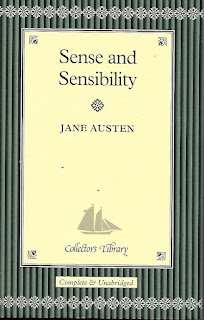
One might argue that the boring cover on my edition of this novel influenced my reading.


Saturday, May 12, 2012

The Dead Witness: Review

The Dead Witness: A Connoisseur's Collection of Victorian Detective Stories by Michael Sims (ed) jumped right off the library "New Arrivals" shelf and into my hands.  Like I needed another book to read right now.  Like I don't have two-thirds of a Mount TBR pile of my own books to read for challenges this year.  Like I could really resist this combination: Victorian (Vintage!)--Mysteries!  The collection gathers some of the best stories about private investigators and police detectives from the mid-19th to the early 20th Century.  It includes well-known stories like Poe's "The Murders in the Rue Morgue" as well as rare gems like "The Secret Cell" by William E. Burton--a story that sees print for the first time since its initial appearance in 1837.  The tales take us from France to London to the Outback in Australia to high-society New York and the backwoods of Canada. 

Here's a run-down of the stories and some thoughts:

"The Secret Cell" by Burton: Quite well-done for an early detective story.  L-- (the only name given the detective) uses the art of disguise and chatting up pub regulars and innkeepers.  There is a highspeed chase (well--as high speed as one can get in horse-drawn carriages) and fisticuffs.  And there is even the use of a dog to track down the missing woman.  Realistic detective work--with an investigator who is not quite the eccentric that Dupin and Holmes will be.

"The Murders in the Rue Morgue" by Edgar Allan Poe: The classic story credited with starting the whole detective ball rolling.  Dupin is a moody, night-loving character.  He uses an investigative method--observing everything and discounting nothing...until it can be proven irrelevant or impossible.  Definitely a forerunner of Holmes's method: "When you have eliminated the impossible, whatever remains, however improbable, must be the truth."

"On Duty with Inspector Field" by Charles Dickens: This is a very uninteresting and confusing "true" story of life on the beat with a policeman.  It just did absolutely nothing for me.

"The Diary of Anne Rodway" by Wilkie Collins: Anne cannot bear to think that her friend Mary has been foully murdered and the culprit will get away.  The verdict at the inquest is accident--Mary has died of a blow to the head that could have occurred in a fall. Anne is convinced that Mary was struck down on her way home.  A piece of a man's cravat clutched in her friend's hand is the only clue to be had.  The diary reveals Anne's journey to find the truth of Mary's death.  Very enjoyable!

"You Are Not Human, Monsieur d'Artagnan" by Alexandre Dumas: A selection from the larger work The Vicomte de Bragelonne, this very short work is pretty matter-of-fact and leaves no mystery for the reader to try and unravel.  D'Artagnan goes and investigates the scene--which is not described to the reader at the time--and then lays his deductions before the king one by one.  No suspense, no mystery.  Interesting only for its place in the development of detective stories.

"Arrested on Suspicion" by Andrew Forrester, Jr.: Another very short piece--notable for the early use of the now time-worn trick of the "mysterious double." Also a fairly good example of a forerunner of today's police procedural.

"The Dead Witness" by "W. W." (Mary Fortune): The first known detective short story by a woman.  Published as an entry in a series featuring the "Memoirs of an Australian Police Officer."  Provides an interesting and slightly shocking surprise at the end--a convenient way to get the culprit to fully confess.

"The Mysterious Human Leg" by "James McGovan" (William Crawford Honeyman): From another series of articles purported to be the experiences of the workaday life of a metropolitan detective.  This one follows McGovan as he tracks down the body belonging to the mysterious leg.

"The Little Old Man of Batignolles" by Emile Gaboriau: This one features a shrewd but compassionate policeman named Mechinet.  We have a Watson-like companion--a 23 year old health officer who lives in the same tenant house as Mechinet.  The story opens with their meeting--and our narrator's attempts to discover what kind of man his neighbor is.  He realizes he has become friends with a detective when Mechinet is called out to investigate the death of a wealthy old man.  Everything points to the man's nephew--but our narrator is the first to call attention to a clue that will lead Mechinet to the truth of the matter.

"The Science of Deduction" by Sir Arthur Conan Doyle: The opening chapters of The Study in Scarlet.  Chapters which give us the one of the most famous meetings of detective story history: "Dr. Watson, Mr. Sherlock Holmes," said Stamford, introducing us.  "How are you?" he said cordially, gripping my hand with a strength for which I should hardly give him credit.  "You have been in Afghanistan, I perceive."

"The Whitechapel Mystery": No fictional short story here.  Just an account of the very first of the attributed Jack the Ripper murders--from a newspaper article in the Evening News to the Daily Telegraph's transcript of the first day of the inquest.

"The Assassin's Natal Autograph" by Mark Twain: the opening of Twain's Pudd'nhead Wilson, this excerpt shows lawyer David Wilson securing the release of an innocent man (and identification of the guilty party) based on fingerprints--well before the first legal conviction using fingerprint evidence which took place in 1902.  A bit long-winded in build-up, but a very nice little synopsis of courtroom antics.

"The Murder at Troyte's Hill" by C. L. Pirkis: Starring Loveday Brooke--the first known female detective created by a female author.  Miss Brooke is presented as not only an intelligent and independent young woman, but as a woman who has taken up the profession because she is good at it.  She's not supporting a sister or a disabled husband.  She's not ultra-feminine to make up for her brains.  She's just a good detective. In this one, she gets to the bottom of the mystery of who killed Alexander "Sandy" Henderson, lodge-keeper to Mr. Craven of Troyte's Hill.  The police have fastened on to the son of the house, but Miss Brooke has reason's to doubt the official reading of the case.

"The Haverstock Hill Murder" by George R. Sims.  This features another female detective of the era--Dorcas Dene.  Dorcas is a former actress--which makes her particularly adept at the art of disguise.  And she puts her art to good use in helping Inspector Swanage discover who murdered Mrs. Hannasford of Haverstock Hill.

"The Stolen Cigar Case" by Bret Harte: Billed as one of the best Holmes parodies (of which there have been many, I have to say that this very short send-up of Holmes and Watson didn't do a whole lot for me.

"The Absent-Minded Coterie" by Robert Barr: Barr wrote short stories which featured a French predecessor to Christie's Hercule Poirot by the name of Eugene Valmont.  Valmont has a superior intellect as well as superior vanity to go along with it.  Considering that the fact is revealed in the very first paragraph, I don't feel bad about telling you that I'm a bit disappointed to find that the bad guys get away at the end of this story.  Valmont is very clever about discovering that Inpsector Hale's quarry is indeed up to no good--albeit not at the crime the English detective suspects.  But his vanity and belief in the superiority of French ways enables the culprits to escape with no fear of capture.  At least not for this crime.

"The Hammer of God" by G. K. Chesterton:  To my mind, a well-known Father Brown story.  At least I have seen it reproduced in several collections.  But it is a clever short story and shows off Chesterton's detective to good effect as he solves the mystery of how such a staggering blow could be delivered by such a small hammer.

"The Angel of the Lord" by Melville Devisson Post: Uncle Abner is another detective with a religious bent.  He is not a clergyman, but he is still very interested in sin and retribution.  Abner follows a man and proves how he disposed of both his partner and his horse.  I have to say that Uncle Abner's style of speech isn't one that just reaches out and draws me in.  Not a very long story, but I couldn't tell that in the reading of it....

"The Crime at Big Tree Portage" by Hesketh Pritchard:  November Joe is a regular backwoods Sherlock Holmes.  Using methods familiar to anyone who has read the Holmes stories, Joe covers the campsite at Big Tree Portage and holds up clues for his "Watson" Quaritch to see and be mystified by.  It's the small indications that lead Joe to the killer of Henry Lyon.

"The Tragedy at Brookbend Cottage" by Ernest Bramah: Starring Max Carrados, a blind detective who has hyperacute senses which allow him to unravel an intricate plot--involving a kite, a plate of metal and a few pebbles at a window.  He prevents a murder, but is unable to prevent the suicide.

"The Case of Padages Palmer" by Harvey O'Higgins: This features Barney Cook, one of the youngest detectives of the era.  Barney begins as a telegram delivery boy and winds up being taken on by Walter Babbing and his detective agency.  In Barney's first "case" he helps Babbing track down a man using a very simple clue--the length of his cigar.

"The Intangible Clue" by Anna Katharine Green: One of a set of short stories starring Violet Strange--a young society woman who assists Mr. Driscoll with cases that involve the strata of society where she can move freely.  This story involves Miss Strange in a "sordid" murder case--something she never intended to be part of.  But...without her observations in the needlewoman's home, the perpetrator would never have been caught.

This is a pretty good collection of early detective stories.  Age of course will tell and there are several plots and twists that will seem old hat to regular readers of detective fiction.  It's good to keep in mind that some of these stories are showing off these plots and twists for the first time and to try and imagine how mystified the readers in the Victorian age must have been.  Three and a half stars for the entire collection.


Sunday, April 8, 2012

Sherlock Holmes: The White Chapel Horrors


The Further Adventures of Sherlock Holmes: The Whitechapel Horrors by Edward B. Hanna plays at "What If?" What if Sherlock Holmes were a real person? (Gasp! Who could doubt it?) And what if he had investigated the horrible murders committed by Jack the Ripper? For surely, the Great Detective would have been called in on such a notorious case.

There is no doubt that Hanna knew his Holmes. He was a long-time Holmes buff and a member of the Baker Street Irregulars. And he most definitely had done his research in Ripper lore. Though a work of fiction, the novel is meticulously footnoted. Those who are well-acquainted with the Holmes canon may say, too much footnoting--he chooses to footnote material that anyone who knows the least bit about Holmes and Watson should know--but better too much than not enough. Hanna has used the Holmes canon and the facts of the terrible murders in 1888 and blended them into a dandy little tale. And it is very interesting to follow Holmes on the track of one of the most notorious killers of all time.

Almost 500 pages long, the book flies by (I finished it in a little over the day) and I didn't want to put it down until I got to the end. Hanna gets almost everything right. Almost. I quibble with bits of his portrayal of Watson--I maintain that the doctor is too good-hearted to espouse some of the derogatory comments and prejudicial beliefs Hanna attributes to him. Yes, some of the comments about the poor and certain races living in London were true of the day--but surely Hanna could have presented those details without putting them in the mouth of the good doctor. Watson does in a lot of ways represent the stalwart British man of his time, but not in all ways.

My other quibble is the ending--or rather the lack thereof. It is very disquieting to follow Holmes throughout the story and be left hanging at the end. We aren't told who the Great Detective believes Jack the Ripper to be and we are supposed to believe that at the end of the day Holmes doesn't even know. That Holmes is no more enlightened than the police. That is not the Holmes we know.

Overall, a good tale. Hanna makes it very believable that Holmes could have investigated this case. And the blend of fact and fiction is very good. An enjoyable read worth three stars.

Quote:

For one thing, life's affairs all too often did not come to a conclusion, satisfactory or otherwise. They simply stopped--abruptly, artlessly, without a shrug of apology. All too often there was no proper finish, no clear resolution or sense of finality, no ending at all; merely a cessation of activity. All too often there lacked that indispensable element of drama, that sense of wonderment, discovery, and surprise--those essential twists and delightfully serpentine turns leading inescapably to the neat and tidy ending the reader of fiction had come to expect (p. 391)

I suppose you can say that he warned me....

Monday, January 2, 2012

The Chunkster Challenge


The Chunkster Challenge is hosted by Wendy & Vasilly and has its own dedicated blog. And I'm back for another round. Definition of a Chunkster:

  • A chunkster is 450 pages or more of ADULT literature (fiction or nonfiction) ... A chunkster should be a challenge.
The rules:
  • No audio books. (There are exceptions to this rule.)
  • No e-books allowed. This was discussed in much detail in the 2011 challenge. The short version: a chunkster isn’t a challenge if you’re reading it on an e-reader. (There are exceptions to this rule.)
  • This year for the first time, essay, poetry, and short story collections will be allowed. Collections have to be read in their entirety to count. If you’ve needed a reason to finally pick up your copy of The Collected Works Of ____ now is the time.
  • Books may crossover with other challenges.
  • Anyone may join. (If you don’t have a blog, just leave a comment on this post with your challenge level and your progress throughout the challenge.)
  • You don’t need to list your books ahead of time.
  • Once you’ve picked a level, that’s it. You’re committed to it!
You must pick a level of participation:
  1. The Chubby Chunkster – this option is for the readers who want to dabble in large tomes, but really doesn't want to commit to much more than that. FOUR Chunksters is all you need to finish this challenge.
  2. The Plump Primer - this option is for the slightly heavier reader who wants to commit to SIX Chunksters over the next twelve months.
  3. Do These Books Make my Butt Look Big? - this option is for the reader who can't resist bigger and bigger books and wants to commit to SIX Chunksters from the following categories: 2 books which are between 450 - 550 pages in length; 2 books which are 551 - 750 pages in length; 2 books which are GREATER than 750 pages in length (for ideas, please refer to the book suggestions page for some books which fit into these categories).
  4. Mor-book-ly Obese - This is for the truly out of control chunkster. For this level of challenge you must commit to EIGHT or more Chunksters of which three tomes MUST be 750 pages or more. You know you want to.....go on and give in to your cravings.
To sign up, hop over to the site (link above), read the complete rules and use Mr. Linky.

I am being reserved and signing up for the The Chubby Chunkster. I've already got a lot going on challenge-wise. Fortunately, three out of the four books were already on tap for other challenges, so I'm only adding one more book to the 2012 TBR pile. My planned reading list:
 

1. The Further Adventures of Sherlock Holmes: The Whitechapel Horrors by Edward B Hanna (471 pages) [4/8/12] 
2. The Dead Witness: A Connoisseur's Collection of Victorian Detective Stories by Michael Sims, ed. (576 pages) [5/12/12]

3. North & South by Elizabeth Gaskell (451 pages) [7/18/12]
4. Sense & Sensibility by Jane Austen (462 pages) [8/13/12]

Challenge Complete! [8/13/12]....but I still have two more Chunksters on the TBR list for 2012.  We'll see if I can complete them too.

5. The Distant Hours by Kate Morton (562 pages)
6. 11/22/63 by Stephen King (at 849 pages, this is the big daddy of my chunksters this year) [10/8/12]

Saturday, November 19, 2011

Challenge Complete: Chunkster Challenge

With my book on Edna St. Vincent Millay, I have finished another challenge for 2011.


The Chunkster Challenge was hosted by Wendy and has its own dedicated blog.

I was initially reserved and signed up for the The Chubby Chunkster. But I was later able to find enough books to upgrade to the Do These Books Make My Butt Look Big? level. My completed reading list:

1. Tristram Shandy by Laurence Sterne (my edition just made it at 458 pages) [5/24/11]
2. Middlemarch by George Eliot (848 pages) [9/27/11]
3. The Angel's Game by Carlos Ruiz Zafón (544 pages) [7/6/11]
4. Savage Beauty: The Life of Edna St. Vincent Millay by Nancy Milford (608 pages) [11/19/11]
5. The Eustace Diamonds by Anthony Trollope (794 pages) [2/1/11]
6. The Book Thief by Mark Zusak (554 pages)


CHALLENGE COMPLETE 11/19/11 So...Do These Books Make My Butt Look Big?

Savage Beauty: Review


I fell in love with Edna St. Vincent Millay when I was in high school. I borrowed every volume of poetry that the local library had and when I came across a volume of her work while in college, I naturally bought it. According to her biographer, Nancy Milford, falling in love with Millay was something that was very easy to do. She was tiny and luminous, filled with ambition and a sense of her power as a poet...and as a woman. When she read her poetry, she held the attention of the audience like no author had since Dickens had made his tours of America. She captivated and seduced; she entranced and captured hearts....through the written word and in every day life.

Thomas Hardy is credited with saying that America had two great attractions: the skyscraper and the poetry of Edna St. Vincent Millay. The most famous poet of the Jazz Age, Millay took the nation by storm: She smoked in public, took many lovers (men and women, single and married), flouted convention sensationally, and became the embodiment of the New Woman. Her poetry became the voice of the young women and men of her time. Savage Beauty: The Life of Edna St. Vincent Millay gives us a wonderful portrait of "this passionate, fearless woman who obsessed America even as she tormented herself."

This was a very good biography. There is so much material here that it is difficult to write a summary or even a review. I went into it knowing what a fine poet Millay was. I learned that she not only wrote fine poetry, but she sold prose as well...under a pseudonym...and plays and one highly acclaimed opera, The King's Henchmen. Her opera played at the Metropolitan Opera House in New York City to sold-out houses night after night. It was great fun to read about how very dedicated and precise she was in this endeavor. Deems Taylor was her collaborator--he to do the music and she to write the libretto. She did so, providing him with an Anglo-Saxon themed piece. When it came to naming it, he had suggested The King's Messenger and she replied by telegram:

KINGS MESSENGER ABSOLUTELY IMPOSSIBLE FOR THIS REASON THE WORD MESSENGER WAS BROUGHT INTO ENGLISH BY THE NORMANS AND I AM WRITING MY ENTIRE LIBRETTO IN ANGLOSAXON THAT IS TO SAY THERE IS NOT A WORD IN THE LIBRETTO WHICH WAS NOT KNOWN IN ONE FORM OR ANOTHER IN ENGLISH A THOUSAND YEARS AGO.

When she had her work pictured a certain way, whether it was a poem or an opera, there was simply no interfering with her perfectionist's view. And she was generally right about what worked best.

If you have any interest in Millay, life during the Jazz Age, growing up in Maine, or American Poetry during this time period, then I highly recommend Milford's treatment of Millay's life. Four stars.

*I also get to add this one to my Victory Garden. I started this biography about 5-6 years ago, but just couldn't get into it for some reason. Two plants for the garden...and three cheers for Bev!

Tuesday, September 27, 2011

Middlemarch: Review

First off...please pardon me a moment while I do my customary "I just finished this really long [No, I mean REALLY long] classic novel celebration dance" all around the blog. Please click on the little bear for full dancing around the blog effect.


There. Done. But seriously. Over 800 pages. I've been reading Middlemarch for over a month. I can't remember the last time it took me a month to read anything. George Eliot, honey, you're one wordy lady. Can't possibly just say something like, "Dorothea walked out into the garden." Oh, no. We must know exactly why she went there and every little thing she thought on her way there and every little flower that she looked at along the way. If there were multiple reasons for going to the garden, then we must examine them each in turn from every which way until there isn't the least little doubt that Dorothea was meant to go there no matter what. Enough already.

Okay. Got that out my system. And I have a little confession to make. For quite some time (oh, for say 25 years or so--ever since college), I've considered myself a Victorianist. I was drawn to the era. But as I waded into Middlemarch, I was beginning to doubt myself. Or at least begin to reconsider what kind of Victorianist I am. I honestly think I am more your Oscar Wilde and Robert Louis Stevenson and Sir Arthur Conan Doyle kind of Victorianist. More a Collins' The Moonstone rather than a Collins' The Woman in White kind of Victorianist. And I suspect (although this is based purely on an experience with Great Expectations) that I'm not really a Charles Dickens kind of Victorianist. Because I'm not all that into long, involved, let's describe things to death narrative. But, then, I liked Trollope's The Eustace Diamonds and that's one long, wordy book....must keep considering.

But, forget all this True Confessions business--what we really want to know is did you like it? Was it an awesome novel like the interwebs says it is? Is it the finest thing that Eliot ever did? Well, I don't know about that last one. Because, you see this is the first work by Eliot that I've ever read. But, yes, it's a wonderful novel. She sketches out an intricate look at British village life. She gives us pitch-perfect character studies. She knows her characters inside and out and understands them. Even though they don't understand each other and mostly don't seem to understand themselves. Who would have thought there could be so much melodrama in the British countryside? And all the interweavings of relationships.

Dorothea and Casaubon. We have the idealistic Dorothea who wants to do good and become educated to increase her capacity for good. Dorothea who somehow thinks that to wed Casaubon and be "lamp unto his feet" and support his scholarly pursuits (and maybe pick up some Latin and other languages along the way) will fulfill her ideals and allow them (D & C) to live happily ever after. Not so much.

Rosamond and Lydgate. Lydgate who is every bit as idealistic as Dorothea. He wants to do great things in medicine and revolutionize the field and then he falls in love with Rosamond and thinks somehow the love of this fine little woman will support him while he succeeds. Rosamond has said all along that she could never marry a Middlemarch man--she's known them all too well and they would never do. And she has stars in her eyes thinking that any outsider (say, Lydgate) must be way better and, hey, doesn't he have relatives who are somebody? So, by golly, they'll live happily ever after too. Well, sort of, depending on your definition of the phrase--and only after much tribulation and gnashing of teeth.

Celia and Sir James. Sir James originally longs for Dorothea--and, in fact, many in Middlemarch expected Sir James and Dorothea to wed. But after watching Dorothea marry that dried up scholar, Casaubon, Sir James sets his sights on sister Celia. Celia, who really has always had an eye for James but thought he was so much better suited to Dorothea. But, hey, if her sister is going to throw away a chance to marry James, Celia won't say no. After all. "Celia confessed it was nicer to be 'Lady' than 'Mrs." and it did allow her to have her pretty jewelry and her precious little Arthur. Who, of course, is the most darling of boys. They certainly will live happily ever after. Most likely.

Mary Garth and Fred Vincy. Fred is a seemingly ne'er-do-well. He means well, but can't seem to settle to anything--and things just don't seem to go right. He goes for schooling to go into the church, but can't quite stick it. He has expectations of a small inheritance that doesn't come through. He finds himself in debt and can only get out through an obligation to Mary's father. Mary and Fred have loved each other since they were small. But Mary won't commit to him until proves himself steady. Will they live happily ever after? Oh, you can count on it. But don't try to count the twists and turns that Eliot will take you through before they get there.

And, oh, I could go on. There's the Bulstrodes and his secret and the man who comes along to spill the beans. And the good vicar Mr. Farebrother who also loves Mary, but who does his best to help love's young dream. And Mr. Featherstone (of the possible inheritance) who keeps everyone guessing about who's going to get the goodies.

In all of these relationships, no one really understands anyone else. I was really struck by the amount of heartache and trouble that could have been averted if these people would have just talked to each other. They all assume what the other person thinks or feels or means, but they rarely get it right. I suppose, on a much smaller scale, that's true of all human relations. Assumptions make for a great deal of trouble. I also absolutely loved the depiction of the village grape vine and social judiciary committee. Who needs facts when you can spread conjectures? The word in Middlemarch "was spreading fast, gathering around it conjectures and comments which gave it new body and impetus....Everybody liked better to conjecture how a thing was, than simply to know it; for conjecture soon became more confident than knowledge, and had a more liberal allowance for the incompatible." The poor folk who are being conjectured about never stand a chance. And isn't that always the way?

So, again, yes, I thoroughly enjoyed the novel. I have to say, it was absolutely worth it to make my way through 770 pages or so to get to the end. The tying up of all the story lines is masterful. The ending is marvelous. It probably deserves another reading--but, honestly, unless I take up the call of the scholarly life, I don't think I'll be devoting another month to rereading it. I highly recommend it for those who want a very thorough look at British provincial life in the Victorian era. Just make sure to carve out plenty of time for reading it. Four stars.

Tuesday, August 30, 2011

The Book Thief: Review


I don't remember the last time a book made me cry. That is, before tonight. I just finished The Book Thief by Markus Zusak and by the time I closed the book, I was weeping. Is this book perfect, no. All-time finest written, no. But, Zusak, has certainly done his job as a writer. He has reeled me in, sometimes faulty prose and all, and made me care about his characters. And I couldn't bear it when my nearly all of favorites were gone at the end. Trust me, I'm not spoiling anything here. After all, the narrator of the book is Death and the book is about Germany during World War II--am I really letting any cats of the bag when I tell you that a lot of people die? I didn't think so.

This book has made so many lists and been so widely reviewed that I doubt that I'm going to say much that's original and a synopsis probably isn't necessary. But for those of you who, like me, don't get out in the world of modern books very often--here's a run-down:


This book is narrated by Death...who, of course, is always busy--but never more so than during the reign of Nazi Germany. The book begins with Liesel Meminger, her brother and her mother on train headed to Molching, outside of Munich, to place the children in a foster home. Death's first job in the book is to claim Liesel brother. A death that will haunt Liesel through nightmares for years. The story follows Liesel as she settles into a working-class neighborhood of tough kids, acid-tongued mothers, and loving fathers who earn their living by the work of their hands. The child arrives having just stolen her first book–although she has not yet learned how to read–and her foster father uses it, The Gravediggers Handbook, to lull her to sleep when shes roused by regular nightmares about her younger brothers death. And then although he is no great reader himself, her foster father takes pains to teach Liesel to read. Across the ensuing years of the late 1930s and into the 1940s, Liesel collects more stolen books as well as a peculiar set of friends: the boy Rudy, the Jewish refugee Max, the mayors reclusive wife (who has a whole library from which she allows Liesel to steal), and especially her foster parents. Liesel's friendships are particularly well-done--and most particularly the prickly friendship between her and Rudy. Depicting a friendship between a girl and a boy at that age is not an easy task.

The story of Liesel and Death's parallel narrative relating the horrors of war surrounding Molching give a very vivid picture of what life may have been like in the small towns of Germany. And the heart-breaking ending is so very well done, it makes up for some of the stilted writing and poor imagery found earlier in the book. (I just can't imagine a chocolate sky--for one thing.) Overall this is one of the finest young adult books I've ever read and certainly one that has most touched me. I could not put it down this evening (and only put it down throughout the day because I had to work). My biggest quibble is about the little asides that appear in bold. I think that some of that could have been left out altogether and the rest would have worked better if it had been incorporated into the story. Those asides put some major bumps in the reading road. Without those, this would have been a five star book. Four and a half stars.

Tuesday, May 24, 2011

Tristram Shandy: Review


Pardon me a moment while I do a little victory dance...I'm done with Tristram Shandy!!!!!!!

OMG. Was there ever such a book? I am pleased as all get out that I can say that I'm done with the thing. It's behind me and I'll never be tempted to pick it up again.

What is Tristram Shandy by Laurence Sterne about you might ask--and well you might and maybe if you ever read it you might figure it out better than I; because I, well, I got all distracted by the INCREDIBLY long sentences and odd punctuation--when there was any to be had; and the major digressions. Do you see what I mean? But, anyway, as far as I can tell, dear Reader, this long-winded novel--if you want to call it that--is supposed to be about Shandy's life and opinions, yet a great deal of it would seem to be about Shandy's birth; but, wait, I can't tell you about that just now--that would be putting the cart before the horse. There's also a story about the midwife to tell and you won't believe what that's about--but wait, I forgot, I need to tell you about the parson and his horse. And Shandy's father's hobby-horse, as well as Uncle Toby's. And speaking of Uncle Toby we also have his little affair of the heart with the Widow Wadman--but I can't go into that now because I have to tell you about Aunt Dinah. And Noses (which are really noses, no matter what anyone says). And the importance of Names. And the doctor's thumb. And the Inquisition ("No one expects the Spanish Inquisition." And I can assure you, I certainly didn't.) And we have to go up and down stairs several times talking all the way before we get back to Shandy. And, oh look, he's born now. But the parson has christened him with the wrong name. Oh no! What shall be done? Well, we'll apply to the church fathers--but while that's going on we'll have a little incident with a hot chestnut. And--hold everything!--I forgot to tell you--oh dear Reader, how could I forget such a marvelous story which was told right in the middle of everything about Diego and his marvelous Nose? It was such a wonderful Nose that it set a whole town on its ear. And I'm not even half done telling you about the book yet.

And now that we've gone on to the second half of this extraordinarily long and disjointed reading experience, I need to tell you that there is also a great deal about the Shandy family luck--or, rather, I should say, their lack of it. Nothing seems to go right for them. From naming poor Tristram to the loss of the firstborn to Tristram's loss of his...... (oops, Sterne doesn't actually write it "out loud" shall we say, so I better not). Oh, and there's a great deal to be said about sieges and battlements. And buttonholes and chambermaids. And did I mention hobby horses? I think I did, but we'll throw them in again just to make sure. And, of course, there is that ultimate question: Is a white bear better than a black one?
Now really, if I had kept that up for over 450 PAGES, wouldn't you be ready to throw my review out the window (or at least hit "delete")? And that was the main temptation that I had to fight the whole time. The back of my edition says that

The purpose of Tristram Shandy, beyond entertainment, seems to be to open the reader's heart and feelings....[as the text says] 'When the heart flies out before the understanding, it saves the judgment a world of pains.' This is the lessen of Tristram Shandy, if lessen there be. There is innate goodness in man, and if he follows his heart, that goodness will become operative in the world. Sterne wants us to use our hearts.

Um. Okay. If you say so. As far as I can see, what Sterne wants is to say whatever the heck comes into his head at any given moment and then to either bore us to tears with it or just kind of mention it, but then think of something else and promise to get back to the first thing later--after coming up with about 14 other things to talk about too. Laurence Sterne would seem to be the great-grand-daddy of the stream of consciousness writers. And I think we've discussed before my feelings about that (see my Intruder in the Dust review). Sure I can see that this was a really influential book--where would Faulkner be without stream of consciousness? And there are even some humorous parts in there but 400 pages of long drawn-out digressions? It just made me want to scream. I don't even know that I can rate this book. So I don't think I'll try.

I suppose I ought to mention that there were two parts that I really liked:

1. Toby's apologetical oration (justification of his own principles and conduct in wishing to continue the war).
2. Tristram's definition of love (when telling us about Uncle Toby and the widow):

Love is certainly, alphabetically speaking, one of the most

A gitating
B ewitching
C onfounded
D evilish affairs of life--the most
E xtravagant
F utilitous
G alligaskinish
H andy-dandyish
I racundulous (there is no K to it [nor J, apparently]) and
L yrical of all human passions: at the same time, the most
M isgiving
N innyhammering
O bstipating
P ragmatical
S tridulous
R idiculous--though by the bye the R should have gone first

And, of course, true to Shandean form--he doesn't complete the alphabet. But I still like it--even though some of it doesn't make sense. Just like love. In fact, as I think over my reading of this book, I find that the best parts are all Uncle Toby. It is just about worth 400 pages to finally get to the amorous campaign upon which the widow embarks and how Toby responds in kind.


Tuesday, February 1, 2011

The Eustace Diamonds: Review


The Eustace Diamonds (1873) is the third novel in Anthony Trollope's Palliser series. However, this is the first Trollope novel I've read--picked out initially for the jewel in the title to fulfill part of the What's in a Name Challenge. I didn't find that stepping into the series in mid-stream hurt my understanding of the book at all. There weren't any references to people or incidents that weren't made clear in the work itself.

According to the blurb on the back of the book, this novel "bears all the hallmarks of [Trollope's] later works, blending dark cynicism with humor and a keen perception of human nature. Following the death of her husband, Sir Florian, beautiful Lizzie Eustace mysteriously comes into possession of a hugely expensive diamond necklace. She maintains it was a gift from her husband, but the Eustace lawyers insist she give it up, and while her cousin Frank takes her side, her new lover, Lord Fawn, declares that he will only marry her if the necklace is surrendered. As gossip and scandal intensify, Lizzie's truthfulness is thrown into doubt, and, in her desire to keep the jewels, she is driven to increasingly desperate acts.
"

This was an interesting read. I find Trollope to be somewhere between Jane Austen and Charles Dickens for me--with Jane being the higher end of literature. Trollope's characters are well-drawn, realistic and believable. In fact he did such a good job of representing Lizzie Eustace a s a grasping, lying, cheating, social-climbing wench, that I can assure you I would have no desire to be introduced to her when out in society. I was a bit disappointed in the ending. Although I do think Lizzie is getting a bit of karma thrown her way, I would have appreciated a better resolution with respect to the diamonds. But I guess we can't have everything we want.


One other quibble...as with many novels from this time period,
The Eustace Diamonds was originally printed in installments--which meant the reading public had to wait a long time to find out what happened next. I appreciate Penguin Classics desire to present the work in precisely the form that readers in the Victorian era would have received it....except that doesn't exactly work. I've got it all in one volume...so rather than having to wait weeks or longer to read the next bit, I was able to plow on through. This meant that the "reminder" passages which were intended to help the Victorian reader remember what had taken place previously really began to irritate me. Whole passages that had just appeared two or three pages ago would suddenly reappear. Minor quibble. Over all an interesting character study of how far one woman will go to hang on to what she has convinced herself is rightfully hers. Three and a half stars.

Wednesday, January 5, 2011

The Chunkster Challenge

This is one of the challenges that has been calling my name. Yes, I know what this means. Birdie (and anyone else within range), just come and slap me. Get it over with. I'm a Reading Challenge Addict (as another of my challenges affirms). I can't stop myself. Besides, I figured out that three of the books I had already decided to read would qualify...and I've added the fourth to my Gothic Reading Challenge. It's all good. Here we go....


The Chunkster Challenge is hosted by Wendy and has its own dedicated blog.

Definition of a Chunkster:
  • A chunkster is 450 pages or more of ADULT literature (fiction or nonfiction) ... A chunkster should be a challenge.
The Rules:
  • No Audio books in the chunkster. It just doesn't seem right. Words on paper for this one folks.
  • No e-Books allowed - we are reading traditional, fat books for this challenge.
  • Short Stories and Essay collections will not be counted.
  • Books may crossover with other challenges
  • Anyone may join. If you don't have a blog, just leave me a comment on this post with your progress (and to let me know you are playing)
  • You don't need to list your books ahead of time.
  • Once you pick a level, that's it...you're committed to that level!
You must pick a level of participation:
  1. The Chubby Chunkster - this option is for the reader who wants to dabble in large tomes, but really doesn't want to commit to much more than that. FOUR Chunksters is all you need to finish this challenge.
  2. The Plump Primer - this option is for the slightly heavier reader who wants to commit to SIX Chunksters over the next twelve months.
  3. Do These Books Make my Butt Look Big? - this option is for the reader who can't resist bigger and bigger books and wants to commit to SIX Chunksters from the following categories: 2 books which are between 450 - 550 pages in length; 2 books which are 551 - 750 pages in length; 2 books which are GREATER than 750 pages in length (for ideas, please refer to the book suggestions page for some books which fit into these categories).
  4. Mor-book-ly Obese - This is for the truly out of control chunkster. For this level of challenge you must commit to EIGHT or more Chunksters of which three tomes MUST be 750 pages or more. You know you want to.....go on and give in to your cravings.

To sign up, hop over to the site (link above), read the complete rules and use Mr. Linky.

I am being reserved and signing up for the The Chubby Chunkster. My planned reading list:

1. Tristram Shandy by Laurence Sterne (my edition just made it at 458 pages) [5/24/11]
2. Middlemarch by George Eliot (848 pages) [9/27/11]
3. The Angel's Game by Carlos Ruiz Zafón (544 pages) [7/6/11]
4. Savage Beauty: The Life of Edna St. Vincent Millay by Nancy Milford (608 pages) [11/19/11]
5. The Eustace Diamonds by Anthony Trollope (794 pages) [2/1/11]
6. The Book Thief by Mark Zusak (554 pages)

***Addendum: If I can find one more book in the 551-750 range, then I'm going to upgrade to Do These Books Make My Butt Look Big? I just think it would be cool to do that level.

Up-Grade! Will now commit to the Do These Books Make My Butt Look Big? Level with six books. (7/15/11)

CHALLENGE COMPLETE 11/19/11