
Showing posts with label 50 Books. Show all posts

Saturday, November 12, 2022

Streaked with Crimson


 Streaked with Crimson (1929) by Charles J. Dutton

This is the first appearance of Harley Manners, professor of abnormal psychology, in Dutton's somewhat short catalog of mysteries (a little less than 20). The first eight feature well-known criminologist, John Bartley, who shares in Professor Manners' adventures here and in whose footsteps Manners tries to follow. We begin the story with Manners motoring his way to spend a month with his old friend George Carter. Carter has promised him a chance to meet Bartley who will also join the two men at Carter's seaside summer place. 

Manners decides to take a "short cut" but soon loses his way when a fog descends on the coastal roads. After many miles of very slow travel, he finds himself at a lonely stone house. A flicker of light in an upper window encourages him to see if someone inside can direct him. But no one answers the door and, after discovering the door is ajar, he wanders inside to discover a macabre scene. An impeccably dressed man is hanging from the high ceiling. He has been killed with a tar-coated rope streaked at intervals with crimson paint. Finding no sign of anyone else, he gets back in his car and, the fog having lifted a bit, manages to find his way to Carter's house. But by the time James Rogan, the chief of police, arrives, the story is told, and they go back to the house, the body has disappeared. The only evidence to support Manners' story is a short length of crimson-streaked rope still tied to the beam in the ceiling. Whoever took the body away was in too much of a hurry to untie the complicated knot.

A brief search reveals that the house is empty, save for a bit of old furniture in the downstairs hallway and one room on an upper floor. This room is furnished in cheap elegance with roses sitting in a vase and it seems apparent that the place has been used as a rendezvous with a woman. While the Chief and Carter search elsewhere, Manners gives the room a closer inspection...until he hears a noise in the attic above. He investigates and follows a figure through a trapdoor and onto the roof. A scuffle ensues, Manners rips off the man's pocket, but is knocked down (nearly falling off the roof), and the man escapes. They decide to revisit the house in the daylight with the hope of finding more clues.

When they return to town, a man by the name of Robb comes to the police station to report that Paul Mason, his employer--and according to Carter (a secret service man) and Rogan a very shady character, has disappeared. Mason was scheduled to meet Robb on the dock for a yachting trip. The next morning's thorough investigation reveals why Mason didn't show up--his body is found (on the roof!) and Manners identifies the corpse as the one last seen hanging from the rope inside.

Before Manners and company can get too deep in the investigation of Mason's murder, another body is found. Mrs. Molly Rand is found dead in her bedroom--hanged with the same type of rope as had been used on Mason. The reason Mrs. Rand is found so soon is thanks to her busybody neighbor, town librarian Abigail Tripp. Miss Tripp did not approve of Molly with her skirts too short and her flirting ways. She observes Molly and her husband having an argument. Robert Rand leaves the house and Molly begins packing a suitcase. She realizes that her shade is up and pulls it down. And that's the last Miss Tripp sees of Molly until the next morning when her curiosity gets the better of her and, when she discovers the door slightly open (that seems to be a trend in this area...) she discovers the body.

Manners and Carter have some adventures with burly strangers (but can't catch any of them) and stumble across clues from a red notebook to a French book about the torture of the saints to a Bible open at a particular verse. Chief Rogan is sure that Robert Rand is the killer--he discovered that Mason was Molly's lover and killed them both out of jealousy. But it isn't until John Bartley arrives that the real motive and real killer are revealed.

Thanks to Rick Mills at The Mystillery for my edition of this book! I was very excited to find that he had sent me that rare thing--an academically-inclined vintage mystery that I'd never heard of. But I must say that I'm a bit disappointed in Professor Harley Manners. I'm no abnormal psychologist, but I did figure out the psychological motive behind the murders and recognized the culprit as soon as they were described to us. I see that Manners is lead in five more books--I hope that he was a quick study under Bartley here and will give me a better showing should I happen to find more of Dutton's books.

A really big deal is made throughout the book about the rope streaked with crimson. Bartley says that Manners (even though he didn't really get it) recognized this important clue--referring to it in the notations he made (and gave Bartley to read). The criminologist gives us half an explanation--he explains that the color red seems to dominate in crimes of this nature (I can't explain what nature precisely without spoiling things), but he doesn't really explain the tar-coated rope. I'm guessing that just as the Bible verse mentioned above has some importance to the psychology of the crime, that the quotation, "He that toucheth pitch shall be defiled therewith," was probably on the culprit's mind. 

photo credit
This is an interesting look at an early example of a mystery where the detective is concerned with the psychology of the crime. It's not just important to find out who did it, but also to find out why. In fact, Bartley looks for why first and then looks at the players in the drama to see if anyone could fit the profile. I enjoyed it--but not quite as much as I hoped. ★★

First line: Bringing his car to a sudden stop, Harley Manners gazed in perplexity at the crossroads which faced him.

Last line: "Streaked with crimson," was Carter's answer.

***************

Deaths = 4 (three strangled; one shot)


Saturday, September 3, 2022

A Scream in Soho


 A Scream in Soho (1940) by John G. Brandon

Detective Inspector McCarthy (and all his neighbors) hears a scream ring out in the middle of a pitch-black night in Soho. No lights spring up--for we're in the middle of the black-out period in Britain. He makes his way to Soho Square--from whence the scream seemed to come--but the only evidence of an incident is a bloody doorway, a stiletto dagger, and an unmarked lady's handkerchief. Oh...and the lingering scent of a very distinctive perfume. There is no sign of a body or anyone who might have screamed. The constable who arrives on the scene is sure the scream came from a woman, but McCarthy thinks it was a man. It may be that they are both right. Before the night is over there will be three victims found...another police constable, an elderly food peddler, and a fashionable lady (who isn't quite...a lady, that is). And before the case is over McCarthy will find himself dealing with Italian gangsters, cross-dressing German spies, Austrian nobility, and a set of missing anti-aircraft defense plans.

This is just a plain fun thriller and espionage adventure. If you're looking for a classic whodunnit with clues and suspects and police interviews and whatnot, then this isn't it. McCarthy is a pretty atypical Yard Inspector. He totes a gun and works more with convenient civilians--particularly a cabman who's handy in a scrap and Danny the Dip whose picadilloes McCarthy overlooks in exchange for some shadowing duties--than he does with fellow officers. This makes McCarthy an appealing roguish hero--whose excellent record of detection keeps him from getting into trouble for his maverick ways. There isn't much doubt about who the bad guys are here, but it's interesting to watch McCarthy track them down and figure out a way to pin the murders and the espionage on them. I enjoyed this walk on the wilder side of World War II mysteries. ★★★★

First line: In that inexpressibly comfortable little Soho café, owned and managed by that dignified Italian lady, the Signora Lucia Spadoglia, Inspector McCarthy sat and waited.

Last line: "You'll either be looking for a job, or they'll make you an inspector--and then the good Lord look after you for nobody else will."

*******************

Deaths = 5 (four stabbed; one natural [pneumonia])

Sunday, August 7, 2022

The Twyford Code (Spoilerific)


 The Twyford Code (2022) by Janice Hallett

Synopsis (from the book flap): It's Time to Solve the Murder of the Century...[according to audio files given to the reader in transcript form] Forty years ago, Steven Smith found a copy of a famous children's book by disgraced author Edith Twyford, its margins full of strange markings and annotations. Wanting to know more, he took it to his English teacher, Miss Iles, not realising the chain of events that he was setting in motion. Miss Iles became convinced that the book was the key to solving a puzzle, and that a message in secret code ran through all Twyford's novels. Then Miss Iles disappeared on a class field trip, and Steven has no memory of what happened to her.

Now, out of prison after a long stretch, Steven decides to investigate the mystery that has haunted him for decades. Was Miss Iles murdered? Was she deluded? Or was she right about the code? And is it still in use today? Desperate to recover his memories and find out what really happened to Miss Iles, Steven revisits people and places of his childhood. but it soon becomes clear that Edith Twyford wasn't just a writer of forgotten children's stories. The Twyford Code has great power and he isn't the only one trying to solve it...

Fair warning: There is no way I can discuss my response to this novel without spoiling bits of the plot here and there. Read on at your own risk!

Okay. Let's just start with the first part of the blurb: It's Time to Solve the Murder of the Century. Except, yeah, no, it's not. There is no murder of that kind of importance here. In fact, some of the murders we're told about apparently didn't even happen. They're made up for the sole purpose of misdirecting the reader. In the big reveal at the end, we discover that one of the most important "murder" victims is, in fact, alive and well and living in comfort not too far away. A second victim is living in about the same circumstances as when we saw him last (before being told he was dead). And those who are killed just don't, I'm afraid, warrant a "murder of the century" label. It would be more accurate to say that it's time to solve the crime of the century (though that is still pushing it as far as hype goes). There's definitely a major crime to be solved. After all, that much gold and jewelry is kind of a big deal.

Next up: I really felt let down after the big build up of Twyford and her code and the secret WWII gold and Nazi spies and all that. I was quite excited that Steve and Lucy were on the track of a major WWII secret and I thought it terrific that children's books had been used to convey a code during the war. But, hey, that's all completely made up! For no real reason at all--except to give Steve a story to tell in audio form so he can hide clues to the real gold that he stole in a way that (supposedly) only his son (a genius math/puzzle guy) will be able to figure out. 

Last of my big quibbles: The ending is left hanging. Does Steve's son go and find the gold? Who knows. Did all of the other murders we're told about really happen? Again, who knows. I'm not even sure that Steve's mom and dad were killed at all, let alone in the ways described. The only one I believe in is the one Steve got put in prison for (and he didn't even do...). As a murder mystery, this leaves a lot to be desired.

Now we'll turn to the positives. Is this a clever book? Oh, yes. I enjoyed the use of the audio transcripts as a means to convey the story. It completely hooked me. I'm not so good at secret codes and anagrams and acrostics, so there's no way that I could have figured out the code if it hadn't been spelled out for us, but that didn't dampen my enthusiasm. I was completely sold on the Twyford Code. Hallett is excellent at pulling the wool over her reader's eyes and that is great fun too--within limits (please see above for where I think the limit was exceeded). I enjoyed the (totally made up) search for Miss Iles and the WWII secrets. I wish it had been more real within the context of the story.

I did appreciate the underlying theme of redemption and reconnection. I hope that Steve's story as it comes through the narrative is more or less true, because it shows how one can overcome one's past and connect to a better future. ★★ and 1/2

First line: Dear Professor Mansfield, I am investigating a mysterious case and suspect you may be able to help.

Last line: Emotions are vivid if echoes remain.

***************

Deaths = 6 (one natural; one beaten to death; one hit on head with poker; two shot; one car crash)

Monday, July 4, 2022

Seven Tears for Apollo


 Seven Tears for Apollo (1963) by Phyllis A. Whitney

Dorcas Brandt flees to the Greek island of Rhodes in order to escape the menacing incidents that have occurred in months following her husband's death in an airplane crash. Twice her belongings are searched and a mysterious chalk drawing of two white circles are left behind. Before his death, Dorcas had learned of Gino Nikkaris's illicit art dealings...and his cruelty. She thought she was free when he died, but it seems that those who worked with him believe that she has something they want...and must acquire at any cost. 

In Rhodes, the beauty and serenity of the ancient Greek ruins begins to calm her and she thinks she may have found safety, as well as a friend in the young American Johnny Orion, who works for Gino's foster mother (of sorts), Fernanda. Fernanda had taken Dorcas and her daughter Beth in when Gino died and now Fernanda, a famous author, had traveled to Greece in search of material for another book. But when the searches and symbols occur again in Greece and a strange woman with hostile eyes is hired to care for Beth it seems that danger has followed her across the ocean. It's especially difficult for Dorcas because no one--not Fernanda nor Johnny--seems to believe her. Is it all her imagination as they tell her (unstable nerves after her tragic loss) or is there an evil hand at work?

Well...this is a gothic romance/mystery, so of course there is evil going on. But who's behind it? What do they want? And when on earth will Dorcas grow a spine and stand up to Fernanda who seems to think she can run the woman's life for her? Just a few questions that occurred to me. Honestly, this is a decent example of its type and the mystery of who was doing what and why was a pretty good one, but I did get very tired of the whole "don't pay attention to Dorcas, she's been a little loopy since her husband died" routine--and Dorcas letting them get away with it. I also would have appreciated a more definite ending...things are just a tad ambiguous as far as certain characters getting their just desserts. ★★

Side note--don't ask me who that lady on the cover is. Our heroine has blonde hair. The cover artist apparently missed that memo.

First line: The museum's stature of Apollo was a copy.

Last line: She walked close to Johnny wondering if the old gods might still amuse themselves on their Olympic heights.

***************

Deaths = 3 (one plane crash; one hit by car; one fell from height)


Wednesday, June 29, 2022

Hans Brinker or The Silver Skates


 Hans Brinker or The Silver Skates (1865) by Mary Mapes Dodge

Hans Brinker is a classic children's story set in Holland and focusing on the poor, but honorable Brinker family. Hans, at 15 years old, and his little sister Gretel, 12, have few friends and miss out on much schooling because they must work to help their mother support their family. Mr. Brinker was a worker on the dykes and made a decent living until he suffered a head injury from a fall from the dyke ten years ago. Since that time, he never speaks and mostly just stares into space. But when he grows irritable and causes physical damage to their home and scares their mother, Hans decides that something must be done.

The two children wanted more than anything to be able to skate in the great race down the frozen canals. There would be two winners--a boy and a girl--and the prize would a set of beautiful silver skates. But the Brinkers cannot afford good skates and only have homemade skates made of sharpened wood and tied to their boots. Two kind-hearted children arrange for both Gretel and Hans to have fine, new skates. But proud Hans insists on working for the money and carves wooden necklaces. Peter, one of the kind-hearted children, suggests to his family that Hans could do the carving which they have wanted done on the front door frame. And Hans sees this as a way to earn money for a doctor. 

But with his father's recent behavior, he has to approach the doctor before he has earned the money and sells his new skates to pay the doctor. Fortunately, Dr. Boekman takes a liking to Hans and offers his services for free. He performs a risky operation and Mr. Brinker regains his speech. Memories follow--but more slowly. The family are anxious for all of his memories to return because there are some mysteries to clear up.  

I never realized that Hans Brinker had--in addition to a charming children's story--a mystery at the heart of it. Two mysteries, in fact. First, there is the missing savings of the Brinker family. A large sum of money--all of their savings--went missing on the same night that Mr. Brinker had his fall from the dyke. The second mystery involves Dr. Boekman's missing son. The answers to both mysteries are locked in Mr. Brinker's brain and it isn't until Hans convinces Dr. Boekman to treat his father that the mysteries will be solved.

This was an enjoyable, uplifting children's story that focuses on family, loyalty, and friendship. It, of course, has a happy ending though {SPOILER} I was surprised to find that Hans isn't the one who wins the silver skates. Since he's in the title and is our primary protagonist, I really expected him to be the winner. But the ending is most satisfactory anyway--Hans's sense of loyalty prompts him to help a friend win and Gretel does wind up the winner of the girls' race. I appreciated the fact that Dodge tells us what happened to all of our primary characters in the years that followed. She also manages to relay a great amount of information gleaned in researches about the Netherlands without making the reader feel like the recipient of info dumps. ★★★★

First line: On a bright December morning long ago, two thinly clad children were kneeling upon the bank of a frozen canal in Holland.

There is an Angel called Charity who would often save our hearts a great deal of trouble if we would but let her in. (p. 150)

Last line: But lest you forget a tiny form trembling and sobbing on the mound before the Brinker cottage: they will never weary telling of the darling girl who won The Silver Skates.

**********

Deaths = 2 (one natural; one poisoned)

Saturday, June 18, 2022

The One Hundred & One Dalmatians


 The One Hundred & One Dalmatians (1956) by Dodie Smith; read by Martin Jarvis

This is the classic children's story that inspired the animated Disney film. Pongo and Missis (not Perdita!) are enjoying a comfortable newlywed life with their human pets, Mr. & Mrs. Dearly (also newlyweds) when two things happen that will change all their lives significantly. First Mrs. Dearly runs into a woman whom she had gone to school with--Cruella de Vil. And, second, Pongo and Missis are found to be expecting puppies. 

Cruella has married a furrier. Which is good for her--since she can never be too warm and constantly wants to be wrapped completely in furs. And she's always on the lookout for new and exotic patterns for furs. She comments on how beautiful the coats of the Dearlys' Dalmatians are...and how Dalmatian coats would make such a lovely fur. If that doesn't make everyone shiver, I don't know what would.

When Pongo and Missis become the parents of fifteen (!) puppies, the entire household is delighted. But fifteen pups are a bit much for Missis to manage feeding, so the Dearlys have to find a mother dog who has lost her own pups and still has milk to give. They are fortunate to find Perdita, a liver-spotted Dalmatian in need of a rescue. And so the eighteen Dalmatians and their humans settle down to a routine of puppy-rearing. Until the unthinkable happens--all fifteen puppies are dognapped and Scotland Yard is baffled. But Pongo has a sneaking suspicion who is behind the crime and sends out an urgent message through the dog-world's message system, the Twilight Barking. Soon every canine in dogdom is on the case and helping the Pongos find their pups...and a whole lot more.

I really enjoyed the original story--a charming tale, though very much of its time. I particularly liked that the dogs who helped the Pongos were featured a bit more than in the Disney film. There are, of course, differences between the printed and filmed versions--mostly, I think, to condense the story into a better length for young audiences. It's a shame that Missis and Perdita were fused into one character in the film, though I can see that having two mothers might have seemed a bit redundant. 

The written story is a bit darker, but overall a delightful adventure for all ages. I both listened and then read an online e-copy of the original book--complete with original illustrations. Great fun! ★★★★

[Photo credit for cover]

I also listened to the audio version read by Martin Jarvis.

First Line: Not long ago, there lived in London a young married couple of Dalmatian dogs named Pongo and Missis Pongo.

Last Line: For in front of every one of the many seats there had been a little carpet-eared, puppy-sized dog bed.


Sunday, June 12, 2022

What Just Happened


 What Just Happened: Notes on a Long Year (2021) by Charles Finch

"What Just Happened" is, I think, a legitimate question from anyone who made it through that horrific last year of 45's presidency. From the pandemic and all it entailed to watching a black man killed by police right there in front of us to a sitting president encouraging his base to go "protest" a legitimate election with the resulting coup attempt--so much of what happened is enough to make me wonder if we all haven't just been living in a very bad dream. A bad dream that we don't, even now, seem to be able to awaken from. Covid-19 goes on. Perhaps not as deadly as it was at its worst, but people are sill dying. People still have long-Covid, the lingering symptoms that just won't go away. Inflation is at an all-time high because the greedy corporations and millionaires & billionaires who somehow managed to keep making all-time high profits during the pandemic haven't had enough and are still raising prices--only now they get to blame it on the war in Ukraine. And so it goes. [A phrase used often by Finch in an echo of Vonnegut.]

Sorry...didn't mean to turn my review into a rant...but there it is. And I'm not changing a word.

Charles Finch is such a gifted writer. It was both harrowing and cathartic to read his diary and relive and remember how very stressful and scary and just plain awful it was. To repeatedly come across phrases that represent exactly what I felt/thought/said at precisely those moments. To see confirmation that I wasn't the only one who felt the disconnect and who didn't want to work (how could I work when so many were dying needlessly; when I might be next or my loved ones might be next). But he also injects just the right amount of humor to keep us from getting mired in the horrific, to keep us on an even keel. And to even show us a bit of hope.

I appreciated most the absolute honesty of the work. He gives us everything--his fears, his anger, even his craziest thoughts. It is an open, authentic view of what he experienced during what is arguably one of the worst years our country has faced in a very long time. Thank you, Charles Finch, for all of it. ★★★★

First line: March 11 There is an emotional chill in the streets today for the first time.

Last line: And so the days glide forward, into a future we have to hope other people haven't already made for us.

Wednesday, June 8, 2022

Trixie Belden & the Black Jacket Mystery


 Trixie Belden & the Black Jacket Mystery (1961) by Kathryn Kenny

Trixie and the Bob-Whites are getting ready to hold an ice carnival on the Wheelers' lake. Trixie and Honey's pen pals in Mexico have been through an earthquake. The disaster destroyed their school library and they don't know how the books will ever be replaced. So, Trixie comes up with the idea of the carnival to raise money and seek book donations. You'd think she'd be too busy to get mixed up in a mystery...but not our Trixie. 

Regan, the Wheelers' groom, is acting oddly. Trixie overhears him asking her mom for advice for some sort of situation and then later she accidently sees a paper in the tack room that indicates some sort of legal trouble. Regan has to go into New York City on some sort of business and the next thing the Bob-Whites know there is a new boy at school. A boy who apparently came from the city and who wears a black leather jacket, cowboy boots, and a peaked black cap. He spends the lunch hour talking about how he and his "club" deal with people. 

He struck a fist into the palm of his other hand forcefully. "Pow!"

Despite the Bob-Whites making efforts to be friendly, he remains stand-offish and even a bit rude. Trixie speculates that his club must really have been a gang and when Honey's watch comes up missing and is found sold to a local store, she suspects Dan of being responsible. Then the clubhouse is broken into and their petty cash stolen. But there are conflicting clues--while there are cowboy bootprints in the dirt floor of the clubhouse, they look to be too big for Dan's foot. But who else could it be? No one else in Sleepyside wears pointy cowboy boots. It's a mystery Trixie just has to solve.

This story represents both a thing I like least about Trixie and something I like best about her and the Bob-Whites. One of the most annoying things about the girl who wants to grow up and have her own detective agency is the way she jumps to conclusions. Jumps, did I say? How about takes a running, flying leap at them. For a girl who has a heart big enough to want to host an ice carnival to to raise money to replace books destroyed in an earthquake, she closes that heart up right quick the minute she sees Dan Mangan in his black jacket and cowboy boots. She decides on little evidence that he must have "stolen" (picked up out of the snow) Honey's watch and then broken into the Bob-Whites' clubhouse. And even when the evidence found proves it couldn't have been him--the footprints are too big and the boots which made the prints are the wrong color--she immediately jumps right back on the "Dan's a bad boy" band wagon the next chance she gets. 

But as mentioned, she does have a big heart. And I love the way she and the others are always finding ways to those in need. Having the ice carnival for their pen pals in Mexico who need to replace their school library books, is a wonderful idea. It was great fun to watch the show come together. I just wish Trixie could be a little bit more open to people right in front of her. Yes, Dan is acting rude. But both Honey and Mart notice that he looks more scared than tough. I'm glad that Trixie did come round to seeing that Dan just really needed the right kind of friends. ★★ and 1/2

First line: "Bobby! If you don't hold still, I'll never have you ready in time to catch your bus!"

Last line: To which Mr. Maypenny nodded and said, "Amen."

Tuesday, June 7, 2022

All Hallows' Evil (Spoilerish)


 All Hallow's Evil
(1992) by Valerie Wolzien

It's Halloween and the ghosts & goblins are out and about. And so are the monsters and....murderers. While a children's Halloween party is going on in the children's section, an unknown man is stabbed to death at the back of the nonfiction area. Susan Henshaw is looking at the cookbooks when she notices the body slumped against the wall. At first she thinks he's just a Halloween prop, but then he lets out a groan, looks at her briefly, and she realizes she's watching a man die. A second body, also stabbed, is found on his front porch--but this man isn't unknown. He is Jason Armstrong, the celebrity host of a popular morning talk show. Jason's wife, Rachel, is so upset and doesn't want to be home alone, so Susan and her husband invite her to stay at their house, little realizing the media circus they're about to become the center ring for...

When a homeless man confesses to the murders, Susan doesn't believe he's guilty and can't believe her old friend Police Chief Brett Fortesque is taking the confession seriously. She's quite sure that something fishy is going on at the library and that it's nothing to do with the homeless. She just doesn't realize how many dirty little secrets are hidden among Hancock's quiet citizens. But which secret drove a killer to stab these particular men?

Spoilers Ahead--Read at Your Own Risk!


So...this wasn't terribly good. The amateur detective solves this by pure inspiration, apparently. Stopping in the middle of thinking about where the first body lay and just shouting, "Brett! I know." Boom. Haven't really gathered any clues. Haven't really gotten anybody to talk about the mystery at all. But, hey, we know who did it. Oh, and the whole bit about having Rachel stay at Susan's house and the television folks creating havoc? I'm thinking that was supposed to comic relief or something. If so--it wasn't. It was just plain annoying. As was the nosy neighbor, Amy Ellsworth. And, for the record, the motive is bizarre and makes zero sense--even when s/he explains their reasoning (if you can call it an explanation) I know the killer winds up being a tad on the paranoid side, but even paranoidal killers have a certain logic. The logic may make sense only to them, but there is usually a credible logic once you look at things from their point of view. Here, the killer says they had to kill the first man because "he knew too much." There is no evidence whatsoever that the victim knew anything at all about the secrets our killer is hiding or that the killer found them anywhere that might lead them to believe the man had discovered anything. The man had been in the library exactly one time and that was the morning he got killed. When exactly was he supposed to have found out what he "knew"?? The second murder makes even less sense. You kill somebody that knew who this unnamed person was so that someone else will be blamed for both deaths??? And the person you have all lined up for the frame-up has zero reason to kill either of them and especially not the second one. I'm sorry, but I'm just not buying what you're selling. I actually do like the lead character but I wish she worked a little more logically. If I hadn't needed this book for challenges, I don't think I would have finished it and I most likely won't pick up another in the series.  and 1/2.

First line: An angel was checking out books at the circulation desk, a mermaid was sprawled on the floor in the magazine sections, and a tall gray-haired witch was helping a four-foot werewolf search for a 1976 almanac.

Last lines: "Lead the way. It's a crime I can ignore."

**************

Deaths = two stabbed

Sunday, May 29, 2022

When Blood Lies (Spoilers)


 When Blood Lies (2022) ~C. S. Harris (Candice Proctor)

Warning! If you have not read the previous books in the series, then there will be spoilers to the long, arcing storyline in our protagonist's life.

In March of 1815, Sebastian St. Cyr, Viscount Devlin, has traveled to France, along with his wife Hero and family. The Bourbons have been restored to power, the French people are growing restless, and there are rumors of the return of Napoleon. But Devlin ha a single purpose, he has firm hopes of finally meeting up with his long-lost mother and learning the truth of his parentage. It's been a long wait--from the moment he learned that the Countess of Hendon did not perished at sea to learning that the Earl was not his father in anything but name to learning that his mother was in France to waiting for France to be calm enough to make this journey possible. There may still be unrest in the Gallic nation, but he refuses to wait any longer. He learns that she has been traveling in Vienna, but is set to return to Paris.

But more tragedy awaits our hero as his mother is fatally stabbed on the bridge leading to the house he has leased in Paris. He arrives in time to be recognized with a ragged, whispered, "Sebastian," but Sophia Hendon dies without regaining consciousness or naming her murderer...or naming Devlin's real father. In these turbulent times, the French authorities have no interest in finding the killer of an Englishwoman who was the mistress of one of Bonaparte's former generals--even if Maréchal McClellan has now sworn allegiance to the Bourbons. And the Bourbons, as represented by Marie-Therese, Duchesse d’Angoulême, warns Devlin off his quest for justice, as does his antagonistic father-in-law, Lord Jarvis. But official warnings have never stopped him before.

The investigation reveals disturbing information about his mother. It seems that before she returned to France she made a detour to Elba. And evidence indicates that at the time of her death she had been in possession of a talisman sacred to those who would rule France. It has since disappeared. Did she deliver it to Napoleon on Elba and is that why he's emboldened to return to Paris? Or was she taking it to someone else before meeting with her son? Does this mean that her death is political? Other deaths follow and the clues begin to point in various directions--including a very personal one. Threats are made against his family and he races to find answers before he loses anyone else dear to him.

I spent 2020-21 rereading the earliest entries in this series and then getting completely caught up with Devlin and his lady. I finished the previous book in July of last year and have been waiting very impatiently--first for this one to be published and second for my turn on the library holds waitlist. I got my hands on it on Friday evening and finished it by Saturday afternoon. I absolutely love this series. It is one of my all-time favorite historical mystery series. It is also one of the deadliest I read (regularly racking up deaths in the double-digits), but the pacing is perfect, the characters so appealing, the historical details so absorbing (without being overwhelming), and mysteries so interesting that the death count wouldn't seem so high if I weren't tracking for the Medical Examiner's Reading Challenge. I have enjoyed watching Devlin's journey, even as I am saddened by each new tragedy Harris sends his way. The next book isn't due out till next April...it's going to be a very long year. ★★★★


First line: One more day, he thought, one more day, perhaps two, and then....

Last line: Long live the Emperor.

***************

Deaths = 13 (one drowned; one natural; five stabbed; one broken neck; two hit on head; two shot; one strangled)

Thursday, May 19, 2022

Reliquary (spoilers ahead)


 Reliquary (1997) by Douglas Preston & Lincoln Child

Once again there is something nasty lurking in New York City. In Relic, the terror was hiding out in the basement hallways of the Museum of Natural History. And now something has taken over the hidden tunnels deep below the subway and sewage systems of the Big Apple.

When police divers go down in sludgy waters of the Humboldt Kill, dumping ground of sewers and factories and all sorts of icky waster, they're searching for a dumped cache of heroin. What find are two decapitated skeletons. The first is quickly identified as a missing young socialite, but the second poses a puzzle. The skeleton is malformed and has odd additions to the bones...and yet it still seems to be human. The other worrisome problem with the remains is they seem to have been chewed on. And the teeth marks all seem to be human, although the force needed to make some of the bites indicate humans with abnormal strength in their jaws. 

The Lieutenant D'Agosta, heading up the investigation, bring in Doctors Margo Green and Whitney Frock (who helped defeat the terror wreaking havoc in the museum eighteen months ago) to examine the remains and provide what clues they can to the killer (or killers...). And soon Special Agent Pendergast is back in action as well. It isn't long before they realize that something has been preying on the homeless who live in the tunnels beneath the city and only recently has begun working above ground. Their search for answers take them deep underground where they join forces with the leader of the homeless group under Central Park. But there is an intelligence behind the cannibalistic killers and that intelligence has set events in motion that could change human life for good. The team will have to work fast to prevent a catastrophe.

********************Spoilers ahead**************

 I cannot discuss my reaction to the story without spoilers--those who have not read Reliquary or Relic will proceed at risk of having important plot points revealed.

This was still a page-turner. Preston & Child know how to write a story that will keep you reading. However, I found some of the story difficult to buy into (even while suspending my disbelief about magic plants that turn humans into killers while also giving them rejuvenating powers). For instance, how did Gregory Kawakita manage to get his hands on these plants that miraculously survived? The last remaining specimens were supposedly destroyed in Relic. But granted that he did...how did he and the others manage to get these specimens (which came from the rain forest) to reproduce at a rate to fill the New York City reservoir? Again...it's only Eighteen. Months. Later. Part of that time was spent trying to grow the things in aquarium tanks. A great deal of that time was spent experimenting on the plants. When did he have time to play Farmer Joe out at the reservoir? We won't even go into the fact that the New York City reservoir is exposed to a New York winter for part of that time. And the plants weren't acclimated to winter coming from the rain forest and all. So, yeah. That doesn't seem so feasible.

I'm also amazed at the huge number of altered humans that are roaming around following our megalomaniac doctor. Again, it's only eighteen months later. How many people could two people (I'm counting Greg and the doctor--even though we aren't told that the doctor participated in the early experimentation phase, but we'll pretend that there are two the whole time)...how many people could two men give this drug to and convert into killer humans in such a short time? And finally...I'm sorry, but the ending was disappointing. Dr. Frock just comes across as a megalomaniac Bond villain. Not that I'm opposed to James Bond stories. I've read several and enjoyed them to varying degrees. But I know what I'm getting into when I do so. The "oh you pitiful normal humans" and "now I'm going to rule the world once I recreate it the way I want--Bwa-ha-ha" shtick just didn't play well in this particular venue. 

On the plus side, Preston & Child tied this into the previous story well and create a decent mystery that reaches beyond the portions of the story that I had difficulty with. Our main characters are well-drawn and it was fun reading about Green, Pendergast, and D'Agosta again. I enjoyed watching them put the pieces together and the action part of the wrap-was good. A solid story, but not quite up to the level of Relic. ★★★

First line: Snow tested his regulator, checked both air valves, ran his hands along the slick neoprene of the suit.

Last line: Although their conversation remains their own, when they left the restaurant D'Agosta was sporting a large--and apparently relieved--grin.

***************

Deaths = 12 (ten beheaded; one throat cut; one electrocuted)

Thursday, April 21, 2022

Only Yesterday


 Only Yesterday
(1931) by Frederick Lewis Allen

Frederick Allen was the editor of Harper's Magazine and a writer of recent (to him) and popular history. Here he provides an interesting look at the Roaring Twenties and adds personal, man-on-the-spot insight on most of the events that should have shown up in our school history books. 

Allen's book covers everything from Prohibition to Lindbergh's flight, from flappers and rum running to the Scopes trial, from the Teapot Dome scandal to prosperity under Coolidge, and from booming business to the stock market crash in 1929. He reports history from the vantage point of a mere ten years (at most), giving readers of today a contemporary view of the times. It is rather disturbing in a way to realize how much our own present reflects the history of 100 years ago. We still endure presidents who place cronies in positions--who rather than "draining the swamp," just added to the swampiness. We still have unions struggling to be relevant in the face of the rich owners who don't want to share prosperity with the little guy. We see the rise of book-burning and fear that schools are indoctrinating the children in some nasty ideology--whether that be the Red Scare of the past or the dreaded "CRT" of today. The more things change, the more they stay the same. 

An interesting history lesson from someone who lived through the First World War and the years that followed. ★★★★

First line: If time were suddenly to turn back to the earliest days of the Post-war Decade, and you were to look about you, what would seem strange to you?

In Mrs. Smith's mind, as in that of the manager of the Palm Garden, short-haired women, like long-haired men, are associated with radicalism, if not with free love. (p. 17)

Last line: The stream of time often doubles on its course, but always it makes for itself a new channel.

Saturday, April 16, 2022

Brand Spanking New Day


Brand Spanking New Day
(2017) by Berkeley Breathed

Bloom County was one of my favorite places to visit back in the 1980s. Berkeley Breathed's world had fantastic humor, memorable characters, and a way of skewering the politics, trends, and celebrities of the day that was fresh and on-point. When he decided to bring back Opus and company with new comics on his Facebook page in order to take on the madness that was the world in the campaign and election of 2016, I was delighted. He mixed the usual Bloomian commentary on all the weirdness with a touching story about Sam the Lion--and he gave Steve Dallas a heart in the process.

Brand Spanking New Day is the second printed collection to come out of Breathed's return to Bloom County and it was a delight to read. The return of Bloom County was one of the few bright spots in the long, dark night that was the era of the Orange Menace.  ★★★★

First line (panel): Steve alert! Vodka-fueled existential crisis heading our way!

Last line (panel): Best nannies EVER.


Thursday, April 14, 2022

The Guest List


 The Guest List (2020) by Lucy Foley

Cormorant Island off the coast of Ireland is set to be the scene of the wedding of the year. Will Slater, the handsome, golden star of the reality show Survive the Night, and Jules Keegan, owner of the online fashion magazine The Download, are getting married in a huge extravaganza on the secluded island. With only the best of everything--an exclusive setting at The Folly, which looks like an Irish castle; a made-to-order wedding gown and gold crown for the bride; a spectacular wedding cake; expensive drinks and wedding breakfast....and enough secrets to make the tabloids go wild. But one of the secrets is worth killing for and it winds up many of the guests have a reason to kill. But who will the victim be? And, in the end, who will wield the weapon? As a terrific storm bears down on the island, the tensions among the wedding party and special guests build towards a splendid, twisty climax.

This was a wild ride--just over 300 pages and I read it all in one day, and nearly all in one sitting. It's always interesting to read a thriller where the group is cut off from civilization or whatnot by weather; when you just know something's going to happen because help is going to be so long coming. Foley provides lots of motive and plenty of twists and turns to keep the plot moving in this real page-turner. I did figure out the primary motive, though I wasn't sure to whom it belonged. The one real drawback is how few of the characters are really likeable and it was difficult to find anyone worth rooting for. But overall a good, well-plotted story. ★★★★

First line: The light go out.

See, mine is a profession in which you orchestrate happiness. It is why I became a wedding planner. Life is messy....Terrible things happen....Bu no matter what happens, life is only a series of days. You can't control more than a single day. But you can control one of them.

Last line: I am only sorry I didn't get the chance to plunge the knife in myself.

************************

Deaths = 4 (one overdose; one drowned; one stabbed; one heart attack)

Wednesday, April 13, 2022

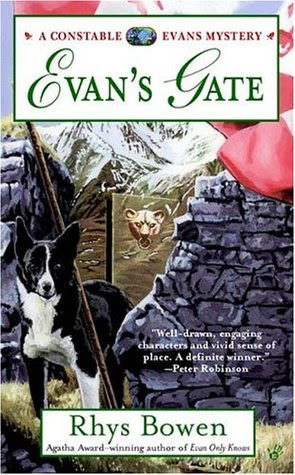
Evan's Gate


 Evan's Gate (2004) by Rhys Bowen

Big changes are in store for Constable Evan Evans. He has recently been accepted into the plainclothes division of the force and he's making preparations to marry Bronwen and make a home in a shepherd's cottage that needs renovation. But he's just started working on getting the building clearances when Evans is called in to help with a missing child case. A five-year-old little girl has disappeared from the seaside caravan park where her mother had brought her for health reasons. The prime suspect is the little girl's estranged father, but an extensive campaign fails to find him...and exhaustive searches in the area fail to find any trace of the girl.

Evans snatches time when he can to make progress on his cottage. One of the tasks is to dig a new water line. And when he digs he finds the skeleton of another child. It appears to be about 20-25 years old and Evans remembers another little girl who went missing on the mountain. A little girl by the name of Sarah who looked a lot like the current missing child--small, fragile, blonde, and very pretty. When he finds out Sarah's family is back in the area--celebrating the birthday of an aged grandfather, he wonders if the two incidents are connected. He's had hunches in the past that panned out and he hopes that if he can find some clues from the past that it just might help solve the current case as well.

I first started reading the Evan Evans mysteries back in the late 90s/early 2000s when they were published. I found them charming, enjoyed the Welsh characters, and the descriptions of the Welsh countryside. And then other books caught my attention (as so often happens) and I wandered off and didn't read this one (that I had picked up at the library's used bookstore) or any later installments. Returning to the series, I still enjoy the Welsh setting and find the characters interesting--though there are fewer appearances of the locals than I remember in earlier stories. The mystery is decent, though the solution to the two cases is a bit dissatisfying--I had hoped they would tie up differently and I thought the explanation of Sarah's death and place of burial to be anti-climactic. I realize that this is a more cozy police procedural, but the answer really was a bit of a let-down. ★★ for setting, characters, and interesting set-up. Would have been higher had the ending been stronger.

First line: The small girl moved over the springy turf of the mountainside, her light feet making so little impression on the grass beneath her that she appeared to be weightless, a bright spirit only barely connected to solid earth.

Last line: "I was right all along," he said in a low voice. "She was taken by the fairies."

**********

Deaths = 2 (one drowned; one fell from height)

Wednesday, April 6, 2022

The Lodger


 The Lodger (1913) by Marie Belloc Lowndes

The Lodger is the first known novelization based on the murder attributed to Jack the Ripper. Last fall I read a volume which contained two shorter fictional pieces (The Hypno-Ripper edited by Donald K. Hartman), but this is the first novel-length story. Here the terrifying murderer signs himself "The Avenger" and seems to have a fixation on drunken women. His murders take place when the streets are fairly empty and come in pairs--either one murder on two nights close together or two murders in a single night. But the story doesn't focus on the murders themselves, rather it focuses on Mr. and Mrs. Bunting, former servants--butler and maid--who have fallen on hard times and have decided to take in lodgers to bolster their dwindling finances. But they've had little luck and have just about given up hope when Mr. Sleuth arrives at the door. 

He's looking for somewhere very quiet and is pleased that he will be the only lodger. In fact, he pays well over the asking price so the Buntings will not take in any other lodgers. And Ellen and her husband believe their luck has turned at last. But then...they each begin to suspect that there may be more to their reclusive, rather odd tenant than first appeared. Could it be possible that they are harboring the villainous creature who preys upon women at night?

The story is full of psychological suspense. We watch the effect Mr. Sleuth's presence and the onslaught of news about the murders have on the Bunting's--particularly on Ellen. Ellen is the one who has the most contact with Sleuth--serving his meals and cleaning his rooms. It isn't until Mr. Bunting encounters Sleuth when returning home late one night that he begins to have doubts about the man. But the first time Mr. Sleuth is out late, Ellen is wakeful and hears him moving about. From that moment on her fears and suspicions grow. She tells herself that if he is the killer, then he isn't responsible. Obviously, he's a bit odd--what other man sits up reading the Bible at all hours, reciting all the cruel bits about women? How many people talk to themselves in that bizarre manner? His oddness serves as a shield--and an excuse for her to accept his money for the lodging. She believes he must be The Avenger, but she doesn't want to have to accept it. 

This is an excellent example of early psychological suspense--it mounts steadily until the final scenes and provides a satisfying ending. ★★ and 1/2.

First line: Robert Bunting and Ellen his wife sat before their dully burning, carefully-banked-up fire.

Last line: Mr. Bunting and his Ellen are now in the service of an old lady, by whom they are feared as well as respected, and whom they make very comfortable.

*****************

Deaths = two stabbed (there were several more--but the names were not given for those)

Saturday, April 2, 2022

An Hour Before Daylight


 An Hour Before Daylight (2000) by Jimmy Carter

Jimmy Carter brings us his Depression-era boyhood on a Georgia farm before the civil rights movement was imagined. He writes vividly, powerfully, and honestly about his family and the area he grew up in--providing a portrait of the rhythms of farming in a sharecropping economy and giving us an intimate look at his father, who was a brilliant farmer. Earl Carter was a strict segregationist, but treated black workers with respect and fairness--allowing his son to play with the children of his black farm workers and to learn farming and life-long skills from the parents. His mother was strong-willed, well-read, and a registered nurse who flouted segregation in many small ways. He also tells us of the five other people who shaped his young life--three of whom were black

Told as if he were reminiscing--one topic leads to another and then circles back again. It is a rich, evocative story of a time when family was first and closest. A time when everyone worked hard, played hard, and spent evenings sitting on the front porch. A time when everyone knew their neighbors--and their vehicles, mules, and dogs--and knew when someone or something was around who didn't belong. Carter gives us an excellent recollection of what life during the Depression was like for farmers in the South and tells how the times shaped him as well as the nation. ★★★★

First line: If you leave Savannah on the coast and travel on the only U.S. highway that goes almost straight westward across the state of Georgia, you will cross the Ogeechee, Oconee, and Ocmulgee rivers, all of which flow to the south and east and empty into the Atlantic Ocean.

Last line: After all, the land belonged to the Indians before it was ours.


Saturday, March 19, 2022

The Man in the Moonlight


 The Man in the Moonlight (1940) by Helen McCloy

The Man in the Moonlight is one of my favorite subgenres in mysteries--the academic mystery. It is set during World War II and features the campus of Yorkville University. Assistant Chief Inspector Patrick Foyle has been visiting the campus in anticipation of the possibility of sending his son there for college. As he's preparing to leave the grounds, he picks up a paper flying in the wind only to read:

I take pleasure in informing you that you have been chosen as murderer for Group No. 1. Please follow these instructions with as great exactness as possible.

The paper goes on to detail a rendezvous at Southerland Hall later that night. Foyle is ready to put it down as an undergraduate rag or some sort of joke. But he is curious and makes his way to the building mentioned. On the way there he hears a pistol shot. Perhaps it's not a gag and someone started proceedings a bit early. But he finds only Professor Raymond Prickett running a psychological experiment on babies' reactions to loud, unexpected noises. [Odd as it may seem, babies cry when exposed to loud, unexpected noises. I could have saved him the trouble of experimentation.] 

There are some hours to go before the rendezvous mentioned in the instructions and Foyle decides to go have dinner and then return to campus and see what exactly is up. During dinner, he overhears another member for the Yorkville faculty, Professor Julian Salt, having an unsatisfactory conversation with his estranged wife. His detective instincts can't help but be interested in the melodrama, but his mind is on Southerland Hall...and more particularly, the laboratory of Dr. Franz Konradi, a biochemist who is a refugee from the Nazi invasions across Europe. Foyle had met Konradi briefly, asked him some questions about the situation and was told that no matter what happened, if Konradi was found killed it would not be suicide...no matter how things looked

He goes back to campus where a young woman tries to dissuade him from going to Southerland Hall. But he's determined and is just in time to watch one of the psychology graduate students (Ian Halsey) perform some very odd actions in a darkened room--lighting a candle, reading from a book, drinking wine, and typing steadily. This goes on for several minutes until a shot rings out. The lights won't come on and the doors and windows are all locked (someone locked the door behind Halsey and Foyle). While they're fumbling in the dark, the murder breaks through a window in the janitor's room (the only breakable window in the place). When they manage to get the lights on, they find Dr. Konradi shot through the roof of the mouth with all the hallmarks of a standard suicide, barring a suicide note. But Foyle remembers what Konradi told him and calls in Dr. Basil Willing, a psychological consultant for the police because as Foyle tells him, it's "right down your alley, doc!" It is indeed, and Dr. Willing will have several very interesting psychological clues to follow up before they'll be able to identify the correct culprit.

First of all, I have to say how very grateful I am to the late Noah Stewart for this lovely Dell mapback copy. He sent it to me as part of one of our Golden Age group Secret Santa gift exchanges. I am only sorry that I did not read it sooner so I could have discussed it with him before he was taken from us much too soon. He knew of my great love for the academic mystery and was thoughtful enough to include this delightful little book in my box of goodies. 

It is, in addition to being a fine mystery, a very good look at the U.S. (and the world) at the time of second world war. We get good descriptions of the situation for refugees, prisoners of war, and the tricky state of trade. We see how precarious fortunes were when they depended on goods needed for the war--especially if any changes in materials might be in the offing. The mystery itself is well-plotted and McCloy pulled the wool over my eyes quite nicely. A very good read.★★★★

First line: the day Dr. Konradi was murdered dawned clear and windy--a fragrant spring day with a cool breeze.

It happened during a psychological experiment--at least that's what they say. Sounds phony to me. That's where you come in. I want you to tell me if it's on the level. There's a guy here named Prickett and he's a three-ring circus all by himself--but wait till you see him. (Inspector Patrick Foyle to Dr. Basil Willing; p. 39)

But do the police realize that this is only a detective story? I'm afraid they'll forget the murderer must
never be a Chinese when they find I have no alibi. (Dr. Feng; p. 96)

Last line: That's not an invitation--it's an order!

************

Deaths = 4 (two shot; one cancer; one drowned)

Monday, March 7, 2022

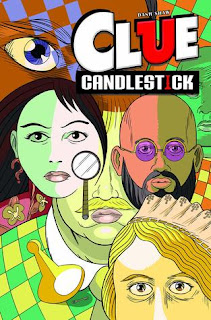
Clue: Candlestick


 Clue: Candlestick (2020) by Dash Shaw

Shaw has taken the classic Clue board game and created a story based on the characters. There are clues dropped throughout and there are puzzles to solve that will help the reader discover the ultimate culprit. But it isn't just a matter of saying "Colonel Mustard in the billiard room with the lead pipe." There are several murders and it isn't necessarily so that they all were committed by the same hand. So watch out for red herrings and false villains.

 So...I went down an online rabbit hole searching for an e-copy of Nancy Drew and came up with this graphic novel based on the mystery board game. The plot is basically okay and the mystery is pretty good for story length. But...I don't really think Shaw has captured the feel of either board game or the 1985 movie. Which may have been the point--but for those of us who grew up on the game and who really enjoyed the movie, it was a bit of a let-down. It seemed a bit odd for Shaw to give us a whole essay at the end where waxes nostalgic about playing the 1972 version of the game (the version I myself played for years) and then to miss the mark in creating a story about it. ★★

First line: Wind blows through the windowsill, creating an eerie whistle.

Last line: What I mean is, to me--you're good.

***********

Deaths = 7 (one shot; three hit on head; one poisoned; one stabbed; one died in fire)

Wednesday, March 2, 2022

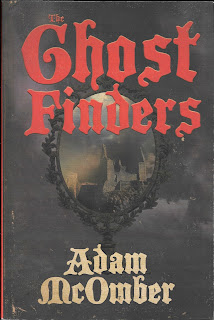
The Ghost Finders


 The Ghost Finders (2021) ~Adam McOmber

The Ghost Finders firm, founded by Phillip Langford, consists of Henry Caxton, Violet Asquith, and Christopher X. Phillip rescues Henry from the gutters of London and sets him up as an occult detective. They add Violet, a telekinetic whose mysterious past will soon catch up with her, and Christopher, a monstrous being with an unknown past and werewolf-like qualities. They take up paranormal (abnatural in the book) investigations--tracking down ghostly figures on horses, the "Up-Train Terror" (which manifested in a dark tunnel) and a tree-climbing pig, among others. 

Things get really interesting and dangerous when the mysterious Sister Rose, a black-bonneted woman, begins dogging Violet tracks and the ghost finders find themselves drawn into a trap that may put a permanent end to their investigations. Each of our characters have a part to play--even the Ghost Finders' housekeeper Mrs. Hastur. How has Violet's training under her father's guidance prepared her for the trial to come? Has Henry received all the preparation he should have? Does it matter that Christopher can't remember anything about who (what) he was before meeting Henry. And what is the job that Mrs. Hastur tells him he must do? What plans do Sister Rose and the "New Lord" have for them? And who is this New Lord that is behind all the mysterious events? What is the dark mirror and can it really be controlled? Or will it destroy everything the Ghost Finders hold most dear?

This is a wonderfully gothic, horrifically fun mysterious adventure. The three main characters are vividly drawn with interesting backstories that are at once disparate, yet also fitting together so perfectly to provide friendship and kinship among these three wildly different individuals. The separate histories weave together to create the fabric necessary for the final scenes. It was interesting to watch these three work their way through various layers of loyalty and betrayal to discover what is necessary to save themselves...and perhaps all reality. 

McOmber is a compelling storyteller. He creates a gaslit world with fully realized characters with complicated stories & complicated relationships and an urgent sense of place. One opens the book and immediately steps into a world of gothic creatures and paranormal manifestations....and it all seems perfectly normal. One shouldn't be surprised by a seven-foot giant with a dog-like head or bones that become animated or men who survive a fatal knife blow. And one isn't because McOmber has created a believable world where anything could happen...and does. ★★ and 1/2.

First line: Storm clouds over the rookeries at Spitalfields.

Last lines: I shook my head. "I think we better get our coats."

****************

Deaths = 10 (one natural; two accident; two shot; one attacked by creature; one drowned; two stabbed; one suffocated)