Showing posts with label Classic Bribe. Show all posts

Tuesday, September 4, 2012

Challenge Complete: The Classic Bribe.


The Classic Bribe – Challenge & Giveaway (sponsored by quirkygirlsread):

  • Read at least 1 Classic over the summer – between Memorial Day and the end of Labor Day Weekend, September 3rd

That's it...that's all I had to do for this one.  Mission accomplished on June 3.  But...being the over-achiever that I am (and having signed up for various **cough** other challenges **cough**) I had plenty more where that come from.  Challenge closed on 9/3/12....so I'm claiming that as my completion date.

Classics Read:
1. The Strange Case of Dr. Jekyll & Mr. Hyde by Robert Louis Stevenson (6/3/12)
2. The Insidious Dr. Fu-Manchu by Sax Rohmer (6/12/12)
3. The Taming of the Shrew by William Shakespeare (6/30/12)
4. The 39 Steps by John Buchan (7/4/12) [Classic spy thriller]
5. File No. 113 by Emile Gaboiau (7/11/12) [Classic French detective story]
6. The Great Gatsby by F. Scott Fitzgerald (7/12/12)
7. North & South by Elizabeth Gaskell (7/18/12)
8. The Four Million & Other Stories by O. Henry (7/21/12)
9. Sense & Sensibility by Jane Austen (8/13/12)
10. Crime on Her Mind: Fifteen Stories of Female Sleuths from the Victorian Era to the Forties by Michele B. Slung, ed (8/18/12) [Classic/Vintage Mysteries] 

Saturday, August 25, 2012

The Innocence of Father Brown: Review

I'm not entirely sure how I feel about G. K. Chesterton's The Innocence of Father Brown.  Part of that may be due to the fact that I feel just plain icky at the moment because of either a summer cold or allergies; it's a bit hard to think when one's head is all congested.  But, if a review is to be done, then it must be done while the reading is fresh.....  

Chesterton can certainly weave an interesting and mystifying tale.  Of course, part of the reason most of the short stories in this collection are mystifying is because they are so improbable.  And the clues aren't necessarily all on display in the way a fan of Golden Age crime would like.  It would be difficult--at least it was for me--for the reader to anticipate the solutions before the priest unravels the mystery.  But Father Brown is an endearing character and Chesterton uses such marvelous descriptions of place and weather and people that I didn't mind...too much.  Another sign that I really appreciated Chesterton's writing is the number of interesting and insightful quotes I managed to pick up for my collection (see below).

As a mystery collection, it is very solid--offering entertainment and improbable crimes, and even one locked garden mystery a la Carr.  Enjoyable, but not off the charts--so three stars.


Quotes:
That woman's over-driven; that's the kind of woman that does her duty for twenty years, and then does something dreadful. [Father Brown] (p. 137; "The Wrong Shape")

You are my only friend in the world, and I want to talk to you. Or, perhaps, be silent with you. [Father Brown] (p. 145, "The Wrong Shape")

The modern mind always mixes up two different ideas: mystery in the sense of what is marvellous, and mystery in the sense of what is complicated. That is half its difficulty about miracles. A miracle is startling; but it is simple. It is simple because it is a miracle. [Ibid.]

The people who wrote the medieval ballads knew more about fairies than you do. It isn't only nice things that happen in fairyland. [Father Brown] (p. 152; "The Sins of Prince Saradine")

I never said it was always wrong to enter fairyland. I only said it was always dangerous. [Father Brown] (p. 153; "The Sins of Prince Saradine")

...one can sometimes do good by being the right person in the wrong place. [Father Brown] (p. 156; "The Sins of Prince Saradine")

Very few reputations are gained by unsullied virtue. [Flambeau] (p. 159; "The Sins of Prince Saradine")

First there is what everybody knows; and then there is what I know. Now, what everybody knows is short and plain enough. It is also entirely wrong. [Father Brown] (p. 214; "The Sign of the Broken Sword")

What is the good of a man being honest in his worship of dishonesty? [Father Brown] (p. 226; "The Sign of the Broken Sword")

There is so much good and evil in breaking secrets....  [Father Brown] (p. 231; "The Sign of the Broken Sword")

A window in Merton's mind let in that strange light of surprise in which we see for the first time things we have known all along. (p. 235; "The Three Tools of Death")

If I ever murdered somebody, I dare say it might be an Optimist. [Father Brown] (p. 236; "The Three Tools of Death")


Saturday, August 18, 2012

Crime on Her Mind: Review

Crime on Her Mind: Fifteen Stories of Female Sleuths from the Victorian Era to the Forties is an excellent collection of stories edited and introduced by Michele B. Slung.  It features women detectives already well-known to me (Mrs. Bradley, Miss Withers and Susan Dare, for example), a few that I had previously met in one short story (Loveday Brooke, Dorcas Dene, and Miss Strange), and then brought several new female detectives to my attention.  It is a very nice overview of some of the earliest women sleuths in fiction.  We have a wide range from upper-class ladies like Miss Strange who "refuses to betray the principles instilled by her breeding and disdains anything so vulgar as spying or eavesdropping" to a stripper who is willing to go to any lengths to find the real killer and get her brother off the hook.  An enjoyable collection of stories--Highly recommended to connoisseurs of the vintage years of crime fiction.  Four Stars

 And a run-down of the stories:
"The Murder at Troyte's Hill" by C. L. Pirkis: Starring Loveday Brooke--the first known female detective created by a female author.  Miss Brooke is presented as not only an intelligent and independent young woman, but as a woman who has taken up the profession because she is good at it.  She's not supporting a sister or a disabled husband.  She's not ultra-feminine to make up for her brains.  She's just a good detective. In this one, she gets to the bottom of the mystery of who killed Alexander "Sandy" Henderson, lodge-keeper to Mr. Craven of Troyte's Hill.  The police have fastened on to the son of the house, but Miss Brooke has reason's to doubt the official reading of the case. [I read this story earlier this year in The Dead Witness: A Connoisseur's Collection of Victorian Detective Stories by Michael Sims (ed)]

"The Man with the Wild Eyes" by George Robert Sims: Starring Dorcas Dene, a former actress who seems adept at assuming any role.  In this one she masquerades as a private nurse in order to find out why a man's daughter claims to have had a fainting fit when it's obvious she's been attacked--and nearly strangled at that.  [I had also met Dorcas The Dead Witness--in "The Haverstock Hill Murder."]

"The Stir Outside the Cafe Royal" by Clarence Rook: Starring Miss Van Snoop.  This is the only detective story to feature Miss Van Snoop.  She follows a familiar route for early female detectives--only taking on the role to avenge the death of a loved one.  She immediately resigns as a detective once her unorthodox method of capture brings the villain to justice.

"Mr. Bovey's Unexpected Will" by L. T. Meade & Robert Eustace: Starring Florence Cusack. Mr. Bovey leaves a will where the legal heir must be proved his weight in gold--literally.  But when the heir is named and the gold is handed over--he is promptly robbed of his fortune.  Miss Cusack discovers where the thief has hidden the golden booty and saves the day.

"The Fordwych Castle Mystery" by Emmuska, Baroness Orczy: Starring Lady Molly of the Yard.  Lady Molly must discover who has murdered the faithful servant of the claimant as the rightful heir to the title and estates of the d'Alboukirk family.  A younger daughter claims that her elder sister is really illegitimate and her servant has held the proofs in paper form.  However, the servant has been murdered and the papers are gone....It's up to Lady Molly to get to the bottom of it.

"The Man With Nine Lives" by Hugh C. Weir: Starring Miss Madelyn Mack, a very Holmes-like detective--complete with a faithful Watson in the form of a female reporter and an addiction of her own (to a cola stimulant that helps her go without sleep and almost without food while on a case).  A man sends a letter to Miss Mack claiming that eight attempts have been made on his life and he fears that a ninth will be made--successfully.  He begs her to hurry to aid him.  She does, but too late, and finds herself searching for an apparent madman as the culprit.

"The Golden Slipper" by Anna Katherine Green: Starring Miss Violet Strange.  Miss Strange proves who is behind a series of high society thefts.  It would seem to be one of group of friends known as "The Inseparables"--with suspicion focused on one of the young ladies in particular.  Miss Strange uses her own jewels as bait to catch a sneak thief.

"The Dope Fiends" by Arthur B. Reeve: Starring Constance Dunlap.  Miss Dunlap discovers the ring leader behind a drug gang and takes care of a bit of police graft while she's at it.

"The Murder at Fenhurst" by Hulbert Footner: Starring Madame Rosika Storey.  It seems an open-and-shut case--the father had kept too tight a grip on his daughter, denying her the right to money she had inherited, keeping her from her lover, not allowing her to go out and about unsupervised.  Her father is found dead and all the evidence seems to point at her.  But then Madame Storey steps in to show us that sometimes all is not as clear-cut as it might seem.

"Too Many Dukes" by E. Phillips Oppenheim: Starring Baroness Clara Linz. An inheritance of jewels.  Two men claim to be the duke and rightful heir.  The jewels are stolen as the men make a crossing from France to England.  It will take the Baroness to discover who took them and where they are.  But don't ask the real duke to stand up....Oppenheim doesn't bother to tell us that.

"The Calico Dog" by Mignon G. Eberhart: Starring Susan Dare.  Another case where two men are claiming to be the same person.  This time it is a lost son who is coming back to claim a mother's affection (not to mention she's rich and will have some serious cash to leave to an heir).  She hasn't seen Derek since he was small (apparently kidnapped by the nursemaid) and both men have the right general features and seem to remember details from childhood that only Derek would know.  But they both can't be the son.  Susan Dare puts a plan in motion that results in a death, stolen & recovered pearls....and, oh yes, discovering the real Derek.

"Angel Face" by William Irish: Starring Angel Face aka Jerry Wheeler (as well as Honey Sebastian).  When the cops nab her brother as the killer of Ruby Rose Reading, Jerry knows that her brother has been fitted for a frame.  Using all the tricks of her trade (and then some), she manages to finger the right man before her brother can be sent to the chair.  A striptease detective that predates Gypsy Rose Lee's G-String Murders.

"The Mother of the Detective" by G. D. H. and M. Cole: Starring Mrs. Elizabeth Warrender, mother of James Warrender, private detective.  Mrs. Warrender finds the stolen family silver (her own!) when her son and the local inspector think it must be long gone.

"Daisy Bell" by Gladys Mitchell: Starring Mrs. Beatrice Bradley before she became a Dame of the British Empire.  It is the puzzle of the missing victim as well as the victim who is not nearly damaged enough by the accident she has apparently had.  Can one run into a stone wall without looking like one has run into a stone wall?

"Snafu Murder" by Stuart Palmer: Starring Miss Hildegarde Withers, schoolteacher and amateur sleuth extraordinaire.  Miss Withers teaches Inspector Piper and the FBI how to spot a murderer and proves that cheaters never win.


Monday, August 13, 2012

Sense & Sensibility: Review

It may well be that the best of Jane Austen is behind me.  I loved Persuasion--that for me is Austen's best work so far.  I also thoroughly enjoyed Love & Friendship.  Next in line, Northanger Abbey and Pride & Prejudice....in that order.  I actively dislike Emma.  And now, Sense & Sensibility....well, it's better than Emma.  At least I can say that.  It's obvious to me that S&S is Austen's first book--even without knowing that beforehand. (*My mistake--as Adam points out below--her first published novel.)  She seems to be searching for her style and voice.  She's quite good at most of the characterizations...giving us Mrs. Jennings to amuse us and Willoughby and Lucy Steele and the John Dashwoods to annoy and vex us.  There are hints of her wit and stunning social commentary.  But overall the story seemed to drag on so.  It would have been even worse if I had actually read the whole thing--but I was helped out immensely by a sudden urge to travel to Chicago this past weekend.  I stopped by the local library, picked up a CD version, and let Wanda McCaddon read to a captive audience of one for 8-9 hours.  Her terrific reading of the novel and interpretation of the characters did wonders for me (and upped the star rating a bit).

Unfortunately, Edward Ferrars is one of biggest drips in romantic hero history.  I'm not terribly convinced of all the virtues that Elinor finds in him.  Of course, pretty much everything we're told about the man comes second-hand.  We don't see him up close and personal or in conversation with Elinor (or anyone else for that matter) much. It's difficult to see him as a viable character.  We get far more insight into the character of Willoughby than we do of Edward--not that Willoughby's character is one I really want to know.  From what we actually see of the man, I certainly can see no reason why he might make Elinor's heart flutter.  Perhaps I would understand it better if we were actually given the chance to see these two interact more (more than the stiff, formal visitations when Edward is engaged to someone else).

I also find it highly unsatisfactory that Robert Ferrars and that snake Lucy wind up back in the good graces of Mrs. Ferrars.  If we're going to tie up all the ends in a happily-ever-after sort of fashion--marrying people off right and left at the end and making everyone who deserves to be happy, happy--then by all means, let's also give the despicable characters a bit of what's coming to them as well.  But, I suppose, one can't have everything.  And, as I've already mentioned, this was Austen's first published book.  She had time to improve her narrative abilities and find a way to make the reader (this reader, anyway) more engaged with her characters.  Three stars--one whole star for a lovely reading performance on audionovel.

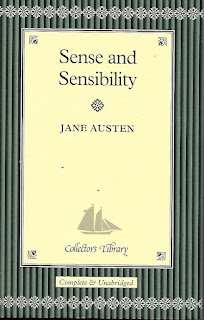
One might argue that the boring cover on my edition of this novel influenced my reading.


Saturday, July 21, 2012

The Four Million: Review

I've mentioned a few times here on the blog and elsewhere that I'm not really an Americanist. I consider myself a Brit Lit girl and my reading lists and tastes generally give proof of that.  But...I love O. Henry.  I've loved him since reading "The Gift of the Magi" in high school.  I just finished up his short story collection The Four Million and Other Stories and I still love him.  He has such a spare style--and yet he says absolutely everything he needs to say and even manages throw in a lovely little twist at the end of each one.  He is witty and uses puns and other wordplay in his stories.  And all in about 10 pages (or less).  He packs more human interest into his short stories than my last read did into 450 pages.  I'll try to give you a run-down of the 29 stories, but they're so short, it will be difficult to do without giving them away.

"Tobin's Palm": Poor Tobin is down-on-his luck.  His girl was supposed to arrive in America and she's nowhere to be found.  He and his go to Coney Island to cheer themselves up--but he gets in a fight and loses his money.  He pins all his hopes on the predictions of a fortune-teller who tells him good luck will come from a man with a crooked nose....

"The Gift of the Magi": Probably Henry's most celebrated story...about a poor couple who gives everything they can to make their partner's Christmas as special as possible.

"A Cosmopolite in a Cafe":The narrator thinks he's met a true child of the world.  Is he right?

"Between Rounds": Mr. & Mrs. McCaskey are fighting it out with the crockery....when an unexpected bell rings to end the round.  But is it the end of the bout?

"The Skylight Room": A young woman gets pleasure from her skylight view....and little else.

"A Service of Love": "When one loves one's Art no service seems too hard."

"The Coming-out of Maggie":  Some girls will go to any lengths to get a date....

"Man About Town": A man goes looking for the "man about town" and discovers that he's closer then he thinks.

"The Cop & the Anthem": All good things come to those who wait....but sometimes after they're no longer wanted.

"An Adjustment of Nature":  Sometimes nature needs a little help in adjusting...

"Memories of a Yellow Dog": When a dog's life isn't all it's cracked up to be...

"The Love-Philtre of Ikey Schoenstein": "Love" potions don't always work the way we plan.

"Mammon & the Archer": A millionaire teaches cupid a trick or two.

"Springtime a la Carte": Love is on the menu.

"The Green Door": Does the green door lead to adventure or romance....or neither?

"From the Cabby's Seat": Should the bride have to pay for her ride?

"An Unfinished Story": Dulcie turns down what seems to be the date of a lifetime.

"The Caliph, Cupid, & the Clock": The "Prince" of the park saves a romance.

"Sisters of the Golden Circle": About a unique bridal gift.

"The Romance of a Busy Broker": Just how busy can the broker be....especially when it comes to his own wedding?

"After Twenty Year": It pays to remember what old pals look like....

"Lost on Dress Parade": Cupid's arrow just misses the target.

"By Courier": A street-wise young man helps the course of "true love."  My favorite!  Love how the boy translates the pretty, high-falutin' speeches of the couple.

"The Furnished Room": This is the saddest of the stories.  I don't see how I can even give you a one-liner without telling you what it's about.  You'll just have to read it for yourself. Very well done.

"The Brief Debut of Tildy": A waitress overshadowed by her beautiful friend has her moment in the sun.

*"The Lotus & the Bottle"
*"The Admiral"
*"Shoes"
*"Ships"

*The last four stories are from the previous collection Cabbages & Kings.  They are all about Honduran characters.  I've found that I don't enjoy them near as much as the stories based in NYC.  O. Henry (William Sydney Porter) had a real feel for the New York of his times and wrote exquisite short stories about the City and its inhabitants.  Four stars.

Quotes:
'Tis easy to be a friend to the prosperous, for it pays; 'tis not hard to be a friend to the poor,f or ye get puffed up by gratitude and have your picture printed standing in front of a tenement with a scuttle of coal and an orphan in each hand. But it strains the art of friendship to be true friend to a born fool.  And that's what I'm doing. ["Tobin's Palm"]

...life is made up of sobs, sniffles, and smiles, with sniffles predominating. ["The Gift of the Magi"]

Expenses had been greater than she had calculated. They always are. ["The Gift of the Magi"]

Spring was in its heyday, with hay fever  soon to follow. ["Between Rounds"]

 But the chief thing at Cypher's was Milly.  Milly was a waitress....She belonged, largely, to waiting. as Minerva did to the art of scrapping, or Venus to the science of serious flirtation. Pedestalled and in bronze she might have stood with the noblest of her heroic sisters as "Liver-and-Bacon Enlivening the World." ["An Adjustment of Nature"]

 As I said, you're a gentleman.  They say it takes three generations to make one. They're off. Money'll do it as slick as soap grease.  It's made you one. By hokey! it's almost made one of me. I'm nearly as impolite and disagreeable and ill-mannered as these two old knickerbocker gents on each side of me that can't sleep of nights because I bought in between 'em. ["Mammon & the Archer"]

Fancy--fluted and droned in a side street. Around the enchanted boundaries of the little park street cars spat and mewed and the stilted trains roared like tigers and lions prowling for a place to enter. ["The Caliph, Cupid, & the Clock"]


Wednesday, July 18, 2012

North & South: Review

North & South by Elizabeth Gaskell has been on my long Victorian TBR list for quite a while.  But my main reason for picking it up this year was the Getting Lost in a Comfortable Book Challenge hosted by Gina at Book Dragon's Lair.  Somebody (or more than one somebody) out there in Gina's circle considered this book to be one of their top five comfy reads.  A book that they return to again and again.  And since I hadn't read it yet and our directive was to pick five books off the list that we'd never read and give them a test drive...I promptly put it on my list.  I have to say: I just don't get it.  

Not the book.  I get that it's an important book about social concerns of the industrial revolution.  The differences between the mercantile/industrial North and the mixture of the intellectual and rural nature of the South.  The questions of authority and obedience.  But a comfortable book?  Not for me, I'm afraid. (And, I'm quite sure there are those who may not find my choices as cozy as I do...).  I think I'd read all 800 pages of Middlemarch again before tackling a North & South reread. 

I don't find anything comfortable about the class struggles between the mill owners and their workers.  The hardships that both sides face as they try to keep the mills running and keep their families together and fed are very real and very difficult.  I don't find comfort in the characters either.  Margaret Hale is an annoying heroine.  In a time period when women were supposed to be thinking about home and hearth and finding themselves a man, she is "offended" (her word) when two men of her acquaintance make her offers.  She is so shocked by the unexpected proposals that she is at best curt and at her worst rude.  She is stubborn and very self-satisfied in her opinions--and very prickly when Mr. Thornton doesn't agree with her.  Thornton is the more promising character.  He's willing to consider what Margaret says--even when she's being her most stubborn and rude.  And beyond Margaret and Mr. Thornton, the other characters are just kind of.....there.  Dickens is quoted on the back of the Penguin edition as saying: "An admirable story....full of character and power."  If full of character = lots of different characters, then I'm absolutely on board with that statement.  Otherwise, no, I don't think the characters are full of character.

I've seen a lot of comparisons between this book and Austen's Pride & Prejudice.  Austen is the better writer.  She approaches her subjects with humor and gives her characters a zest that is lacking in Gaskell.  Gaskell gives me the feeling of having an IMPORTANT MESSAGE and she doesn't want that to get lost in a lot of appealing characterization and interactions between the characters.  And we certainly wouldn't want any real romance to gum things up.  Thornton spends a great deal of time thinking about Margaret, a few excruciating moments proposing to her, and then there's a lot of frustrating nothing until the final pages.  The best part of the book for me was the first third or so--before the Hales get settled into Milton.  There was a lot of promise in those early chapters that I wish I could say had been fulfilled.

Three stars: for being an "important message book" (I get that, I do), for the promising early chapters, and for the few quotes that I gleaned (especially the "there's nothing like a book" reference).  I'm also making allowance for the fact that I had a preconceived notion that I was settling into a comfy book--and was disappointed.  It's possible that a straight read based on its Victorian classic status might have produced different results.

Quotes:
She had, however, of late settled upon her own health as a source of apprehension; she had a nervous little cough whenever she thought about it; and some complaisant doctor ordered her just what she desired--a winter in Italy. (p. 15)

Of course, as your feelings are so decided, and as the conversation has been so evidently unpleasant to you, it had better not be remembered. That's all very fine in theory, that plan of forgetting whatever is painful, but it will be somewhat difficult for me, at least, to carry it into execution. [Henry Lennox] (p. 31)

But the future must be met, however stern and iron it be. (p. 60)

I dare say, my remark came from the professional feeling of there being nothing like leather. [Mr. Hale--about books; reminding me of my statement that "there is nothing like holding a real book in your hands"] (p. 86)

That's what I call a fine girl....Who would have thought that little hand could have given such a squeeze? Bu the bones were well put together, and that gives immense power.  What a queen she is!...That girl's game to the back-bone. Another, who had gone that deadly colour, could never have come round without either fainting or hysterics. But she wouldn't do either--not she! And the very force of her will brought her round. Such a girl as that would win my heart, if I were thirty years younger. [Dr. Donaldson] (pp. 126-7)


Thursday, July 12, 2012

The Great Gatsby: Review

I don't quite get why The Great Gatsby by F. Scott Fitzgerald is billed as possibly "the Greatest American Classic."  [Personally, my vote goes to To Kill a Mockingbird.] Honestly, it's a fairly decent read.  It's a pretty darn quick read (5 hours--including time to work in there).  Fitzgerald has a way with words...mostly. There are times when I tripped over some of his adjectives-- "dilatory" limousine comes to mind (how exactly is a limousine "dilatory"???).  But he had plenty of interesting passages that just seemed have flowed right out of his pen (off his typewriter?) and I gleaned all kinds of quotes (as you'll see below).  And, yeah, I get that he's given us a nice little slice of the Jazz Age--people showing up to parties they haven't been invited to, drinking like fish, playing at being best friends with people whose names they don't even know, making free with Gatsby's house and servants and liquor cabinet and pool.  Generally representing the wild, Roaring Twenties.  I get the whole Gatsby and Daisy representing the disillusioned youth and the emptiness of the American Dream thing.  After all, none of those gate-crashers (or even folks who claimed to be Gatsby's pals) bothered to show up for him in the end.  Well....none but the narrator and the owl-eyed, unnamed man.

Admittedly, I was a bit saddened by the ending, nice and tragic and just a bit pointless (in a pointed way, you know)....but I didn't really care about Gatsby and Daisy and Tom and the Wilsons the way I imagine I was supposed to...and the way I thought I would given the first half of the novel.  Just when FSF had started to build up my interest in this mysterious Gatsby character (about whom nobody really knows anything), he lost me. Maybe that's because our narrator, Nick, seems pretty disconnected from it all.  If the man representing our "eyes" in this world is so removed from the characters, then it's difficult to get deeply involved with them.

Oh, and spoiler here, but how the heck did Mrs. Wilson escape from the rooms over the garage in order to get killed?  Last we heard of her, she was locked in--for two more days or so.  Loved that she suddenly was out--just in time to get run over and help propel us to that depressing ending.  The least FSF could have done is explain what she's doing out of the room.  Don't just say, "Hey, you know what, I need to wrap this book up now and somebody's gotta die because I've got this depressing ending planned.  Let's make it Mrs. Wilson." Poof, she's running out in the road now.

Final analysis: Decent read, but totally overrated as the uber-classic of American Lit.  I'm willing to agree that it represents an Age--but I'm not convinced that it deserves superstar status based on that alone. Three stars--mostly for writing style.

Quotes:
I wanted to get out and walk eastward toward the Park through soft twilight, but each time I tried to go I became entangled in some wild, strident argument which pulled me back, as if with ropes, into my chair. Yet high over the city our line of yellow windows must have contributed their share of human secrecy to the casual watcher in the darkening streets, and I was him too, looking up and wondering.  I was within and without, simultaneously enchanted and repelled by the inexhaustible variety of life. (p. 35)

A tray of cocktails floated at us through the twilight, and we sat down at a table with the two girls in yellow and three men, each one introduced to us as Mr. Mumble. (p. 43)

We all turned an looked around for Gatsby. It was testimony to the romantic speculations he inspired that there were whispers about him from those who had found little that it was necessary to whisper about in this world. (p. 44)

USMM: I've been drunk for about a week now, and I thought it might sober me up to sit in a library.
JB: Has it?
USMM: A little bit, I think. I can't tell yet.  I've only been here an hour.
[Unnamed, stout, middle-aged man; Jordan Baker] (p. 46)

I had taken two finger-bowls of champagne, and the scene had changed before my eyes into something significant, elemental, and profound. (p. 47)

...I like large parties. They're so intimate. At small parties there isn't any privacy. [Jordan Baker] (p. 49)

Everyone suspects himself of at least one of the cardinal virtues, and this is mine: I am one of the few honest people I have ever known. [narrator] (p. 58)

It's a great advantage not to drink among hard-drinking people. You can hold your tongue, and moreover, you can time any little irregularity of your own so that everybody else is so blind they don't see or care. [Jordan Baker] (p. 77)

There are only the pursued, the pursuing, the busy, and the tired. (p. 79)

The exhilarating ripple of her voice was a wild tonic in the rain. I had to follow the sound of it for a moment, up and down, with my ear alone, before any words came through. (p. 85)

...there was a change in Gatsby that was simply confounding. He literally glowed; without a word or a gesture of exultation a new well-being radiated from him and filled the little room. (p. 89)

When the melody rose, her voice broke up sweetly, following it in a way contralto voices have, and each change tipped out a little of her warm human magic upon the air. (p. 108)

There is no confusion like the confusion of a simple mind.... (p. 125)

...it grew upon me that I was responsible, because no one else was interested--interested, I mean, with that intense personal interest to which everyone has some vague right at the end. (p. 164)

Let us learn to show our friendship for a man when he is alive and not after he is dead. [Wolfsheim] (p. 172)


Wednesday, July 11, 2012

File No. 113: Review

If you stick with the detective, Lecoq, and the main action of this mystery, then File No. 113 by Émile Gaboriau beats The Mystery of the Yellow Room by Gaston Leroux hands down in the category of French detective novels.  Not nearly as well-known as the ground-breaking locked room mystery of Leroux, File No. 113 features a likeable detective, Monsieur Lecoq, who is as adept at the art of disguise as Holmes and more connected with human emotion than his British counterpart. (And I say that as a fan of Holmes, mind you.)

The story seems to be a simple puzzle.  The banking-house of Andre Fauvel has been robbed of 350,000 francs.  Only two men had the key and the secret word that would open the safe where it was kept.  One is Andre Fauvel and the other is his trusted head cashier Prosper Bertomy.  Both protest their innocence and, naturally, the police would never dream of suspecting the respectable Monsieur Fauvel, so the culprit must be the cashier.  Fortunately for Prosper, the great detective Monsieur Lecoq believes him to be innocent and is ready to go to great lengths to prove his theory.  Lecoq dons disguises and marshals all the officers he can to discover how the money could have disappeared if neither the banker nor the cashier is guilty.
In the end, he traces the plot to the past--a story of young lovers, separated by fate, whose actions will have repercussions in the present.  And he discovers the guilt of two evil, grasping men who use their knowledge of those actions to try and ruin Prosper and his young love, Madeleine.

As I mention at the beginning of this review, the present story of the bank robbery and the actual descriptions of the Lecoq's detective work are terrific.  I thoroughly enjoyed Gaboriau's narrative in those sections and my rating for this story rests completely on those portions.  Where it bogs down is in the middle section where Gaboriau describes the past love affair and how it has built up to the present situation.  Quite simply, that goes on WAY too long.  The length completely distracts from the events we're supposed to be concentrating on--the robbery and who is framing Prosper, even though it explains the whole set up.  It goes on for so long that I began to feel like I had wandered into a completely different story--one of star-crossed lovers and unhappy endings.  I would have upped my rating if Gaboriau had found a more succinct way to relay that information.  As it is--three and 3/4 stars for a very good mystery with romance interruptions.


Quotes:
Alas! we must suffer ourselves before we can feel for others. [Nina Gipsy] (p. 21)

I have watched him as only a woman can watch a man upon whom her fate depends, but it has always been in vain. [Nina Gipsy] (p. 21)

There are some people who must be saved without warning, and against their will. [Nina Gipsy] (p. 22)

A father is the one friend upon whom we can always rely. In the hour of need, when all else fails, we remember him upon whose knees we sat when children, and who soothed our sorrows; and even though he may be unable to assist us, his mere presence serves to comfort and strengthen us. (p. 33)

As to acknowledging that he was about to obtain a triumph with the ideas of another man, he never thought of such a thing. It is generally in perfect good faith that the jackdaw struts about in the peacock's feathers. (p. 55)

Excessive suffering brings with it a kind of dull insensibility and stupor.... (p. 60)

Like those imperceptible insects which, having once penetrated the root of a tree devour it in a single night, suspicion, when it invades our minds, soon develops itself and destroys our firmest beliefs. (p. 75)

Vengeance is a delicious fruit, which must be allowed to ripen in order that it may be fully enjoyed. [M. Verduret {Lecoq}] (p. 85)

You say she loves him? No one but a coward would be defrauded of the woman he loved and who loved him. Ah, if I had once felt Madeleine's hand tremble in mine, if her rosy lips had pressed a kiss upon my brow, the whole world could not take her from me. [Louis, the Marquis de Clameran] (p. 189)

It is at the family fireside, often under the shelter of the law itself, that the real tragedies of life are acted; in these days traitors wear gloves, scoundrels cloak themselves in public esteem, and their victims die broken-hearted, but smiling to the last.  What I have just related to you is almost an every-day occurrence; and yet you profess astonishment. [M. Verduret {Lecoq}] (p. 214)

...chance is sometimes a wonderful accomplice in crime. [M. Verduret {Lecoq}}] (p. 219)

...a statement from you is more convincing than all the proofs in the world. [Joseph] (p. 223)

 He was as yet not sufficiently experienced in ruffianism to know that one villain always sacrifices another to advance his own project; he was credulous enough to believe in the old adage of "honor amongst thieves." (p. 236)


Saturday, June 30, 2012

The Taming of the Shrew: Mini Review

I would normally feel a little intimidated trying to write a review on Shakespeare.  I, mean, seriously after hundreds of years you'd expect everything that needed saying to have been said.  But that wouldn't stop me from throwing my two cents in as well.  However, this time, I really feel at a loss.  I started The Taming of the Shrew 10 days ago (which is a long time in Bev reading time) and didn't touch it all over vacation.  I expected to have reading time while on the road (and even brought along three other books--"just in case"), but it never materialized.  So...by the time I got back to Kate and Petruchio, I had a hard time getting back into the ol' Shakespeare mood.  And maybe I should give this one another go sometime.  But for now, I've finished it and here's what I've got....

Rather than try to do my usual longer, more indepth review and synopsis, I'm just going to throw a few thoughts out here.

First, I expected to like this one way more than I did.  Thus far, I've read Romeo & Juliet, Hamlet, Julius Caesar, and Othello and I've really like all of them, with Othello being my favorite.  But I'm just not into Kate being rude and downright nasty to anyone and everyone without even a hint of a reason.  Sure, she's got a father who expects her to marry when she doesn't want to....but it's the 16th Century.  Every woman is expected to get married...and it's not unreasonable (for the times) for fathers to meddle in the matrimonial proceedings.  So, that's not really a legit reason for her unspeakable behavior.  I agree that she needs a lesson or two.  BUT....

Second, I take great exception to Petruchio's method of "taming" her.  Lessons are one thing...out and out abuse is another.  Starving her and depriving her of sleep is extreme to say the least.  I sort of see the point of the extreme "lesson" being needed to meet her extreme behavior...almost, but not quite.

Third, the subplot of Bianca and her suitors.  I had a hard time keeping the players straight and just found Bianca boring in the extreme.  I guess it was good that she had her looks, 'cause I can't figure out any other reason why these guys would want to marry her.  

Fourth....well, at this point I can't really think of a fourth.  I'm all out of steam.  Hopefully, once I'm back in the work routine, I'll get my reading and reviewing act together.  I'm giving this one a nice middle of the road, three star rating.  Mostly because it's Bill Shakespeare, darn it, and it's supposed to be good.   I think maybe I should take one of the Goodreads reviewer's suggestion and go watch the Elizabeth Taylor version of the movie.....


Tuesday, June 12, 2012

The Insidious Dr. Fu-Manchu: Review

I just had me a nice little dose of déjà vu.  Earlier this year I read Sax Rohmer's The Golden Scorpion.  And now I have finished The Insidious Dr. Fu-Manchu.  And it was like reading the same pulpy, cliff-hanger, Yellow Peril story all over again.  Evil, all-powerful, Chinese master criminal bent on world conquest with ominous green eyes? Check.  Leaving behind a trail of murdered experts in their field?  Check.  Beautiful, mysterious, woman who is strangely enslaved to the evil master criminal, but who has fondness for our gallant narrator and who alternately helps him and does her master's bidding?  Check.  Edge-of-your-seat endings to each chapter as the heroes narrowly escape from danger, just miss saving someone from the villain's clutches, or occasionally snatch a victim from Fu-Manchu's grasp? Check.  Throw in a huge supply of weird, dangerous creatures to spice things up a bit--and we're all set.

This time our evil villain, Dr. Fu-Manchu, is determined to get his hands on all the experts on the Far East that he can--and eliminate them.  He's also picking up a few doctors and scientists along the way and sending them back to China where they will be forced to aid him in his quest for world domination.  Nayland Smith, who has mysterious connections with Scotland Yard, is out to stop the doctor no matter what the cost.  Smith enlists the help of his friend Dr. Petrie--and the two of them set out to warn and rescue as many people on the doctor's hit list as they can.  With mixed results.  The final showdown occurs in a cottage and ends in flames.  But is it the end of the Doctor?

Once again, this story is not for those who want a nice sanitized view of the early 20th Century.  Rohmer uses the period's conventional mistrust of the Far East and the Asian culture to create his super villains--members of the Yellow Peril, a group bent on dominating the world and, particularly, conquering Britain and America.  It's good old fashioned fun--especially for those of us who are familiar with the cliff-hanger serial stories of yesteryear. Lots of hyperbole and exaggeration (I've given a few examples below)--either about Fu-Manchu or in his dialogue.

If you're looking for fast-moving, pulpy fun, then Rohmer is your man.  Another fun romp through one thrilling adventure after another.  A good solid three stars.

This is also my final read for the League of Extraordinary Gentlemen Challenge.  And I would have to say that of all the characters included in that graphic novel, Fu-Manchu was the most faithfully rendered.  Maybe it's easier to get it right when you're already dealing with an over-the-top villain.  I don't know. But Moore did a great job capturing Fu-Manchu's "I'm going to rule the world!!!!" madness.  Don't remember straight off whether he got the Doctor's eyes piercingly green enough or not.  But well done on Fu-Manchu over all.

And--this being one of the classic pulp thriller/detective novels, I'm counting it for the Classic Bribe Challenge as well.


Quotes:
Other members of the household were moving about, more or less aimlessly, and the chilly hand of King Fear had touched one and all, for, as they came and went, they glanced over their shoulders, as if each shadow cloaked a menace, and listened, as it seemed, for some sound which they dreaded to hear. (p. 4)

Singular though my friend's  proceedings appeared to me, I had ceased to wonder at anything. Since Nayland Smith's arrival at my rooms I seemed to be moving through the fitful phases of a nightmare. (p. 9)

But a woman is a two-edged sword, and treacherous. [Nayland Smith] (p. 11)

Imagine a person, tall, lean and feline, high-shouldered, with a brow like Shakespeare and a face like Satan, close-shaven skull, and long, magnetic eyes of the true cat-green. Invest him with all the cruel cunning of an entire Eastern race, accumulated in one giant intellect, with all the resources, if you will, of a wealthy government--which, however, already has denied all knowledge of his existence. Imagine that awful being, and you have a mental picture of Dr. Fu-Manchu, the yellow peril incarnate in one man. [Nayland Smith] (p. 13)

It was a sidelight upon the character of the awful being with whom we had to deal. My very soul recoiled from the bare consideration  of the fate that would be ours if ever we fell into his hands. (p. 19)

There are few states, I suppose, which exact so severe a toll from one's nervous system as the anticipation of calamity. (p. 56) 

I felt as one bound upon an Aztec altar, with the priest's obsidian knife raised above my breast! (p. 56)

"They die like flies!" screamed Fu-Manch, with a sudden febrile excitement; and I felt assured of something I had long suspected: that that magnificent, perverted brain was the brain of a homicidal maniac--though Smith would never accept that theory. "It is my fly-trap!" shrieked the Chinaman. "And I am the god of destruction!" (167)


Sunday, June 3, 2012

Classic Bribe Challenge & Giveaway


The Classic Bribe – Challenge & Giveaway (sponsored by quirkygirlsread):

  • Read at least 1 Classic over the summer – between Memorial Day and the end of Labor Day Weekend, September 3rd
  • You can have begun the Classic prior to Memorial Day, but it needs to have been completed between the challenge dates above
  • Post a review on your blog of each Classic that you read during the challenge period and reference a link to this “The Classic Bribe” challenge page
  • Link to each of your reviews separately by clicking on Mr. Linky on the challenge page
  • Each linked review counts as 1 entry – no entry limit per blogger – read and review as many as you like
  • Each entry builds up $1 toward an Amazon gift card – the more entries the higher the balance can grow – capped at $35
  • Random winner selected Labor Day weekend from all entries- no restrictions on region
  • Winner receives the full Amazon gift card balance accumulated based on entries receive
Click Underlined Challenge Title above to head to the site and sign up.


Yes.  I know.  I already have 30-some challenges.  Plenty to read.  But....I did this one last year and it fit in with what I was already reading and caused no extra challenge stress whatsoever.  Really.  (no, I didn't twitch...you imagined it)  And, so, I am drinking the reading challenge Kool-Aid and signing up for just one more....

Classics Read:
1. The Strange Case of Dr. Jekyll & Mr. Hyde by Robert Louis Stevenson (6/3/12)
2. The Insidious Dr. Fu-Manchu by Sax Rohmer (6/12/12)
3. The Taming of the Shrew by William Shakespeare (6/30/12)
4. The 39 Steps by John Buchan (7/4/12) [Classic spy thriller]
5. File No. 113 by Emile Gaboiau (7/11/12) [Classic French detective story]
6. The Great Gatsby by F. Scott Fitzgerald (7/12/12)
7. North & South by Elizabeth Gaskell (7/18/12)
8. The Four Million & Other Stories by O. Henry (7/21/12)
9. Sense & Sensibility by Jane Austen (8/13/12)
10. Crime on Her Mind: Fifteen Stories of Female Sleuths from the Victorian Era to the Forties by Michele B. Slung, ed (8/18/12) [Classic/Vintage Mysteries]


Dr. Jekyll & Mr. Hyde: Encore, Encore!

Thanks to Man of La Book's League of Extraordinary Gentlemen Challenge, I have now read The Strange Case of Dr. Jekyll & Mr. Hyde three times in as many years. [Most of my previous thoughts on Jekyll & Hyde can found HERE and HERE.]  I'm not complaining....I love this late Victorian Gothic morality play about the division of good and evil that lies in every person.   It's just that I'm not sure I've got much that's fresh to say about this one on my third go round.  That being the case, I may not be able to do this review without spoilers--so beware!

As I mention in a previous review--the story tells us all too well that if we are not very careful, then evil can overtake us. Once started down the road, lesser sins can soon lead to bigger until finally it becomes near impossible to turn back and become what we once were. It is particularly difficult for those with addictive personalities--one looks for bigger and better thrills and that is part of what leads one further down the road.  

I think what strikes me most this time around is a very tiny moment in Jekyll's final days.  It's a point that I didn't really take note of before.  After the murder of Sir Danvers, he is determined not to let Hyde loose again.  He spends a good two to three months suppressing the "child of Hell" and begins to feel very good about himself.  He has used his time trying to repay good for the evil Hyde has done.  He has been immersing himself in spiritual studies.  He begins to compare himself to other men--"comparing [his] active good-will with the lazy cruelty of their neglect."  And you know what they say about pride...it goeth before a fall.  Jekyll is setting himself up for a doozy.  In almost every list of the seven deadly sins pride is considered the most serious.  It represents the primary fault that led to Lucifer's fall.  The moment when Jekyll begins to feel prideful about how well he's done in suppressing Hyde and making reparations for his behavior is his point of no return.  From that time on the potion no longer works as well--he finds himself turning into Hyde with very little effort and with no notice, right there in a public park.  

Image Source
The only other thoughts I have are in connection with the League of Extraordinary Gentlemen.  In the original story, Hyde is depicted as much smaller than Jekyll--a shrunken, "little" man; pale and dwarfish; "particularly small and evil-looking."  And, yet, the League graphic novel (and movie, for that matter) portrays him an almost-giant, an Incredible Hulk type (less the green skin) with immense strength.  If we allow that Jekyll/Hyde actually survived (rather than committing suicide as Stevenson's story relates), then, for Hyde to have become as large and strong as he is in League I see no way for him to ever appear as Jekyll.  Hyde would have to have completely subdued his original persona to grow to such proportions. Stevenson mentions towards the end that Jekyll feels as though Hyde had grown--but even at that, Jekyll's clothes still hang on him, many sizes too big.


Tuesday, September 6, 2011

Challenge Complete: Classic Bribe Challenge


Back in June I signed up for Quirky Girl Reads' Classic Bribe Challenge. Here are the basic requirements:


  • Read at least 1 Classic over the summer – between June 1st and the end of Labor Day Weekend, September 5th


  • You can have begun the Classic prior to June 1st, but it needs to have been completed between the challenge dates above


  • Post a review on your blog of each Classic that you read during the challenge period and reference a link to this The Classic Bribe challenge page


  • Completed Book List:
    Northanger Abbey by Jane Austen (6/11/11)Seven Gothic Tales by Isak Dinesen (8/15/11)
    Three Victorian Detective Novels by E. F. Bleiler [ed.] (8/20/11)
    The Master of Ballantrae by Robert Louis Stevenson (8/17/11)Lady Audley's Secret by Mary Elizabeth Braddon (8/24/11)Sir Nigel by Sir Arthur Conan Doyle (8/21/11)
    Kathleen by Christopher Morley (8/17/11)
    Shatterday by Harlan Ellison (8/23/11)
    The Arrow by Christpher Morley (8/25/11)
    The Name on the Bracelet by Margaret Sutton (8/27/11)
    Lord Peter Views the Body by Dorothy L Sayers (8/28/11)
    The Unpleasantness at the Bellona Club by Dorothy L Sayers (8/29/11)
    Perelandra by C. S. Lewis (9/2/11)
    The Devil's Dictionary by Ambrose Bierce (9/5/11)
    Parnassus on Wheels by Christopher Morley (9/5/11)


    I had hoped to complete the following two books in my original post, but Middlemarch proved too much for me...at least for now. I will have to complete these two if I want to finish a few more challenges (no wiggle room on those...)

    Middlemarch by George Eliot
    Hide & Seek by Wilkie Collins

    That makes for 14 Challenges Complete! Only about 17 more to go.....

    Parnassus on Wheels: Review


    Actually finished this one late last night, so it counts for the last of my Classic Bribe Challenge Reads. Parnassus on Wheels (1917) is the first novel by Christopher Morley. It tells the story of Helen McGill who is getting tired of taking care of her older brother Andrew who has recently become a famous "homespun" author and who is spending less and less time doing the farm chores that are supposed to be his end of the bargain. One day Roger Mifflin, owner of the Parnassus on Wheels traveling bookshop, shows up at the gate hoping to sell his wares (lock, stock & barrel) to the famous author. That's the last thing Helen wants. Because she knows if Andrew takes off in the bookcart for more adventures to write up he won't show up at the farm for several months. So, she decides to buy it and treat herself to a well-deserved vacation and adventures of her own.

    This is a light-hearted and charming snapshot of a by-gone era--days when travel by horse and wagon was the norm. Morley's first novel shows all the promise of his later works like Kathleen and The Haunted Bookshop. The cornerstones of light comedy, a bit of adventure and gentle wit are all there. I enjoyed this little adventure with Helen...although I must say that the more fully developed Haunted Bookshop is still my favorite. Roger Mifflin gives us the benefit of some of his wisdom about the importance of books, but not near as much as we will hear in the later book. Over all, a quick, fun read with a dash of romance. Four stars.

    Monday, September 5, 2011

    The Devil's Dictionary: Review


    The Devil's Dictionary by Ambrose Bierce was much harder going than anticipated. Weighing in at a mere 145 pages, you would think I would have whizzed right through this. Not so much. Bierce was a well-known American journalist, editorialist, short story writer, critic, and satirist. His satiric wit is especially renowned. I had found several mentions of his classic satirical reference book over the years and grabbed a copy up when I saw it on the shelf at our Friends of the Library's book store.

    This "reference" book offers up reinterpretations of various terms in the English language. He devotes a lot of entries to lampoons of cant and political doublespeak, as well as other aspects of human foolishness and frailty. The difficulty in reading it now is that I am sure that many of the entries were much more pointed and funny to the reading public of the first decade of the 1900s. There are numerous references that I either didn't get at all or only recognize vaguely. The entries that I "get" are very funny and I wish I understood all of them equally well. It would probably also help if I were more of an Americanist in my reading. If I were as grounded in American literature from the time period as I am in British lit, I'm sure I'd find the humor in a lot more entries.


    Some of my favorites:

    Oblivion
    , n. The state or condition in which the wicked cease from struggling and the dreary are at rest. Fame's eternal dumping ground. Cold storage for high hopes. A place where ambitious authors meet their works without pride and their betters without envy. A dormitory without an alarm clock.

    Mausoleum
    , n. The final and funniest folly of the rich.

    Egoist, n. A person of low taste, more interested in himself than in me.

    Telephone
    , n. An invention of the devil which abrogates some of the advantage of making a disagreeable person keep his distance.

    Omen
    , n. A sign that something will happen if nothing happens.

    I suppose this can only count for the R. I. P. Challenge if we base it on the use of "Devil" in the title. I believe I'll read another book. Three stars...barely.


    Friday, September 2, 2011

    Perelandra: Review


    Perelandra is the second book in the classic space trilogy by C. S. Lewis. The first part of the story, Out of the Silent Planet, takes place primarily on Mars. In this outing, Dr. Ransom--philologist and part-time space traveler is sent to Venus (Perelandra to everyone else in the universe). Venus is a lovely primeval planet. With garden-like floating islands on a tumultuous ocean. There are plants with fruit that taste exquisitely like nothing on earth. Everything tastes, feels, and looks much more intense than their earthly cousins. It is a classic retelling of the story of Adam and Eve. Only this time, Eve will have a human counselor sent to help her resist the temptations of the "Bent One." In this battle for the innocent mother and father of Venusian life, Ransom is sent to represent good, while Dr. Weston is taken over by the agent of evil. Ransom finds that he can't just use the Biblical tale of the Garden of Eden to guide him...he must find a new way to fight evil on this new planet. The fate of Venus, and possibly Earth, lies in the balance.

    It is not necessary to have read Out of the Silent Planet in order to understand the story in Perelandra. It will provide some background information, but the reader can manage well enough without it. I must say, however, that I enjoyed the first book much more. The basic retelling is good enough and the concept is a very nice one, but I feel like Lewis is far more heavy-handed and pedantic in his Christian imagery. And I say this being a Christian myself. There are long passages of somewhat convoluted thought processes--either on the part of Ransom or the Lady (Eve) of Perelandra--and an entire speech by the possessed Weston that is way over the top. I missed the simplicity and beautiful language of Out of the Silent Planet. I plan to read the final book of the trilogy, That Hideous Strength, and can only hope that Lewis returns to the writing style of the first book. Two and a half stars.

    Monday, August 29, 2011

    The Unpleasantness at the Bellona Club: Review


    The Unpleasantness at the Bellona Club by Dorothy L Sayers is another lovely, classic, Golden Age mystery. Old General Fentiman is found peacefully passed away, sitting in his favorite chair by the fireplace in the Bellona Club. Nothing strange about a ninety-year-old gentleman falling asleep and never waking up. Or is there? Lord Peter Wimsey immediately notices a few oddities about the corpse, but as the doctor in charge doesn't say anything, he decides to refrain from pointing them out. But then the lawyers get involved. For it seems that it matters a great deal exactly what time General Fentiman moved on from this mortal coil. In fact, it matters about half a million pounds worth. Because General Fentiman's sister, Lady Dormer, has passed away on the same day and depending on who died first, somebody is going to be awfully wealthy.

    Lord Peter is brought into the case by Mr. Murbles--his own man of business, as well as the representative for the Fentimans. Wimsey tries to convince the lawyer that it would be best if he were to convince his clients to settle, but it seems that Lady Dormer's legatee doesn't see it quite that way. What follows is a fun Golden Age romp with out of service telephones, the elusive Mr. Oliver, the mystery of the missing item from General Fentiman's clothing, and the question of why the elderly gentleman's knee swung freely when the rest of him was quite stiff with rigor mortis. There will be a trek across Europe and a party about glands before it's all over. And, of course, Lord Peter will follow all the threads to their proper source.

    I always enjoy Lord Peter. And, while I have thought about it before, I was quite struck this time by how Ann Dorland seems to be a precursor to Harriet Vane. There's the artistic leanings, and the intelligence, and the respect that Lord Peter has for her. There's her sense of humor, her unhappy love affair, and part of the description of her looks--particularly the eyebrows. I definitely think that Harriet was percolating away in the mind of Sayers just waiting to appear in Strong Poison. A thoroughly enjoyable reread--with slightly more serious undertones than either Whose Body? or Clouds of Witness. We're given a very good look at what WWI, gassing, and shell-shock did to the young men who made it back from the war. Poor George Fentiman really thinks he might have been capable of poisoning his grandfather. Four stars.

    I also would like to add that the filmed version of this with Ian Carmichael is absolutely delightful. The scenes with him and Mrs. Munns (landlady to George Fentiman and his wife, Sheila) is worth the price of admission. Not strictly to the letter with the novel--but great fun!