
Showing posts with label World at War. Show all posts

Tuesday, September 24, 2019

The Two-Pound Tram: Mini-Review

The Two-Pound Tram (2003) by William Newton (aka Dr. Kenneth Newton) follows the lives of two brothers, Duncan and Wilfred Scrutton, during the early years of World War II. Originally, they live in a big sprawling house in the country and spend their time catching butterflies, hiding out in an old railway carriage, and using catapults to catch their dinner (rabbits, small birds, etc.). When their parents' marriage falls apart--their mother runs off and their father takes up with a succession of women, they decide to London with the bit of money they have saved up and buy their dream...a two-pound tram. Their story leads them through all sorts of adventures from buying the tram (and a horse to pull it and the horse's dog companion, Tiger) to joining up with a young woman who loves the idea of selling tickets on their tram to serving as emergency light signalers when the war descends on Britain to a decoration of valor for Duncan from the royal family. 

This is a marvelous, heartwarming little book that tells a coming of age story smack in the middle of the Second World War. Duncan and Wilfred go through rough times, but they manage to survive and thrive in the life they make for themselves. Duncan fulfills his dream of becoming a tram driver as well as being a hero and Wilfred is his loyal and supportive brother. It's a story of perseverance and loyalty and doing what you can on the home front during the war. It was a delight to read. I hate to give it such a short review--but, on the other hand, it's a short book and I don't want to give it all away.  ★★★★


Monday, March 25, 2019

Whose Body? Audio CD Edition

I know what you're going to say. Bev, haven't you read Whose Body? by Dorothy L. Sayers like a couple hundred times? Well...maybe. But I like to have audio novels to listen to when I run around in the car and it's helpful if they're stories that I've already read. 'Cause my middle-aged brain doesn't hold on to new stories so well when I just listen to them. Especially if I'm not in a position to take careful notes (that doesn't work so well when driving....). Also--up till now the only person I've listened to reading the Lord Peter stories has been Ian Carmichael and I thought I'd give this version with David Case a shot when I saw this version on my library's shelf. So--this review is of the audio novel performance and NOT a review of Sayers's work. My review of the story may be found HERE.

I have to say that Ian Carmichael spoiled me. He was the first Lord Peter I ever heard on CD and he was the first Lord Peter I saw on screen. I love his performances in both media. I dearly wish that he had been able to convince someone to do the Sayers stories when he first brought it up (and was young enough to really be appropriate for the earlier stories). His experience playing Bertie Wooster would have made him perfect as a screen version of Lord Peter in Whose Body? (an episode that never got televised btw). He manages a perfectly splendid Bunter and Parker in the audio novels too. 

I'm afraid that David Case had a very tough act to follow and he did a poor job as LPW. His snobbish, superior tones are perfect for Sir Julian Freke who seems to think he is above everybody and everything. But he gives Lord Peter, Bunter, and Parker none of the humanity that makes them people that their fans would want to know. Lord Peter, though his tones are differentiated from Freke's, still has an air of looking down his nose on folks--even his good friend Inspector Parker.

One positive note on the performance--whenever my son was in the car with me and I had it playing, he was endlessly amused. Though, whether it was just from the comic episodes he wandered into (such as the Dowager Duchess conversing with the American railway tycoon Milligan) or enjoyment at the audio novel performance in general, I'm not entirely sure. But the audio novel definitely entertained my son. I never did quite settle down with Case's voice, but I did enjoy the chance to visit with Lord Peter again--even if he didn't sound quite right.  ★★

****************
All Challenges Fulfilled: Virtual Mount TBR, Just the Facts, PopSugar Challenge, Craving for Cozies, Cruisin' Thru the Cozies, World at War, Cloak & Dagger, Brit Crime Classics, Outdo Yourself, How Many Books, Medical Examiner

Monday, March 18, 2019

Challenge Commitment Complete: World at War

World At War Reading Challenge
Host: Becky's Book Reviews
Sign up here
Duration: January - December 2019
Goal: Get at least one bingo! (more are welcome, of course!)


Go to Becky's post for links to book suggestions.

I committed to just one bingo to claim the challenge as complete--and have now claimed that bingo across the bottom of the card. I will keep on the lookout for more books to use in the challenge as I read this year. Any other bingos will be bonus!


Books and Categories Completed:

_ Any book published 1918-1924: The Mysterious Affair at Styles by Agatha Christie (1920) [1/18/19]
_ Any book published 1925-1930: Blind Corner by Dornford Yate (1927) [1/27/19]
_ Any book published 1931-1938: Blood of the North by James B. Hendryx (1938) [2/15/19]
_ Any book published 1939-1945: The Murder of a Quack by George Bellairs (1943) [1/14/19]
_ A nonfiction book about 1930s: Hitler's First Victims by Timothy W. Ryback (1/24/19)
_ A nonfiction book about World War II: Code Talker by Chester Nez w/Judith Schiess Avila (3/8/19)
_ A fiction book set 1918-1924: Murder on the Links by Agatha Christie (3/9/19)
_ A fiction book set during World War II: The Dead Shall Be Raised by George Bellairs (1/13/19)
_ A book set in the United States or Canada: The Lucky Stiff (1945) by Craig Rice [US] (3/1/19)
_ A book set in England, Ireland, or Scotland: Night of the Fox by Jack Higgins (2/19/19)
_ A book set elsewhere: Died in the Wool by Ngaio Marsh [New Zealand] (1/10/19)
_ Watch any movie about either war: The African Queen (WWI) --I just rewatched this, but have not written anything new.  I've attached my previous review of book & film. (1/21/19)


Thursday, March 14, 2019

Murder on the Links: Review

As readers of the blog may know, I am currently doing a reread of Agatha Christie--reading the works in order. Some books I've read many times, others only a few or perhaps just once back in the mists of time. Murder on the Links (1923) is one that I have read a bit more often, so for this go 'round I decided to pick up a book on CD version from the library to take along on a trip back to my hometown last week. I had the privilege of listening to Captain Hastings himself--Hugh Fraser--read the novel to me as the miles rolled by.

As I mentioned the last time I reviewed this novel, it's difficult to realize that this is only the second Hercule Poirot novel and also the one where Hastings meets his wife-to-be. And soon Hastings will disappear to the Argentine and Poirot will be without his Watson for many cases. In fact, Hastings appears in only eight of the Poirot novels, though he narrates the majority of the short stories.

At first the story seems very straight-forward. The famed millionaire Monsieur Renaud sends Poirot an urgent message requesting the detective's assistance. He fears for his life and wants Poirot to get to the bottom of the threats. Poirot and Hastings head to France at the earliest moment, but they arrive too late to save Poirot's client. M. Renaud has been murdered...stabbed to death and left lying in a shallow grave in a bunker on a golf course he has sponsored. His wife has also been discovered bound (so tightly she has wounds on her wrists) and gagged. She tells them a story of mysterious South Americans who tied her up and forced her husband from the house while muttering threats about a "secret." There are other mysteries surrounding the case...the dark-haired woman who visited Renaud at night, the girl with (as Poirot says) "the anxious eyes," the dark-haired young woman who pops in and out of Hastings life, the strange tramp who quarreled with Renaud, a random piece of lead piping, the special daggers, and Renaud's son who was told by his father to go to South America, but who was in the area on the night of the murder. Who can get to the bottom of all this? Will it be Giraud, the darling of the French police with his modern methods and his Holmes-like way of crawling about in search of clues? Or will it be the older, wiser Poirot--exercising his "little grey cells" and considering the psychology? Need you ask?

I quite enjoyed Hugh Fraser's reading of the story and was thoroughly immersed in the world of Poirot and Hastings even as I traveled the roads of Indiana. Even though I was well acquainted with the story, I still loved listening to the twists and turns of the plot and was well-satisfied when "Papa Poirot" managed to show up the dandified Giraud. A wonderful visit with old friends in the mystery realm. ★★


[Finished 3/9/19]

*******************
All Challenges Finished: Agatha Christie, Just the Facts, Virtual Mount TBR, Calendar of Crime, Century of Books, World at War, Cloak & Dagger, Brit Crime Classics, Outdo Yourself, How Many Books, Six Shooter, Medical Examiner


Code Talker: Review

Code Talker: The first and only memoir by one of the original Navajo code talkers of WWII (2011) by Chester Nez with Judith Schiess Avila.

As is evident by the title, this is an extraordinary memoir by one of the Original 29 Code Talkers (officially, 29--32, by Chester's count because he includes 3 men who helped develop the code). It details Chester's life from his early years in the Checkerboard through his war years and beyond. While the primary focus is on his time in the Marines helping to develop the code and then putting it to use in the Pacific Theater, we learn quite a bit about what it was like for a young Navajo to grow up pre-1940. Of course, life for Native Americans on the reservations was never easy and the forced relocation onto the reservations was a dark period in our history, but Chester considered his home life to be fairly happy until the white men decided to decimate Navajo herds because of over-grazing. Not only did this wipe out the wealth of Navajo families, but since the government used Navajos to enforce the thinning of the herds it also created distrust and sowed division among the people.

It was amazing to read how Chester and the other young Navajo men bravely used the very language that their white school teachers had tried to strip from them to save the country they loved. How they courageously laid their lives on the line for a country that had oppressed and restricted them--and that would never treat them as equals when they weren't wearing the uniform of their country. Heck--the U.S. Army soldiers that Chester was sent to help at one point nearly killed him--accusing him of being a Japanese soldier in a stolen uniform. All because he did not look like the standard G.I. Joe. It was heartening to read that the Marine commanders did recognize their worth...and a number treated their men as equals, regardless of rank. It is a shame that enough of us don't carry that over into everyday life.

Chester tells his story with humor and humility. Others call him and his fellow Code Talkers heroes. He never claims that title for himself, saying that he merely did what he knew he could do--as well as he could do it. He speaks of family and friendship--of all the things that made the fight worth taking up. He tells us of the bravery of others and shows us how important this piece of our shared history was. ★★★★

[Finished 3/8/19]

Tuesday, March 12, 2019

The Lucky Stiff: Review

"Anna Marie St. Claire died in the electric chair at one minute after midnight this morning, with a smile on her lips..."

In The Lucky Stiff (1945) by Craig Rice (aka Georgiana Ann Randolph Craig), Anna Marie St. Claire is destined for a date with the electric chair for a crime she didn't do. Her lawyer has gone through the appeals process to no avail and the governor has turned a deaf ear to a plea for a reprieve. At the eleventh hour, she's saved from a shocking death (sorry, I couldn't resist...) by a dying gangster's confession. St. Claire, her lawyer, and the warden are the only ones who know she didn't keep her date with the executioner...so Anna Marie insists that they play it like she died and have the newspapers report her death. Because Anna Marie has a plan to haunt a few characters who didn't feel like saving her skin during the trial.

She smiled at him, "Me? I'm dead. So what am I going to do? Guess. I'm going to haunt houses.

Along the way, Anna Marie meets up with some of Rice's favorite characters: John J. Malone, the slightly bent Chicago lawyer; his friend Jake Justus and Justus's beautiful and strong-willed wife, Helene; and Captain Daniel von Flanagan who regrets being a cop every time he gets mixed up in one of these wacky crimes. The five of them spend their time (both separately and together) trying to get to the bottom of the murder of Anna Marie's boyfriend--i.e., who masterminded the gangster's shooting and the frame-up up Anna Marie. Our friendly "ghost" pops in and out of bars, restaurants, and hotels...scaring her targets into indiscreet action. And there are numerous extra bodies piling up--but don't take them to the local funeral parlor. They're liable to get blown up. Really. Buckle up and get ready for a wild and bumpy ride that leads to an interesting denouement....

This was another fun read from Rice (like my first encounter with her in The April Robin Murders). Plenty of screwball comedy with a slightly noirish twist. Malone tries at times to sound like a hard-boiled private eye, but he's got a much softer spot for the ladies and Yogi Berra way with words. I thoroughly enjoyed my trip through the surreal gangster land concocted by Rice's fertile imagination. The mystery is interesting with a nice hook and deft flick of the wrist to land us with a surprise ending. ★★★★

[Finished on 3/1/19]
Quotes:

DvF: But, no, murderers are dumb. They gotta do everything the hard way.
JJM: The hard way for you, the easy way for them. Damn few murderers take into consideration the problems of the homicide squad. [Daniel von Flanagan; John J. Malone; p. 80]

DvF: Nothing to it. With my City Hall connections, you think I couldn't get a license inside of twenty-four hours? And a guy like me, with what I know about psychology? F'instance, here's what I mean. If I'd of been in Joe the Angel's bar last night [when the "ghost" was seen], nobody would of got upset. I'd of used psychology. [Daniel von Flanagan; p. 82]

AMSC: Malone, do you think I'd lie to you?
JJM: Could be. Girls do tell lies. That's why lawyers study up on cross-examining. [Anna Marie St. Claire; John J. Malone; p. 92]

HJ: How do you know?
JJM: I don't know. I told you it was just a feeling.
JJ: It's bad enough you have to be a respectable businessman, on top of that, you have to be psychic.
[Helene Justus; John J. Malone; Jake Justus; pp. 118-9]

DvF: It's a deduction. Psychology and deduction, they go together like the Smith Brothers. [Daniel von Flanagan; p. 126]

DvF: when politics and murder gets mixed up together, there's likely to be trouble. [Flanagan; p. 127]


Saturday, February 23, 2019

The Night of the Fox: Review

Night of the Fox (1986) is the second World War II thriller I've read by Jack Higgins. It's just before D-Day and the Allies having been running training simulations in Lyme Bay at Devon. American boats mistake signal lights for British convoys and are attacked by the German E-boats. Nearly 650 American servicemen are lost--among them are three men who have all the details of D-Day in their heads. As the bodies are recovered, the ranking officers hope that all three men are among them. Two are found, but a third, Colonel Hugh Kelso is still missing. 

Badly wounded, he manages to scramble aboard a life raft and drifts until he lands on the German-occupied island of Jersey. Luckily, he is found by Helen de Ville and, with the help of "General" Sean Martin Gallagher--a Dublin veteran of the Irish wars, she manages to hide him and provide medical attention. But will they be able to keep him from the Nazi occupiers? Sean manages to send word to London via a French resistance group and the Allies face the fact that Kelso must be rescued or silenced.

A plan is formed and it will require their best--Harry Martineau, a British scholar who is fluent in German and particularly skilled in impersonating Nazi officers. He's done it before--and the Germans know it (much to their chagrin). He's got a flair for reckless courage, but it may be that he will trust his skills once too often. By his side is Sarah Drayton. She is an innocent nineteen-year-old who tried to sign up for the secret service once but was turned down. But this time they need her. She's a Jersey Island native who knows the terrain and can provide Harry with the bona fides to gain Helen and Sean's confidence. She'll need every bit of acting skill she's got to keep up her role as Standartenfuhrer Vogel's (Martineau's) French mistress. 

World War II thrillers are not often my thing--but Jack Higgins sure knows how to write them. Having read The Eagle Has Landed (I've always enjoyed the movie made from it) a couple years ago, I picked this one up last year. It was another absorbing read.  He has a particular flair for the WWII time period and in both books he has created fully-fledged characters that the reader cares about. All of the central characters get a full treatment with distinct personalities. With so many characters (there's a whole sub-plot with Rommel and another impersonator), it would be easy to lose track with less well-defined personalities. 

Martineau is a particularly complex character. He is a brilliant scholar who has seen a bit too much in this war. He's lost his love (Rosa) to the Nazis and now he likes to see himself as a man of action willing to kill as many Nazis as possible. But he's lost his purpose just a bit. Not too long before the events in this book he was able to exact revenge on the man he held responsible for Rosa's death. It was satisfying at the time....but it's lost its savor. He now seems like a cold, hard man...and yet he can show compassion to Sarah when she breaks down one night. The other characters are only slightly less complex. 

I've seen a few reviews that say Higgins gets a bit formulaic in his extensive output and I can see how that's probable. [He uses very similar framing devices for both this and The Eagle Has Landed.] But at this point, the stories are so interesting and well-told that they are very enjoyable for this reader.

The blurb on my copy says it was based on real events, but I haven't been able to find any specifics. Not sure if it just means the plot to kill Hitler and the German occupation of the island of Jersey (which were definitely real things)--or if there was an incident with a downed officer near Jersey. I'd be interested in any details on what Higgins was drawing from. ★★★★


*****************
All Challenges Fulfilled: Mount TBR Challenge, Book Challenge, Just the Facts, Calendar of Crime, Alphabet Soup, Century of Books, World at War, Cloak & Dagger, Print Only, Strictly Print Challenge, Outdo Yourself, How Many Books, Medical Examiner, Historical Reading Challenge, 52 in 52 Weeks, Reporter's Challenge
January = pub month
Deaths = 2 shot; 1 stabbed; 1 downed in plane over the English Channel (drowned?)


Sunday, February 17, 2019

Blood of the North: Spoilerifc Review

Fair warning: This review contains several spoilers. Since the novel is not really a mystery in the truest sense (we know who the bad guys are and we know what they have done; I guess that means I get to count it as an inverted mystery), I've decided to give a more explicit run-down of the plot for my own records. There are few points that those interested in reading the novel might not want to know ahead of time...

Angus Murchie, son of a Scotch fur trader and an Indian woman, finds himself seeking justice in a white man's world. His father is killed by a rival trader and whiskey runner, Jacques LaRue. But the jury of white men choose to believe LaRue's protests of innocence and fabricated alibi over the truth spoken by Angus. Angus had promised his father (who suspected LaRue would try to murder him) that he would not kill LaRue himself--that he would let the law take care of him. When justice lets him down, Angus follows LaRue until he has a notebook full of white men and the solid evidences that see the trade convicted on the charge of murder--this time of the two Indians who supported the fabricated alibi. These Indians not only lied for him, but they were also responsible for the death of Miqua, an Indian who prevented their tribe from trading for liquer. We suspect (though we are not explicitly told) that Angus may have dispatched the two Indians himself (having not promised his father anything about any henchmen that LaRue may have hired) and allowed circumstantial evidence to convict LaRue. To his way of thinking, justice has been served--the men responsible for his father's murder have paid for their crimes as the law should have required in the first trial.

Once the trial is over, Angus sets about putting his father's affairs in order. He finds that Colin Murchie was a shrewd businessman and that he has left his son more wealth than anticipated. He has also left a parcel of land that becomes the target for an unscrupulous land dealer. Bradford Townsend has been sent to buy up land along the rive for a company looking to build a dam and create a power supply for the North--and he doesn't mind how much he underpays. He sees in Angus (a man who admits he knows little about business) and Jean McPherson (daughter of Colin Murchie's long-time friend and playmate to Angus in their young years) two easy marks for low-ball offers. Angus may not know much about business--but he knows enough to use Townsend's low opinion of him to advantage--selling at the low-end price, but keeping an "ace in the hole" with which to hold the man accountable later

This was a bit disappointing. I got it in the mystery section--but it is more adventure with a bit of revenge and romance thrown in for spice. Not a bad book. Just not what I was expecting. I do like Angus's sense of honor and how he repays the bad guys. His justice may be a little rough in the instance of his father's murder, but one does understand his point of view. I especially like how he uses Townsend's poor opinion of him to his advantage and forces the land dealer to give him what is due--and nothing more. He also makes sure they do right by Jean McPherson--even though he believes she still thinks of him as a "worthless half-breed." Of course, the two do work out their differences for a true "happily-ever-after" ending. ★★

It is worth noting that, despite appearances on the cover, our hero is NOT the Canadian Mountie. In fact, the Mountie doesn't figure much other than to help arrest LaRue when he needs arresting and to stand by as one of the few minions of the law who will take the word of a man with a native heritage as worth as much (or more) than that of a white man.

**********
All Challenges Fulfilled: Mount TBR Challenge, Just the Facts, Calendar of Crime, Alphabet Soup Authors, PopSugar Challenge, Book Challenge, World at War, Cloak & Dagger, Print Only, Strictly Print Challenge, Outdo Yourself, How Many Books, Medical Examiner

Sunday, February 3, 2019

Blind Corner: Review

Blind Corner (1927) by Dornford Yates (Cecil William Mercer) is more adventure/thriller than classic golden age mystery. Richard Chandos is on holiday in France when he manages to witness a murder. Does he report it to the authorities? Of course not. Instead he runs up to the dying man, breathing the fire of the righteous, to tell the man that he will hunt the blighter down and get him. But the man tells him not to bother--he just wants Richard to take care of his dog. And--since Richard admits that he overheard talk of a treasure--he tells him that if he looks in the dog's collar, he'll find that "she can pay for her keep." Then he dies.

Richard heads back to England where he hooks up with Jonathan Mansell and George Hanby. They discover a paper hidden in the dog's collar that gives instructions on how to find a great treasure. A treasure hidden on the grounds of an Austrian castle. Mansell is a great one for planning and soon the young men are kitted out with supplies and trusty servants and they take off for the continent. But they aren't the only ones in the hunt. The murderer in France has joined up with the villain  "Rose" Noble and his gang--and they are determined to have the treasure even if they have to kill six men to get it.

Yates plays fast and loose with the "Boys Own Adventure" rules--Mansell and company have no problem with killing in a good cause and certainly don't mind running off with a treasure that doesn't really belong to them. They resort to dirty tricks (draining the other side's auto's oil pan, for one) in order to outwit their opponents and their cars have secret compartments for getting the loot past the customs officials. But it's all in the name of adventure--and, of course, having the good guys win out over the baddies. So, settle back, buckle up, and get ready for an adventurous ride. Not much mystery going on here and crime detection is out the window, but if you're in the mood for adventure, treasure-hunting, and a simple world where the good guys always win (regardless of method) then this is great fun. ★★

[Finished on 1/27/19]


**************
All Challenges Fulfilled: Mount TBR Challenge, Just the Facts, Calendar of Crime, Alphabet Soup Authors, Alphabet Soup, Book Challenge, World at War, Cloak & Dagger, Print Only, Strictly Print Challenge, European Reading Challenge, Brit Crime Classics, Outdo Yourself, How Many Books, Medical Examiner, Charity Challenge, Mystery Reporter

Calendar of Crime = May (events take place)

Thursday, January 24, 2019

Hitler's First Victims: Review

In Hitler's First Victims: The Quest for Justice, Timothy Ryback recounts the background and events of one of the many "What If" situations leading up to World War II. At its most basic, the book argues that there may have been a great difference made in history if the rule of law and Germany's judicial system had worked as well as it had previously been capable of in the years leading up to the war. In the first instance, if Hitler and his, then, smaller band of followers had received a stiffer penalty for their actions in what became known as the "Beer Hall Putsch," much might have been avoided. At the most extreme, it was possible "since Hitler's stated goal was to topple the Weimer Republic, he could have been dispatched to the Reich Court in Leipzig, where a conviction for treason could have resulted in a death sentence." As it was, the procedures were botched and the group faced a sympathetic local judge and received a ridiculously light sentence. Hitler and company were unrepentant and left the court (albeit to short prison sentences) in a celebratory mood more fitting to the victors of a conquest.

Once Hitler rose to the Chancellorship and the Nazi forces began to take over, there was still the remnants of judicial power left to those who wished to see the country returned to a free republic. As the first concentration camp (then called a detention camp and work camp for political prisoners) was formed at Dachau, it still fell under the jurisdiction of state police authority and due process. When political prisoners--nearly all Jews--began to die in suspicious circumstances, Josef Hartinger, a German prosecutor, began collecting evidence and meticulously examined every coroner's report looking to build a case that would bring justice to the camp and seriously hamper the power of the SS men who were gaining control of the camp. His efforts managed to halt the killings temporarily, but the steamroller that was the Nazi movement soon ran him--and the few good men helping him, such as state medical examiner Dr. Moritz Flamm--over. Ryback poses the question: What if there had been hundreds of Hartingers and Flamms throughout Germany, standing up to Nazi rule? Would the weight of judicial evidence and power been enough to strangle the Nazi movement before it hurtled Germany into World War II? Of course, we'll never know--but he makes a strong case.

The book is meticulously researched and gives an excellent portrayal of a country on the brink--unsettled and with its citizens often caught unawares by the movement of power and unsure how to fight back. Even those with some power--like the judiciary and state police--found it very difficult to work within the laws to try and combat the creeping evil. The records of Josef Hartinger and Dr. Flamm make it all too clear how quickly the political landscape could change--taking with it the rules, conventions, and laws that hold a society together. 

An absorbing historical account of men who, as they watched their way of life going off the rails, tried their best to stave off the coming Nazi deluge. It is disturbing to read of these early Nazi atrocities (which actually pale in comparison to what was to come), but it was also heartening to read about men who were trying to do what they could to maintain a system of justice in perilous times. ★★★★


Sunday, January 20, 2019

The Mysterious Affair at Styles: Review

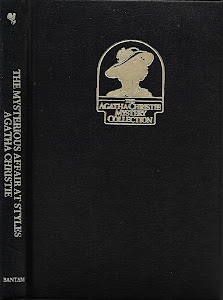
The Mysterious Affair at Styles by Agatha Christie is the first novel to feature Hercule Poirot. And, although Hastings has met the great detective in the past, this is apparently the first time that he has played Watson. Hastings is home on medical leave from the Great War and is invited by his old friend John Cavendish to spend his recovery time at the family's country home, Styles. Cavendish tells his friend, "I'm afraid you'll find it very quiet down here, Hastings." And Hastings assures him, "My dear fellow, that's just what I want." Unfortunately, it's not going to be quiet for long...

John's step-mother Emily Inglethorpe has recently been remarried to a much younger man. Alfred Inglethorpe has not been welcomed to the family bosom. The stepsons (John and Lawrence) don't think much of their step-papa, the servants all think Mrs. Inglethorpe has married beneath her, and even the man's own cousin, Mrs. Inglethorpe's beloved companion Evelyn Howard, believes he married Emily for her money. It isn't any surprise then that when Emily Inglethorpe dies of strychnine poisoning that suspicion immediately falls on Alfred. 

In the meantime, Hastings has run across Poirot in the village. Poirot is one of several Belgian refugees from the war in Europe whom Mrs. Inglethorpe has helped to resettle. When tragedy strikes, Hastings convinces John to call upon the retired member of the Belgian police. The household is astonished when Poirot produces evidence of an alibi for Alfred and the hunt is on to discover who else might have had a motive to do away with the elderly lady.

This is not my first reading of Agatha Christie's first mystery novel. It is, however, the first time I have read it in over 30 years. And, I have to say, she did it again. Christie is one of the few detective novelists who can--if it has been long enough since I last read the book--manage to pull the wool over my eyes more than once. She is a master of misdirection and even in her debut novel, she is quite good at making the reader look at this when they really ought to be looking at that. Needless to say--I spent too much time looking at this. I am about as swift off the mark as Hastings. 


It was quite enjoyable to go back to the beginning and start reading the novels again. My first reading of Christie was rather haphazard--I read whatever title came my way in whatever order I found them. I've now committed myself to a reread of her work in publication order. I am looking forward to seeing how her writing develops over time and which tropes she reuses (and how effectively each time).  ★★★★


*****************
All Challenges Fulfilled: Mount TBR Challenge, Just the Facts, Calendar of Crime, Alphabet Soup Authors, Century of Books, World at War, Cloak & Dagger, Print Only, Strictly Print Challenge, Brit Crime Classics, Agatha Christie, Outdo Yourself, How Many Books, Six Shooter, Medical Examiner, PopSugar

My copy = no dust jacket

Wednesday, January 16, 2019

The Murder of a Quack

The Murder of a Quack (1943) by George Bellairs once again finds Scotland Yard's Inspector Littlejohn investigating murder in a small English village. This time Nathaniel Wall, a beloved local "quack" bonesetter is found hanging from one of the contraptions he uses in his cures. At first it looks like the only people who had any dislike at all for the man were certified doctors. Wall comes from a family of bonesetters (those who can manipulate bones and joints, but who have no formal training) and the people of Stalden have come to rely on his skill. In fact, they prefer him over the new doctor who has bought the practice of a doctor who long had respect for the bonesetter. Circumstances (the doctor's alcoholic ways and a certain incident of a missed broken collarbone) had caused the villagers to seek out Wall's help even more. But would a doctor really resort to murder to get rid of the competition? 

Littlejohn soon discovers that there are others with a possible motive--from the young woman who had considered him an uncle...until "uncle" decided to poke his nose into her romantic affairs to the young man she wishes to marry (and who has a decided row with the doctor) to the mysterious man who once sought the doctor's help with a deformity. When newspaper clippings are found which feature a bank robbery and a well-known forgery, Littlejohn begins to wonder what the connections are. Once he figures that out, he'll be well on his way to solving the mystery. But not before another body is found at the bottom of a well....

This is another pleasant mystery in the Littlejohn line-up. The Inspector is a good man who investigates at a steady pace and with little "flair" or excitement, but provides a nice comfortable story to follow. As with the previous novel, the major complaint is that there are too few suspects. There isn't much doubt after about half-way in who the main culprit is, but Bellairs provides a little bonus that makes it well worthwhile. These stories are perfect for when you don't want a complicated mystery--just a little puzzle and nice visit to Britain of the 1940s. There is also a thread of wry humor that runs throughout and makes things interesting. ★★ and 1/2.

**********
All Challenges Fulfilled: Just the Facts, Virtual Mount TBR, Alphabet Soup Authors, Century of Books, World at War, Cloak & Dagger, Print Only, Strictly Print Challenge, Brit Crime Classics, Outdo Yourself, Mystery Reporter, How Many Books, Medical Examiner,

Sunday, January 13, 2019

The Dead Shall Be Raised: Review

In The Dead Shall Be Raised (1942) by George Bellairs, Inspector Thomas Littlejohn and his wife are set to spend a quiet Christmas holiday in the small town of Hatterworth. The story begins cozily enough--with a warm welcome from the local police superintendent and a visit from the village carolers. But the Christmas night performance of Handel's Messiah (with Superintendent Haworth in a starring role) is interrupted by the announcement that members of the Home Guard have dug up a skeleton while practicing maneuvers and fortifications on the moor. 

Materials found with the skeleton soon allow it to be identified as Enoch Sykes, a man thought to have murdered a former friend and run off after a falling out over a young woman over 20 years ago. Apparently someone else had it in for both Jeremy Trickett and Sykes and thought burying Sykes's body would allow their crime to go undetected...they've been right (and lucky) up till now. Haworth asks the Scotland Yard man if he'd like to take a busman's holiday and lend a hand in digging up the past. It's going to be a difficult job--half of the participants are dead, hrough old age, illness, or having perished in the current war. It isn't long before Littlejohn and Haworth discover that there were those who knew more than they told at the time and they had their reasons for holding their tongues. One of those in the know think it better to try their hand at blackmail than to take their knowledge to the police...and, of course, they meet the end destined for many blackmailers in detective fiction.

The Yard man and the local policemen work hard to track down clues on a very cold case. And they come down to being a hairsbreadth away from laying their villain by his/her heels. It will take the wiles of the 80-year-old retired Inspector Entwhistle to give them the evidence that allows the final confrontation.


This is delightful Golden Age mystery that I am so very glad the British Library Crime Classics decided to reissue. Bellairs writes about the English countryside during wartime with a sure hand yet gives the reader a pleasant, homey description of the village. Inspector Entwhistle is (to borrow a GAD phrase) a caution and I only wish that he had been allowed to participate more fully in the investigation. The characters are introduced with warmth and descriptions that make them seem like remembrances of real people rather than just characters in a novel.

Sometimes these Golden Age writers who produced mysteries during the war years appear to have been trying to forget that there even was a war going on. Perhaps they wanted to provide their readers an escape from the horrors. In fact, some of the novels could have been written just about any time, given how little current events make their way into the story. Bellairs brings references to the war into his narrative so easily that it places the book firmly in that era without making the story itself seem dated. Mrs. Littlejohn and Mrs. Haworth sit at home and knit scarves and other warm necessities for the soldiers. Ration books and identity cards are a necessary addition to life on the war-era home front. He also allows us to look back at a time when tramps were a common sight and farm laborers, game keepers and poachers were part of the country landscape.

The one draw-back as a mystery is the fact that there are fewer suspects than might be desirable to keep the reader mystified. There is, however,  a portion of the solution that allows for a bit of a surprise which almost makes up for the lack of suspects and red herrings. Overall, a good entry in the Littlejohn chronicles and I definitely look forward to moving on to Murder of a Quack--the second novel in the British Library Crime Classics reprint edition. ★★ and 3/4.

**********
All Challenges Fulfilled: Just the Facts, Virtual Mount TBR, Calendar of Crime, Century of Books, World at War, Cloak & Dagger, Print Only, Strictly Print Challenge, Brit Crime Classics, Outdo Yourself, How Many Books, Mystery Reporter, Medical Examiner

Thursday, January 10, 2019

Died in the Wool: Review

Died in the Wool (1945) by Ngaio Marsh finds Inspector Alleyn still in New Zealand hunting spies in World War II. Alleyn had already been hard at work in the counter-espionage business in Marsh's previous novel, Colour Scheme. This time he's asked to investigate the death of a member of New Zealand's Parliament--Florence "Flossie" Rubrick. The Rubricks own a large country property which includes sheep herds and wool processing quarters. She had gone missing one evening after announcing she was headed to the wool shed to practice an up-coming speech. It isn't until sometime later that her body is found packed into a bundle of wool that has been sold.

Her nephew, Douglas Grace, fears that a spy is at work on the farm. He and Fabian Losse (nephew to Flossie's husband Arthur) have been working on a top-secret, hush-hush gadget that will greatly aid the war efforts and Grace is certain that Flossie must have discovered proof of the spy's identity and been killed because of it. Losse doesn't believe in the spy theory, but he does want the murder solved and after the local police flounder for over a year he writes to the "big wigs" and asks for Alleyn to drop in...dangling the possibility of a spy in front him as justification.

Since the case is so cold (no clues lying helpfully about to be picked up), Alleyn spends most of his time listening to every member of the household's account of the night in question and their impressions of Flossie. Arthur is no longer around--he died shortly after Flossie disappeared--but the two nephews, Flossie's ward Ursula Harme, and Terence Lynne, Flossie's secretary all give Alleyn their version of events. It isn't long before Alleyn realizes that there are several currents of motive running beneath the surface. There's a local boy who was Flossie's favorite until they had a grand row. And there's the growing affection between Terry (Terence) and her employer's husband. Not to mention the sudden fall from favor that Douglas experience with his aunt. A late-night hunt in the wool shed (yes--even all this time later) is called for and Alleyn becomes the target for the murderer himself before the curtain falls on this one.

What is particularly nice about this one is the way Alleyn's interviews so clearly underline that no one is the same person to each person they interact with. Every member of the household produces a different Flossie for the Inspector to understand. Marsh uses the psychology of each person's version to help Alleyn to understand what Flossie did in the days leading up to her murder that made her death imperative for the killer. Some may find this a bit slow going--there's a lot of talk and little action until the last third or so of the book--but in this instance I think it works. A good closed group mystery with excellent setting and background. ★★ and 1/2.


****************
Mount TBR Challenge, Just the Facts, Calendar of Crime, Alphabet Soup Authors, Alphabet Soup, PopSugar Challenge, Ngaio Marsh Challenge, Cloak & Dagger, World at War, Print Only, Strictly Print Challenge, 52 Books in 52 Weeks, Back to the Classics, Brit Crime Classics, Outdo Yourself, Mystery Reporter, How Many Books, Six Shooter, Medical Examiner

Wednesday, November 28, 2018

World at War Reading Challenge


World At War Reading Challenge
Host: Becky's Book Reviews
Sign up here
Duration: January - December 2019
Goal: Get at least one bingo! (more are welcome, of course!)


Go to Becky's post for links to book suggestions.


I am committing to just one bingo to claim the challenge as complete. Any others will be bonus!


The categories:

_ Any book published 1914-1918
_ Any book published 1918-1924: The Mysterious Affair at Styles by Agatha Christie (1920) [1/18/19]
_ Any book published 1925-1930: Blind Corner by Dornford Yate (1927) [1/27/19]
_ Any book published 1931-1938: Blood of the North by James B. Hendryx (1938) [2/15/19]
_ Any book published 1939-1945: The Murder of a Quack by George Bellairs (1943) [1/14/19]
_ A nonfiction book about World War I
_ A nonfiction book about 1910s and 20s
_ A nonfiction book about 1920s and 30s
_ A nonfiction book about 1930s: Hitler's First Victims by Timothy W. Ryback (1/24/19)
_ A nonfiction book about World War II: Code Talker by Chester Nez w/Judith Schiess Avila (3/8/19)
_ A fiction book set during World War I:
_ A fiction book set 1918-1924: Murder on the Links by Agatha Christie (3/9/19)
_ A fiction book set in the 1920s: Whose Body? by Dorothy L. Sayers (3/24/19)
_ A fiction book set in the 1930s
_ A fiction book set during World War II: The Dead Shall Be Raised by George Bellairs (1/13/19)
_ A book set in the United States or Canada: The Lucky Stiff (1945) by Craig Rice [US] (3/1/19)
_ A book set in England, Ireland, or Scotland: Night of the Fox by Jack Higgins (2/19/19)
_ A book set in Europe
_ A book set in Asia or Middle East
_ A book set elsewhere: Died in the Wool by Ngaio Marsh [New Zealand] (1/10/19)
_ A book focused on "the war"
_ A book focused on "the homefront": The Two-Pound Tram by William Newton (9/24/19)
_ Watch any movie released in 1940s
_ Watch any movie released in the 1930s
_ Watch any movie about either war: The African Queen (WWI) --I just rewatched this, but have not written anything new.  I've attached my previous review of book & film. (1/21/19)


Some of the possibilities from my shelves and virtual TBR lists:
The War Comes home: Disabled Veterans in Britain & Germany 1914-1939 by Deborah Cohen
Here Is Your War by Ernie Pyle (pub 1943)
See Here, Private Hargrove by Marion Hargrove (pub 1942)
Green Hazard by Manning Coles (fiction, WWII)
After the Armistice Ball by Catriona McPherson (Fiction, 1920s)
Kings, Queens, & Pawns: An American Woman at the Front by Mary Roberts Rinehart (WWI Nonfiction)
A Duty to the Dead by Charles Todd (WWI fiction)