
SCAM artist alert

Apparently there is someone calling themself "Luigi Calloway" out there who is claiming to be associated with the Mount TBR Reading Challenge. He is contacting authors and telling them if they pay him, then their books will be used for the challenge. It's possible he's also telling people they must pay to participate in any way. Please know that there is absolutely no charge associated in any way with this reading challenge and that this person does NOT represent me or anything associated with my blog. I DO NOT endorse anything that he claims.There will NEVER be a reason for anyone to have to pay for participation in any way for any of my challenges. If only people who exert this much time and effort on scamming people would put it into something worthwhile....like reading their own books! A message to Luigi: Please cease and desist contacting authors (or anyone) in my name or claiming to represent this reading challenge. You absolutely DO NOT.

Tuesday, August 4, 2015

The Avenging Parrot: Review

John over at Pretty Sinister Books first brought Anne Austin* to my attention with his terrific review of One Drop of Blood. At the time I thought I might read Murder at Bridge (available through Project Gutenberg, but I'm such a book in hand kind of girl that I never got round to it. Instead, I picked up a lovely hardback edition of The Avenging Parrot (1930) at last year's Red Cross Book Sale.


From researches online, it appears that Parrot is the second of Austin's mysteries. However, the novel reads as if it were the very first of the James "Bonnie" Dundee series. Bonnie got his name from "a sentimental lass he lost his heart to in high school [who] found a Rab Burns poem called 'Bonnie Dundee' and made him a present of the nickname." It stuck. The book opens with Dundee arriving in the office of his uncle Police Commissioner O'Brien in Hamilton (Midwest, USA**) fresh from a six-month stint with Scotland Yard, as a records officer. [Perhaps the first novel, The Black Pigeon, takes place in London?] Dundee is determined to make a name for himself as a detective. But Lieutenant Strawn, O'Brien's best detective is none too sure about the new man, particularly when he finds out Bonnie's been to college and spent his time "reading everything on criminology [he] could lay his hands on."

Hmm! A story-book detective. I'm afraid you're going to be disappointed in Hamilton as a crime center, Dundee. Offhand, I can't recall a single case where a rich old man was found dead in his library, a carved dagger in his heart, and doors and windows barred. And so far as I know, there's not a single house in all Hamilton with a secret passage--

Dundee will have to work hard to impress Strawn and Sergeant Turner, a seasoned officer who resents the nephew's status, and refute any talk of nepotism.

He gets his first chance when O'Brien's secretary brings in a "crank" letter. Old Mrs. Hogarth writes from the Rhodes House, a local boarding house, praising O'Brien for a recent speech in which he said that "crime prevention is of even greater importance than crime detection." Mrs. Hogarth challenges him to put his belief to the test by preventing her murder. Neither O'Brien nor Strawn are prepared to take her seriously, but after rereading the letter, Dundee asks to be allowed to go under cover as a boarder and investigate the old lady's claims.

He settles into his new lodgings that very afternoon and soon discovers that the woman has stirred up plenty of reasons for folks to plot her death. Rumored to have a miser's hoard stashed somewhere in her room, Mrs. Hogarth has fastened on each of her fellow-boarders in turn, making the current favorite her heir in an ever-changing will. As soon as the blue-eyed boy or girl upsets her, she chooses a new favorite and makes them the heir. And Mrs. Hogarth isn't the easiest woman to play favorite for. She expects little presents and constant attention since she isn't well enough to venture far from her room on the second floor.

After meeting all the inmates at dinner that first night--from the current heiress, a lovely girl by the name of Norma Paige, and her fiance (and previous favorite) Walter Styles to the pompous businessman Lawrence Sharp and his wife to Cora Baker, pianist for the local picture show as well as another previous favorite, to Bert Mangus, Cora's admirer, to Henry Dowd, a mystery man whose former employer seems to have gone out of busines,s to various other hangers on and possible candidates for heir or heiress of the week--Dundee tries to have a private talk with Mrs. Hogarth to let her know a detective is on the job. However, the other residents keep popping in and out and he has no chance for an in-depth discussion. He decides to go for a walk--and report his initial impressions to Strawn--and plans to visit the older woman when he returns.

Somebody decides they've had enough of Mrs. Hogarth--whether it's because of the revolving will and the rumored hoard or another reason yet to be discovered. When Dundee visits her room the second time, he receives no answer to his knock and finds the door unlocked. Mrs. Hogarth in her fear of murderers had been scrupulous in locking her door when visitors left. He enters the room and finds Mrs. Hogarth strangled with her own scarf and her room ransacked. Did the murderer find what he or she was looking for? The only eye witness to the cold-blooded crime was her pet parrot. Dundee is convinced that bird's squawking has a clue to the murderer's identity, but O'Brien and Strawn thinks it only wishful thinking. How Dundee used the avenging bird and a handful of clues found amongst trash and other bits and pieces to solve the murder makes for an absorbing read.


This is a lovely Golden Age mystery with clues fairly planted and the opportunity for the reader to solve the mystery before Dundee breaks the case. A handy map is also provided as so often happens in the books of this period. Dundee is an appealing young detective. He's sure of his ability to make a detective of himself, but not so cocky as to alienate the reader (or his colleagues...too much). He makes some mistakes and works hard to find the right answers as well as trying to smooth the ruffled feathers of the more experienced officers. The solution may be a little more obvious to modern readers, but I suspect it may have proved a bit of a puzzle for Austin's contemporaries. Dundee's fellow boarders are given enough attention to round out their characters fairly well for the time period. ★★★★


*From Amazon: Born in 1895, Anne Austin began by writing romance novels about young women in the mid 1920's but soon turned her talents to producing a string of mysteries through the 1930's, some of which appeared as serials in newspapers.. Many of these mysteries feature as the detective “Bonnie” Dundee, Special Investigator for the District Attorney, including Murder Backstairs, The Avenging Parrot, Murder at Bridge, and One Drop of Blood. Several of her mysteries were translated into French, including Le Pigeon Noir and Le Crime Parfume. Despite her success as a novelist, Anne Austin disappears from the public record after the 1930's.  Amazon lists Murder Backstairs as an available reprint from Resurrected Press

**John has made an argument for somewhere in Michigan based on references in One Drop of Blood to the Eastern time zone and five hour train ride from Chicago. After a discussion with him, I'm plumping for Iowa based on all the references in The Avenging Parrot to various Iowa towns which seem to be "near by." I'm banking on the fact that Austin changed the location at some point in her books (sort of like Dr. Watson's moving wound from Afghanistan and various chronological issues in the Holmes stories) and am going to claim this for Iowa in the Reading Road Trip Challenge.

Saturday, August 1, 2015

July Wrap-Up & P.O.M. Award


I'm enjoying another year of tracking reading progress and statistics for all things bookish on the Block. I will also be contributing to Kerrie's Crime Fiction Pick of the Month. Here's what happened here on the Block in July....
Total Books Read: 17
Total Pages:  3,545
Average Rating: 3.24 stars
Top Rating: 5 stars 
Percentage by Female Authors: 47%
Percentage by US Authors: 59%
Percentage by non-US/non-British Authors:  6%
Percentage Mystery:  71%
Percentage Fiction: 88%
Percentage written 2000+: 29%
Percentage of Rereads: 0%
Percentage Read for Challenges: 100% {It's easy to have every book count for a challenge when you sign up for as many as I do.}  
Number of Challenges fulfilled so far: 10 (24%)


Not bad, not bad at all. I picked up the pace a bit in July. And boosted the page count quite nicely. Still running a bit behind schedule, though, if I'm going to get 40,000 pages done by the end of the year. And now for the P.O.M. Award in Mysteries.


As mentioned above, Kerrie had us all set up for another year of Crime Fiction Favorites. What she was looking for is our Top Mystery Read for each month. Of the seventeen books read in July, twelve were mysteries. Here are the mystery books read:


The Turquoise Shop by Frances Crane (3 stars) 

Young Mrs. Cavendish & the Kaiser's Men by K. K. Beck (2.5 stars) 
Hand of Fate by Michael Underwood (4 stars) 
The Case of the Borrowed Brunette by Erle Stanley Gardner (4 stars) 
The Crime & the Crystal by Elizabeth Ferrars (3 stars) 
The Lack of the Irish by Ralph McInerny (3 stars) 
Murder Past Due by Miranda James (3 stars)  
Resorting to Murder by Martin Edwards, ed (4 stars) 
Two & Two Make Twenty-Two by Gwen Bristow & Bruce Manning (4 stars) 
Shadow of a Doubt by June Thomson (4 stars) 
The Bookfair Murders by Anna Porter (1.5 stars) 
The Penny Murders by Lionel Black (3 stars)
 
Again--as has been the case for the last two months, I actually handed out one full five-star rating in July, but that went (also again) to a science fiction master. Not Harlan Ellison this time, but to Isaac Asimov's story The Last Question. Unfortunately, science fiction doesn't qualify for the P.O.M. So, for the best mystery fiction we have a passel of contenders with four stars each. The first is Michael Underwood's Hand of Fate, an inverted courtroom drama with p
lenty of suspense waiting to see if the culprit will be declared guilty or not. And a grand finale worth waiting for. Next up is The Case of the Borrowed Brunette by Erle Stanley Gardner. Gardner delivers a definite winner with an excellent build-up and a fast pace-- picking the reader up with Perry and Della at the beginning and running fast and furious to the last scenes. Also in the running is a collection of Golden Age short stories edited by Martin Edwards. Resorting to Murder is a collection with a holiday theme--holiday in the British sense, referring to a vacation of sorts rather than Christmas or Halloween. The authors take us to seaside resorts and French hotels, on walking tours and mountain-climbing trips where murder just happens to be on holiday as well. And, of course, June Thomson's Shadow of a Doubt collected four stars this month as well. It is one of the best detective novels I've read by Thomson. The clues are displayed quite fairly and the alert reader should be able to gather them up along with the detectives and reach the same conclusion. Thomson was at her plotting and clue sleight-of-hand best when she put this one together and there are some interesting circumstances that feature in the denouement. But good as these four were, they didn't quite capture my attention the way our winner did.  This month's P.O.M. Award goes to....

 
Two and Two Make Twenty-Two by Gwen Bristow and Bruce Manning. Bristow and Bruce Manning takes us to Paradise Island off the coast of Louisiana in the beautiful Gulf of Mexico. A cozy island get-away for the rich and elite, Paradise Island and its exclusive Peacock Club makes every wish come true for those who can afford its delights. But like the holiday venues in Resorting to Murder, death lurks on the island. When you read my review (linked above), it may sound like it's a grubby little drug-ring caper, but the murder in the cottage makes it a good old-fashioned clue and time-table driven mystery. Armchair detectives have a fair chance to put the clues together themselves. I managed to figure out the how, but Bristow and Manning did a good job keeping me from figuring out the who. If you have the chance to get hold of a copy of this one, I'd be interested to know if you put it all together.

August Read It Again, Sam Reviews


Please post reviews below.


August Mount TBR Reviews


Please post reviews below.


August Vintage Bingo Reviews


Please post reviews below.


Friday, July 31, 2015

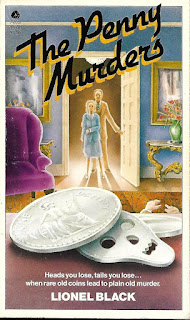
The Penny Murders: Review


 Kate and Henry Theobald represent the 1970s in a long line of husband and wife amateur sleuthing teams, following in the footsteps of of such duos as Nick and Nora Charles, Pam and Jerry North, Pat and Jean Abbott, and Jeff and Haila Troy among others. As usual, Kate is the one who usually finds herself in trouble--quite often of the life-threatening variety. Kate, as an investigative newspaper reporter at least has good reason to stick her nose in other people's business--but not necessarily to such an extent. She has a knack for starting an innocent inquiry and winding up in the middle of murder.

The Penny Murders (1979) starts in just such an innocent fashion. Kate is indulging her husband by attending a coin auction where a single coin (a Charles I Oxford crown, to be exact) can be had for a mere 27,000 pounds. Just previous, a tray of coins sells for 12,000.

Kate tried to feel impressed. Twelve thousand smackers for a tray of old coins. Whew! But all she really felt was drowsy in this stuffy, dusty, sombre brown room. Numismatics was not, she thought, her thing.

But it is Henry's. As an amateur collector, it isn't likely that he'll be able to bid on anything, but he does like to see what's on offer. And he promises Kate that he'll be able to steer her into a good story. Both she and her editor are a bit dubious, but they each feel like humoring Henry. Until the Charles I coin comes up for auction, it looks like humoring her husband is all Kate will get out of it. Then Henry notices that Foskett, a well-known coin man, is bidding for Miles Cabral. Cabral is a reclusive millionaire who is rarely seen in public. If Kate could score an interview with the man she would make a major journalistic coup and the auction provides a perfect occasion to try and meet the man.

Fortunately for Kate, Henry has met Cabral (why hasn't he told her before now? she wonders) and his father, a barrister before him, once acted for the man. Henry manages to wangle an evening invitation to drinks at Cabral's impressive London townhouse --well-known for its fortress-like security set-up. Cabral isn't just mildly interested in rare coins; he had a collection that is the envy of numismatists all over the world and he has an alarm system especially designed for the task. His rivals include an American by the name of Cornelius Ball who seems particularly annoyed at having been out-bid by Cabral.

When Kate and Henry arrive at the townhouse, Cabral's Rolls Royce stands at the curb, lights on, and his garage door is wide open. No one answers the bell and Kate, ever the intrepid investigator, notices that the door is unlocked. She doesn't expect to find Miles Cabral dead in his coin room, an apparent suicide. For you see, even though she and Henry waltzed right in without any trouble--the alarm system was working and the police arrive within about five minutes of the moment when Kate tripped the "perimeter alarm." Since the police cannot find anyone in the house and it's apparent that Cabral was dead well before the alarm brought them to house, Inspector Comfort can't help but believe that the millionaire shot himself.

Kate, her reporter's nose for news all a-twitch, doesn't believe it. There are plenty of people who would have been happy to see Cabral dead--from those who might have wanted his collection, to his ex-wife, to the beautiful but empty-headed woman he conned out of three priceless coins and her wrathful boyfriend, to the mysterious Middle Easterners who keep warning Kate off the story. Kate keeps digging up clues, but the one roadblock she keeps running into (and Henry keeps reminding her of) is that darn alarm system. It was foolproof. Once the perimeter alarm was on, no one could get in or out without a key. One set was in Cabral's pocket, one was in the pocket of his manservant who was unquestionably on a train back to London at the time, and the spare set (reserved for the police and situations such as this) safely kept by a holding company. Will Kate be able to figure it all out before someone kills her story for good?

The Theobald mysteries by Lionel Black (pen name of Dudley Barker who also wrote under the name Anthony Matthews) are light mysteries with a likeable starring couple. This one is the first "locked room" mystery that I've read by Black and while he may not have been John Dickson Carr, he did a good job keeping me mystified until Kate figures it out. I do think she manages that in a fairly off-the-cuff, oh-look-I-bet-it-was-done-that-way sort of manner, but we'll let her have it. The one troublesome bit that keeps this fun, action-driven, mystery from the four-star ranks is how quickly I knew who did it. From the moment we got a really good look at the person, I knew. I had a fair idea of why. I just couldn't figure out how s/he could have done it. It's a shame that Black couldn't have done better at making the other suspects more...well...suspicious. Perhaps it's just me. I took an immediate dislike to X and pictured them as the criminal. I happened to be right. I'd love to know if anyone else reads or has read this and, if so, whether the villain was as glaringly obvious to you. ★★


This counts for the "Locked Room" square on the Silver Vintage Bingo card.


Wednesday, July 29, 2015

The Bookfair Murders: Review


The Bookfair Murders (1997) takes place at the Frankfurt Bookfair in Germany. A real-lifepublishing convention, the Frankfurt Bookfair is the world's largest trade fair based on the number of publishing companies and visitors which frequent the convention. Agents, editors, and other publishing representative all get together to wheel and deal for international publishing and licensing rights. Big-name authors show up to make good impressions on potential buyers and to stir up media interest. There may be a few underhanded deals and agents and publishers alike may try to steal authors from one another...but no one expects someone to be murdered over a book deal.

But it looks like that's exactly what has happened. Marsha Hillier sidles up beside literary agent Andrew Myles's chair to ask him about the paperwork he's promised her on the latest Margaret Drury Carter romance novel deal. She spends several minutes chatting him up before she realizes he's never going to answer her. Someone has used the biggest, most exclusive party at the bookfair as the venue to drop a bit of poison in Andrew's drink. And pretty much everyone who knew Andrew is a suspect, for while he was the best literary agent in the business he definitely wasn't the most well-liked. To know Andrew was to hate him and Inspector Hübsch of German police force faces the tough task of narrowing down the suspects. His job is made more difficult when a publisher is found dead from the same poison and finding solid links between the two seems impossible.

The mystery won't truly be solved until Marsha returns home and she and her freelance writing friend, Judith Hayes follow the elusive romance novelist to her island hide-away. There is evidence that Andrew made a visit there earlier in the year and there are rumors that the dead publisher had claimed to have stolen the publishing rights to Carter's books from under Marsha's nose. What is the truth? And how does all this fit into the killer's motive?

Anna Porter, you had me at the title. After all, what self-respecting mystery and book lover could resist a murder mystery set at a large publishing convention in Europe? But just as you ask within your own story

...why in the name of the nine million dollars for this book alone, did she choose to run the store? The inventory-taking alone occupied the better part of chapter two. [about the latest Margaret Drury Carter plot]

why in the name of detective novels did you feel it necessary to pad your plot with the most minute, unnecessary details of the book publishing trade? We spent forever at that bookfair and learned very little about our main characters--except that they like to hop into one another's beds and make snide comments about everyone else. And why did you need to drag in the subplot of Judith Hayes, her atrocious ex-husband, and the neo-Nazis? Did that have a point? I missed it, if so. In fact, Judith is pretty much unnecessary to this story. There's no reason on earth why Marsha Hillier, our trusty editor, couldn't manage to perform Judith's part in the grand finale. Removing Judith and her entourage from the plot would have shaved about one hundred pages off this nearly four hundred page volume. 

The solution wasn't much of a surprise. And while the denouement did offer a bit of excitement (and, incidentally, the best dialogue and action of the entire book), it didn't make up for the previous three hundred pages plus. I wanted to like this one. I really did. But I can't say it was a real winner. There isn't even a real detective to follow. Inspector Hübsch pops in and out asking Marsha questions, but there isn't a lot of detective work going on in the narrative. And--while Marsha and Judith wind up discovering the killer, they don't actually behave like amateur detectives. Judith is just out for an interview with Carter so she can earn an article fee and Marsha is trying to figure out if her company really does have the exclusive rights to Carter's book. and a half.

Monday, July 27, 2015

Shadow of a Doubt: Review

Shadow of a Doubt (1981) is one of the best detective novels I have read by June Thomson. It is set at and near Hawton Hall, an exclusive private clinic where politicians, high-rolling businessmen, and high-strung actors can go to rest and recover from various forms of stress. The clinic is run by the charismatic and ambitious Dr. Howard Jordan. An autocratic and forceful man, the women on his staff respect him as a professional...and maybe have a few other feelings for him as well.

But he has little time or patience to spend on his wife. Claire may have been there with him from the beginning and helped him to launch his career, but he seems to regard his pale, shy wife as more of burden than a helpmate now that he's well on the road to success. He treats her with near disdain in private and very little better in public. So no one at the Hall is too surprised when Claire Jordan disappears one day while the doctor and one of his assistants run professional errands. Their only surprise is that she actually got up the nerve to do it. 

The other surprise is when Detective Chief Inspector Finch (*renamed Inspector Rudd in U.S. editions) from regional headquarters is assigned to look into the matter. What should have been a matter for the local bobby is given to Finch at the direct request of one of the Hall's elite clients. Is the Home Office official afraid that some specific scandal will be exposed? Or just hoping for a discreet inquiry that will keep him out of the limelight in a general way?

Finch has barely begun his investigation when an attack on one staff member and the murder of another makes it obvious that there will be no hushing this one up. Are all of these events related? The victims are all female and all connected to the clinic in some way. Is there a motive against the women in particular or does someone have a grudge against the clinic? Dr. Jordan denies that any of his patients had disorders of the kind which would result in violent behavior--whether against women or the clinic--but Finch suspects that Jordan is keeping something back. But then he suspects that every one of his witnesses are hiding or lying about something. It will take him some time to unearth all the hidden truths and discover exactly why Claire disappeared and why someone else had to die.

June Thomson has consistently provided solid, middle-of-the-road mysteries for Inspector Finch to unravel. He and Detective Sergeant Boyce are interesting and determined characters--hardworking detectives who use the art of interrogation and observation to get their man (or woman) with none of the "flair" or "nose" of some of their fictional colleagues. This doesn't mean the the stories themselves lack flair or individuality. The cases often take Finch to special settings--such as the exclusive clinic here--and he and Boyce have to feel their way around the unusual background. 

The clues are displayed quite fairly and the alert reader should be able to gather them up along with the detectives and reach the same conclusion. I missed an early one that Thomson dropped so casually into the descriptions. It would have gone a long way to helping me with the solution. Thomson was at her plotting and clue sleight-of-hand best when she put this one together and there are some interesting circumstances that feature in the denouement. A very enjoyable ★★★★ outing.

This fulfills the "Medical Mystery" square on the Silver Vintage Bingo card and provides me with my second Silver Bingo (finally!). I've now fulfilled my basic challenge commitment--but you all know I'm going to try to fill both cards.

*As noted above, Inspector Jack Finch was renamed Rudd in U.S. editions. This was done to prevent confusion with Margaret Erskine's Inspector Septimus Finch. I own and have read the British paperback edition and, thus, refer to the character as Finch.


Thursday, July 23, 2015

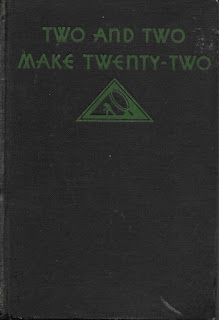
Two & Two Make Twenty-Two: Review

Two & Two Make Twenty-Two (1932) by Gwen Bristow and Bruce Manning takes us to Paradise Island off the coast of Louisiana in the beautiful Gulf of Mexico. A cozy island get-away for the rich and elite, Paradise Island and its exclusive Peacock Club makes every wish come true for those who can afford its delights. Brett Allison, the mysterious owner, provides entertainment in the form of sports and gaming tables, enough to keep even the most demanding guests occupied. Or so you would think.

But somebody on Paradise Island has time enough to indulge in a little diamond-smuggling here and a little drug-running there with enough left over for the a spot of murder. The guests are shocked to find themselves in the midst of a real-life game of Clue and the murderer is someone sharing the island with them as a brutal storm keeps them all captive.

For quite some time Federal authorities have known that drugs were being smuggled into the country via the Gulf of Mexico. But just when they get close to finding the source and the point of entry, their agents have a way of dying--through the most innocent-seeming ways possible. Most recently, an agent on the way with what was to be "absolute proof" went down in his plane, taking the proof with him. No evidence of tampering, just a fluke accident. Or so it would seem.

Major Jack Raymond and Andrew Dillingham aren't so sure and when they are sent to Paradise Island to investigate whether that lovely playground of the rich is the entry-point for the smugglers they discover indications that a woman may be involved...and may have had a hand in the agents' deaths. Another agent, Linton Barclay, meets them there and directs their attention to the beautiful Eva Shale. Eva has wealth from an unknown source and skillfully runs her own boat all over the Gulf. Unfortunately for Andrew, who has fallen for Eva, there seems to be good cause for suspicion. 

But there is also reason to suspect their genial, though rarely seen host. Brett Allison also has made his wealth through mysterious means and little is known about the Island's owner. Is it possible that the money comes from the drug game? Circumstantial evidence piles up....and just as the three are preparing to spring a trap to catch the drug runners, Linton Barclay is murdered in his cottage and the last person known to be with him was Eva. 

Allison contacts the mainland police and is put in charge until the storm will allow the officials to reach the island. A night of questions and alibis, confessions and surprises will reveal that more than one person on the island may have wanted Barclay dead. There is the jealous husband, Tracy Cupping, who thought his (much younger) wife Imogen was spending too much time with the handsome Barclay. There is Judith Garon who initially held Barclay's attention until Imogen and then Eva came along. There is Foster the man who wants to buy Paradise Island and who had rivals in the business. And then there is Mrs. Penn, the club housekeeper, who visited Barclay's cottage that night on an undisclosed errand as well.  

Plenty of strange goings-on to confuse the issue. Allison would like to clear the matter up before the authorities arrive--but Barclay's thuggish boat crew make things difficult when drugs and diamonds are finally discovered and someone bashes the island's radio operator over the head and wrecks the radio set to prevent further communication with the outside world. Fortunately, the good guys have a secret weapon--Daisy Dillingham, Andrew's grandmother and daughter of the late Judge Dillingham. She may be to quote one of her fellow club residents "two years older than Adam" but her wits are sharp and she's on the ball when it comes to noticing vital clues. Daisy is fully capable of outwitting a murderer and handing Major Raymond a drug runner on a platter.

  For the record...Daisy Dillingham makes this book. Bristow and Manning give us an islandful of well-drawn characters, but Daisy is the star of this show. And not just because she's the amateur sleuth who gets to the bottom of everything. She's sprightly and spunky and not willing to take anything from any of these people. She's lived long enough to do as she pleases and she has the social clout to get away with it. She's exactly the kind of feisty grandma we all want on our side. 

Oh, and the mystery is pretty good too. It may sound like it's a grubby little drug-ring caper, but the murder in the cottage makes it a good old-fashioned clue and time-table driven mystery. Armchair detectives have a fair chance to put the clues together themselves. I managed to figure out the how, but Bristow and Manning did a good job keeping me from figuring out the who. If you have the chance to get hold of a copy of this one, I'd be interested to know if you put it all together.  ★★★★ for a very nifty Golden Age mystery.


Gwen Bristow and Bruce Manning were a married couple who wrote many books and screenplays separately and co-authored four mystery novels together (The Invisibile Host [aka The Ninth Guest], 1930; The Gutenberg Murders, 1931; The Mardi Gras Murders, 1932; and this one). Bruce Manning was born on July 15, 1902 and gives me another July author to add to the Birthday Month Challenge.

My copy = no dust jacket

This  fulfills the "Number in Title" square on the Golden Vintage Bingo card as well as completing two more Bingos.


Monday, July 20, 2015

The British Invasion: Mini-Review

The British Invasion by Barry Miles attempts to cover everything that was the British invasion of the 1960s. It wasn't just an influx of music--from The Beatles to the Dave Clark Five to the Kinks and the the Rolling Stones. British actors made their mark on Hollywood snagging Oscars and making Americans long for London. The Avengers invaded television to become a cult icon and hip and mod styles became the dream fashion of thousands of teenagers.

The book is filled with photographs that will bring back memories for those who lived through the period and will bring the era to life for those who came along too late to experience it first-hand. While Miles does make the effort to bring in music and pop culture beyond The Beatles, he still brings everything back to them. The focus is on the Fab Four and the many ways that their arrival in America in 1964 made everything else possible. An interesting look at the pop culture of the 1960s and especially of interest to Beatles and music fans. ★★ and a half.

Saturday, July 18, 2015

Resorting to Murder: Review

Resorting to Murder is one of those books that call the name of the dedicated vintage mystery reader when she walks into the library. At least...the name of this dedicated vintage mystery reader. Martin Edwards and British Library Crime Classics--with the help of the Poisoned Pen Press here in the States--have been steadily re-introducing classic crime novels and short stories to a modern readership. For those of us who already know and love the Golden Age of detective stories, this is an incredible bonanza--a chance for some of us who haven't a fortune to spend on ABE books or Ebay to get our hands on original editions to read the work of authors whose names we've heard/seen. 

This is a collection of such short stories. A collection with a holiday theme--holiday in the British sense, referring to a vacation of sorts rather than Christmas or Halloween. The authors take us to seaside resorts and French hotels, on walking tours and mountain-climbing trips. We enjoy stories by well-known authors like Sir Arthur Conan Doyle, G. K. Chesterton and Anthony Berkeley, but also sample the work of Phyllis Bentley, Helen Simpson, and M. McDonnell Bodkin and others. We see murderers polish off their victims through drowning and climbing accidents and disappearances down boggy holes. There are houses that scream and a prison governor who is mysteriously transported from the prison grounds to the wreckage of his car at the bottom of a cliff. 

Of course, murder may not be everyone's idea of the perfect holiday get-away, but a good murder or two (or fourteen--which just happens to be the number in this collection) with a classic detective to ferret out the clues and resolve the mystery is just the kind of vacation I like. This is a grand group of stories with puzzles to keep the armchair traveler absorbed and entertained.  ★★★★

Tuesday, July 14, 2015

The Witch & the Hysteric: Mini-Review

The Witch & the Hysteric: the Monstrous Medieval in Benjamin Christensen's Häxan by Alexander Doty and Patricia Clare Ingham is an academic chapbook by two outstanding scholars which examines Christensen's 1922 film and the representations of women as both witches and hysterics (and, ultimately, as the monstrous) in medieval times and in the early 20th C. The accusers may change from religious conservatives on witch hunts to early psychiatrists diagnosing the causes of women's mental illnesses, but the stigma of the monstrous remains. Christensen's film would seem to make the claim that the modern--scientific--viewpoint is better than the religious fanaticism of the medieval period, but Doty and Ingham point out that the juxtaposition of images in Häxan encourage the viewer to believe that very little has changed.

The appeal of this book was, I must admit, primarily due to my friendship with one of the authors--Patty Ingham. I was most curious to read one of her works and (sorry, Patty) not likely to read one her longer books more heavily anchored in the medieval period. I'm just not that into medieval. This chapbook was an ideal chance to sample her work (as well as that of the late Alexander Doty). Well-written, as expected, it was accessible to me as a non-scholar. And it has made me very curious to see Christensen's film. For someone more well-versed in medieval or film studies, I'm sure it will be even more accessible. ★★ and a half.

[Patty Ingham is not only a friend--she also shares my birthday, July 1. This allows me to count this book for the I Dare You Challenge and Birthday Month Challenge--both which call for an author born in July.]

Monday, July 13, 2015

Murder Past Due: Review

Murder Past Due by Miranda James is a cozy cat mystery that isn't just "too much" as so many of
them can be. Diesel is a Maine coon cat with a human named Charlie Harris. Diesel doesn't solve mysteries--he's just a big, lovable cat whose most extraordinary habits is walking around town on a leash, warbling and chirping instead of meowing as other cats do. The mystery solver is Charlie--college librarian and first-time amateur sleuth. Since everyone in Athena, Mississippi knows Charlie, they are more apt to gossip with him than spill what they know to the law. 

When former classmate, now bestselling novelist Godfrey Priest returns home for an honorary dinner and to donate his papers to his alma mater, he stirs up more trouble than good feelings and someone decides to perform a killing review on the author and end his days on the bestseller list for good. There is no shortage of suspects--from Charlie's boss who lost his wife to Godfrey's womanizing ways to Godfrey's half-brother who could have used financial help in the worst way to a possible ghost writer to the bookshop owner who lost a great deal of business when the famous author cancelled a couple of book-signing to an old flame who wound up pregnant years ago and now it looks like Godfrey wants to steal her son's affection.

Charlie spends his time in the library's archives and it looks like he'll need to dig in the town's past history to find all the clues necessary to help the sheriff's office solve the mystery of the cancelled author.

This is a pleasant cozy mystery. There are a fair amount of clues and enough suspects to distract, although I did pick the culprit out. The plot was still enjoyable and it was interesting meeting the regulars for what looks to be a good series. It's nice to have a "cat mystery" where the cat is just a cat. He doesn't find the clues; he doesn't point them out to his owner. But he is a lovely addition to the cast. Charlie is an interesting character, but I think I like Diesel even more. ★★

Sunday, July 12, 2015

Challenge Complete: Pop Sugar Challenge

Pop Sugar has what they think is the ultimate reading challenge. From a book your mom loves to a book with a love triangle, they're giving you a wide range of reads, spanning eras and genres, instead of specific books. You don't have to read all 50 books (technically 52, since one is a trilogy), but it's a fun incentive to diversify your reading — you may be surprised by what you find you enjoy! Click link above to see the full post.

My declared goal was 30 (just a little over half). Any over 30 will be bonus. No links to reviews here--my full reading list (with links) can be found at the You Read How Many Books OR 100+ Reading Challenges. I will date when the book is read. 

I just finished my 30th book, so my challenge is complete. Below is the list of categories and the books I read for them.

Book that became a movie: The Great Dinosaur Robbery by David Forrest (5/15/15)
Published this year: The Golden Age of Murder by Martin Edwards (5/5/15)
Book with nonhuman characters: The Mote in God’s Eye by Niven & Pournelle (4/12/15)
A funny book: Death of a Tall Man by Frances & Richard Lockridge (1/31/15)
Book by a female author: Mother Finds a Body by Gypsy Rose Lee (1/12/15)
Mystery or thriller: Death Over Deep Water by Simon Nash (2/8/15)
Book with a one-word title: Panic by Helen McCloy (2/22/15)
Book of short stories: The World’s Best 100 Detective Stories Vol. 1 by Eugene Thwing, ed. (2/26/15)
Book set in different country: A Dead Man In Istanbul by Michael Pearce (1/14/15)
Nonfiction book: Mystery! A Celebration by Ron Miller (2/3/15)
Popular author’s first book: Caught Dead in Philadelphia by Gillian Roberts (2/11/15)
Book from author you love but haven’t read yet: 13 Steps Down by Ruth Rendell (2/15/15)
Book based on a true story: Into the Valley by John Hersey (2/28/15)
Book at bottom of TBR pile: The Eye in the Museum by J. J. Connington (5/8/15)
Book you can finish in a day: Lost Laysen by Margaret Mitchell (2/17/15)
Book with antonyms in title: RFK: His Life & Death by Editors of American Heritage (4/15/15)
Book set somewhere you always wanted to visit: Death of a Dwarf by Harold Kemp (1/25/15)
Book that came out the year you were born: The Wilberforce Legacy by Josephine Bell (4/19/15)
Book with bad reviews: Spock, Messiah! by Theodore R. Cogswell & Charles A Spano, Jr. [and I added another one] (5/8/15)
Book from childhood: The Ringmaster’s Secret by Carolyn Keene (4/16/15)
Book with a love triangle: The Riddle of the Traveling Skull by Harry Stephen Keeler (6/21/15)
Book set in the future: Ten Thousand Light-Years from Home by James Tiptree, Jr. (1/12/15)
Book with color in the title: Ride the Pink Horse by Dorothy B. Hughes (1/3/15)
Graphic novel: The Adventure of the Three Students by Sir Arthur Conan Doyle [graphic novel version adapted by Vincent Goodwin; illustrated by Ben Dunn] (4/23/15)
Book by an author you’ve never read before: The Case of the Painted Girl by Frank King (1/6/15)
Book you own by have never read: The Case of Colonel Marchand by E. C. R. Lorac (4/27/15)
Book that takes place in your hometown: The Lack of the Irish by Ralph McInerny (7/11/15) [closest I could come--South Bend in fairly close to Wabash)
Book set during Christmas: The Crime & the Crystal by Elizabeth Ferrars (7/9/15)
Book written by an author with your initials: Call for Michael Shayne by Brett Halliday (4/22/15)
Book based on or turned into a TV show: Harlan Ellison's City on the Edge of Forever by Ellison; Adapted by David & Scott Tipton (6/5/15)

Saturday, July 11, 2015

The Lack of the Irish: Review

The University of Notre Dame in South Bend, Indiana is gearing up for a highly anticipated football game. Baylor University, the country's preeminent Protestant college, will meet the Catholic football powerhouse for the first time. Game day, most ironically, falls on Reformation Day--the day recognizing the historic moment when Martin Luther nailed his 95 Theses to the door of the Schlosskirche (castle church) in Wittenberg in 1517.  Off the field, scholars prepare a theological conference featuring participants from the rival schools that will address Catholic and Protestant history. And a female pastor (who seems to be a bit of a loose cannon) plans to protest the game as some sort of statement about Protestantism's superiority over Catholicism. She hopes to stir up a religious fervor to eclipse the football fanaticism. 

Sparks seem to be flying everywhere. Even the campus event coordinator is stirring up trouble--she seems to believe it her duty to throw as many obstacles in the path of conference directors as possible. When she is found strangled shortly before the big day, there seems to be no shortage of candidates for the role of murderer. Roger (a professor) and Philip (a private eye) Knight use their various skills to help search for the killer. But there are no definite clues until Notre Dame's famed, brilliant, and troubled quarterback mysteriously disappears and evidence links him to the crime. But did he do it....or does he just know who did? 

The Lack of the Irish is a fairly solid mystery offering from the late Ralph McInerny. Very light, cozy feel with the academic setting and most of the mystery-solving provided by the professor half of the brothers Knight rather than the private eye. Interesting characters and a realistic motive for the culprit. Not really in the fair-play tradition...either that or I was asleep at the wheel when it came to noticing clues, but it was a fun, quick read and I do enjoy Professor Knight and his brother.  ★★