SCAM artist alert

Apparently there is someone calling himself "Luigi Calloway" out there who is claiming to be associated with the Mount TBR Reading Challenge. He is contacting authors and telling them if they pay him, then their books will be used for the challenge. It's possible he's also telling people they must pay to participate in any way. Please know that there is absolutely no charge associated in any way with this reading challenge and that this person does NOT represent me or anything associated with my blog. I DO NOT endorse anything that he claims.There will NEVER be a reason for anyone to have to pay for participation in any way for any of my challenges. If only people who exert this much time and effort on scamming people would put it into something worthwhile....like reading their own books! A message to Luigi: Please cease and desist contacting authors (or anyone) in my name or claiming to represent this reading challenge. You absolutely DO NOT.

Tuesday, October 20, 2015

Challenge Committment Complete: 1001 Books Before You Die


Rachel at Resistance is Futile thought it would be fun to gather a few people who are interested in reading through the list of 1001 Books You Must Read Before You Die.  She has put together a perpetual--lifelong!--challenge and has posted a compilation of all editions of the list for us to follow.  OR you're welcome to work from the compilation or from one specific edition - your choice! For full details and to sign up, jump on the link above.
 
When I signed up I was quite sure I wouldn't read (nor want to read) all 1001+ books on the list. So I've made my goal to read at least five books from the list every year, Just finished my fifth book for 157 total so far.

Challenge Goal 2015: Five books (review links may be found at my original post)
1. The Day of the Triffids by John Wyndham 
2. Brighton Rock by Graham Greene
3. The Crying of Lot 49 by Thomas Pynchon
4. Alias Grace by Margaret Atwood
5. The Hitchhiker's Guide to the Galaxy by Douglas Adams
 

The Hitchhiker's Guide to the Galaxy: Review

I just took myself on a little journey back to the 80s. The 1980s. That's when I discovered that marvelously funny science fiction and cult classic The Hitchhiker's Guide to the Galaxy written by Douglas Adams in 1979 at the age of 27. Since I needed a SF book written in 1979 for the Genre Decades Challenge and written by someone younger than 30 for the Pop Sugar Challenge, I decided to revisit an old friend and see how it holds up over 30 years later.

Quite nicely, in fact.

The book is one delicious romp--starting with Arthur Dent, a rather boring Englishman who wants one thing out of life...to save his fairly unattractive house from being demolished to make way for a new freeway. To this end, he is lying in the mud in front of a bulldozer when his friend Ford Prefect plucks him from the mud, convinces him to down several pints of beer, and helps him snag a ride onboard a Vogon ship which has just come along to demolish the Earth to make way for galactic freeway. Ford, ostensibly an out-of-work actor, is in reality an alien from Betelgeuse who has been doing research for a revised version of the Guide and has been waiting fifteen years for someone to come along and rescue him from this backwater little planet. He didn't really want it to be Vogon ship...after all Vogons hate hitchhikers and are likely to drop you out of an airlock if they find you. And if you're really unlucky they'll read their poetry to you first.

This is the story of Arthur and Prefect's adventures after they survive the horrors of Vogon poetry (oh and the demolition of a planet and being tossed out an airlock). Adventures that hook them up with Zaphod Beeblebrox, the two-headed, three-armed President of the Galaxy who's out for a good time and in search of something that his future self wants him to find but won't tell him about; Trillian a brilliant and beautiful woman whom Arthur tried once to pick up at a party and who knows how to fly a ship with Improbability Drive; Marvin, the paranoid android, who is so depressing he causes a space ship to commit suicide; Slartibartfast, award-winning designer of fjords; two white mice in search of a question; and, briefly, a large sperm whale and a surprised bowl of petunias. 

What will our brave heroes learn on there journey? Why, nothing much--just the answer to Life, the Universe, and Everything. Oh wait. That's an entirely different book in the series. ;-) 

I absolutely loved this book when I discovered it back in high school. I thoroughly enjoyed all the witty dialogue and the outrageous adventures of our heroes. I didn't mind that there really (if you think about it much harder than you should) isn't much of a plot. When you're having so much fun imagining the events that Adams puts in front of you, you don't really notice that the story line doesn't have much of an arc. And, you know what? Over thirty years later...I still didn't notice. This is an excellent, crazy, off-the-wall science fiction adventure. I enjoyed every minute. ★★★★★

Monday, October 19, 2015

Fall Bookstore Pilgrimage

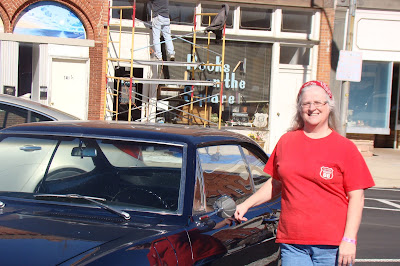
With the Corvair in front of Books on the Square

The hubby wanted to take a trip to Route 66 in "his" 1966 Corvair. I was agreeable--especially when I found out that my reward for being an agreeable wife was a trip to one of my favorite used bookstores: Books on the Square in Virden, IL. We took a long weekend for a lovely fall drive (about 500 miles round-trip) and Bev came back a very happy girl. I tend to have great success finding my beloved pocket-size editions in Virden and this trip was no different. I am now 39 books richer....


Here's the run-down of the haul:

The Gorgeous Ghoul Case  by Dwight V. Babcock (Avon #320--"specially revised & edited")
Charlie Chan Carries On by Earl Derr Biggers (Pocket Books #207; 3rd printing)
Death Against Venus by Dana Chambers (A Handi-Book Mystery; abridged)
The Camera Clue by George Harmon Coxe (Dell Mapback # 453)
Murder with Pictures by George Harmon Coxe (Dell Mapback #441)
No Time to Kill by George Harmon Coxe (Dell Mapback #182)
Another Woman's House by Mignon G. Eberhart (Bantam #849)
The Velvet Fleece by Lois Eby & John C. Fleming (Dell Mapback #272)
While the Wind Howled by Audrey Gaines (Dell Mapback #51)
The Case of the Silent Partner by Erle Stanley Gardner (Pocket Books #468; 2nd printing)
The Body Missed the Boat by Jack Iams (Dell Mapback #274)
Death Draws the Line by Jack Iams (Dell Mapback #457)
If I Die Before I Wake by William Irish (Cornell Woolrich) [Avon #104]
Phantom Lady by William Irish (Cornell Woolrich) [Pocket Books #253; 9th printing]
Puzzle in Petticoats by Samuel Melvin Kootz (Black Knight Mystery)
Death of a Doll by Hilda Lawrence (Pocket Books #540; 1st printing)
Death Takes a Bow by Frances & Richard Lockridge (Avon #131)
Murder Within Murder by F & R Lockridge (Dell Mapback #229)
House of Darkness by allan MacKinnon (Dell Mapback #237)
Colour Scheme by Ngaio Marsh (Pocket Books #351; 2nd printing)
Who's Calling by Helen McCloy (Dell Mapback #151)
Said With Flowers by Anne Nash (Bart House #19)
The Clue in the Clay by D. B. Olsen (Bart House #35)
The Day He Died by Lewis Padgett (Bantam #306)
Mayhem in B Flat by Elliot Paul (Bantam #850)
Halfway House by Ellery Queen (Pocket Books #259; 5th printing)
The Tragedy of X by Ellery Queen (as Barnaby Ross) [The Reader's League]
Murder at Arroways by Helen Reilly (Dell Mapback #576)
The Big Midget Murders by Craig Rice (Pocket Books #528; 2nd printing)
The Corpse Steps Out by Craig Rice (Pocket Books #476; 2nd printing)
The Thursday Turkey Murders by Craig Rice (Pocket Books #461; 2nd printing--poor copy, reading copy only)
The Fourth Postman by Craig Rice (Pocket Books #651; 2nd printing)
Yesterday's Murder by Craig Rice (Popular Library #253)
Too Busy to Die by H. W. Roden (Dell Mapback #185)
Alphabet Hicks by Rex Stout (Dell Mapback #146)
Cold Steal by Alice Tilton (Phoebe Atwood Taylor) [Dell Mapback #142)
The Greene Murder Case by S. S. Van Dine (Pocket Books #256; 2nd printing)
Dangerous Ground by Francis Sill Wickwood [Dell Mapback #248]


Friday, October 16, 2015

The Ghost Writer: Review

Well...that took much longer than anticipated to finish. John Harwood's debut novel, The Ghost Writer, started off really well. Gerard Freeman and his family live in the fictional town of Mawson, Australia. When Gerard Freeman is young he sneaks into his mother's room to open a drawer that has been locked as long as he can remember. He's dying to know what's inside...but all he finds is a picture of a beautiful woman he has never seen before. His mother catches him red-handed and launches into a tirade and whirlwind of beating that he'll never forget. From that moment on the few stories she's told him of her childhood in far-away England stop. She refuses to discuss England or her childhood home of Staplefield or her grandmother Viola who raised her. Gerard has never been told much about his English heritage and now it seems he'll not find out more. His mother becomes more secretive than ever, telling her son that she is only trying to protect him. But from what? Or who?

Not long after this he begins a "penfriend" relationship with Alice Jessel through a penpal service advertised at his school. Alice is his age and has been crippled ever since an accident that killed her parents. She wants to know everything about Gerard and asks for pictures of him and his family, but won't send him pictures in return because she doesn't want him to think of her as crippled. The friendly letters turn romantic...from "penfriends" to "invisible lovers" and Gerard is determined to make his way to England to see Alice. She doesn't want to see him unless the doctors can find a way to cure her so she can walk again.

Interspersed in the narrative are ghost stories written by Gerard's great-grandmother. As he grows to adulthood, he finds more and more stories and pieces of stories that showcase Victorian ghosts and ghouls. But there seems to be more to these stories than just a peek at Viola's Victorian mind. When Gerard finally makes a trip to England, he starts investigating his past and the number of incidents in his family history and present life which mirror the events in Viola's ghost tales is disturbing. And what the stories seem to be telling him about his mother's past is very disturbing indeed. Gerard efforts to solve the mysteries of the past will involve him in a mysterious present.

I enjoyed the first few chapters of The Ghost Writer very much. It set a very convincing stage of a frightened woman doing her best to shelter her son from some unknown danger. It was also convincing that Gerard would be curious--both about his family history and about England. Alice provides a link to the land of his heritage. I also enjoyed Viola's ghost stories. In fact, I think I could have read a whole book of just those stories. But Harwood lost me at about the mid-point. Jumping back and forth between the stories and Gerard's present was confusing. The connections made at the end seemed far-fetched and conclusion did not make any sense to me at all. I don't want to give the ending away--but I cannot figure out how the person behind everything could have stage-managed it all. There's no way s/he could have known where Gerard was. No one knew his mother had gone to Australia. It just doesn't make sense. 

I'm giving this three stars--for a good intro, good ghost stories, and the promise of a really good over-all plot that just didn't quite work for me. Others have rated this quite highly, so your mileage may vary.  ★★★


Tuesday, October 13, 2015

Tuesday Night Bloggers: The Problem of the Stand-Alones

It's Tuesday and it's time once again to gather round the table with my fellow GAD-ers* for a cozy session of The Tuesday Night Bloggers. We will continue our discussions of all things Agatha Christie throughout the month of October. Noah has suggested a year's worth of authors to keep us busy in the months to follow. If you're a fan of Golden Age mysteries, we'd love to have you join in. Please check out his post (HERE) for background and details.

This week I'm going to take a look at some of Agatha Christie's stand-alone novels. I'll be upfront--Generally speaking, I haven't been as big a fan of the stand-alones as I am of her series novels with Poirot and Miss Marple and Tommy & Tuppence Beresford.  This is due in part to my fondness for recurring characters, but it's my opinion that she did her most of her best work within the classic mystery mileau. Christie used a large number these stand-alones to explore the spy/thriller and suspense genres rather than the straight-forward detective novel with sleuth, suspects, and clues. There are, however, a few of these one-offs that I find particularly enjoyable and would like to highlight.

The Man in the Brown suit is her earliest effort and represents an attempt at light-hearted espionage. Yes, there are deaths and mysterious master criminals directing nefarious schemes and hidden diamonds and blackmail, but I found it hard to take seriously it all seriously. That doesn't make it any less fun or exciting to read, but it doesn't produce the edge-of-your-seat thrills that some espionage stories will. And while it may be a bit exasperating to watch Anne fall into the classic heroine trap of being tricked into coming to an isolated home alone and then bound and gagged to wait for the "Colonel" to come, it is also refreshing to see her use her resourcefulness to escape her captors. It is also nice to see her learn from the experience and not be caught napping again. Anne is a likable main character--smart, brave, and willing to learn from her mistakes. I enjoyed Anne very much. And I enjoyed the story for what it is--but, be warned, it's lighter than a lot of Christie's work and the emphasis is not so much on the mystery. 

So Many Steps to Death (originally published Destination Unknown) is another foray into spy/thriller territory.  This time we have scientists and chemists and medical researchers disappearing at an alarming rate.  In the Cold-War-Era climate, this is particularly disturbing and England's secret service becomes especially interested when a young scientist by the name of Thomas Betterton vanishes. Enter Hillary Craven, a young woman with no ties and who happens to look like Betterton's wife. She is asked by the secret service to her place and lead them to Betterton (and those behind the scientists' disappearances). Christie seems to have had a definite preference for placing the amateur in the world of crooks and spies. While the plot may require a bit more suspension of  disbelief, the story is good and makes for a fun, quick read.


Of course the most familiar and, in my opinion, the most successful stand-alone is And Then There Were None (aka Ten Little Indians, etc). It is one of my all-time favorite Christie novels. It is the ultimate locked room mystery (a "locked" island to be exact) or, in the broader term, impossible crime. ATTWN is Christie at her suspenseful best. The tension on the island builds and builds and each time the reader chooses a suspect the potential killer is killed. The story is a familiar one to most mystery lovers and certainly to all of us in the Tuesday Night Bloggers: ten people of various backgrounds are invited for a holiday on Indian Island and at the end of the holiday everyone on the island is dead. Who did it?  

Even though I've read it many times, I still get nearly the same pleasure from it each time I reread it. Of course, the pleasure would be complete if I could conveniently forget the solution--but the story is told so well that I don't mind knowing ahead of time what will happen. I have had an ongoing practice of telling my friends whenever I find out that they plan to read this one for the first time, "If you can honestly tell me that you figured out who did it before the end of the story, I will buy you dinner--wherever you want to go." Thirty years and counting....and I have not had to pay up yet. 


++++++++++++++

*Golden Age Detection aficionados

Sunday, October 11, 2015

Mount TBR Checkpoint #3 Winner!


Well, I hauled out the Custom Random Number Generator and after feeding in all the entries, listening to it clank and whir, we have a winner! Our lucky climber is #3 Michelle @inkalicious! Congratulations, Michele!  I'll be contacting you with the prize list very soon.

Thanks again to all of you who checked in. I enjoyed reading your answers...and thanks also to all who are busy climbing with us!  It's hard to believe that the next checkpoint will be the wrap-up for the end of the year. Are you ready to make a final sprint to the finish?

Paris in the Twentieth Century: Review


Did she love Monsieur Boutardin and was she loved by him in return? Yes, insofar as these businesslike hearts could love; a comparison will complete the portrait of the pair: she was the locomotive and he the engineer; he kept her in good condition, oiled and polished her, and thus she had rolled forward for a good half a century, with about as much sense and imagination as a Crampton Motor.

Unnecessary to add that she had never derailed. (p. 32)


Paris in the Twentieth Century is the "lost" novel by Jules Verne. It was written in 1863, rejected by his publisher as portraying a far too unrealistic view of the future, and languished in a family safe for over 100 years. Inside the safe, opened by Verne's great-grandson, was a sheaf of handwritten pages detailing a dystopian France of the 1960s. Verne's mid-Twentieth Century is a bleak place where culture, literature, and the arts have been shoved aside in favor of commerce and technology. A place where efficiency and monetary gain rule supreme in a bustling, overcrowded metropolis where the homeless starve and shiver on the well-lit streets teeming with horseless carriages. Sound familiar?

The [Academic Credit] Union statues followed, carefully expressed in financial terms. As is apparent, no scholar's or professor's name appeared on the Board of Directors, a matter of some reassurance with regard to the commercial prospects of the enterprise. (p. 6)

In Verne's world, we follow the fortunes of Michel Dufrénoy who wins prizes in Latin verse from the Academic Credit Union (which has replaced the standard universities and colleges), but soon learns that his gifts have no place in a world of finance and industry. He has inherited his artistic abilities from his father--who was (as his prosperous uncle reminds him) a good-for-nothing musician. 

...for form's sake, some classes in literature were still taught, though those were sparsely attended and inappreciable--indeed anything but appreciated. (p. 7)

Upon his graduation from the Union, his uncle tells him that he must give up his unfortunate artistic pursuits and find himself a practical job. He tells him, "You are without fortune, which is a blunder...I have decided that you must enter the Casmodage and Co. banking house...Work to become a practical man!" But Michel cannot apply himself to practical work and winds up moving from job to job trying to find one that he can manage well enough to support himself so he can write the poetry he loves in the evening. However, even work that was once grounded in the arts--such as theatre--has been turned into a mere mechanical industry and Michel has difficulty finding anything that he can do even adequately. He finds others like him and a girl to love, but will he ever become practical enough to be able to marry and support her?

The notes tell us that the reason Verne's publisher turned this down was because of his far-fetched vision of the future, but there are more "practical" reasons why this might not have done well. While I was impressed by how many of Verne's predictions turned out to be correct--the advent and spread of electricity in all walks of life, the rampant use of "gas-cab" horseless carriages, elaborate subway systems, and a form of fax machines, computers, calculators, I was less impressed by the plot. With Verne stories, I am used to grand adventures. Voyaging round the world in 80 days. Diving under the ocean in the Nautilus . Or making a journey to the center of the earth. There are usually dangers to overcome and a strong story arc. This is far less apparent in this novel.

Paris in the Twentieth Century is far more a book of ideas and commentary than readers of Verne are used to. He examines everything from man's growing reliance on mechanical and electronic gadgets to wealth in the hands of commercial and industrial giants to the lack of human contact created by a world that values language, literature, and the arts less and less. Men and women have few real emotions (see opening quote) and are referred to throughout the book in mechanical and commercial terms. Verne's vision of the future is a bleak, emotional wasteland. 

Working in a university, I have to say that passages referring to the Academic Credit Union strike a chord. The sciences and business-oriented programs on campus receive the lion's share of the recognition and financial support. More and more, the arts and humanities find themselves scrambling to prove themselves relevant to the modern world. Verne definitely got more than a few things right in his prediction of the future.

This is an important work--perhaps not his best story, but an excellent commentary on a proposed future that has all too much in common with our present. ★★★


Saturday, October 10, 2015

It's Book Fair Time Again!

Last year about this time I was worried that I had attended my last huge book fair in Bloomington. The Red Cross had announced that it was pretty much dismantling the local chapter and their sponsorship of the book fair was no more. The community's outcry of dismay was so great that several local charities offered to take it up. The Hoosier Hills Food Bank has become the new host of the Bloomington Community Book Fair.
So, on Friday I packed up my book list & huge rolling shopping bag and headed to the fair grounds for another happy morning of treasure-hunting. And then the hubby and I took another trip out there today--in search of possible comic books for him and chance for me to see if I missed any. I came home with a grand total of 67 books. But...realistically, I only wound up 60 keepers. No matter how carefully I consult my To Be Found book list I somehow manage to come home with unplanned duplicates. Some of the 60 were planned duplicates--vintage copies of books I already own or just plain more desirable copies. 

The highlights of this year's round is a Dover reprint copy of The Mystery of a Hansom Cab by Fergus Hume, a 1st edition Mr. & Mrs. North with dust jacket, and nearly two dozen of my beloved pulp-era, pocket-size editions. I was beginning to think I'd never get my hands on a hard copy of the Hume book. Here's the run-down (interesting vintage editions noted):

Friday's Haul

Vintage Mysteries (pre-1960)
Take Two at Bedtime by Margery Allingham (Penguin--solid green, no picture)
Tether's End by Margery Allingham
Murder, Maestro, Please by Delano Ames
Murder of the Clergyman's Mistress by Anthony Abbot (Popular Library edition #286)
The Triumphs of Eugène Valmont by Robert Barr (Dover reprint)
Trent Intervenes by E. C. Bentley (Dover reprint)
Seven Keys to Baldpate by Earl Derr Biggers (Popular Library edition #132)
The Smiler with the Knife by Nicholas Blake (Popular Library pocket edition #41)
Dead Lion by John & Emery Bonett (1st Penguin edition)
What Beckoning Ghost by Douglas G. Browne (Dover reprint) 
The Hardway Diamonds Mystery by Miles Burton (1st Mystery League edition)
Patrick Butler for the Defense by John Dickson Carr
The Three Coffins by John Dickson Carr (1st Dell pocket edition) 
Without Lawful Authority by Manning Coles (Rue Morgue reprint)
The Bowstring Murders by Carter Dickson 
The Mystery of Cloomber by Sir Arthur Conan Doyle (non-Holmes; Dover reprint)
The March Hare Murders by E. X. Ferrars (Pocket Books pocket edition #735, 2nd printing)
Harvard Has a Homicide by Timothy Fuller (Triangle Books)
Three Thirds of a Ghost by Timothy Fuller (Popular Library edition #81) 
Cosmopolitan Crimes by Hugh Greene, ed [foreign rivals of Sherlock Holmes]
The Gift Horse by Frank Gruber (Bantam pocket edition #2)
The Mighty Blockhead by Frank Gruber (1st Superior Reprint edition)
The Talking Clock by Frank Gruber (Penguin 2nd printing)
Best Detective Stories of the Year 17th Annual Collection by Brett Halliday, ed (1st Dell pocket edition) 
Murder & the Married Virgin by Brett Halliday (Dell Mapback) 
The Mystery of a Hansom Cab by Fergus Hume (Dover reprint)
Odor of Violets by Baynard Kendrick (Dell Mapback)
Killing the Goose by Frances & Richard Lockridge (Front Page Mysteries--with weapons imprint)
Murder Within Murder by Frances & Richard Lockridge (1st edition w/dust jacket)
The Scarlet Thumb by Jermyn March (Mystery Library)
The Singapore Exile Murders by Van Wyck Mason (Pocket Book pocket edition #129) 
Murder Loves Company by John Mersereau (Rue Morgue reprint)
Skeleton Key by Lenore Glen Offord (Dell Mapback) 
Harvey Garrard's Crime by E. Phillips Oppenheim (Triangle Books w/dust jacket)
The Puzzle of the Silver Persian by Stuart Palmer (Dell Mapback #18)
The Mysterious Mickey Finn by Elliot Paul (Dover reprint)  
Man in Ambush by Maurice Procter
The After House by  Mary Roberts Rinehart (1st New Dell pocket edition)
The Bat by Mary Roberts Rinehart (1st New Dell pocket edition)
The Mountain Cat Murders by Rex Stout
Death Lights a Candle by Phoebe Atwood Taylor (3rd printing Pocket Books pocket edtion #204)
Death of a Lake by Arthur W. Upfield 
The Murder  Book of J. G. Reeder by Edgar Wallace (Dover reprint)
The Spiral Staircase by Ethel Lina White (Popular Library edition #120)

Post-1960 Mysteries
The Cambridge Theorem by Tony Cape
The Glass-Sided Ants' Nest by Peter Dickinson
A Death for a Double by E. X. Giroux
The Philomel Foundation by James Gollin 
Death After Breakfast by Hugh Pentecost 

Reference
The Mystery Reader's Walking Guide: London by Barbara Sloan Hendershott & Alzina Stone Dale
The Great Detectives by Otto Penzler, ed

Science Fiction
I Have No Mouth & I Must Scream by Harlan Ellison
Out of the Everywhere & Other Extraordinary Visions by James Tipree, Jr.

Saturday's Haul

Vintage Mysteries (pre-1960)
The Man in the Brown Suit by Agatha Christie (1st New Dell pocket edition)
Murder on the Links by Agatha Christie  (1st New Dell pocket edition)
The *New* Exploits of Sherlock Holmes by Adrian Conan Doyle & John Dickson Carr (Ace D-181 pocket edition)
The Riddle of Samson by Andrew Garve
The American Gun Mystery by Ellery Queen
How the Old Woman Got Home by M. P. Shiel

Post-1960 Mysteries
The Perfect Murder by H. R. F. Keating

Wednesday, October 7, 2015

Happiness Is a Warm Corpse: Mini-Review

Happiness Is a Warm Corpse (1969) is a collection of short stories presented as "personally selected by Alfred Hitchcock." These collections of stories Hitchcock's name and include introductions ostensibly written by the director, but it is generally agreed that Hitchcock had little, if any, involvement in the books. Such collections were plentiful in my school libraries and I soon made my way through all that were available. This may well have been one of them--if so, I did not record it in my book log and I have long forgotten it. As a collection, it is--as most collections are--a mixed bag. There are several excellent stories...from "Once Upon a Bank Floor," the tale of a foiled bank robbery that yielded loot for one of the criminals much later, to "The Egg Head" in which a young scientist wins the respect of his police chief father-in-law by helping to solve an unsolved murder to "IQ-184" which produces a most surprising murderer, indeed. And "Kill If You Want Me" is a very chilling story of cold-blooded murder. But there are a few stories that are either a bit confusing ("The Sweater," for instance) or which fall just a bit flat in the telling. Overall, a solid mystery collection--just right for a cozy October evening of reading. ★★★

This counts for the "Short Story Collection" square on the Silver Vintage Bingo card.


Tuesday, October 6, 2015

The Tuesday Night Bloggers: At Bertram's Hotel

This is my second installment for Curtis's brain-child The Tuesday Night Bloggers--an endeavor in which several bloggers associated with the Golden Age Detection group on Facebook come together each week to discuss all manner of things associated with the Queen of Crime, Agatha Christie. Curt gathers up our various musings and links them over at his delightful blog The Passing Tramp. It is possible that we will continue our meetings to cover other Golden Age practitioners of the art of murder, but for now we will present various posts honoring Dame Agatha.

Last week I briefly mentioned At Bertram's Hotel in conjunction with my featured Christie novel, Murder on the Orient Express. I picked those two up at an elementary school book fair and launched myself into a more grown-up world of mysteries that took me steadily away from Nancy Drew. Bertram's didn't make a favorable impression on my younger self and I noted that it was one of the few (and on second thought perhaps the only) Christie novels that I have never reread. I've since seen each of the dramatizations starring Joan Hickson and Geraldine McEwan as Miss Jane Marple, but never felt the desire to revisit the novel. I decided to use the Tuesday Night Bloggers forum as reason to do so now. So--what are my thoughts after nearly 40 years?

"So, there was something wrong with this place?"
"There was and is everything wrong with it."
Miss Marple sighed, "It seemed wonderful at first--unchanged you know--like stepping back into the past--to the part of the past that one had loved and enjoyed."

On the surface Bertram's Hotel represents an Edwardian past that many Londoner hated to see go. Here, elderly ladies like Miss Jane Marple can come and be pampered with real buttered muffins and chambermaids and rooms with all the comforts they remember from their visits as much younger people. Here, Lady Selina Hazy and other members of the fading aristocracy can come still to see and be seen and to recognize dear old friends from the past. Here, absent-minded clergymen like the Canon Pennyfeather can be shepherded gently to appointments they might otherwise miss and reminded of why they came to Bertram's in the first place. Old world splendor and service are to be had at a premium.

I learned (what I suppose I really knew already) that one can never go back, that one should not ever try to go back—that the essence of life is going forward. Life is really a One Way Street, isn’t it? (p. 194)

Still, Miss Marple senses that despite appearances Bertram's isn't really the same. And Chief Inspector Davy is quite sure that there is more to Bertram's than meets the eye. One wonders how--even at premium prices--Bertram's can possible turn a profit operating in the modern world under Edwardian precepts and in Edwardian style. And the combined observations of Miss Marple and Inspector Davy, along with standard police investigations soon lead Davy to the discovery of just what Bertram's is all about.

Meanwhile, there is another mystery surrounding the adventuress Lady Bess Sedgewick and her estranged daughter, Elvira Blake. Racing driver Ladislaus Malinowski has been hanging about the hotel, but is he there to see Bess or Elvira? Or both? It's even possible that he is somehow involved in the mysterious goings-on behind Bertram's placid facade. And then there's the doorman Micky Gorman. He, too, has connections with Bess and Elvira and Inspector Davy becomes very interested indeed when Gorman is shot and killed one foggy night--apparently protecting Elvira from a gunman. Was Elvira the intended target? Or does it matter that she has already been mistaken twice for her mother? These, too, are questions that Miss Marple and Inspector Davy will have to resolve.

Such a thing has never happened at Bertram's. I mean, we're not the sort of hotel where murders happen. (p. 240)

This time around I found myself liking the story itself much more than I did when I first discovered Agatha Christie. It is very intriguing to investigate the differences between appearances and reality. The slower pace of the novel didn't disconcert me nearly as much even though the murder doesn't come along until more than two-thirds of the way into the novel. Having already read Christie's novels once through, I better appreciate Miss Marple's subtle observations and references. And I also enjoy Inspector Davy's approach to detection which involves a "hunch" or two that will fortunatey pan out. It is a shame most of the actual detective work (tracking down the money from the train robbery, for instance) takes place off-stage.

What is also bit difficult to ignore as a more experienced reader is that Bertram's isn't the only place where the past seems to intrude on the present--in this case the early sixties where those "long-haired Beatles or whatever you call them" rule as Colonel Luscombe says. Despite the world in general being more modern, young women like Elvira Blake (who is nearly twenty, by the way) mustn't go out and about without chaperons and are sent to finishing schools and if they have lovers they may be viewed as nymphomaniacs. The Edwardian (and possibly pre-Edwardian) world still seems to hold sway over the modern sensibilities of the swinging sixties. Is this deliberate on Christie's part--to further emphasize how things are a bit "off" in the story. Or are Christie's Golden roots showing?

Overall, a much more enjoyable experience on a second reading. A solid story from Christie's later period and an interesting look at the changing world. Still not one that will top my list for rereads, however. ★★★

************
As I mention above, I first got this book through an elementary school book fair, but that copy (pictured, left) was long ago given up. I bought another copy in the 1990s with the thought that I would give it another try, but that didn't happen. Until now. And that's how it comes to count for my Mount TBR Challenge tally.

Saturday, October 3, 2015

Challenge Complete: Color Coded


I managed to come up with another rainbow of reading in 2015 in my own Color Coded Reading Challenge. It has pretty simple rules--read nine books that feature the following colors either in the title or on the cover. Here are the books I included in this year's palette.


1. A book with "Blue" or any shade of Blue (Turquoise, Aquamarine, Navy, etc) in the title/on the cover.
The Turquoise Shop by Frances Crane (7/2/15) 
2. A book with "Red" or any shade of Red (Scarlet, Crimson, Burgandy, etc) in the title/on the cover.
The Red Box by Rex Stout (10/3/15)
3. A book with "Yellow" or any shade of Yellow (Gold, Lemon, Maize, etc.) in the title/on the cover.
Poison Jasmine by Clyde B. Clason (4/5/15) 
The Golden Age of Murder by Martin Edwards (5/5/15)
4. A book with "Green" or any shade of Green (Emerald, Lime, Jade, etc) in the title/on the cover.
The Avenging Parrot by Anne Austin [cover is completely green] (8/4/15)
5. A book with "Brown" or any shade of Brown (Tan, Chocolate, Beige, etc) in the title/on the cover.
The Case of the Borrowed Brunette by Erle Stanley Gardner (7/6/15)
6. A book with "Black" or any shade of Black (Jet, Ebony, Charcoal, etc) in the title/on the cover.
Asimov's Choice: Black Holes & Bug-Eyed Monsters by George H. Scithers [ed] (1/9/15)
7. A book with "White" or any shade of White (Ivory, Eggshell, Cream, etc) in the title/on the cover.
The Cavalier in White by Marcia Muller (4/18/15)
8. A book with any other color in the title/on the cover (Purple, Orange, Silver, Pink, Magneta, etc.).
Ride the Pink Horse by Dorothy B. Huges (1/3/15)
9. A book with a word that implies color (Rainbow, Polka-dot, Plaid, Paisley, Stripe, etc.). 
The Case of the Painted Girl by Frank King (1/6/15)

October Read It Again, Sam Reviews


Please post reviews below.


October Vintage Mystery Reviews


Please post reviews below.


Mount TBR Check Point #3


Oh my goodness!  Where does the time go?  Last I checked, September was just starting....and now it's gone and it's time to get the third quarterly checkpoint up and running. Let's see how our challengers are doing after 9 months are under the ol' mountain-climbing belt.  

For those who would like to participate in this checkpoint post, I'd like you to do two things:


1. Tell us how many miles you've made it up your mountain (# of books read).  If you're really ambitious, you can do some intricate math and figure out how the number of books you've read correlates to actual miles up Pike's Peak, Mt. Ararat, etc. 

2. Complete ONE (or more if you like) of the following:
A. Who has been your favorite character so far? And tell us why, if you like.
B. Pair up two of your reads using whatever connection you want to make. Written by the same author? Same genre? Same color cover? Both have a main character named Clarissa? Tell us the books and what makes them a pair.
C. Which book (read so far) has been on your TBR mountain the longest? Was it worth the wait? Or is it possible you should have tackled it back when you first put it on the pile? Or tossed it off the edge without reading it all?
D. Choose 1-4 titles from your stacks and using a word from the title, do an image search.  Post the first all-eyes-friendly picture associated with that word.


Please prepare your answers in a Checkpoint blog post and link up below.


And what do you get for all that hard work (and distraction from the actual climb)? The link will close at 11:59 pm on Saturday, October 10.  Sometime next Sunday I will crank up the Custom Random Number Generator and pick a winning climber. He or she will have the chance to add to their TBR stack via my gently-used book vault (prize list will be sent). Just think, if you win a book you can start up a pile for next year's Mount TBR Challenge. 

Even if you're not in the mood for a prize or you've already finished your climb, I'd love to have you check in with us and tell us all your news!

***Please note--the linky is for Checkpoint posts only.  The link must be to a specific Checkpoint post (not your blog's home page in general). Links that are not Checkpoint-specific will be removed--to make it easier for me to track a winner.  Enter here OR on my Goodreads Challenge site (but not both places, please).


Sign in below with your Checkpoint post.


October Mount TBR Reviews


Please post reviews below.