

Wednesday, February 11, 2015

Caught Dead in Philadelphia: Review

Amanda Pepper is a bit annoyed when a fellow teacher from Philadelphia Prep arrives, wet and dripping, on her doorstep one morning. She's also a bit confused--after all, she and Liza Nichols aren't exactly bosom pals. Liza, a part-time actress & part-time instructor, is beautiful and well on her way to becoming the full-time wife of a scion of one of Philadelphia's wealthiest families. Liza isn't too coherent about her purpose, but swears all she needs is some sleep--could she please take a nap on Amanda's couch until she's supposed to meet Amanda's class in the afternoon? 

But Liza doesn't show up for the discussion of Macbeth and Amanda is definitely annoyed with her morning visitor when she heads home for the day. She figures Liza stood her up to go shopping for bridal clothes or something. But when she gets home she finds her door unlocked and Liza is lying on the floor, dead. Once the police arrive, Amanda is in for another shock...she seems to be a suspect. The handsome detective in charge of the case, C. K. Mackenzie makes her believe he thinks she ran home on her lunch break to shove Liza violently against fireplace.

True to cozy mystery tradition, Amanda decides to do a little sleuthing on her own--to clear her name and to clear up a few other mysteries. Like--who was the Winnie-the-Pooh necklace intended for? Why did Liza really come to her house? Why did Liza tell everyone that she and Amanda were best buddies? Why did she tell her mother and her fiancee that she was spending weekends and overnights at Amanda's house? Why does everyone connected with the case think that Amanda knows more than she's telling? And most importantly--does the killer think Amanda knows something dangerous? By the time Mackenzie crosses her off his suspect list, they've figured out that their relationship needs a little investigating as well. But Mackenzie will need to find a killer before the killer crosses all the victims off of his (or her) list....and before he gets to Amanda.

Winner of the Anthony Award for Best First Mystery (1988), Caught Dead in Philadelphia is, indeed, a very good debut novel by Gillian Roberts. Caught Dead caught my eye because of its cozy academic spin and it kept me reading because it's a nicely done, fast-paced read. Amanda Pepper is a feisty protagonist who still has quite reasonable fears and wobbly legs when confronted with murder. I enjoy her interactions with C. K. Mackenzie (and her efforts to learn his disguised first name) and I look forward to continuing the series to see how their relationship develops.

Roberts give us a good mystery plot with an abundance of suspects and motives--enough to keep armchair detectives guessing and waiting for the next clue. Mixed with humor, it makes for an enjoyable, light read. ★★★★

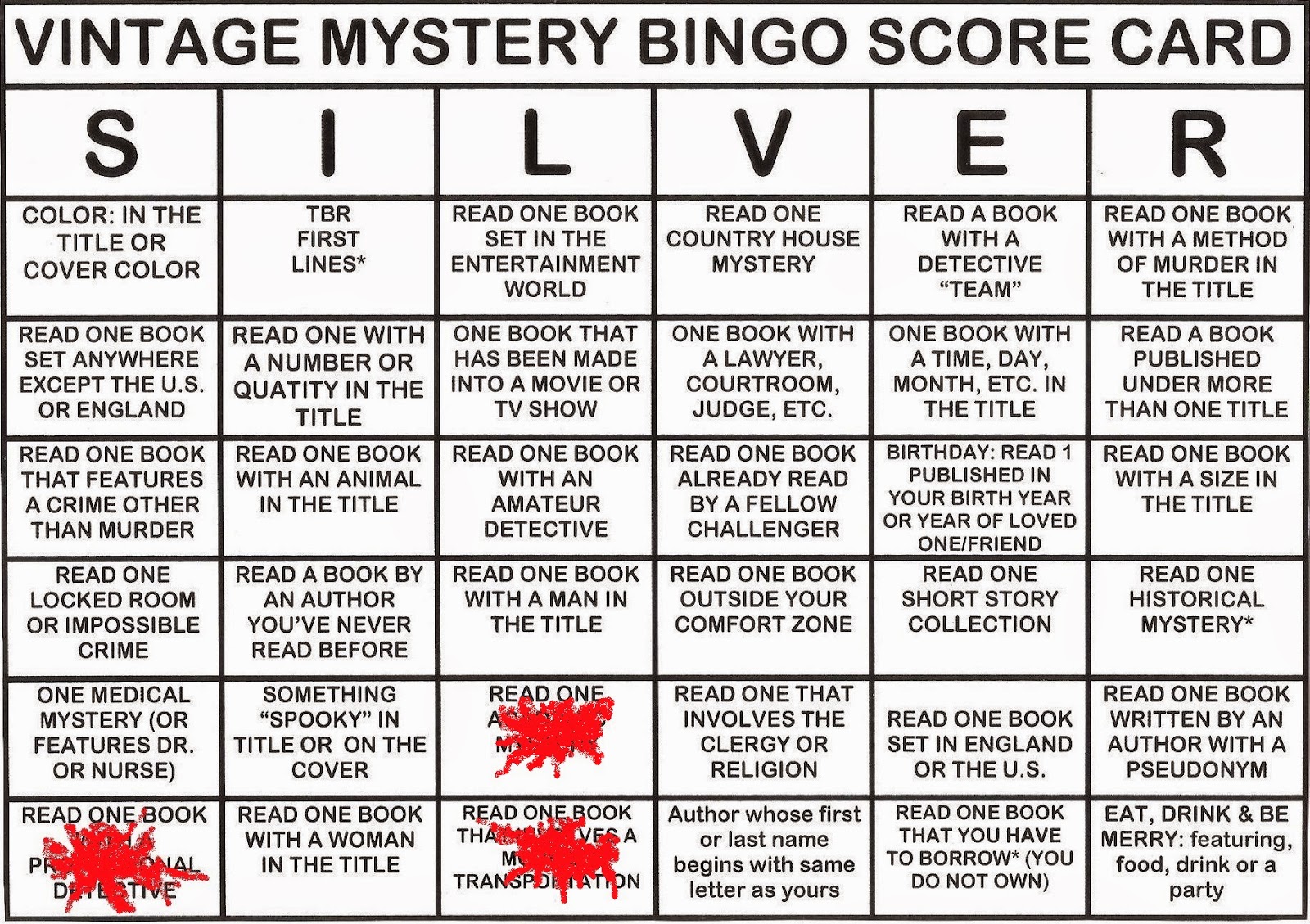
This fulfills the "Academic Mystery" square on the Silver Vintage Bingo card.


All Challenges fulfilled: 100 Plus Challenge, How Many Books, Vintage Mystery Challenge, Reading Road Trip, Monthly Motif, Mount TBR Challenge, What's in a Name, Cloak & Dagger, My Kind of Mystery, 52 Books in 52 Weeks, Men in Uniform, A-Z Mystery Author Challenge

Tuesday, February 10, 2015

I Killed: True Stories of the Road from America's Top Comics

If I've got my show biz/standup comedy terminology down, then the title of this book ought to start I Died instead of I Killed: True Stories of the Road from America's Top Comics. Because this thing died on stage. And apparently lay there for a week or two before anybody noticed. Definitely no belly laughs here, maybe a brief flicker of a smile or two. Maybe. But overall this is not a funny book. I refuse to tag it as humor on Goodreads. It would seem that Ritch Shydner and Mark Schiff, our comic hosts for this little tour, think that four letter words and sex with waitresses, strippers, and whoever else might have been available to lonely comics on the road (and the four letter word for sex) are the funniest things their fellow comedians could tell us and a close runner up is how ineptly and/or forcefully said comedians dealt with hecklers and horrendous gigs.

I chose this book primarily because it helped me with Clue #3 in my Super Book Password Challenge. But I also sincerely thought I would enjoy it. With promises of stories from the likes of Jay Leno, Mike Myers, Jeff Foxworthy, Drew Carey, Tim Allen, Joan Rivers, and others, I expected better...and funnier. I was sorely disappointed. Not recommended. is, I think, generous and I only give it one star in honor of the few funny bits--nearly all of which were by or in reference to older comedians (Bob Hope, Red Buttons, Milton Berle, Jonathan Winters....).


Sunday, February 8, 2015

Death Over Deep Water: Review

Adam Ludlow, English don and sometime amateur detective, is all set to enjoy a Mediterranean cruise with stops at various European ports. He happily enjoys seeing the Temple of Apollo in Greece and then seeing the Temple of Apollo in Corinth (as he pedantically explains to a suspicious American--the ancient world was simply littered with Temples of Apollo). But despite the calm seas and brilliant blue sky overhead, Ludlow has a feeling of an impending storm.

And the clouds seem to be gathering around Diana Acton, a wealthy beauty whose inner beauty doesn't seem to match the outer. She manages to have unpleasant encounters with just about everyone--from her own family to various crew members, whom she claims to be slacking in their duties. But were any of her disputes serious enough to end in murder? It would seem so.

Her cabin mate (and one of the few on board to have escaped Diana's scathing remarks) Julie returns from dinner one evening find Diana sprawled across the bed, dead from poisoned juice. Ludlow has often been the recipient of Julie's confidences and he happens along as she is rushing for help. He quickly takes in the situation and makes sure that the body his handled appropriately (or as appropriately as possible by the slightly drunken doctor), the cabin is sealed, and the proper authorities are notified.

When the ship docks at Malta, Ludlow's old friends Inspector Montero and Detective Springer come aboard having been sent by Scotland Yard to take the matter in hand. Between the three of them, they soon find motives more solid than ill-tempered disputes--pending investment deals, a need for cash by the dead the woman's brother, rebuffed suitors, jealous wives, and a confidence trickster or two all serve to muddy the waters. But Ludlow has noticed a few clues in the dead woman's cabin as well as in the questioning of passengers and Montero allows him to round up the suspects for a grand finale reminiscent of the golden age. He examines each one in turn before finally revealing the culprit.

This is the third in the short mystery series by Simon Nash (Raymond Chapman). There are five books in all. Chapman was a Professor Emeritus of English Literature at the London School of Economics and had a brief burst of crime fiction writing from 1962-1966 before returning to more scholarly writing for an impending promotion.* Adam Ludlow, his protagonist, seems a bit more pedantic and antisocial in this particular outing than the other two which I have read. It made this shipboard cozy a little less appealing, but Chapman still put together a tidy little mystery with plenty of red herrings and suspects with motive and opportunity. I did identify the killer before the final wrap-up, but didn't quite have all the details worked out. A satisfying ★★ mystery.

(biographical information courtesy of gadetection)

Since the main action takes place near and in port at Malta, I will claim Malta as the place of interest for those challenges related to location. Published in 1963, it also counts for the "Mode of Transportation" [cruise ship] square on the Silver Vintage Bingo card.


of English Literature at the London School of Economics - See more at: http://www.iesabroad.org/study-abroad/news/remembering-raymond-chapman#sthash.D51238UN.dpuf

Quotes:
As a university teacher, he heard quite enough of his own lectures during the year without listening to others when he was supposed to be enjoying himself. (p. 1)

Julie West was not a woman that one could dislike without feeling mean about it. She was full of the friendliness, the spirit of good-neighbourship, the avidity for information, which characterize the American abroad. (p. 4)

One reads. There is little enough opportunity for continuing one's education....However, the Government has not yet pulled down all the libraries in order to build atomic computers or whatever the latest nonsense may be. The time is rapidly approaching, but at present we are still allowed to have a few books. (Adam Ludlow; p. 5)

--she can't go on having all the luck. Life isn't like that. I don't believe anybody can be happy forever. (Theresa Acton; p. 17)

The young always take up some extreme attitude, if they have any character at all. In two or three years, you'll find her indignantly denying that she was ever like this. (Ludlow; p. 25)

Ludlow sadly registered the thought that he had spent his life being persecuted by women who bored him and avoided by those who attracted him. (p. 33)

All people were lonely, and their sadness was that they reached out of their loneliness in so many different ways and seldom made contact. (p. 41)

...these excursions are organized on the principle that tourists are stupid but potentially dangerous animals. Nobody has a chance of straying far from the main body, or the human sheep-dogs which accompany it. (Ludlow; pp. 78-9)

[interrupting a literary digression] "If Mr. Ludlow can't tell us anything more, perhaps we ought to start questioning, sir," said Springer, who regarded his chief's literary interests as a burden to be borne and a dangerous interference with routine. (p. 81)

All Challenges Fulfilled: 100 Plus Challenge, How Many Books, My Kind of Mystery, Vintage Mystery Challenge, Travel the World, Mount TBR Challenge, Cruisin' Thru the Cozies, Monthly Key Word, Cloak & Dagger, European Reading Challenge, Mystery Reporter, A-Z Mystery Author Challenge,

Friday, February 6, 2015

A-Z Mystery Author Challenge


I'm always excited to get an email from Michelle saying that her A-Z Mystery Author challenge sign-up is ready to go.  I just got it tonight.  You all have to know that I love me some mysteries!  And I love trying to fill out the alphabet with mystery authors. 


Rules: A-Z represents the LAST name of the author in the mystery, thriller, suspense, cozy, noir, etc. genre. Read as many or as little as you want. Post your links at her site for your Challenge post and your reviews! (click link above to take you there).  Challenge Runs February 6, 2015 - February 6, 2015
 
My declared commitment will once again be for the letters A-M.  I say that because, although I will try for every letter, I will probably have to cheat on the letter X.  There are few authors whose last name starts with X and even fewer in mystery genres I like--so I'll probably wind up sticking an X wherever it will work.  
 
Here's my list. Sometimes, I fill it in ahead of time--this year I'm going to fill them in as they come:

A: The Darling Dahlias & the Cucumber Tree by Susan Wittig Albert (6/5/15)
B: Dine & Be Dead by Gwendoline Butler (3/29/15)
C: Night Train to Paris by Manning Coles (3/14/15)
D: Death Dines Out by Theodora Du Bois (9/30/15)
E: The Cases of Susan Dare by Mignon G. Eberhart (8/10/15)
F: The Great Dinosaur Robbery by David Forrest (5/15/15)
G: Brighton Rock by Graham Greene (3/2/15)
H: Playground of Death by John Buxton Hilton (3/18/15)
I: The Gay Phoenix by Michael Innes (9/30/15)
J: Murder Past Due by Miranda James (7/13/15)
K: The Ringmaster's Secret by Carolyn Keene (4/16/15)
L: A Stitch in Time by Emma Lathen (2/17/15)
M: Panic by Helen McCloy (2/22/15)

****Bonus****
N: Death Over Deep Water by Simon Nash (2/8/15)
O:
P: The Bookfair Murders by Anna Porter (7/29/15)
Q: The Vanishing Corpse by Ellery Queen (10/31/15)
R: Caught Dead in Philadelphia by Gilian Roberts (2/11/15)
S: The Three Fears by Jonathan Stagge (5/17/15)
T: Shadow of a Doubt by June Thomson (7/27/15)
U: Hand of Fate by Michael Undewood (7/5/15)
V:
W: The Secret of Magnolia Manor by Helen Wells (2/24/15)
X: The Bat Flies Low by Sax Rohmer (9/10/15)
Y:
Z: Murder in the Hellfire Club by Donald Zochert (11/3/15)

Thursday, February 5, 2015

One Touch of Blood: Review

"It's J. B. on the telephone for you, Mr. Clark," she announced. Her excitement agitated the front of her pink blouse. She'd only been working for me a week so I hadn't gotten around yet to deciding whether they were real.

I knew exactly where I was from the moment I opened One Touch of Blood (1955) by Samm Sinclair Baker. Smack dab in the middle of a pulpy, fast-talking, B-movie-style crime novel with more mangled metaphors than the dames (the blondes, the redhead, AND the brunette) in this story have curves...and they have more curves than the winding road leading to the cliff-hanging house where the main murder takes place. Well, you get the idea.

What we've got is, as the back cover announces, a Recipe for Murder! You take one advertising man by the name of Clark Clark Clark (his father stuttered) who isn't quite satisfied with the hot blonde number he has at home...oh, he loves her all right, but there are just so many luscious ladies to behold that he's just got to hold them. Mix in a trio of wealthy clients looking for a sure-fire advertising scheme to make even more customers long for Old Rankler bourbon, a couple of buxom private secretaries (very private), add a hulk of a man who decides Clark is his best buddy (and ticket to revenge), a cop or two and let simmer until the clients who tell Clark to place this ad:


Wanted: Murderers
If you are about to commit murder, we need you and will pay well. No risk. Write at once to Box XXX.

get exactly what they ask for. One murder made to order and they won't even need to look for outside help after all.

All they need to do is take the whole gang (including Mrs. Clark) to the Plupes' (makers of Old Rankler) cliff-side estate for a fun weekend of advertising brainstorming, attempts at wife- and girlfriend-swapping, plenty of Old Rankler manhattans, and a high dive exhibition by exhibit A--the soon to be very dead J. D. Plupe. Good ol' J. D. has an even harder time keeping his hands off the ladies than Clark and manages to make everyone in the party mad enough to push him off the cliff. But who actually did the dirty work? Clark thinks he's going to play detective and figure it out--but his better half fits into the shoes of Sherlock Holmes better than he does and fingers the killer in a nice traditional wrap-up scene in the end.

The verdict--yes, indeed. Pulpy, B-movie fare. But Baker provides a decent ride in this charming little B-movie-style crime novel. Sure, the dames are bouncing "their blouses full of goodies" all over the place and I'm quite sure I ought to be offended. And he pulls out more tired, stock phrases than an actor past his prime--but he introduced me to Weasel, a mountain-sized man with mountain-sized feelings who only wants to beat J. D. Plupe to a pulp because he insulted his sister. But he didn't get a chance--or so he says. I like Weasel, he's got character and a sense of loyalty that can't be beat. Then Baker escorted me into a meeting of the MWA where Mrs. Clark, wife of our hero, asks those assembled to figure out who pushed J. D. Plupe off the edge. And the authors decide that any of the participants in that weekend part could have done the job. It's a short parody of Anthony Berkley's Poisoned Chocolates Case and works pretty well. The only place he really falls down on the job is with misdirection. There isn't much. I picked out the culprit early on and I didn't feel that there was a whole lot of effort to disguise identity (although Clark tries to make it seem like a huge puzzle...I think it's just the bourbon talking). ★★ and 1/4 for a fun, off-my-beaten-path read.

I submit this for Rich's Year in Crimes of the Century (this month is 1955) over at Past Offences as well as the "Set in the U.S. or England" square on the Golden Vintage Bingo card.


Quotes
The telephone rang insistently, I tried to ignore it. Because I hate telephones. I should have been born in the days when they delivered important messages by ox-cart. Even that would have been too quick. Because I also hate important messages. Maybe the reason is that I'm in the advertising business. Where every message is important. (p. 7)

Today, perhaps the most popular reading is mystery fiction, right? Just about every magazine carries at least one mystery story. The big babies, the Post and Collier's, usually feature a mystery serial. The American has a monthly short mystery novel. Fill out the list yourself and you'll find practically every important magazine included, those catering to women as well as men. (p. 10)

[about Rocky Cove Lodge--scene of the crime] I'd been there before, but the place still looked to me like a medieval haunted house with modern plumbing. It had a dark-brown English-manor exterior, and an interior with a labyrinth of rooms, twisting all over the landscape. Maybe the general idea was to keep the right bedrooms from knowing what the left bedrooms were doing. (p. 35)

Lunch would have been more fun with a group of cadavers in the back room of a dissecting lab in a medical school. Even the Old Rankler manhattans which were a lunchtime ritual at Rocky Cove tasted like embalming fluid. (p. 85)

Most people are friends, if you only give them a chance. Don't you find that? (Weasel; p. 95)

That boy is too nervous. I don't think he gets enough vitamins, that's his big trouble. The way I figure it, them healthy little round vitamin pills lay around in your veins and keep the blood from running along too fast and getting your nerves all hot and bubbly and excited. Don't that sound logical? (Weasel; p. 133)

Tuesday, February 3, 2015

Mystery! A Celebration: Mini-Review

I have often enjoyed programs offered up by Mystery! over the years--everything from Jeremy Brett's Sherlock Holmes to David Suchet's Poirot; from Joan Hickson's Miss Marple to Francesca Annis's Tuppence Beresford. So, when I saw a near-perfect edition of Mystery! A Celebration: Stalking Public Television's Greatest Sleuths* sitting on the shelf at our Friends of the Library Bookstore last October, I had to make it my very own. It would be worth it for the illustrations by Edward Gorey if nothing else, but Ron Miller does a fine job highlighting the various programs and mixing it up with interviews with authors and actors who have given us some of the world's finest detectives and mysteries.  It was great fun to look at pictures from behind the scenes and learn about the factual crimes behind several of the featured programs. I felt nostalgic as I was reminded of programs that I hadn't seen for quite a long time. My only quibble--keeping the book at a ★★ rating rather than five--is that there are several prime actors who are still living (Patrick Malahide as Inspector Alleyn, for example) who seem to receive rather short shrift. It's not clear if those not interviewed were passed over or if they just weren't available. Okay, so Miller probably couldn't interview absolutely everyone...but it would have been nice. 

Overall, a great read and it was especially nice to finish it while snuggled up in a blanket--home sick with whatever nastiness is going round. Reading for healing....that's my motto. 

*Clue #2 in my second round of Famous Person in the Super Book Password Challenge.


Sunday, February 1, 2015

Reading Event Complete: Sci-Fi Experience


2015sfexp275 Carl V over at Stainless Droppings who sponsors the Sci-Fi Experience  also advertises his reading event (which spans December and January) as "not a challenge."  So, I needing a goal to meet, set myself a personal challenge of five by January 31st and lined it up for my 2015 challenge list.

Here's what I managed--all in January:
1. Ten Thousand Light-Years from Home by James Tiptree, Jr. (1/2/15)
2. Asimov's Choice: Black Holes & Bug-Eyed Monsters by George H. Scithers, ed (1/9/15)
3. Alpha 2 by Robert Silverberg, ed (1/18/15)
4. Rod Serling's Twilight Zone Revisited adapted by Walter B. Gibson (1/20/15)
5. The Day of the Triffids by John Wyndham [1951] (1/22/15)

Reading Event Complete: Vintage Science Fiction Month

Vintage SF badge

Sponsored by Redhead at Little Red Reviewer, the Vintage Science Fiction month! (not a challenge) has us focus on reading “older than I am” science fiction. Our mission (not a challenge :-) ) is to read science fiction and speculative fiction published before 1979. We're also encouraged to visit those worlds via audionovel, radio plays, TV or silver screen as well.

After participating in 2014, I signed up for another round and, as a personal challenge, committed to at least two science fiction reads in January.
 
Here's what I managed last month:

1. Ten Thousand Light-Years from Home by James Tiptree, Jr. [1973] (1/2/15)
2. Asimov's Choice: Black Holes & Bug-Eyed Monsters by George H. Scithers (ed) [1977] (1/9/15)
3. Alpha 2 by Robert Silverberg (ed) [1971] (1/18/15)
4. Rod Serling's Twilight Zone Revisited by Walter B. Gibson (adapted by) [1964] (1/20/15)
5. The Day of the Triffids by John Wyndham [1951] (1/22/15) 
 

February Read It Again, Sam Reviews


Please link up below


February Mount TBR Reviews


Please post reviews below.


February Vintage Bingo Reviews


Please link up your reviews below.


January Wrap-up & P.O.M. Award


Illustration by Abby Wright

I'm ready for another year of tracking reading progress and statistics for all things bookish on the Block. I will also be contributing to Kerrie's Crime Fiction Pick of the Month. So, here we go--let's take a look at January....


Total Books Read: 15
Total Pages: 3709 

[That's a bit of drop from last year (19 books and 4413 pages. But still a good start to the new year.]
Average Rating: 3.15 stars  
Top Rating: 4 stars 
Percentage by Female Authors: 40%

Percentage by US Authors: 53%

Percentage by non-US/non-British Authors:  13%
Percentage Mystery:  60% 

Percentage Fiction: 100%
Percentage written 2000+: 20%
Percentage of Rereads: 7%
Percentage Read for Challenges: 100% {It's eas
y to have every book count for a challenge when you sign up for as many as I do.}    
Number of Challenges fulfilled so far: 2--final posts coming (5%)


AND, as mentioned above,
Kerrie had us all set up for another year of Crime Fiction Favorites. What she was looking for is our Top Mystery Read for each month. January found me with nine mysteries--which is pretty good considering that I was participating in two science fiction reading events. Here are the books read:


Ride the Pink Horse by Dorothy B. Hughes (3 stars)  [1946]

The Case of the Painted Girl by Frank King (4 stars)  [1931]

Police Procedurals by Martin H. Greenberg & Bill Pronzini, eds (3 stars)  [1985]

Mother Finds a Body by Gypsy Rose Lee (2 stars)  [1942]

A Dead Man in Istanbul by Michael Pearce (3 stars)  [2005] 
Death of a Dwarf by Harold Kemp (4 stars)  [1955]

The Golden Slipper & Other Problems for Violet Strange by Anna Katharine Green (3.5 stars)  [1915]

A Dead Man in Trieste by Michael Pearce (2 stars)  [2004]

Death of a Tall Man by Frances & Richard Lockridge (4 stars) [1946]

This month's P.O.M. Award really isn't difficult for me, although three books managed to snag the four-star rating. Death of a Dwarf by Harold Kemp thoroughly charmed me. 


I had no idea what to expect from this one--I had never heard of Kemp (and if you try to find anything out about him on the internet, you'll find information to be practically nil). But the story is quite good with a standard motive given a nice little twist. Fairly clued--it's certainly not Kemp's fault that I completely forgot a little tidbit that he prominently displayed for me back in the early chapters. I was caught up by this excellent, serendipitous find.


Saturday, January 31, 2015

Death of a Tall Man: Review Take 2

I originally read Frances and Richard Lockridge's Death of a Tall Man back in 2010 (back in my early days of blogging). For my first review, please go HERE. I picked it up again this year as the opening Clue in my second "Famous Person" entry in my new Super Book Password Challenge. The clue portion of the title is in bold.

Visiting with Pam and Jerry North, Acting Captain Bill Weigand, and Sergeant Mullins was just as much fun this time as it was in 2010. It's just like visiting old friends. It didn't matter that I already knew who did it--that just allowed me to pay more attention to the relationships between our recurring characters and to really absorb Pam's interesting logic and manner of speaking. 

Of course, we all know that it isn't reasonable for her and Jerry to be as involved in as many murders as they are. But the stories would lose a lot of their charm without them. It is especially delightful to listen to Mullins worry about how O'Malley (in command of the detective bureau) will explode if he finds out "those Norths" are mixed up in it again. Mullins should know--there's no way to keep them out and O'Malley will survive. 

I gave the book ★★ when last I read it. The rating still stands.

Quotes
It occurred to Grace Spencer, sometimes, that Andrew Gordon was excessively interested in what people could see out of their eyes, and insufficiently concerned with what other people could see by looking into them. Not that, as things stood, it would make any difference to her; it was fortunate, indeed, that he never saw anything in her eyes except their physical efficiency. (p. 13)

Things were so easily a mess at twenty. You had so little time at twenty; even when you were only thirty-two you had more time. It was a most ingenious paradox. (p. 22)

The human mind was seldom as logical as it tried to make itself. (p. 45)

...she was as unlikely to get in touch with anybody if her Dan came back, as she was to shave off her softly waving brown hair, Bill told himself. Less likely. So that that would have to be taken care of. Humanity was frequently exasperating; particularly humanity in love. (p. 60)

Weigand was patient. He did not follow any of the alleys Smith opened for him. He agreed in general; he agreed in detail; he praised Smith's attitude, and mentioned how much better it would be if all people were as reasonable and straightforward. (p. 66)

PN: I still think it was something she saw when he was leaving.
JN: I know. Because people who are about to be murdered look different from people who aren't. It shows on their faces....
PN: No. Really. Because murders are the end of something else, almost always....And the victim is worried too, just as much as the murderer. (Pam North, Jerry North; p. 117)

Everybody's worried in the morning. It's the natural state of man. Particularly at what would be about seven thirty. (Jerry; p. 117)

Humanly it was unbelievable. But her mind stopped her there. About people little was really unbelievable.... (p. 128)

JN: Listen. Where are you? Where've you been?
PN: Lots of places. The last one blew up. (Jerry, Pam; p. 131)

[about Pam] That, the doctor told Jerry, was the aftermath of shock. She would, if she were his wife, spend a day or two in bed. ("Not if I were his wife," Pam said cryptically, when they were outside. Jerry examined that remark and, in the interest of finding out what had happened, decided not to pick it up.) (p. 133)

"Those damn pilot lights," the detective had said. "Half the time somebody decides to bump himself off with the gas he forgets the pilot light. And the hold place blows up. They never learn."

It was not entirely clear who never learned. As nearly as Pam could work it out, the detective seemed to mean that the people who committed suicide never learned. It seemed, Pam told Jerry, an odd thing to reproach them with. (pp. 134-5)

"Look," Pam said, "no woman's going to buy a new hat just before she and her lover kill her husband."

Jerry shook his head at that. He didn't, he said see why not. Women would, as far as he could see, buy hats any time. (p. 138)

It's always useful to know the impossibles. Along with the possibles. Narrows the field. (Bill Weigand; p. 141)

BW: Right. So for God's sake--don't you get intuitional on me.
SM:  O.K., Loot, I won't get institutional. (Bill Weigand; Sergeant Mullins; p. 144)

And when people were married, Andy had told her--still gently--there would be a new kind of intensity between them; a new kind of sensitiveness. If people were married at all. It was hard to explain, but words meant more then; gestures meant more. You saw things that you would, before, have overlooked. (p. 147)

But neither of them looked as if they minded being wet and cold. They looked as if they were very warm and contented. From the expression on their faces, they might have been sitting in front of a fire. Actually, Pam North thought, they are. In the only sense that makes much difference. (p. 186)

Wednesday, January 28, 2015

Mind Meld: All About That Backlist

http://www.sfsignal.com/archives/2015/01/mind-meld-all-about-that-backlist/


I am very excited to say that today you will find me over at SF Signal discussing the science fiction backlist with current SF authors, established reviewers, and fellow bloggers. Their feature, "Mind Meld," regularly asks a question of a cross-section of the science fiction community and this week's prompt was:

Q: All about that backlist: You’re reading through (or have read through) an author’s backlist? Brilliant!  where would you suggest a reader new to that author’s work start?

To see my answer and the answers of other contributors please visit--either through the link above or by clicking on SF Signal's "Mind Meld" image above. 

Tuesday, January 27, 2015

A Dead Man in Trieste: Review

A Dead Man in Trieste is the first novel in Michael Pearce's series featuring Seymour of Special Branch. Growing up in the East End with exposure to the languages of many immigrants , Seymour has a special flair for languages that makes him invaluable to the Service and just the man to send to the Trieste when Lomax, the British Consul, goes missing. Of course, the older members of Special Branch aren't too sure--after all, he's "a member of one of those East End immigrant families from somewhere in Europe. He's all right, but with these blokes you never can tell. You can never rely on them. A bit dubious really." 

But with the mix of nationalities in Trieste--Austrians, Hungarians, Italians, Slavs, an Irishman or two, and a Bosnian/Croatian mix known as Herzegovinians [Seymour isn't even sure what that means]--Seymour feels more at home than some of those upperclass Foreign Office chappies might. He still has to feel his way carefully through the nationalist movements that are threatening to upset life in the port city. His real job, however, is to figure out exactly what Lomax had been up to and who he was involved with--no easy task, especially when he is acting in an unofficial capacity and keeping his position as a policeman hidden. 

On the surface, it looks like the Consul spent his days lolling at the tables at the Cafe of Mirrors in Piazza Grande, hobnobbing with the artistic crowd. Seymour knows there must be more to Lomax than that and the longer the man is missing the more sinister his absence seems. When Lomax's body is found by one of the fishing boats, it becomes apparent that the man was mixed up in something more than artistic endeavors and Seymour must work through the man's friends and the local police to discover what that something was.

Having read the second novel (A Dead Man in Istanbul), I decided to hunt up the debut of this series before reading any others. I have to say--if I had read this one first, I might not have gone on. Trieste, is a very slow-moving book. Very little action--until the end--and very little clue-gathering. For someone who likes their mysteries from the Golden Age where clues are strewn about, fair play is in force and an effort is made to distract the reader from the culprit, this is a disappointment. Not that I didn't guess who did it--I did. But not because there were clues to follow--simply because there really aren't that many people with motives to choose from. 

The book does give us an interesting look at Trieste before World War I broke out. Good period detail and historic descriptions of the tensions building in that area of the world. The cast of characters are quite colorful--although they could use a bit of depth. It was an okay read at ★★. Since #2 garnered three stars, we shall hope that the third novel (which I have sitting on the TBR pile) will be an improvement as well.


A bit of explanation--I am participating in the Travel the World Challenge and the European Reading Challenge. Although Trieste is now part of Italy, during the time period in which A Dead Man in Trieste takes place, it fell under the Austro-Hungarian Empire and was considered part of Austia--serving as Austria's main trading port. I am therefore claiming this book under Austria for the purposes of the challenges.